Metro Atlanta has attracted over 150,000 businesses and serves as a headquarters or expansion site for companies including Coca-Cola, Mercedes-Benz USA, Microsoft, and Takeda, according to the Metro Atlanta Chamber's Global Center of Growth overview. That figure changes how executives should think about relocation. Atlanta isn't just gaining offices. It's becoming a control point for corporate decision-making, operating networks, and regional growth.
That rise creates a second issue most relocation analysis misses. When a company moves its headquarters, it also moves years of accumulated IT assets, aging endpoints, network gear, storage devices, lab equipment, and data-bearing hardware. The strategic case for Atlanta may be strong, but the move succeeds or fails on execution inside server rooms, wiring closets, storage cages, and disposal workflows.
The Unstoppable Rise of Atlanta as a Corporate Hub
A headquarters market becomes more defensible once enough large employers, service providers, and infrastructure operators cluster in one place. Atlanta has crossed that threshold. The region's corporate base now includes a wide spread of industries, from consumer brands and logistics to fintech, healthcare, and enterprise software. The Fortune 500 city and state breakdown helps illustrate that concentration by showing how many major public companies are already anchored in Georgia, with a meaningful share tied to metro Atlanta.
That concentration changes the relocation equation. Executives are not choosing a city only for prestige or near-term savings. They are choosing a market where legal counsel, finance talent, recruiting firms, cloud providers, transportation partners, and enterprise IT vendors already operate at scale. Atlanta increasingly fits that model, which lowers the time required to stand up headquarters functions after a move.
Digital infrastructure strengthens the case. Companies reviewing office needs and hybrid work policies are also asking where their applications, backups, and interconnection points should sit. That is why analysis around Atlanta's position as a data center hub belongs in the headquarters discussion. The fundamental decision is broader than office location. It is about where the company wants to place management, systems, and operational control.
Why concentration changes relocation risk
A dense corporate market reduces some risks and creates others at the same time.
- Faster market entry because relocation teams can source legal, staffing, facilities, and technical support without building a new vendor network from zero.
- More complicated execution because headquarters moves usually overlap with office redesigns, network changes, equipment refresh cycles, and workforce transitions.
- Higher disposal exposure because consolidations often leave behind retired laptops, servers, storage devices, phones, and other data-bearing assets that still carry security and compliance obligations.
The operational point is easy to miss. A company can make the right strategic call on Atlanta and still create avoidable risk during the move itself.
That risk often sits with IT. Once teams begin closing floors, combining sites, and decommissioning hardware, every asset has to be tracked, wiped, redeployed, recycled, or destroyed under a documented chain of custody. For leadership teams, Atlanta's rise explains why the move happens. Asset control determines whether the move is executed well.
Decoding the Financial Drivers Behind the Move
The financial logic behind Atlanta's rise is stronger than the usual “lower cost city” shorthand. The region offers a pro-business environment with tax benefits, and that's one reason it stands out against legacy headquarters markets. CBRE notes that companies have looked for alternatives to states with high tax burdens and litigation pressure, including California, where at least 272 companies moved their headquarters out between 2018 and 2021.
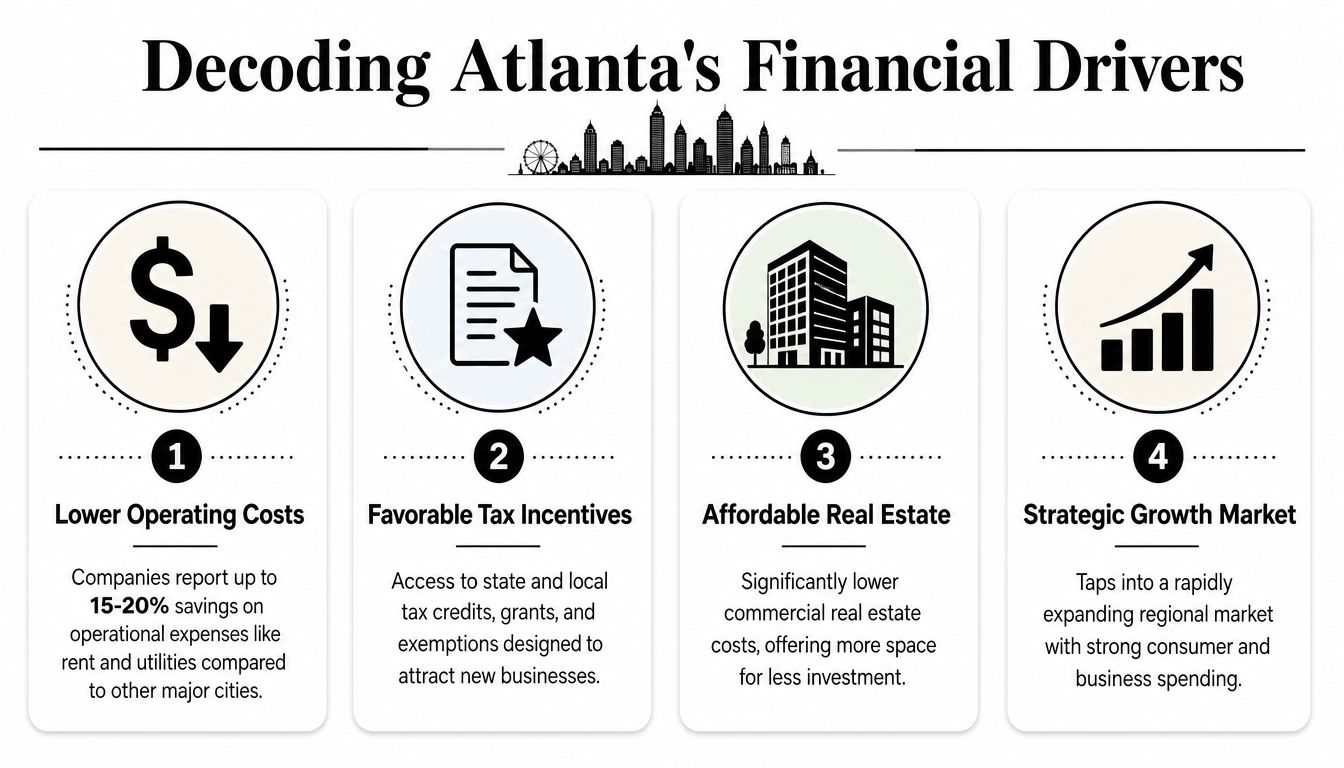
That doesn't mean every move is purely tax-driven. It means finance leaders are widening the scorecard. They're comparing total operating friction, not just lease rates. Atlanta fits that broader model because companies can pair business-friendly conditions with a large commercial ecosystem and shorter path-to-operational readiness.
What finance teams actually evaluate
Three issues usually drive the shortlist.
| Decision factor | Why Atlanta stands out |
|---|---|
| Operating environment | Companies see a market positioned as pro-business, with fewer of the cost pressures associated with some coastal hubs |
| Relocation speed | State-supported sites and certified industrial locations support tighter timelines |
| Expansion flexibility | Firms can align office, industrial, and digital infrastructure decisions in one metro |
That mix matters in a hybrid era. A headquarters isn't only a symbolic address anymore. It's part collaboration center, part recruiting magnet, part operational command layer.
The hidden financial leak in relocation
Savings on occupancy or tax treatment can disappear if companies mishandle their technology estate during the move.
- Duplicate equipment spend happens when teams relocate hardware they should have retired.
- Storage costs grow when obsolete devices sit in warehouses because no disposition plan exists.
- Compliance exposure increases when decommissioned drives, laptops, and servers aren't tracked.
For leaders comparing infrastructure models, Atlanta business trends around colocation versus cloud add another layer to the cost equation. The headquarters move often triggers broader decisions about what stays on-premises, what gets migrated, and what should be securely retired.
Atlanta's Strategic Advantage in Talent and Logistics
Cost gets companies to consider Atlanta. Talent and logistics explain why they stay.
Atlanta hosts the third-highest concentration of Fortune 500 headquarters globally, and 37% of residents aged 25 and older hold a bachelor's degree, according to Cresa's analysis of Atlanta's corporate position. That combination creates a corporate network effect. Companies don't just access workers. They access workers who already understand large-enterprise processes, supplier ecosystems, and regulated operating environments.

Talent density matters more than talent volume
A headquarters move places unusual demands on staff. Companies need finance leaders who can manage multi-state transitions, HR teams that can support hybrid workforce changes, and IT teams that can execute cutovers without disrupting operations. A market with a deep concentration of enterprise employers is better positioned to supply those skills than a market that is merely growing.
That's also why Atlanta IT hiring trends and in-demand skills matter to relocation planning. Labor strategy and infrastructure strategy are no longer separate decisions.
Strategic takeaway: Headquarters markets win when they offer both executive-grade talent and technical labor that can support the move after the announcement.
Logistics turn a good market into an operating base
Atlanta's appeal also rests on movement. Companies need people, equipment, and suppliers to reach the headquarters efficiently. The city's established role in transportation and supply chain planning gives firms a practical advantage when they're coordinating office openings, data center transitions, regional distribution, and client access.
That becomes especially relevant for businesses with:
- Multi-site operations that need centralized leadership and decentralized execution
- Field service teams that rely on predictable transport links
- Technology-heavy footprints where equipment must move between offices, colocation sites, and disposal vendors
The strategic insight is simple. Atlanta isn't only attractive because it's cheaper than some rivals. It gives companies a platform where talent access and physical movement reinforce each other.
The Hidden Challenge A Corporate Move Creates for IT Teams
Most headquarters relocation coverage stops at incentives, labor, and office space. IT teams know that's only the visible layer. The hard part starts when the company has to move live systems, archive equipment, decommission old hardware, and prevent data from slipping into unmanaged channels.
A headquarters move usually leaves behind a mixed environment. Some assets are still useful and need redeployment. Others are obsolete but still hold sensitive data. Some belong in a data center rack, some in a storage room, and some under a desk nobody has inventoried in years. If teams treat all of it as “equipment to move,” they waste money and create risk.
What gets overlooked during a move
The relocation checklist often misses these tasks:
- Legacy hardware review so old servers, desktops, and networking gear aren't moved by default
- Chain-of-custody controls for storage devices removed during office closures
- Coordination between facilities and IT when cabling, UPS units, racks, and endpoints are de-installed on different schedules
- Documentation for what was relocated, wiped, destroyed, remarketed, or recycled
Operational planning resources on managing complex office relocations successfully are useful because they frame the move as a cross-functional project, not just a transport event. That's the right lens for technology as well.
Why relocation exposes weak asset governance
Companies can run for years with loose endpoint tracking and still function. A headquarters move removes that cushion. Every undocumented laptop, forgotten backup appliance, or retired hard drive turns into a decision point. Move it. Store it. Wipe it. Destroy it. Recycle it. Recover value from it.
The issue isn't only logistics. It's accountability.
When a company can't say where a drive went during a move, that's no longer an inventory problem. It's a governance problem.
Teams preparing for an office transition usually need more than movers and internal project plans. They need a process for IT office relocation services that connects de-installation, transport, redeployment, and disposition.
That's where many otherwise well-planned headquarters moves become messy. The destination strategy is sound. The asset-level execution isn't.
Ensuring Compliant IT Asset Disposal During Your Relocation
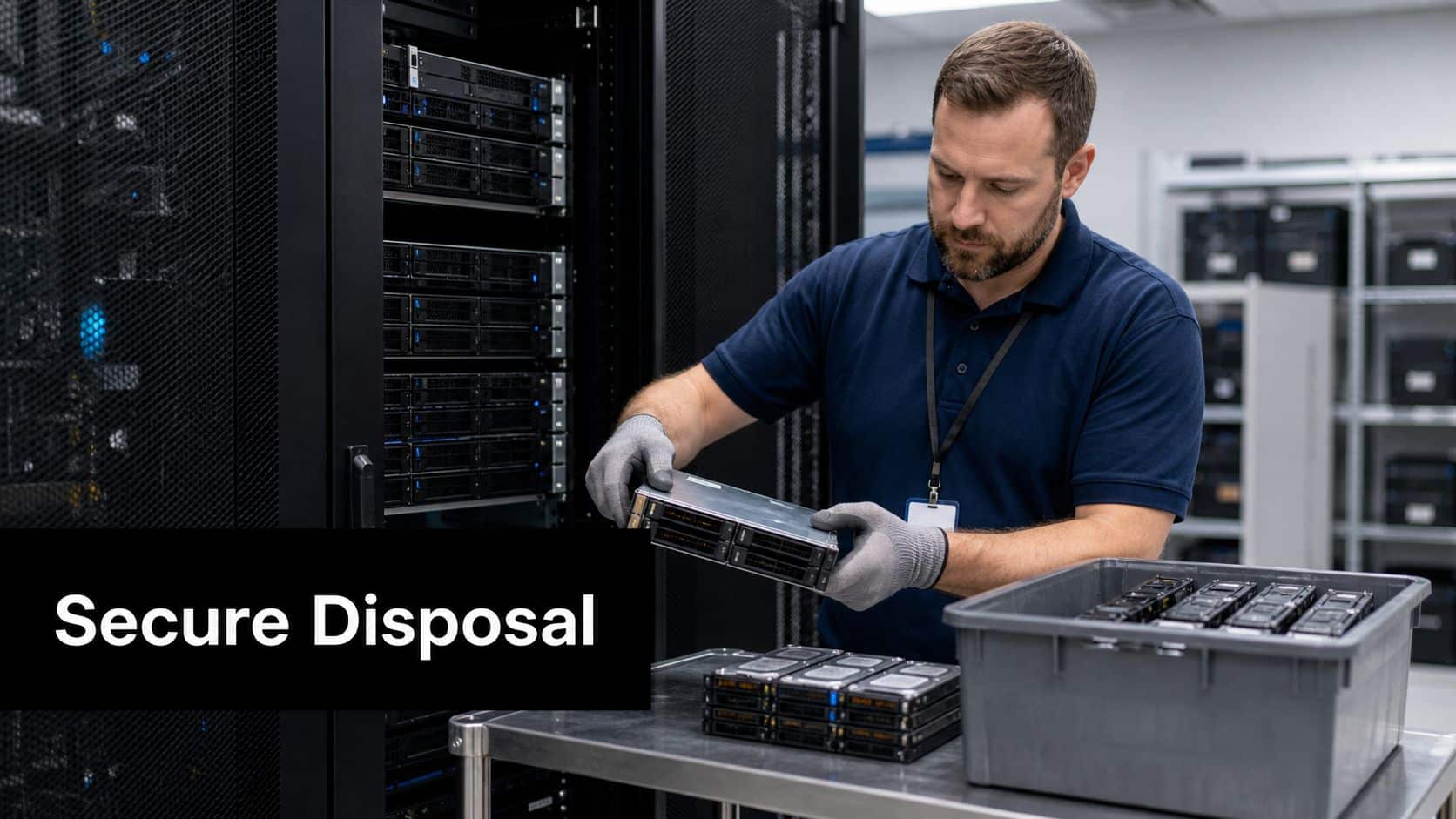
The disposal phase is where relocation risk becomes legal, technical, and reputational at the same time. A company may close floors, consolidate departments, and modernize infrastructure during a headquarters move. That creates a surge of retired laptops, monitors, switches, drives, phones, medical devices, and lab systems. If those assets aren't handled through a compliant process, the move can create a new liability trail.
The scale of the problem isn't abstract. The total volume of global e-waste reached 62 million tonnes in 2022, and projections indicate it will rise to 82 million tonnes by 2030, according to this overview of global e-waste volumes and recycling pressure.
Why disposal belongs in the relocation budget
Companies often fund move management, tenant improvements, and systems migration while treating end-of-life hardware as an afterthought. That's a mistake because retired devices can still contain regulated, confidential, or commercially sensitive data.
A professional IT asset disposition process should cover:
- Verified data destruction for hard drives, SSDs, and other data-bearing media
- Documented chain of custody from pickup through final processing
- Environmental handling that keeps electronics out of improper disposal channels
- Disposition reporting that supports audit readiness
For procurement and IT leaders evaluating vendors, guidance on choosing a compliant IT disposal provider is useful because it focuses attention on process controls rather than pickup convenience alone.
The board-level reason this matters
Improper disposal can undermine the business case for the move itself. A relocation designed to reduce cost and improve efficiency loses credibility if it creates a preventable data incident or leaves the company without documentation for retired assets.
That's why organizations planning Atlanta transitions often need dedicated Atlanta ITAD services as part of the move plan, not after it.
Risk rule: If a device stored company data, the relocation plan should specify how that data will be destroyed before the device leaves controlled custody.
The strongest headquarters moves don't just relocate technology. They separate what should be migrated from what should be eliminated, and they prove it on paper.
Your Essential IT Relocation and Asset Disposition Checklist
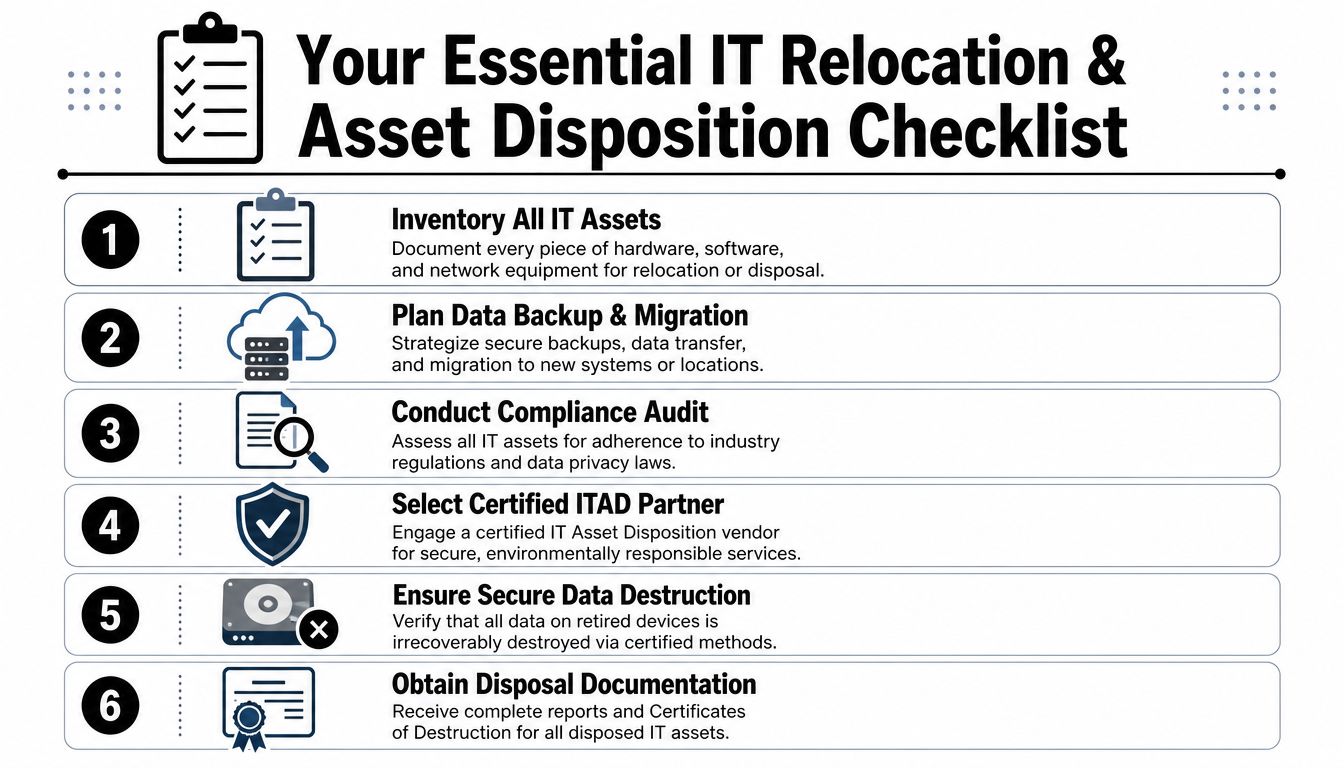
The cleanest relocation projects use a disciplined sequence. Not because every office move is identical, but because every missed step creates downstream problems. In the United States, only 12.5% of all e-waste is properly recycled, leaving a large volume of devices in unmanaged disposal streams, according to this summary of U.S. e-waste recycling rates. For corporate moves, that statistic is a warning. Without a plan, retired equipment drifts.
Six actions that prevent expensive mistakes
Build a full asset inventory
Capture laptops, desktops, servers, storage, network switches, access points, printers, mobile devices, AV gear, lab equipment, and spare parts. If it plugs in, stores data, or supports operations, it belongs on the list.Separate migrate, store, redeploy, and retire decisions
Don't let movers determine asset strategy by default. IT, facilities, security, and procurement should classify equipment before pickup dates are scheduled.Create a data destruction plan early
Identify which devices require wiping, shredding, or another approved destruction method. This should happen before offices start packing, not after assets have already been mixed together.
Documentation is part of the work
Confirm compliance responsibilities
Healthcare, finance, education, manufacturers, and government contractors may each have different retention and disposal requirements. The move team should know which devices need heightened controls.Coordinate transport and custody
The handoff from office floor to truck to processing site should be documented. Unclear custody is where disputes, losses, and audit headaches begin.Collect final disposition records
Certificates of destruction, recycling records, serialized reports, and value recovery summaries should be retained with the project file.
Good relocation governance means being able to answer three questions quickly: what did we move, what did we destroy, and who handled it?
What strong teams do differently
They don't treat IT disposal as cleanup. They treat it as one of the main workstreams of the relocation. They also decide early whether assets have remarketing value or should move directly to destruction and recycling. That distinction protects both budget and compliance posture.
Finalize Your Atlanta Move with a Secure IT Strategy
Headquarters moves create value only when operating risk stays under control. Atlanta may offer a stronger business case on cost, talent, and access, but leadership teams still have to manage what happens to aging laptops, retired servers, backup media, network gear, and devices that no longer belong in the new environment.
That is where many relocation plans weaken. The board approves the move for strategic reasons. IT inherits a compressed timeline, overlapping vendors, and a mixed inventory of assets that must be moved, redeployed, remarketed, recycled, or destroyed. If those decisions are made late, companies increase the chance of data exposure, custody gaps, avoidable storage costs, and compliance problems that follow them into the new headquarters.
The smarter approach is to treat IT asset disposition as a risk-control function, not a cleanup task. That means tying relocation governance to documented asset status, approved destruction methods, custody records, and final reporting. It also means checking whether the move overlaps with broader security changes. If infrastructure is being redesigned at the same time, security teams should review system controls in parallel and, where relevant, secure your SOC 2 with pentesting.
Execution matters more than intent.
Companies that finish an Atlanta headquarters move well usually do one thing consistently. They apply the same discipline to asset retirement that they apply to site selection, tax modeling, and workforce planning. That reduces exposure during the move and leaves the new office with a cleaner, more supportable IT estate.
If your organization is planning an Atlanta headquarters move, Beyond Surplus can help with certified electronics recycling, secure IT asset disposal, data destruction, logistics coordination, and documentation that supports compliance. Contact Beyond Surplus for certified electronics recycling and secure IT asset disposal.