

More than 70% of the Fortune 1000 already operate in Metro Atlanta, and the region has offices of approximately 1,250 multinational corporations, with over 330 global and North American businesses choosing the area as their headquarters, according to Atlanta Economic Development. That figure changes the usual relocation conversation. Atlanta isn't an emerging option. It's already part of the operating map for major enterprises.
The key question for executives isn't whether Metro Atlanta is visible enough. It's whether the region fits the company's cost structure, hiring model, logistics needs, and compliance obligations once the move is underway. That's where many relocation discussions go shallow. They focus on rent, talent, and airport access, then stop before the harder operating questions show up.
For companies with large IT estates, regulated data, distributed teams, or tight retention targets, why businesses are relocating to Metro Atlanta comes down to more than a cheaper lease. The strongest moves are built around execution. Can you keep key employees after the move? Can you retire obsolete servers, laptops, lab devices, and network gear without creating a data security problem? Can facilities, procurement, and IT work from the same playbook?
Atlanta's Magnetic Pull on Corporate America
Metro Atlanta has become a default option for companies that want scale without the friction of older coastal markets. The concentration of major employers matters because it signals something practical. Other large enterprises have already tested the region's labor market, supplier base, legal environment, and infrastructure, and they've kept operating there.
Why the market keeps attracting headquarters
The most cited reasons are straightforward. Atlanta offers a broad business ecosystem, deep air connectivity, and enough industry diversity that companies aren't betting on one local sector. The region also supports corporate functions that often need to move together, including finance, logistics, technology, and healthcare.
That density creates advantages beyond prestige:
- Supplier access helps procurement teams source everything from office buildout support to specialized technical services.
- Peer market validation gives boards more confidence in a relocation decision when comparable firms already operate in the area.
- Operational resilience improves when a region can support headquarters staff, distributed field teams, and infrastructure-heavy business units at the same time.
Atlanta works best for companies that treat relocation as an operating model decision, not just a real estate transaction.
Where typical relocation advice falls short
Most guides stop at the obvious benefits. They rarely deal with what happens after the ribbon cutting. A relocation can look efficient on paper and still underperform if key engineers resign over commute pain, if school-location choices create family stress, or if old hardware from the prior office sits in storage without a documented disposition plan.
Those issues don't get the same attention as lease rates, but they affect whether the move works.
For IT leaders, this is especially important. A move usually triggers a full asset review. Some equipment should be redeployed. Some should be sold. Some should be destroyed under documented chain of custody. If that process isn't planned early, the relocation inherits unnecessary risk.
The Unbeatable Economic Equation
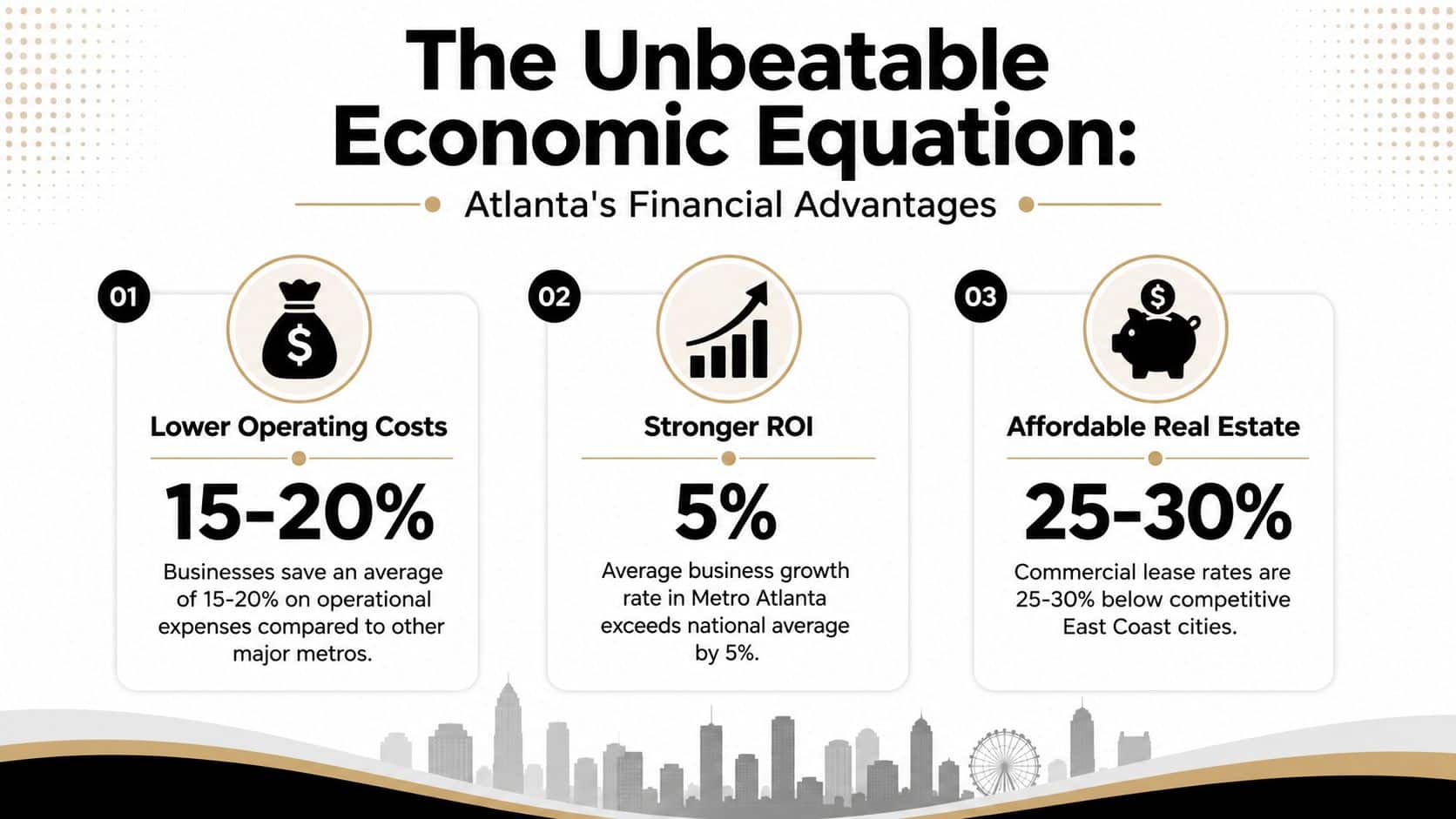
The financial case for Atlanta is strong because the savings show up in both the business budget and the employee experience. Businesses relocating to Metro Atlanta benefit from office rents averaging $27 per square foot, which is about 59% lower than the $66 per square foot average in San Francisco, while overall living costs are approximately 35–40% lower than Los Angeles, as noted in this analysis of Atlanta's cost advantage.
What lower costs actually change
Those savings matter because they give leadership room to choose. A company can put that capital into hiring, facility upgrades, product development, or a more deliberate transition plan. It can also avoid forcing every cost reduction onto headcount.
For relocation teams, lower operating costs create practical flexibility:
- Longer overlap periods: Keep legacy and new sites running in parallel while systems migrate.
- Better hiring packages: Use savings to make offers more competitive in hard-to-fill technical roles.
- Stronger relocation support: Fund the support employees care about, including temporary housing, school search help, and commute testing.
A broad view of the region's business momentum appears in Beyond Surplus's look at how Atlanta's economy is driving growth across Georgia.
Incentives that can improve the model
Georgia also gives companies a useful tax and incentive framework when the move includes job creation or manufacturing activity.
A few points are worth checking early:
| Incentive area | Practical detail |
|---|---|
| Job Tax Credits | Metro Atlanta counties offer credits ranging from $1,250 to $4,000 per new full-time job, per year, for five years, depending on county development status and job creation thresholds, according to the City of Marietta incentive summary. |
| Job qualification rules | To qualify, each new job must be at least a 35-hour work week, include health insurance benefits consistent with existing employees, and pay more than the state's lowest average county wage, which was $636 per week as of June 2023, according to Georgia's business incentive update. |
| Manufacturing exemptions | Georgia exempts sales and use taxes on energy essential to manufacturing from the state's 4% rate, with additional local exemptions varying from 1% to 3%, and many counties offer a freeport exemption on qualifying goods held for 12 months or less, as outlined by Georgia economic development incentives. |
Practical rule: Incentives only help if your tax, HR, and operations teams align on qualification rules before hiring starts.
Cheap space alone doesn't make a relocation successful. But when lower rents, lower living costs, and targeted incentives line up, Atlanta becomes financially hard to ignore.
A Deep Reservoir of Talent and Innovation
A low-cost market without skilled labor is just a cheaper problem. Atlanta isn't that. The better argument for relocation is that companies can hire here without giving up technical depth.
Metro Atlanta has attracted four corporate headquarters relocation announcements or completions since February 2026, across technology, healthcare, manufacturing, and financial services, driven primarily by access to a deep, talent-ready workforce with growing technical sophistication, according to Capital Analytics.

The quality of the pipeline matters
Georgia Tech and Georgia State University show up in relocation conversations for good reason. They help create a local workforce that can support software engineering, cybersecurity, data, and systems-heavy operations. That matters more than generic “talent pipeline” language because technical hiring fails when a market produces volume without specialization.
Recent expansions by Apple, Alphabet, Microsoft, Cisco, and Visa in the region reinforce the point already established by the local business base cited earlier. These companies aren't choosing Atlanta because it's trendy. They're choosing it because they believe the labor market can support sustained technical growth.
Companies moving in should still tighten their hiring process. Screening errors get expensive fast in a new market, especially when relocation timelines are tight. Teams that want a more disciplined process can use resources like Talantrix's book on candidate screening to improve first-call evaluation for technical candidates.
What works when hiring after a move
Leaders usually make one of two mistakes. They either assume the labor market will solve everything for them, or they overbuild compensation because they haven't calibrated locally.
A better approach is simpler:
- Map roles by difficulty: Separate commodity hiring from scarce technical positions.
- Use local credibility: Candidates want to hear why the company is building in Atlanta, not why it left somewhere else.
- Coordinate with facilities and IT: Recruiting top engineers into a poorly planned office build is avoidable self-sabotage.
For more context on the region's startup and technology ecosystem, Beyond Surplus's overview of how Atlanta became a top destination for tech startups is a useful companion read.
World-Class Infrastructure and Global Connectivity
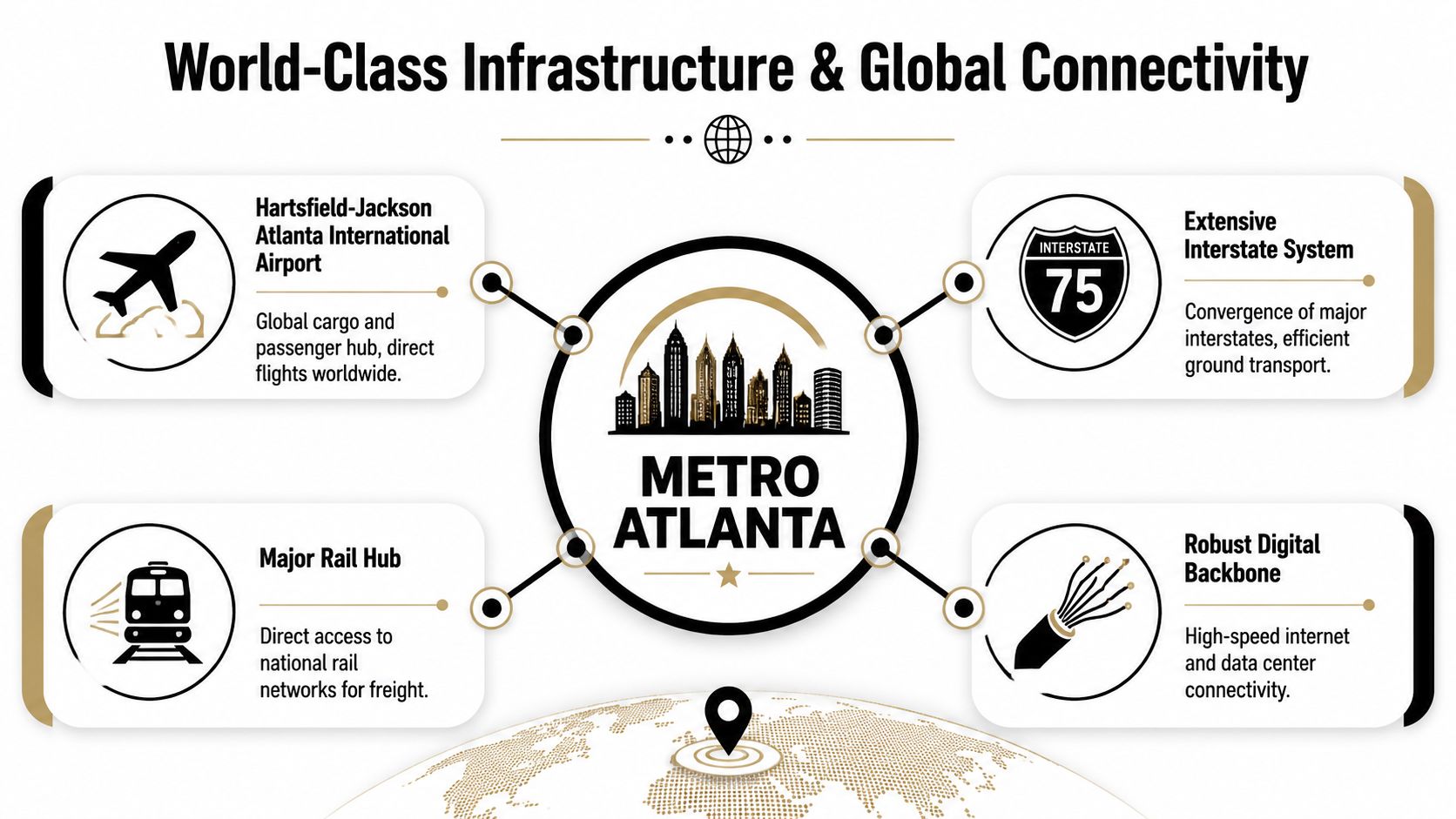
A relocation succeeds faster when the physical network supports the business model. Atlanta's infrastructure matters because it reduces friction for companies that move people, products, replacement parts, and IT hardware across multiple locations.
The region's appeal is tied in part to logistics connectivity through Hartsfield-Jackson Atlanta International Airport and the broader highway network, as noted in the earlier Atlanta economic development data.
How connectivity affects day-to-day operations
For procurement and facilities teams, good infrastructure isn't abstract. It changes lead times, service responsiveness, and distribution options.
Three operating benefits stand out:
- National reach from one hub: Companies can support regional offices and customer sites without managing from the coasts.
- Faster hardware movement: Replacement devices, decommissioned equipment, and product returns move more efficiently when airport and highway access are strong.
- Better vendor coordination: Office buildouts, data center work, and multi-site deployments are easier when contractors and carriers can reach sites predictably.
Where this matters most
This matters most for businesses with moving parts. Data center operators need dependable hardware logistics. Healthcare and finance organizations need secure movement of retired equipment and media. Manufacturers need inbound and outbound transport that doesn't introduce delays every week.
Companies evaluating site access near the airport can review Beyond Surplus's page on Hartsfield-Jackson Atlanta International Airport and the surrounding business environment.
The Hidden Challenge of Workforce Relocation
This is the issue executives underestimate most often. They assume lower housing costs will automatically improve employee satisfaction. That isn't how relocation works in practice.
According to the Corbin Team's Atlanta relocation playbook, 70% of Fortune 1000 companies already operate in Atlanta, yet few studies quantify how many relocated employees leave within 18 months because of commute stress or school mismatches. The same source warns that buyers should test commutes at 7:30 a.m. and 5:30 p.m. before signing.
Why the commute issue matters
A relocation package can look generous and still fail if an employee's daily life becomes harder. Commute unpredictability hits productivity first, then morale, then retention. School fit has the same pattern for employees moving with families. Once those problems surface, replacing a departed engineer or operations leader is far more expensive than solving the issue before the move.
Test the commute before the lease. Test the school fit before the offer is finalized.
What companies should do differently
The most effective relocation teams treat employee placement as an operating decision, not a personal side issue.
Use a checklist like this:
- Commute validation: Have employees drive likely routes during actual peak windows, not midday.
- Role-based flexibility: Give critical hires hybrid options if their route is likely to create friction.
- Family support: Include school-search assistance in the move plan for employees with children.
- Manager accountability: Require business unit leaders to flag retention risks early instead of waiting for resignation notices.
The common failure pattern is clear. Leadership sees lower housing prices, the employee sees a longer and less predictable day. If those two views aren't reconciled, the relocation starts giving back the savings it created.
Bridging the Critical IT Asset Disposition Gap
Most relocation guides ignore the ugly middle of a business move. Old laptops pile up. Retired servers sit in cages. Network gear from the former office stays boxed because nobody owns the disposition process. Printers, lab systems, thin clients, access control hardware, and failed drives remain on site long after the move team declares success.
That's not just messy. It creates security, compliance, and chain-of-custody risk.
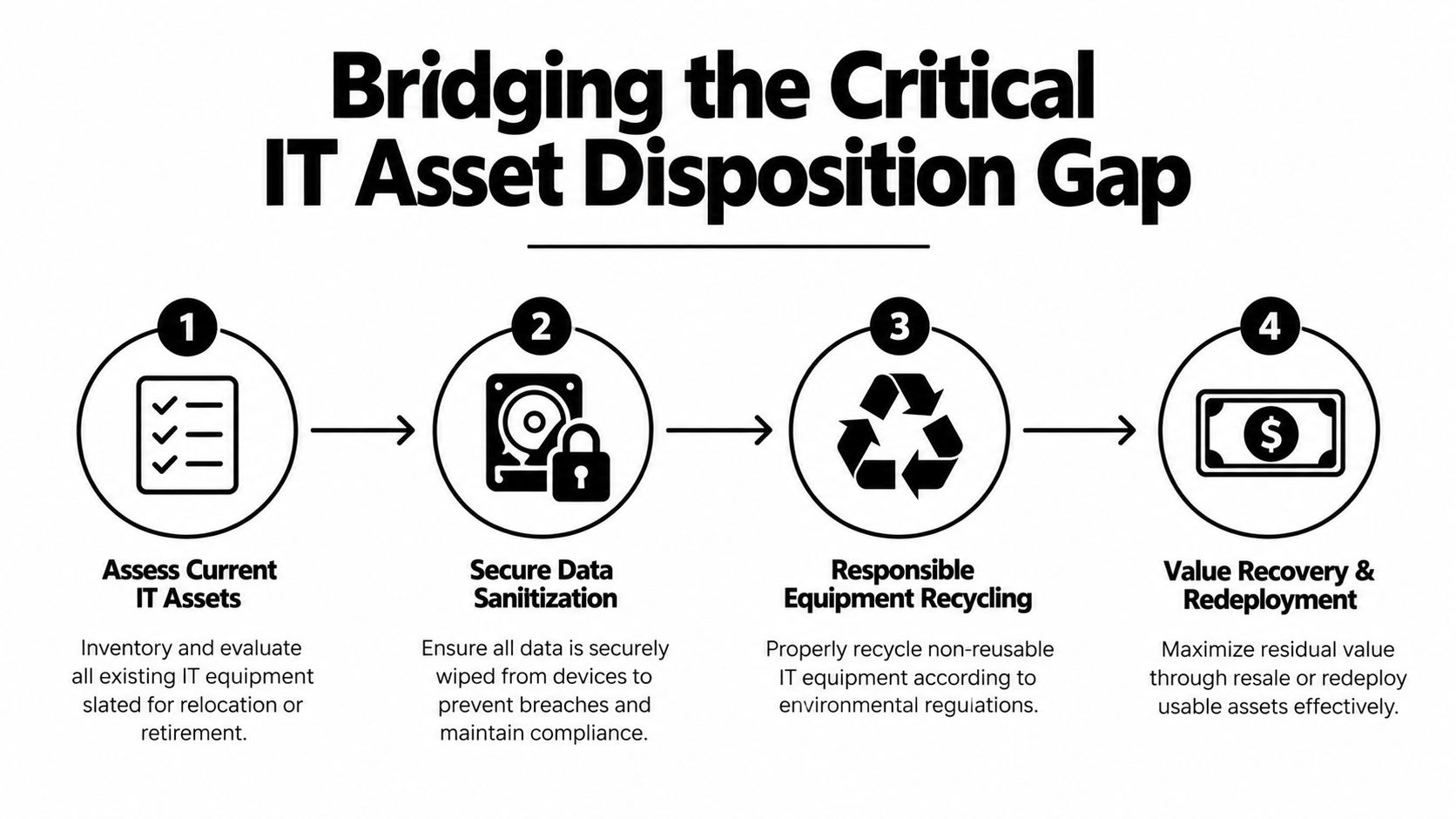
For organizations moving to Atlanta, the lack of localized, R2/ISO-certified ITAD partners with on-site hard drive shredding and FTC Disposal Rule compliance creates a critical gap in end-of-life technology management, according to Atlanta Real Estate Forum's roundup of booming businesses.
What gets missed during a relocation
A move creates two asset streams at once. One stream contains equipment worth redeploying to the new site. The other contains equipment that should never make the trip. Companies that fail to separate those streams early pay for it through storage costs, project delays, and unnecessary risk.
The overlooked categories usually include:
- End-user devices such as laptops, desktops, tablets, and monitors assigned to hybrid staff
- Back-room infrastructure including switches, firewalls, rack gear, UPS units, and retired servers
- Specialized equipment such as medical devices, laboratory systems, barcode gear, and industrial control hardware
- Media and data-bearing components including loose hard drives, SSDs, backup devices, and embedded storage
What a sound ITAD plan looks like
An effective plan starts before movers arrive. IT, facilities, security, and procurement need a single inventory process that tags each asset for relocation, resale, redeployment, recycling, or destruction.
A practical sequence usually looks like this:
- Inventory assets by class and location. Don't rely on memory or outdated spreadsheets.
- Identify data-bearing devices first. Those assets drive the security workflow.
- Set disposition rules. Decide what moves, what gets wiped, what gets shredded, and what gets recycled.
- Document chain of custody. Every handoff should be clear, especially in regulated sectors.
- Close the loop with certificates. Procurement and compliance teams need final documentation.
If obsolete equipment leaves your old office without documented custody, you haven't reduced risk. You've moved it.
Companies coordinating the physical side of a move may also need specialized relocation support. For example, teams planning server room transitions or office technology moves can review expert help with IT office moves to understand how physical relocation services and disposition planning should intersect.
One Atlanta-based option for the disposition side is Beyond Surplus's Georgia IT asset disposition service, which handles secure data destruction, electronics recycling, IT buyback, and chain-of-custody documentation for organizations managing retired equipment during a move. The value isn't marketing language. It's operational clarity. When the ITAD workflow is built into the relocation plan, obsolete assets stop being a lingering liability.
Planning Your Strategic Move to Atlanta
Atlanta makes a strong case on economics, workforce depth, and logistics. For many companies, that combination is enough to justify serious board-level attention. But relocations don't fail because the market lacked advantages. They fail because execution gaps were treated like minor details.
The checklist executives should keep in view
A disciplined move to Metro Atlanta should cover five things:
- Validate the financial model: Include rent, incentives, labor, and transition costs.
- Build the hiring plan early: Don't assume the market will absorb weak recruiting process.
- Pressure-test employee retention: Commute and school realities need real evaluation.
- Align facilities and IT: Office readiness and technology readiness are inseparable.
- Create an ITAD workstream: Old equipment needs a defined end-of-life path before move day.
A move has more staying power when the operating assumptions are realistic. That includes where employees will live, how they'll get to work, what equipment should be redeployed, and what should be destroyed or recycled under documented controls.
For companies tracking location strategy and office planning, Beyond Surplus's look at the Atlanta real estate market forecast for 2026 adds useful context to the broader decision.
If your team is planning a relocation, expansion, office consolidation, data center decommissioning, or secure equipment retirement in Georgia, contact Beyond Surplus for certified electronics recycling and secure IT asset disposal.


