

Georgia's labor market already shows a measurable AI exposure profile, and that makes the state a clear business case for adaptation, not speculation. A 2025 labor-market analysis found that 26% of Georgian workers are in occupations where some tasks could potentially be performed, fully or partially, by generative AI, and more than one-third of those exposed workers are in medium- to high-exposure roles. That mix matters because Georgia isn't just a tech story, it's a logistics, services, agriculture, and public-sector story too, which means AI will reshape operations unevenly across the state rather than landing as one uniform shock. How AI is changing Georgia's workforce exposure profile
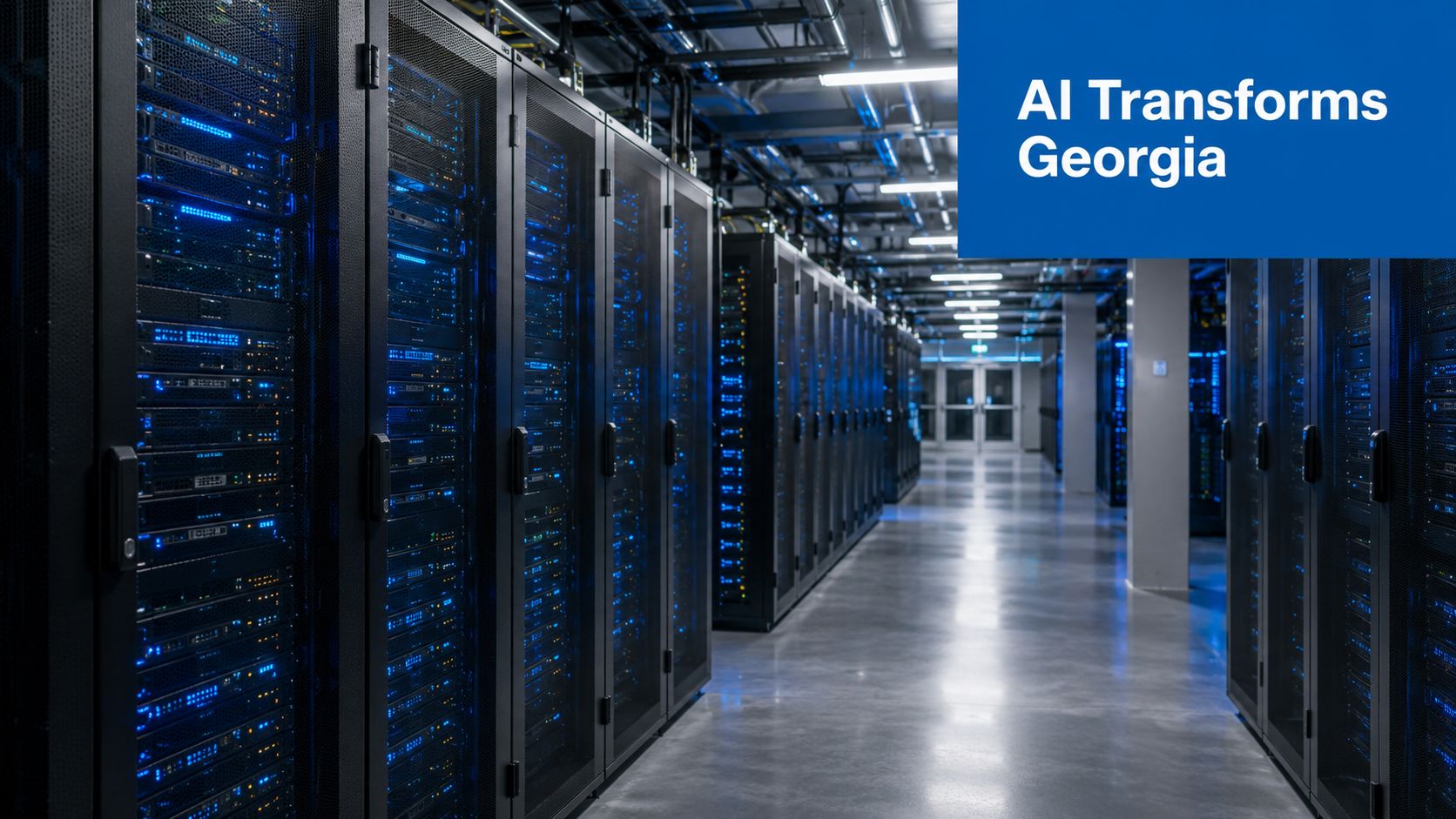
For executives, the key takeaway is strategic. Georgia's economy is being pulled in two directions at once, toward task augmentation in many occupations and toward automation pressure in a narrower set of roles. That means leaders have to think beyond software adoption and start planning for the downstream effects on skills, infrastructure, compliance, and the lifecycle of the hardware that powers AI.
How the AI Wave Is Reshaping Georgia's Economy
Georgia is a useful test case because its economy combines a fast-moving metro innovation base with a broad set of sectors that depend on physical assets, regulated workflows, and distributed labor. The state's labor structure includes a large agricultural workforce and a sizable service and trade sector, and the analysis cited earlier says those areas are comparatively less exposed to full GenAI automation. That changes the economic question from whether AI will replace jobs everywhere to where it will raise productivity, and where it will put pressure on staffing models.
Why Georgia looks different from a one-sector AI market
The state's profile makes AI adoption more operational than abstract. In Atlanta, firms use AI for analytics, service delivery, and process automation, a pattern explored in a recent analysis of Atlanta firms using AI to grow faster. Outside the metro core, businesses are more likely to feel AI through inventory systems, logistics planning, back-office workflows, and customer response automation. The result is a layered economy where some teams gain an advantage quickly while others need a slower, more deliberate transition.
Practical rule: treat AI as a productivity system first, not a software purchase. The companies that gain the most usually connect data, workflows, and asset planning before they deploy widely.
That distinction matters for business leaders and IT teams because AI changes the speed at which work is created, moved, stored, and retired. It also changes how often organizations need to refresh endpoints, servers, storage, and networking equipment to support heavier workloads. For IT directors, the economic story becomes an infrastructure and asset-lifecycle story as well.
Georgia's geography also matters. A state with strong logistics, a major urban hub, and a wide base of service businesses gives AI multiple routes into the economy. Some uses will be highly visible, like analytics and digital customer service. Others will sit inside procurement, compliance, and asset management, where they are less flashy but often more important for cost control and hardware planning.
That is where the operational burden becomes clearer for IT leaders. As AI adoption spreads, the pace of device replacement, server upgrades, and secure disposition rises with it, especially as organizations add more compute-intensive tools and retire older equipment sooner. In practice, Georgia's AI shift is not only about digital output, it is also about how quickly companies can track assets, protect data at end of life, and keep capital tied to equipment that still matches business demand.
For logistics-heavy employers, the pressure is especially visible. AI can improve routing and scheduling, but it also changes the infrastructure behind those gains, from fleet systems to warehouse terminals and the devices that support them. That is why broader economic growth links directly to high-paying logistics careers for drivers, since efficiency gains in freight operations often depend on the people and systems that keep physical movement reliable.
Transforming Key Sectors from Logistics to Healthcare
Georgia's AI shift is easiest to see in day-to-day operations. In the state's digital economy, much of the growth sits in exported digital services, especially software development, design, marketing, support, and back-office work delivered online to foreign clients. Independent analysis describes AI as a productivity layer that helps smaller firms scale content, customer support, and administrative work without adding headcount at the same pace, so the immediate effect is a change in how services are delivered, not a distant automation overhaul. Georgia's digital economy and AI productivity layer
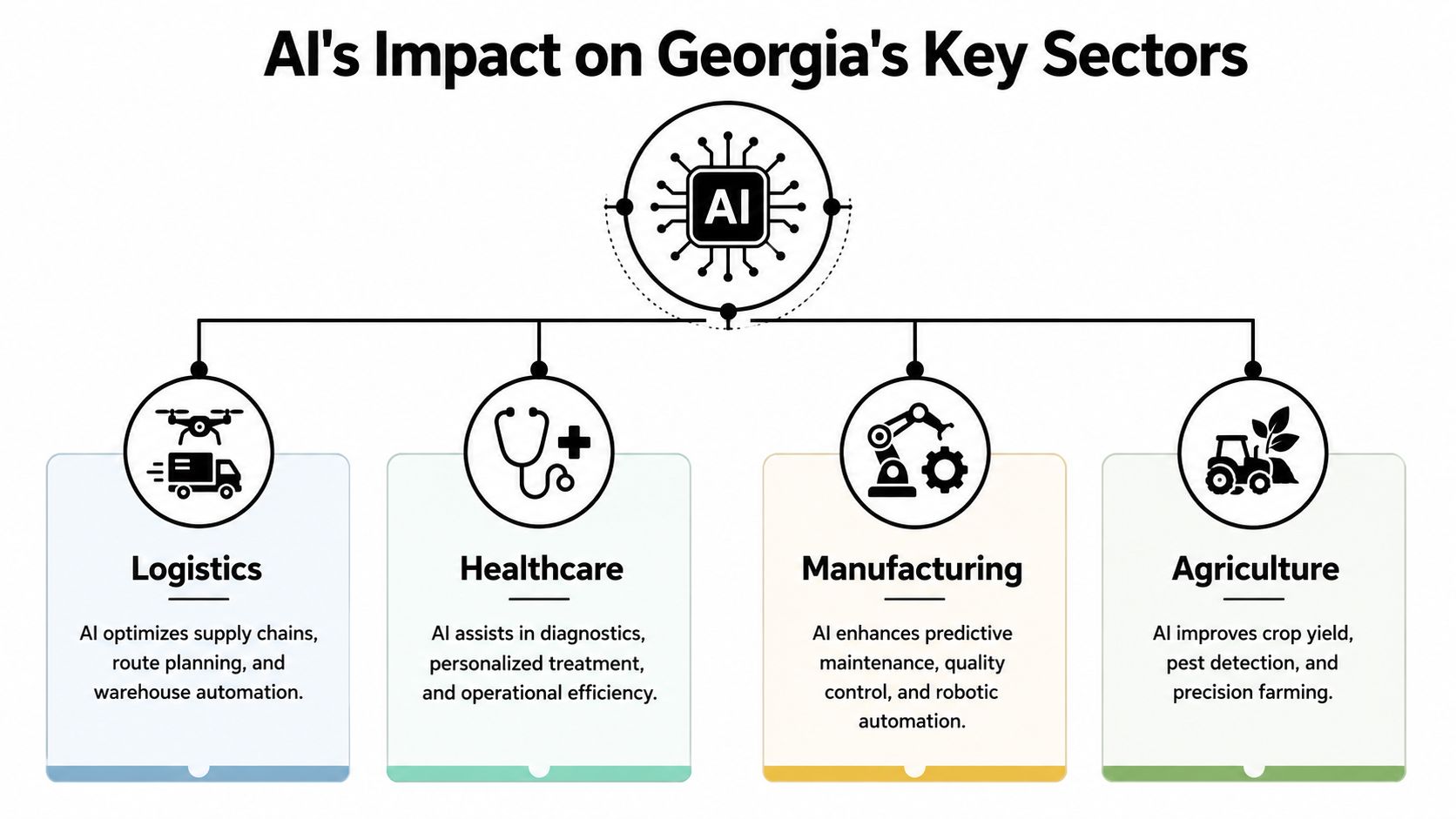
Logistics, healthcare, manufacturing, and agriculture are not moving the same way
Georgia's logistics network is a natural fit for AI because optimization tools can reduce friction in routing, scheduling, and warehouse operations. That affects freight teams directly, and it also changes delivery promises, fuel planning, and how companies staff peak periods. The economic signal is straightforward. Faster movement and better scheduling create room for tighter margins and more predictable operations.
Healthcare uses AI differently. Hospitals and health systems care less about novelty and more about throughput, documentation, and decision support. In that setting, AI matters because it can help organizations organize information faster and support operational efficiency in environments where time and accuracy carry real cost.
Manufacturing teams are approaching AI as a way to stabilize output and improve quality control. Agriculture is more likely to use AI where it improves monitoring, prediction, and resource use. Those are distinct workflows, and they produce different return-on-investment timelines, which is why IT leaders cannot treat sector adoption as a single pattern.
A useful way to think about the labor market is through roles that expand rather than disappear. The logistics sector still depends on dispatchers, planners, and drivers, but AI is changing what counts as high-value work inside that chain. Readers looking for a wage benchmark in adjacent transportation roles can review high-paying logistics careers for drivers as a reminder that technology usually reshapes job content before it removes entire categories.
That matters for firms selling digital services too. If AI helps a small Georgia company handle more client work without scaling payroll at the same pace, the firm can compete farther beyond the state. That is why AI is becoming a margin story as much as a technology story. Atlanta businesses are already using AI to improve speed and capacity, which reinforces the point that operational gains, not abstract novelty, are driving adoption. How Atlanta businesses are using AI to grow faster
The Physical Backbone Powering Georgia's AI Ambitions
Georgia's AI ambitions depend on physical infrastructure as much as software talent. AI workloads run on servers, storage, networking, power, cooling, and disciplined asset management, and those systems determine whether digital projects scale cleanly or stall under operational strain.
Data centers, energy, and the equipment stack
As AI workloads grow, companies need more compute capacity and more reliable connectivity. That makes data center strategy a business issue, not a facilities side note. Georgia's role as a logistics and enterprise hub strengthens that need because many organizations want infrastructure that can support fast data movement, resilient uptime, and easier access to regional business operations. Atlanta's position as a data center hub reinforces why these decisions are concentrated in the state. Why Atlanta is a prime data center hub
The World Bank's GovTech work on Georgia points in the same direction from the public sector. It calls for a whole-of-government GovTech approach, stronger digital foundations such as Mobile ID and digital documents, modernization of core platforms like tax administration, and greater use of artificial intelligence, machine learning, and big data for evidence-based decision-making. World Bank GovTech work on Georgia
That matters because firms do not adopt AI in isolation. They adopt it inside an ecosystem built on identity, compliance, interoperability, and trustworthy records. When those foundations improve, companies can move sensitive workflows into digital systems with less friction and less operational risk.
The asset side is just as important. Every AI-ready environment adds more hardware to procure, monitor, refresh, and eventually retire. GPUs, servers, switches, storage arrays, laptops, and edge devices all face shorter useful lives when workloads become more intensive. For IT leaders, AI strategy and decommissioning strategy now sit in the same planning cycle.
AI infrastructure creates a new kind of inventory problem. The faster compute capacity scales, the faster end-of-life assets accumulate, and those devices still contain business data, configuration history, and compliance exposure.
The companies that prepare for that reality will keep more control over value recovery, chain of custody, and audit readiness. The ones that do not will feel the costs later, usually when refresh cycles collide with security reviews or space constraints.
Developing a Future-Ready Workforce for the AI Era
Georgia's AI labor story is about augmentation and exposure at the same time. The earlier labor analysis shows that 26% of Georgian workers are in occupations where some tasks could potentially be performed by generative AI, and more than one-third of those exposed workers sit in medium- to high-exposure roles. That tells business leaders something important. AI isn't just a software layer, it's a force that changes which tasks matter, how teams are organized, and which skills command value.
Skills are shifting faster than job titles
The most resilient workers will usually be the ones who can combine domain knowledge with AI-enabled tools. That includes analysts who can validate outputs, managers who can redesign workflows, and operators who can use automation without losing oversight. In practice, companies need more people who can translate between technical teams and business units.
The Georgia Tech-led initiative funded by a $65 million federal grant is a strong signal that workforce development is now a core economic issue, not an optional add-on. Its programs are aimed at increasing job opportunities in distressed and rural communities and among historically underrepresented groups, which shows that the main challenge is distribution, not just total growth. Georgia Tech's $65 million AI and manufacturing initiative
That distribution question is essential for employers. If AI-related opportunity clusters only in metro hubs, companies outside those hubs will compete for a narrower talent pool and may struggle to retain skilled staff. If reskilling reaches more communities, the state gets a broader base of implementers, operators, and support talent.
What employers should look for now
- Workflow translators: People who can redesign processes around AI without breaking compliance or customer service.
- Data stewards: Staff who understand data quality, access control, and retention.
- Operational validators: Employees who can check AI output against business rules, especially in regulated settings.
- Technical maintainers: Teams that can support the hardware and systems behind AI adoption.
Skills Georgia employers are looking for
The broader point is simple. AI adoption creates demand for less repetitive work and more judgment-heavy work. Companies that build training around that shift will have a smoother transition than those that assume new tools automatically produce new capability.
Investment and Innovation in Georgia's AI Ecosystem
Georgia's AI ecosystem is getting stronger because investment is starting to connect research, infrastructure, and export potential. The most important evidence here is not a splashy startup headline. It's the relationship between R&D and high-value output.
R&D is becoming an export strategy
Policy research on Georgia reports a significant positive effect of R&D expenditure on the state's high-technology exports, and it also finds that ICT-goods exports contribute positively over time. The same study notes that real GDP is negatively associated with those exports, which is a useful reminder that broad macro growth alone doesn't automatically create a stronger technology export base. Targeted AI and innovation policy still matters. R&D and high-technology exports in Georgia
That has direct business implications. If AI investments improve model training, productization, and data infrastructure, Georgia firms can move faster from local capability to exportable digital services. The advantage comes from producing more valuable output, not just more output.
Public and private capital reinforce each other
Georgia's innovation environment works best when universities, enterprises, and public institutions reinforce each other's priorities. Training programs create talent. Talent supports firms. Firms justify more investment in research and deployment. That cycle matters because AI projects often need repeated iteration before they create durable value.
Startup funding trends in Atlanta
For operators, the practical conclusion is that AI spending should be judged like any other strategic capital allocation. If the investment improves service quality, export potential, or internal efficiency, it strengthens the ecosystem. If it produces isolated pilots with no workflow integration, it becomes a cost center.
Georgia is moving toward the first path, but it will need disciplined execution to stay there.
Navigating AI Risks and the Regulatory Horizon
AI adoption in Georgia is also a governance story. As automation spreads, the control burden rises with it. Policy discussions in Georgia have already raised concerns about data privacy, deepfakes, and transparency, which points to a market moving from experimentation toward regulated deployment, where risk management and secure data lifecycle management become part of the cost of doing business. Georgia's AI policy and governance concerns
Regulation is becoming part of the operating model
Public-sector digital reform is setting the tone. The World Bank's GovTech work on Georgia shows that artificial intelligence and machine learning are being considered for evidence-based decision-making in core government functions, including tax administration, which means AI is moving into operational systems rather than staying in isolated pilots.
For companies, that changes the risk register. Model risk, privacy risk, vendor risk, and asset disposal risk now sit closer together because the same data, infrastructure, and workflows support both production systems and AI experimentation. If hardware is retired without secure handling, organizations can leave behind sensitive files, access credentials, and system traces that create compliance and security exposure.
Governance slows reckless adoption, but it also makes wider adoption possible because controls define what can scale safely.
IT and compliance teams therefore need to coordinate earlier in the lifecycle. AI systems affect data provenance, retention, access controls, and auditability, so the operational question is no longer whether to manage these issues, but how quickly the organization can make them repeatable across procurement, deployment, and disposal. That is where predictive maintenance ML models also matter, because they help IT teams see which assets can stay in service and which ones should move into the retirement queue before they create operational risk.
An IT Director's Playbook for Thriving in Georgia's AI Economy
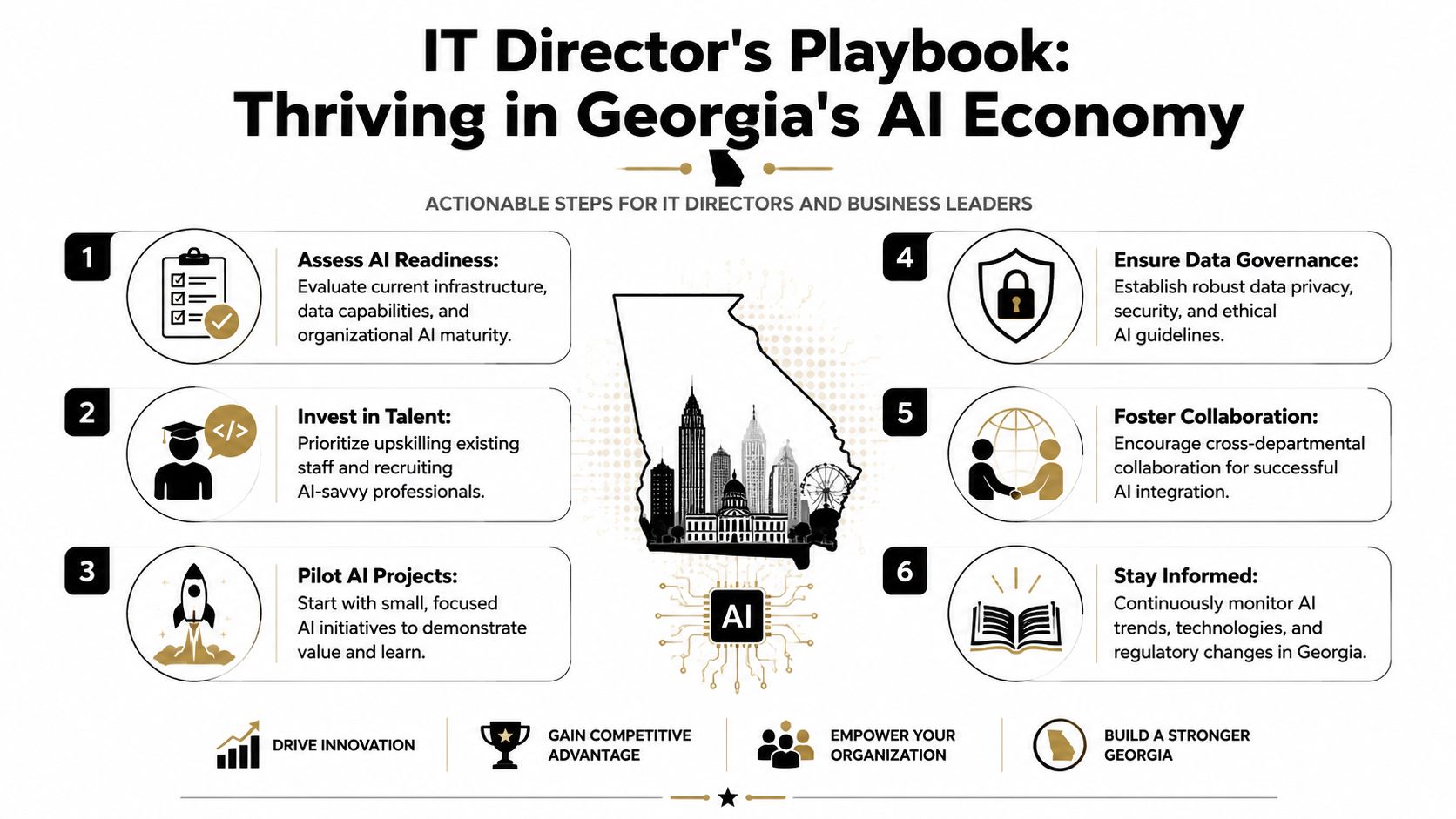
AI changes the IT director's job from infrastructure upkeep to lifecycle orchestration. The organizations that benefit most won't be the ones with the most tools. They'll be the ones that can align procurement, security, support, and end-of-life planning around faster-moving workloads.
Build for shorter refresh cycles
AI workloads tend to push organizations toward more frequent hardware evaluation. That doesn't always mean full replacement, but it does mean IT teams need tighter visibility into performance, power draw, warranty status, and remaining resale value. Predictive maintenance practices can help extend useful life where it makes sense, and teams looking for a technical overview can review predictive maintenance ML models as a useful reference point.
Treat retired assets as a risk class
Retired AI-era hardware can still contain business data, credentials, configuration files, and workflow traces. That makes secure destruction and certified data wiping core controls, not optional clean-up tasks. For Georgia organizations, the compliance conversation now includes what happens after a server or laptop leaves the rack.
A practical disposition program should cover:
- Asset visibility: Know what you own, where it is, and when it needs to move.
- Data sanitization: Match destruction or wiping methods to the sensitivity of the device.
- Chain of custody: Keep records from pickup through final processing.
- Value recovery: Resell or redeploy equipment that still has usable life.
- Environmental handling: Route unusable material into responsible recycling streams.
Use governance to reduce friction
The best AI programs don't create more chaos for IT teams. They create repeatable processes. That means standardizing intake, approval, imaging, refresh, and retirement steps across departments. It also means bringing procurement and finance into the lifecycle conversation earlier, so asset plans match actual workload patterns.
Beyond Surplus is one option for businesses that need secure IT asset disposition, electronics recycling, and documented data destruction as part of that lifecycle.
Georgia's AI economy is moving fast enough that hesitation now becomes a cost later. If your organization is refreshing infrastructure, retiring old servers, or planning for AI-related hardware turnover, contact Beyond Surplus for secure electronics recycling and certified IT asset disposal that fits enterprise operations.


