

Atlanta businesses aren’t treating AI as a side experiment anymore. Recent assessments put overall AI adoption among surveyed companies in Atlanta at 68%, far above the 17 to 20% of U.S. businesses using AI in production operations as of May 2026, according to the U.S. Census Bureau and a local roundup of Atlanta business adoption trends (Atlanta AI adoption research). That gap matters because it shows how local firms are using AI inside operations, not just in marketing demos.
The shift is especially visible in logistics, healthcare, and finance. In Georgia, SMB AI adoption rose 22% in Q1 2026 versus the prior quarter, and the Georgia Department of Economic Development tied early adoption to revenue growth of more than 10% over the last 12 months in surveyed firms across all 159 counties (Georgia SMB AI surge report). For Atlanta leaders, the lesson is straightforward. Faster growth is coming from better asset decisions, cleaner workflows, and tighter control over hardware, compliance, and logistics.
That has a direct connection to IT asset disposal and electronics recycling. As companies automate more work, they also replace more devices, retire more servers, and create more pressure on custody tracking, secure data destruction, and remarketing. The smartest Atlanta operators aren’t separating AI strategy from end-of-life technology strategy. They’re connecting the two.
Here are seven practical ways Atlanta businesses are using AI to grow faster, and how those same moves create opportunities for better ITAD, buyback, and electronics recycling execution.
1. AI-Powered Inventory Management for IT Asset Tracking

Atlanta companies with large device fleets are using AI inventory platforms to answer a question that usually gets handled too late. Which assets should stay in service, which should be sold, and which should move into secure recycling?
In healthcare systems, that might mean tracking laptops, mobile carts, network switches, and attached medical IT devices across multiple campuses. In finance, it often means monitoring trading floor workstations, storage arrays, and backup hardware for decommissioning readiness. AI helps by centralizing serial numbers, model data, usage history, and custody records so teams don’t rely on scattered spreadsheets.
Where AI creates growth
The growth benefit isn’t just operational neatness. Better lifecycle tracking helps companies refresh equipment on schedule, avoid overbuying, and move aging devices into value recovery before resale windows close. When AI flags assets approaching retirement, procurement and IT can act earlier instead of waiting for break-fix chaos.
That’s where ITAD execution starts to matter. If the inventory system exports clean records, handoff to a recycler or buyback partner is faster and easier to audit. Beyond Surplus positions this as part of inventory optimization for retired IT assets, which is exactly the point many firms miss. Good AI decisions still need a documented downstream process.
Practical rule: If your asset data can’t move directly into pickup, chain-of-custody, and disposition records, the AI layer won’t deliver full value.
How local teams are implementing it
The strongest Atlanta programs usually standardize a few basics first:
- Tag every device: Use QR codes or RFID so scanners and mobile apps can identify assets consistently.
- Set disposal triggers: Define the policy event that moves a device from active use into hold, resale, recycling, or destruction.
- Reconcile often: Run quarterly checks between AI records and physical inventory.
- Train the people entering data: AI systems still depend on accurate intake and update habits.
A university managing laptops and lab systems across multiple campuses can use this approach to keep refresh cycles predictable. A hospital network can use it to coordinate secure removal of outdated medical IT gear without losing custody visibility. In both cases, AI improves growth by making technology turnover less reactive and more financially disciplined.
2. Predictive Analytics for Data Center Decommissioning Planning
Server rooms rarely fail on a convenient schedule. That’s why Atlanta enterprises are applying predictive analytics to hardware performance, power draw, thermal conditions, and maintenance history to determine when infrastructure should be migrated, retired, or decommissioned.
For firms consolidating data centers or shifting workloads to the cloud, this changes the timing of every downstream decision. Instead of discovering problems after failures start, teams can schedule migration windows, hard drive destruction, transportation, and recycling around a forecast.
What this looks like in practice
A regional healthcare network might use AI signals from aging storage and compute infrastructure to line up migration dates with disposal planning. A fintech company might forecast which racks are nearing retirement and prepare secure pickups in phased batches rather than one disruptive event.
Decommissioning should be understood as a business continuity project, not merely a facilities project. Clean forecasting reduces emergency replacement, helps legal and compliance teams prepare records, and gives IT asset disposition providers time to coordinate labor and transport. Beyond Surplus speaks to that operational side in its overview of data center decommissioning trends in Atlanta.
Why manufacturers offer a useful signal
One of the clearest proof points for predictive AI comes from industrial operations. Atlanta manufacturing firms using AI-powered predictive maintenance report up to a 70% reduction in equipment breakdowns, a 25% decrease in maintenance costs, and labor productivity gains ranging from 5% to 20%, according to industrial AI reporting on predictive maintenance. The direct lesson for data centers is that early failure detection changes economics before a shutdown happens.
Decommissioning works best when AI alerts trigger migration planning, not when outages force disposal planning.
A strong rollout usually includes budget alignment, migration playbooks, an approved ITAD partner, and detailed equipment lists before the first shutdown date is set. If those elements aren’t connected, predictive analytics may identify the right time to retire infrastructure, but the organization still won’t execute cleanly.
3. AI-Driven Secure Data Destruction Verification and Compliance Documentation
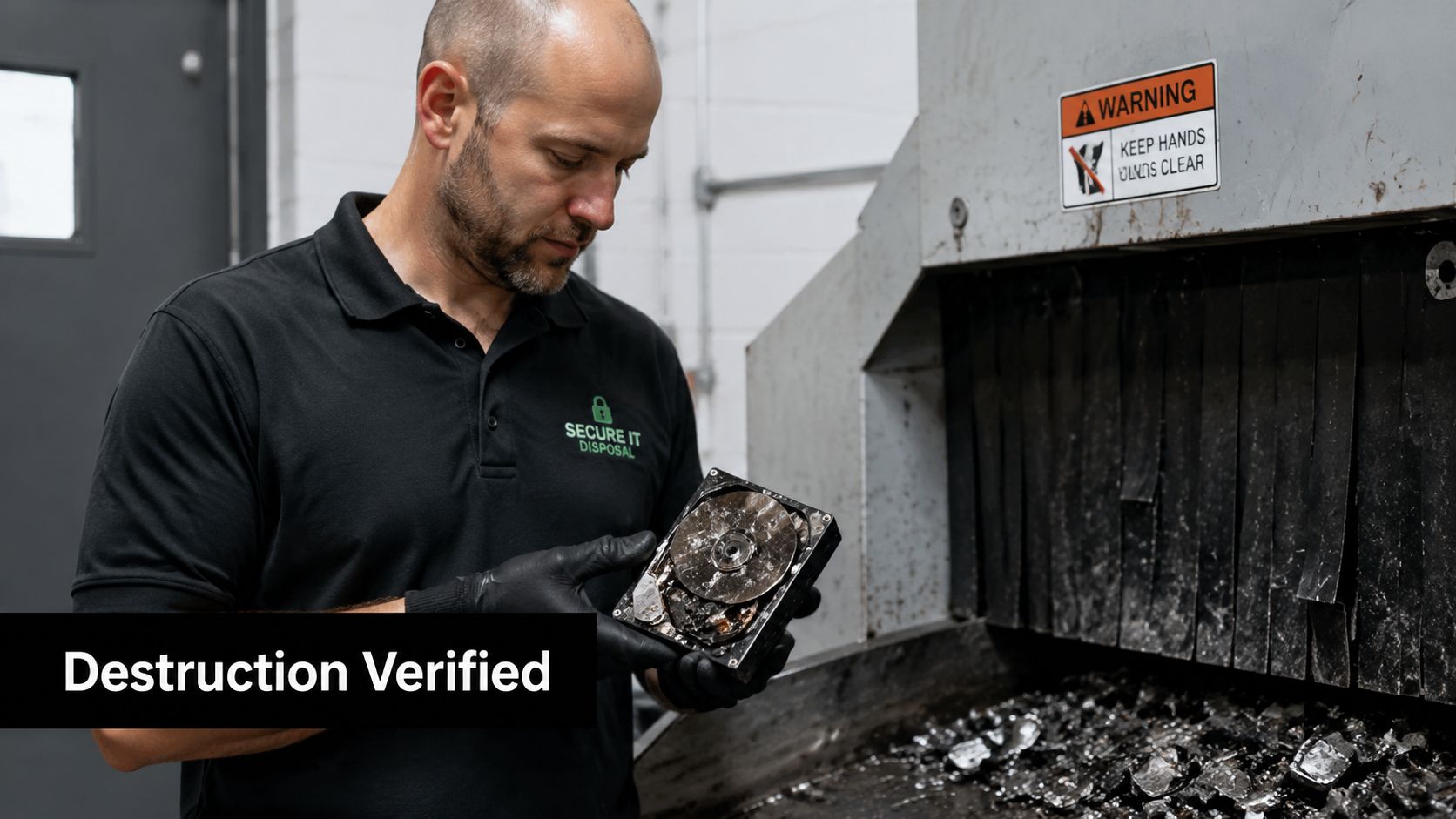
For Atlanta businesses in healthcare, finance, and government contracting, growth depends on trust. AI is now helping protect that trust by tightening verification around data destruction and documentation.
The practical use case is simple. Teams want proof that drives, servers, laptops, and mobile devices were destroyed or wiped according to policy, and they want evidence that stands up in an audit. AI-assisted verification tools can review destruction images, match them to device manifests, and automate the production of destruction records tied to chain-of-custody events.
Why documentation is becoming a growth tool
Most companies think of destruction certificates as a back-office artifact. In regulated industries, they’re also a sales enabler. A healthcare organization that can show reliable disposal records supports HIPAA readiness. A financial services firm with stronger audit evidence reduces friction with internal risk teams. A government contractor with clear destruction trails lowers exposure during contract reviews.
AI earns its place by shortening the gap between physical destruction and usable documentation and by reducing the chance that evidence sits in email threads, local folders, or paper binders no one can retrieve quickly.
For Atlanta operators, the stronger model is integrated documentation. Beyond Surplus highlights that process in its guidance on chain of custody documentation for IT assets, which is the operational backbone behind any AI verification layer.
How to tighten the process
- Build complete manifests: Record device type, serial number, and data classification before pickup.
- Connect evidence systems: Push destruction records into your compliance or GRC platform.
- Audit the verification workflow: Review how images, logs, and certificates are matched.
- Match policy to vendor output: Make sure your provider’s documentation format works for your auditors.
A hospital disposing of endpoint devices with patient data, or a broker-dealer retiring branch hardware, doesn’t need more vague assurances. It needs verified evidence with retrieval speed. AI helps convert disposal from a risky manual process into a controlled, searchable compliance workflow.
4. Machine Learning for IT Asset Buyback Value Optimization
Atlanta companies replacing large numbers of laptops, desktops, and network devices are using machine learning to decide something procurement teams have historically guessed at. Is this batch worth remarketing now, or should it go straight to recycling?
That decision shapes cash recovery. It also affects how quickly organizations can fund the next refresh cycle. In practice, machine learning models review model age, condition, market demand, and likely resale channels to sort equipment into resale, refurbishment, or scrap streams.
Why timing matters more than most teams think
An annual workstation refresh at a technology company creates a narrow window for value recovery. If devices sit in storage too long, their resale position weakens while handling costs rise. AI helps teams classify and move assets faster by scoring units based on expected recovery potential instead of broad category rules.
For schools and universities, the same logic applies to surplus laptops and lab equipment. For employers managing returned remote-work devices, it helps separate high-value recoverable units from damaged hardware that should move directly into secure recycling.
Beyond Surplus frames this combined approach in its article on maximizing value with ITAD services in Georgia. That dual capability matters. Companies usually lose money when they split remarketing and recycling into disconnected workflows.
A hidden Atlanta constraint
There’s also a less discussed issue behind this trend. An Atlanta-focused analysis notes that AI scaling creates a hardware refresh problem many small businesses underestimate, especially as old servers and GPUs are displaced. That same report points to pilot budgets in the $5,000 to $10,000 range for some AI efforts and notes that Atlanta tech raised $1.2 billion in 2025, intensifying hardware turnover and disposal pressure (Atlanta AI hardware refresh analysis). A significant takeaway isn’t the headline funding number. It’s that AI growth can create disposal bottlenecks if no one plans value recovery and secure disposition together.
Smart buyback programs don’t start with resale pricing. They start with fast grading, secure data handling, and clear routing rules.
Teams that do this well usually test devices before valuation, photograph hardware consistently, bundle units for more efficient transport, and avoid flooding the secondary market with one oversized release. Machine learning improves the recommendation. Good ITAD execution captures the result.
5. Natural Language Processing for Compliance Requirement Analysis and Risk Assessment
Many Atlanta organizations don’t struggle with a lack of disposal policies. They struggle with too many overlapping rules. Finance teams need one set of controls, healthcare teams another, and legal departments often add contract-specific requirements on top.
Natural language processing is helping by scanning regulations, customer agreements, and internal policies to identify what applies to a given disposal workflow. Instead of a manager manually cross-checking HIPAA language against internal procedures and vendor paperwork, an NLP system can surface conflicts, missing records, or unclear obligations.
Where this helps most
This is especially useful for businesses with multiple regulated lines of operation. A healthcare network may have different requirements for endpoint devices, diagnostic support systems, and archived storage media. A financial institution may need disposal controls that align with privacy rules, records retention, and vendor obligations all at once.
The immediate growth benefit is reduced delay. When compliance review becomes faster and more consistent, technology refreshes move faster too. Procurement, IT, facilities, and legal can approve projects with less back-and-forth because the requirements are easier to trace.
A practical operating model
Strong teams usually treat NLP as a review layer, not a replacement for counsel or compliance leadership. The system flags obligations and potential gaps, then humans decide policy and vendor standards.
A useful pattern looks like this:
- Load current rules: Keep updated versions of relevant laws, contracts, and internal policies in the system.
- Review quarterly: Re-run risk checks as regulations or customer terms change.
- Tie findings to vendors: Require disposal partners to document the controls your review identifies.
- Report upward: Export risk summaries for executives and board oversight when needed.
An Atlanta government contractor, for example, can use NLP to map disposal obligations against cybersecurity standards and subcontractor terms before a pickup is scheduled. That reduces surprises later, when auditors ask for records the business assumed someone else was keeping.
6. Computer Vision for Automated Equipment Condition Assessment and Grading
Condition grading has always been one of the slowest, most subjective parts of IT asset disposition. Computer vision is changing that. Atlanta businesses are using image-based assessment tools to review laptops, desktops, servers, and peripherals and assign condition categories more consistently.
The operational advantage is speed. Instead of relying only on manual inspection, teams can capture photos from multiple angles and let trained models flag cracked housings, missing components, port damage, cosmetic wear, and other visible issues. That speeds routing into resale, refurbishment, or recycling.
Why this matters during large refreshes
A corporate campus collecting thousands of returned laptops after a refresh cycle can’t afford inconsistent grading. If one technician calls a unit resale-ready and another routes a similar unit to scrap, value gets lost. Computer vision creates a common standard that helps procurement, finance, and ITAD partners work from the same baseline.
Educational institutions can use the same method to evaluate lab systems and student devices. Technology employers can apply it to remote employee returns. In both scenarios, visual grading creates faster triage before deeper testing begins.
The best use of computer vision isn’t replacing expert inspection. It’s telling experts where to focus first.
What makes the system work
These programs only perform well when the intake process is disciplined. Lighting, background, image angles, and device labeling all affect output quality. Businesses that want reliable grading usually standardize the photography setup and validate AI grades against periodic manual review.
A good workflow includes consistent photos, close-ups of damage points, and automatic flags for items that need technician review. Once that happens, buyback valuations get more accurate and recycling streams become cleaner. The result is a disposition program that’s faster, easier to scale, and less dependent on individual judgment.
7. AI-Powered Logistics Optimization for Nationwide Equipment Pickup and Consolidated Shipping
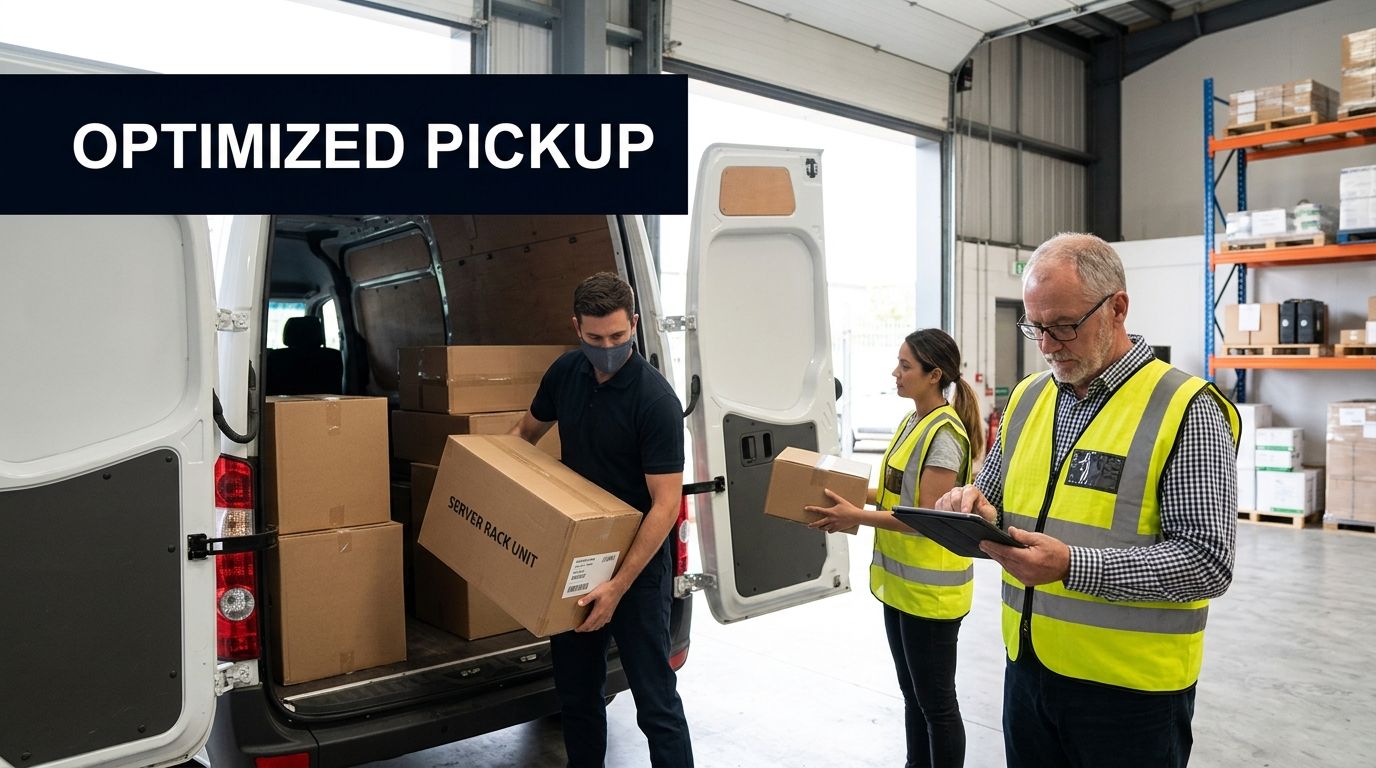
For Atlanta-based enterprises with offices, clinics, branches, or retail sites across the country, logistics often determines whether a disposal program scales. AI is helping solve that by optimizing routes, pickup timing, and shipment consolidation.
IT asset disposition costs don’t come from recycling alone. They come from fragmented pickups, half-filled trucks, rushed schedules, and poor visibility into what’s ready where. AI models can combine location data, equipment volumes, urgency, and facility schedules to build more efficient pickup plans.
Why nationwide operators are leaning on it
A multi-state healthcare network may need to remove medical IT equipment from several facilities while preserving chain of custody. A retailer may want to consolidate back-room hardware from stores into regional loads. A financial institution may need branch pickups timed around strict security windows.
AI helps identify cluster opportunities, sequence pickups more efficiently, and reduce unnecessary transport legs. For companies already centralizing asset data, this becomes a natural extension of inventory intelligence.
Beyond Surplus connects this idea to distributed device recovery in its article on automated logistics for remote employee laptop returns. The same logic works at enterprise scale. If pickups can be grouped intelligently, companies lower operational drag while improving service consistency.
Execution details that matter
- Keep location data current: Bad quantity or site data undermines route planning.
- Allow scheduling flexibility: Wider pickup windows create better consolidation options.
- Set shipment thresholds: Don’t dispatch immediately if bundling will improve economics and control.
- Ask for routing visibility: ITAD partners should explain how pickups were grouped and scheduled.
The strategic point is bigger than transportation savings. Logistics optimization lets Atlanta firms manage disposal as a coordinated national program instead of a string of local exceptions. That’s how a recycling and ITAD workflow starts supporting growth instead of merely cleaning up after it.
7 AI Applications Driving Atlanta Business Growth
| Solution | Implementation Complexity 🔄 | Resource Requirements ⚡ | Expected Outcomes 📊 | Ideal Use Cases 💡 | Key Advantages ⭐ |
|---|---|---|---|---|---|
| AI-Powered Inventory Management for IT Asset Tracking | Medium, integrations, device tagging & staff training | QR/RFID tags, data pipelines, integrations with procurement/accounting, subscription costs | More accurate inventories; fewer manual audits; timely disposal decisions; compliance-ready records | Distributed fleets (healthcare, education, finance), multi-site device management | ⭐⭐⭐⭐, automation improves accuracy, auditability, and disposal timing |
| Predictive Analytics for Data Center Decommissioning Planning | High, sensor deployment, model calibration, cross-system integration | Monitoring sensors, historical performance data, ML experts, 3–6 month setup | Predict failures; plan orderly decommissions; reduced emergency costs; sustainability metrics | Data centers, cloud migrations, large server farms (finance, healthcare, gov) | ⭐⭐⭐⭐, prevents outages, optimizes schedules and migration planning |
| AI-Driven Secure Data Destruction Verification & Compliance Documentation | Medium–High, camera/crypto infrastructure and certification | Camera systems, secure logging/blockchain, compliance integrations, validation effort | Irrefutable certificates of destruction; auditable chain-of-custody; lower liability exposure | Regulated industries (finance, healthcare, government) requiring certified disposal | ⭐⭐⭐⭐⭐, strongest audit trail and remote verification for compliance |
| Machine Learning for IT Asset Buyback Value Optimization | Medium, market-data integration and valuation modeling | Market feeds, diagnostics/photos of devices, pricing engine, logistics cost data | Higher cash recovery (typ. +15–40%); optimized sell vs recycle decisions; transparent pricing | Large refresh cycles, educational institutions, corporate buyback programs | ⭐⭐⭐⭐, maximizes recovery revenue and timing for resale markets |
| NLP for Compliance Requirement Analysis & Risk Assessment | Medium, legal collaboration and model tuning | Document corpus of regulations/contracts, NLP models, legal/compliance input | Automated gap identification; risk scoring; faster audit prep; alerts on regulatory changes | Enterprises subject to multiple overlapping regulations (financial services, healthcare, gov) | ⭐⭐⭐⭐, reduces manual review time and surfaces compliance gaps early |
| Computer Vision for Automated Equipment Condition Assessment & Grading | Medium, standardized imaging setup and model training | Multi-angle photography stations, lighting, trained ML models, validation processes | Rapid, consistent grading (<2 min/device); improved buyback accuracy; auditable condition records | High-volume returns (corporate campuses, retail, education) needing fast triage | ⭐⭐⭐⭐, fast, consistent condition assessments that scale throughput |
| AI-Powered Logistics Optimization for Nationwide Pickup & Consolidated Shipping | Medium, fleet/carrier integrations and routing algorithms | Accurate location/quantity data, carrier APIs, fleet management integration | Reduced transportation costs (20–40%); better pickup reliability; lower emissions | Nationwide multi-location businesses (retail chains, multi-state healthcare) | ⭐⭐⭐⭐, significant cost and carbon reductions via consolidation |
Next Steps for Your AI Growth Strategy
Atlanta’s AI story is no longer about experimentation. It’s about operational maturity. Local companies are putting AI into inventory control, decommissioning forecasts, documentation, valuation, compliance review, condition grading, and logistics. Those aren’t flashy use cases. They’re the systems that make growth repeatable.
The pattern across all seven strategies is clear. AI creates the most value when it improves decisions around physical technology assets, not just digital workflows. Every device that gets tracked better, retired at the right time, documented correctly, graded consistently, and shipped efficiently contributes to faster execution and lower risk. That’s what separates AI theater from AI operations.
For Atlanta businesses, the local context matters. The city’s high adoption level shows firms are moving faster than many peers nationwide. Georgia SMBs are also accelerating their use of AI through automation, forecasting, scheduling, customer service, and other operational tools, as noted earlier. That means more organizations will face the same downstream issues. More refresh cycles. More displaced hardware. More pressure on secure disposal and value recovery.
That’s why IT asset disposition should be treated as part of the AI growth stack. If your company is adding AI tools, expanding cloud environments, refreshing endpoint fleets, or replacing data center infrastructure, the back half of that process needs just as much discipline as the front half. Otherwise, growth creates disorder. Equipment piles up. Devices sit ungraded. Compliance records scatter. Value recovery shrinks.
A stronger approach usually starts with four decisions. First, centralize asset data so AI systems can identify what’s active, aging, and ready to move. Second, define clear routing rules for resale, recycling, and destruction. Third, make documentation retrieval easy enough for legal, compliance, and procurement teams to use without delay. Fourth, choose logistics and ITAD partners that can execute at the speed your AI-driven refresh cycles require.
Beyond Surplus fits into that operating model because the company sits at the physical end of the AI growth equation. Businesses need certified electronics recycling, secure data destruction, chain-of-custody records, IT buyback, product destruction, data center de-installation support, and nationwide pickup coordination. Those services aren’t separate from growth anymore. In many cases, they’re what allows growth initiatives to scale safely.
If you’re building an AI roadmap in Atlanta, include your retired hardware roadmap at the same time. The companies that do both well won’t just move faster. They’ll recover more value, reduce more risk, and keep future refresh cycles from becoming operational debt.
Contact Beyond Surplus for certified electronics recycling, secure IT asset disposal, data destruction, and IT buyback services that help Atlanta businesses turn AI-driven refresh cycles into a controlled, compliant growth advantage.


