

If you're staring at a rack of aging servers and a lease handback date, you already know the central problem. The hardware isn't the hard part. The hard part is proving every drive was handled correctly, every serial number was tracked, and nothing sensitive walked out the door with the recycler.
That's why Server Recycling in Georgia: What Businesses Need to Know is really about defensibility, not disposal. Georgia does not have a statewide electronics take-back mandate, so businesses have to lean on federal data-security and hazardous-waste controls, plus documented ITAD processes, to stay clean in an audit or dispute. The global picture shows why that matters, too, because the Global E-waste Monitor 2024 figures summarized in Georgia business guidance say 62 million metric tonnes of e-waste were generated worldwide in 2022, only 22.3% was formally collected and recycled, and the total is projected to reach 82 million tonnes by 2030. In other words, skipping paperwork on server retirement is a bad bet.
Why Server Recycling Is a Compliance Event in Georgia
An Atlanta IT manager doesn't need a lecture on clutter. You need the server room cleared, the colo contract closed, or the lease return signed off without a last-minute scramble over data-bearing drives. The mistake many teams make is treating server recycling like a hauling job. It isn't. It's a controlled transfer of custody, and every shortcut becomes a risk later.
Georgia's lack of a statewide e-waste mandate does not mean you can move hardware casually. The practical controls come from federal data-security and hazardous-waste rules, plus downstream recycling obligations, not from a single state take-back law. Georgia business guidance makes that plain, and it's why chain-of-custody, secure destruction, and proof of recycling or reuse are the primary controls that matter in a no-mandate state. Georgia e-waste compliance guidance for businesses frames the issue clearly.

What the risk actually looks like
A missing manifest, an unsanitized SSD, or a drive that was “probably wiped” can stay hidden until a breach review or vendor dispute. By then, the rack is gone and the liability is still yours.
Practical rule: If a server contains data, the disposal event must be run like a compliance workflow, not a cleanup ticket.
Georgia's data-center market makes this more urgent, not less. In 2024, Metro Atlanta recorded the highest net absorption in the U.S. data-center market at 705.8 MW, and construction activity in the region was 76% higher than the same period of 2023. The state also hosts nearly 160 data-center facilities, with at least 11 additional projects planned or under development, according to Georgia data-center market coverage. More facilities means more turnover, more decommissions, and more opportunities for sloppy disposal to become an incident.
Federal and State Rules That Govern Server Disposal
A server retirement in Georgia is a compliance event, not a junk removal job. The FTC Disposal Rule requires reasonable steps to protect consumer information during disposal. HIPAA's Security Rule requires covered entities and business associates to write and follow policies for the final disposition of electronic devices and media, and Georgia guidance points to 45 CFR §164.310(d)(2)(i), which requires data to be rendered “completely unusable, unreadable, and indecipherable.” Georgia compliant electronics recycling guidance sets that baseline.
The federal baseline and Georgia controls
NIST SP 800-88 is the standard businesses should use for media sanitization. It gives you the decision path for clear, purge, or destroy, and that matters because a server chassis is not the same thing as its drives, controllers, or embedded storage. Georgia agency guidance for surplus electronic media goes further and requires contents to be certified as destroyed or unrecoverable and sanitized in line with applicable requirements and the DOAS Electronic Equipment Disposal Policy. Treat that as a hard requirement, not a suggestion.
Georgia also cares about what happens after pickup. The state's secondary-metals recycling framework requires the Georgia Bureau of Investigation to maintain a database of purchase-transaction information from secondary metals recyclers, and recyclers must submit daily transaction data and make reasonable efforts to ensure the information uploaded is complete and accurate. GBI secondary-metals recycling requirements matter because your scrap trail does not stop at the dock.
If a vendor cannot explain where residual scrap goes, they are asking you to trust a black box.
Use Georgia electronics recycling laws and ITAD compliance as the plain-English map, then assign every asset class to the right treatment. Cheap pickup is the shortcut that gets companies fined, breached, or both.
Choosing Between On-Site Wiping, Off-Site Wiping, and Physical Shredding
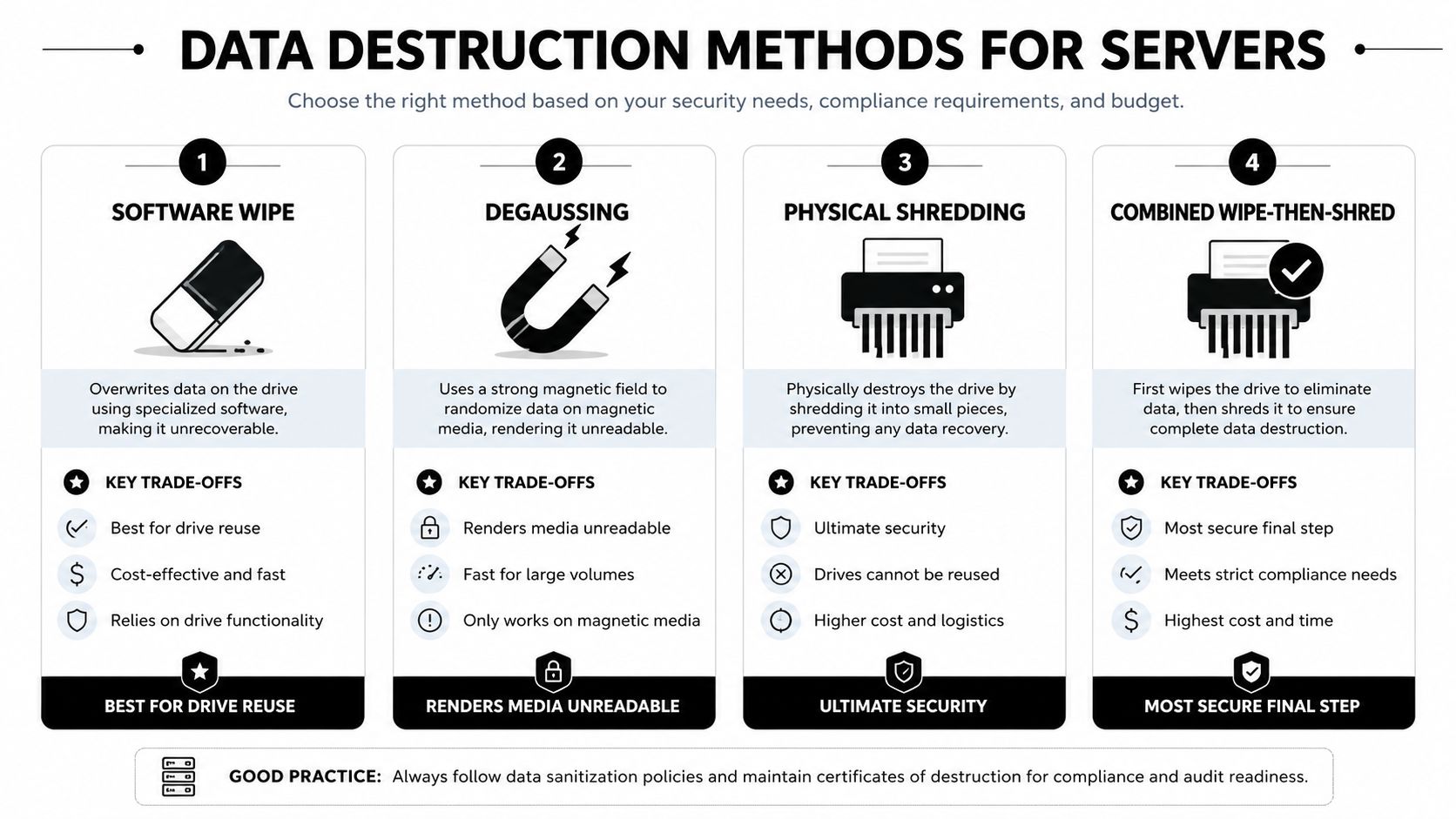
There are four real choices here, and anything else is marketing fluff. You can wipe software on-site, wipe off-site, degauss legacy magnetic media, or physically shred the storage media. The right call depends on the device, the data, and whether the hardware still has resale value.
Match the method to the media
On-site wiping keeps the chain of custody inside your building. That's the cleanest path for regulated environments because you don't hand over readable media before sanitization. Off-site wiping can make sense for less-sensitive, higher-volume retirements where the vendor can document transport and sanitization properly. Physical shredding is the safest option when the data is sensitive, the hardware is obsolete, or the drive won't be reused.
Degaussing only belongs in a narrow lane. It works for legacy magnetic media, but it doesn't solve the problem for SSDs. That catches people off guard because they assume every drive behaves like an old spinning disk.
The safest default for servers holding PHI, financial data, or covered defense information is the Destroy category under NIST SP 800-88. That avoids firmware quirks, operator error, and the temptation to reuse media that should never be reused.
On-site vs off-site ITAD services in Georgia is useful if you need a service model comparison before you approve a work order.
Building a Defensible Chain of Custody
Chain of custody is where weak ITAD programs fall apart. If you can't prove who had the hardware, when they had it, and what was done to each serial-numbered component, you don't have compliance. You have a pickup receipt.
What the record must contain
Inventory every server by serial number. Then inventory the parts that store data, including each drive, controller, and embedded storage element. Georgia-focused compliance guidance is blunt on this point, because one unsanitized component can still preserve recoverable data even if the chassis itself gets recycled. That's the failure mode that causes most avoidable exposure.
The handoff process should be boring in the best possible way. Locked staging areas, sealed containers, named signoffs, and matching manifests turn a moving truck into an auditable process. ITAD chain-of-custody in Georgia is the right framework to follow if you're building this internally.
Your documentation package should include:
- Serialized inventory: Every server, drive, controller, and storage element logged separately.
- Destruction or sanitization method: Wipe, shred, or combined process named clearly.
- Named handoffs: Who released the assets and who accepted them.
- Final certificates: Serial numbers tied to the outcome, plus the chain-of-custody reference.
- Retention discipline: Keep the records for at least three years, because that's the practical benchmark cited in enterprise guidance.
Practical rule: If a certificate doesn't tie back to a serial number, it's paperwork, not proof.
Wipe, Remarket, or Shred The Value vs Compliance Decision
Most Georgia guides skip the decision that changes project economics. Not every server should be treated as waste. Some should be wiped and resold. Some should be destroyed immediately. A few should be split, with the chassis remarketed and the storage media shredded.
Use the asset, not the vendor, to decide
Start with a technical-spec audit before de-installation. Look at the model, CPU generation, RAM, drive layout, and condition. Industry guidance for Atlanta data-center equipment recycling specifically calls out inventory fields like CPU type, RAM amount, and drive configuration because those details determine whether an asset has reuse value or should go straight to destruction. Atlanta server and data-center equipment recycling guidance makes the point clearly.
Here's the rule I'd use in the field. If the server is current enough to have resale value, the drives can be fully wiped with verifiable logs, and the downstream channel is named and defensible, then remarketing can offset disposal cost. If the system is obsolete, high-risk, or carrying regulated data, default to destruction. Don't let value recovery defeat compliance.
| Server Disposition Decision Matrix | Asset Profile | Data Sensitivity | Recommended Method | Documentation |
|---|---|---|---|
| Current enterprise server, healthy drives | Low to moderate | Wipe, then remarket | Serialized wipe logs, resale disposition record |
| Obsolete server with uncertain drive history | High | Physical shredding | Destruction certificate, serial list |
| Mixed environment with reusable chassis and sensitive media | High | Split disposition, chassis recovery plus drive shred | Separate certificates by component |
| Legacy magnetic media | Moderate | Degauss or destroy | Method record, chain-of-custody log |
Shredding a remarketable server destroys real value. Remarketing a sensitive drive creates avoidable exposure. Pick the wrong lane and you pay twice.
How to Evaluate a Georgia Server Recycling Vendor
A good vendor is a process vendor, not a pickup vendor. If all they sell you is a truck and a promise, keep looking. Your shortlist should be built around documentation depth, media handling, downstream transparency, and whether they can support a rack-scale or multi-site project without improvising.
Questions that matter
Ask how they track serial numbers. Ask what sanitization standard they use. Ask for sample certificates. Ask who handles the residual scrap after destruction. If the answers are vague, the service is weak.
The red flags are obvious once you stop being polite about them:
- No serial-level reporting: If they can't tie assets to certificates, stop there.
- No named sanitization standard: “We wipe drives” is not a standard.
- No downstream explanation: If they can't say where the metal goes, they're hiding something.
- No multi-site support: A single-truck local vendor won't fit a distributed enterprise.
For vendors serving Atlanta and surrounding operations, logistics matter too. You want a team that can handle pickup across the Southeast, support larger decommissions, and document every handoff cleanly. Beyond Surplus operates from Smyrna with pickup for organizations and logistics coordination for business equipment, so it's one model to compare against others when you're reviewing service scope. How to choose an ITAD vendor in Georgia is a solid checklist if you're building a procurement scorecard.
Practical rule: Buy the documentation package, not the lowest quote.
Project Timeline From Inventory to Final Certificate
A clean decommission doesn't happen in one afternoon. For a typical 50-to-500-server project, the timeline should be staged so IT, facilities, procurement, and compliance all know when they need to act.
Week one is for discovery and classification. Inventory every server, identify sensitive workloads, separate reusable hardware from destroy-only media, and lock the serial list before anyone touches a screwdriver. Week two is vendor scoping and contract signoff, which is where you confirm method, custody controls, and certificate format.
Week three is execution. That might mean on-site wiping, staged pickup, or a split workflow if some assets are being remarketed and others destroyed. Week four is where the project either closes cleanly or falls apart, because that's when destruction certificates, recycling records, and chain-of-custody documents need to land with the right stakeholders.
The usual failure points are predictable. Serial reconciliation gets rushed, drive-level logs get lost, and certificates go to the wrong inbox. Compressed schedules make those misses more likely, because every gap in custody gets bigger when the team is trying to move too fast.
Atlanta Logistics, Drop-Off Options, and Next Steps
Georgia businesses around Atlanta have a few practical routes, but only one should drive the decision: what gives you the best proof. For local drop-off, Beyond Surplus has a Smyrna facility, and businesses can also use on-site pickup for larger projects anywhere in the contiguous United States. The company also offers mail-in options for select residential items, though that's outside the enterprise workflow that matters here.
If you're dealing with a server refresh, colo exit, or multi-site decommission, stop thinking in terms of “getting rid of old boxes.” Think in terms of serialized inventory, media sanitization, documented transport, and final certificates. Electronics drop-off locations are useful when you need a physical handoff option, but business server retirement still needs an ITAD plan.
The right next move is simple. Scope the project, confirm the destruction method, and make sure the vendor can prove what happened to every drive and every server. That's how you protect the business and preserve any recoverable value.
Beyond Surplus handles certified server recycling, secure data destruction, and documented IT asset disposal for Georgia businesses that can't afford sloppy handoffs. If you need a defensible plan for decommissioning servers, visit Beyond Surplus and request a scoping discussion for pickup, wipe, shred, or remarketing options tied to your asset list.


