

IT asset disposition is the controlled end-of-life process for retired technology, combining secure data sanitization, certified destruction, logistics, value recovery, and documented chain of custody. The right program protects sensitive information and proves what happened to every asset. Treating retirement as simple recycling is the most common and most expensive mistake because a recycling receipt doesn't prove that customer data was removed or liability was transferred.
A company can retire a large equipment fleet and still have no defensible answer when an auditor asks which drive held regulated data, who handled it, which method was used, and where the certificate is stored. ITAD closes that gap. It turns a loose collection of laptops, servers, storage media, networking equipment, and medical or laboratory devices into a controlled disposition record.
The stakes are environmental as well as operational. The world generated 62 million tonnes of e-waste in 2022, while only 22.3% was formally collected and recycled in an environmentally sound way, according to the Global E-waste Monitor assessment. ITAD therefore has two tests: can the organization prove that data was made inaccessible, and can it show that residual equipment entered a responsible downstream process?
Table of Contents
- What IT Asset Disposition Actually Covers
- The End-to-End ITAD Workflow
- Regulatory and Compliance Requirements
- Data Sanitization Methods Compared
- Chain of Custody and Certificates
- Value Recovery Through IT Buyback
- Choosing the Right ITAD Provider
- Engaging an ITAD Partner in Practice
What IT Asset Disposition Actually Covers
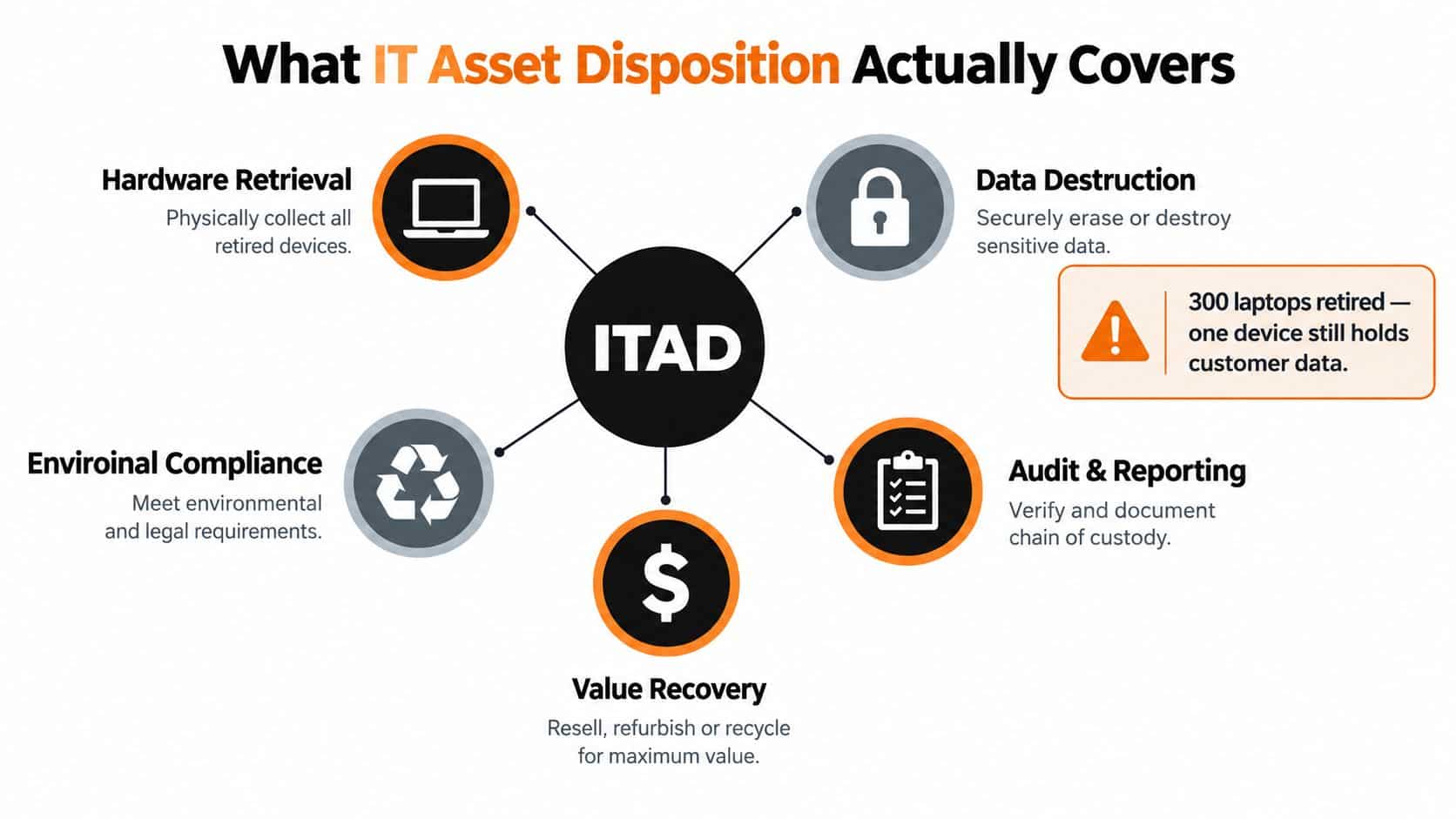
A 500-employee company retires 300 laptops after a refresh. Facilities loads them onto a pallet marked “electronics,” a recycler weighs the shipment, and the organization receives a receipt. Months later, one laptop appears with customer information still accessible. The receipt proves that material moved. It doesn't prove that the specific device was sanitized.
That distinction defines IT asset disposition. ITAD is the governed retirement process for servers, laptops, mobile devices, storage systems, networking gear, peripherals, and specialized equipment. It combines:
- Hardware retrieval: Collect every approved asset from offices, data centers, clinics, laboratories, or warehouses.
- Data destruction: Apply a method matched to the data sensitivity and media type.
- Environmental compliance: Route residual materials through responsible processors.
- Value recovery: Redeploy, refurbish, resell, or harvest usable components where risk permits.
- Audit and reporting: Preserve serial-level records, custody events, certificates, and settlement details.
Recycling is only the endpoint
An informal e-waste drop-off addresses transportation and material recovery. Scrap-metal pickup focuses on commodity value. Asset remarketing focuses on resale. None of those services, by themselves, establishes a complete security control.
The correct question isn't “Did the equipment leave the building?” It's “Can we prove what left, who accepted it, how its media was sanitized, what happened to the components, and which documents close the record?” That makes ITAD primarily a liability transfer and risk-reduction discipline, with recycling as one downstream outcome.
The market's size reinforces that shift. Estimates for the global ITAD market range from USD 18.4 billion in 2024 to USD 25.31 billion in 2024, with projections reaching USD 54.54 billion by 2030 and USD 39.66 billion by 2031, depending on scope and methodology, as summarized by Mordor Intelligence's ITAD market analysis. The important conclusion isn't which estimate is perfect. ITAD has become a recurring enterprise lifecycle function tied to security, compliance, recycling, and recovery.
The End-to-End ITAD Workflow
A server leaves the loading dock without a scan, and the organization loses more than visibility. It may also lose the evidence needed to prove who accepted the equipment, whether its data was sanitized, and where liability shifted. A defensible workflow has five stages, with an accountable owner and a record at every handoff.
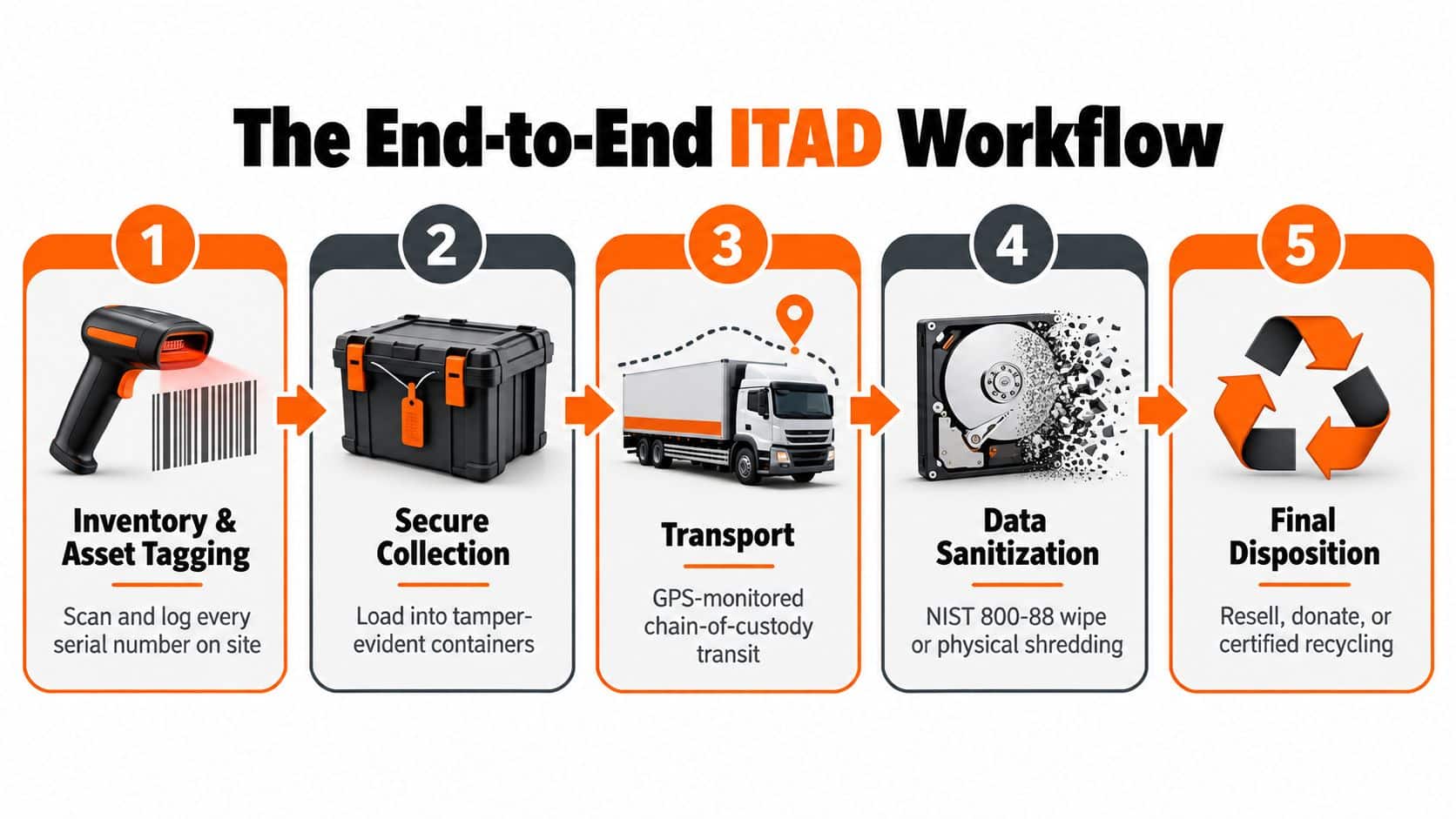
1. Inventory and asset tagging
Begin at the client site. Scan each serial number and asset tag, then record the model, location, owner, media type, and approved disposition instruction. Flag servers, storage arrays, backup media, clinical systems, and equipment assigned to regulated teams for closer handling.
The inventory must identify every asset approved for removal. A spreadsheet with missing serials creates an audit gap and leaves room for disputes about what the provider received.
2. Secure collection and transport
Stage equipment in a restricted area before pickup. Use sealed containers or wrapped pallets, record seal numbers, and document both the releasing and receiving parties. Set transport requirements for insurance, route control, and asset condition.
The custody record should show when equipment left, who accepted it, and when the next party received it. Do not let an unscanned mixed pallet become the provider's first view of the inventory. That breaks the link between the approved asset list and the shipment.
3. Sanitization or destruction
At the processing facility, classify each media item and apply the approved method. NIST defines sanitization categories as Clear, Purge, and Destroy, with the method matched to information sensitivity and control requirements in NIST SP 800-88 Rev. 2.
Evidence should link every serial number to the method, operator, tool or process, date, and verification result. “All drives were wiped” does not establish what happened to a specific device and will not support a serious audit.
4. Refurbishment and value recovery
Only after data risk is addressed should usable equipment enter testing, grading, repair, redeployment, resale, or parts harvesting. Resale lots must retain serial reconciliation through release. Require the provider to show how failed units and nonfunctional media are separated from resale inventory.
5. Final recycling
Residual materials go to downstream processors for recovery and compliant handling. Request a material or weight manifest, processor details, and a final certificate tied to the actual disposition route. Recycling is the endpoint, not the control. The record must show how each item reached that endpoint and who handled it along the way.
Practical rule: No stage is complete until its record makes the next stage possible.
Regulatory and Compliance Requirements
Compliance isn't satisfied by choosing a vendor with a green website. It's satisfied when the organization can connect its legal obligation to a specific control and a retrievable document.
The FTC Disposal Rule requires covered businesses to take reasonable measures to prevent unauthorized access to consumer information during disposal. The FTC identifies erasing or destroying electronic media so information can't be read or reconstructed as reasonable measures in its disposal guidance. Due diligence in selecting a disposal contractor matters because outsourcing the physical work doesn't erase the organization's responsibility to manage the process.
Healthcare organizations need media controls that account for protected health information. Financial institutions must align disposal with customer-information safeguards under GLBA. Payment environments should identify cardholder data on retired point-of-sale systems, workstations, and storage before disposition. State requirements can add separate duties around e-waste handling and data disposal, so a national program needs a state-aware control matrix.
| Regulation | Scope / Applies To | Required ITAD Evidence |
|---|---|---|
| FTC Disposal Rule | Covered consumer-report information | Sanitization or destruction record, contractor due diligence, custody documentation |
| HIPAA | Protected health information handled by covered entities and business associates | Media inventory, approved sanitization method, certificate of destruction, access controls |
| GLBA | Customer information held by financial institutions | Disposal policy, vendor oversight, sanitization logs, certificates, review record |
| PCI DSS | Systems and media containing cardholder data | Media identification, destruction or sanitization evidence, custody record, control validation |
| State e-waste and disposal laws | Requirements vary by state and organization type | Processor credentials, weight manifest, downstream documentation, destruction evidence |
Evidence must match the exposure
A certificate of recycling can show that material entered a recycling stream. It doesn't necessarily prove that information was unreadable before resale, dismantling, or transport. A certificate of destruction answers a different question, namely whether specified media was destroyed.
Organizations should map each asset class to the document an auditor or investigator would need. A sanitization log may be appropriate for a drive prepared for reuse. A destruction certificate may be required for failed media or highly sensitive systems. A downstream processor record supports the environmental side of the file.
For a practical explanation of how NIST sanitization controls fit into an ITAD program, review Beyond Surplus's NIST SP 800-88 resource. The principle is straightforward: a compliance claim without corresponding evidence is only an assertion.
Data Sanitization Methods Compared
NIST's three categories provide the decision framework. The right choice depends on data sensitivity, media technology, equipment condition, and whether the organization wants resale value.
Clear uses logical techniques appropriate for less sensitive data and supported media. Purge applies stronger logical or physical methods intended to make recovery infeasible using advanced methods. Destroy renders the media unusable through physical destruction. NIST's guidance emphasizes matching the method to the information and the organization's controls.
| NIST Category | Operational Methods | Media Types | Residual Risk | Resale Compatible |
|---|---|---|---|---|
| Clear | Logical overwrite or supported reset | Usable magnetic and solid-state media | Depends on coverage and verification | Often |
| Purge | Cryptographic erase, specialized sanitization, approved device-level process | Self-encrypting drives and supported modern media | Low when correctly executed and verified | Often |
| Destroy | Shredding, crushing, disintegration | Failed, highly sensitive, or unsupported media | Very low after complete destruction | No |
Match the method to the decision
Software wiping can preserve the hardware's resale potential, but only if the tool supports the media and produces a verifiable result. Cryptographic erase can be appropriate for self-encrypting drives when encryption keys and device state are properly controlled. Degaussing has a narrower role with magnetic media and isn't a universal solution for modern solid-state storage.
Physical destruction is the clear choice for nonfunctional media, unsupported devices, or information requiring the strongest control. It removes forensic risk, but it also removes resale value. That trade-off should be decided before equipment leaves the client's control, not after a reseller discovers an unreadable drive.
Organizations handling employee or customer devices can also consult Used Mobiles 4 U's data removal guidance for practical device-level considerations. Enterprise programs still need formal records, approval, and provider verification.
Validate every result
A defensible report includes the asset serial, media identifier where available, sanitization category, method, tool or process, technician, timestamp, and verification outcome. Sample testing can supplement the record, but it can't replace serial-level reconciliation.
For solid-state media, review the technical trade-offs in this comparison of secure SSD destruction methods. The operational rule is simple: if the provider can't show which method was applied to which asset, the organization can't confidently connect the control to the risk.
Chain of Custody and Certificates
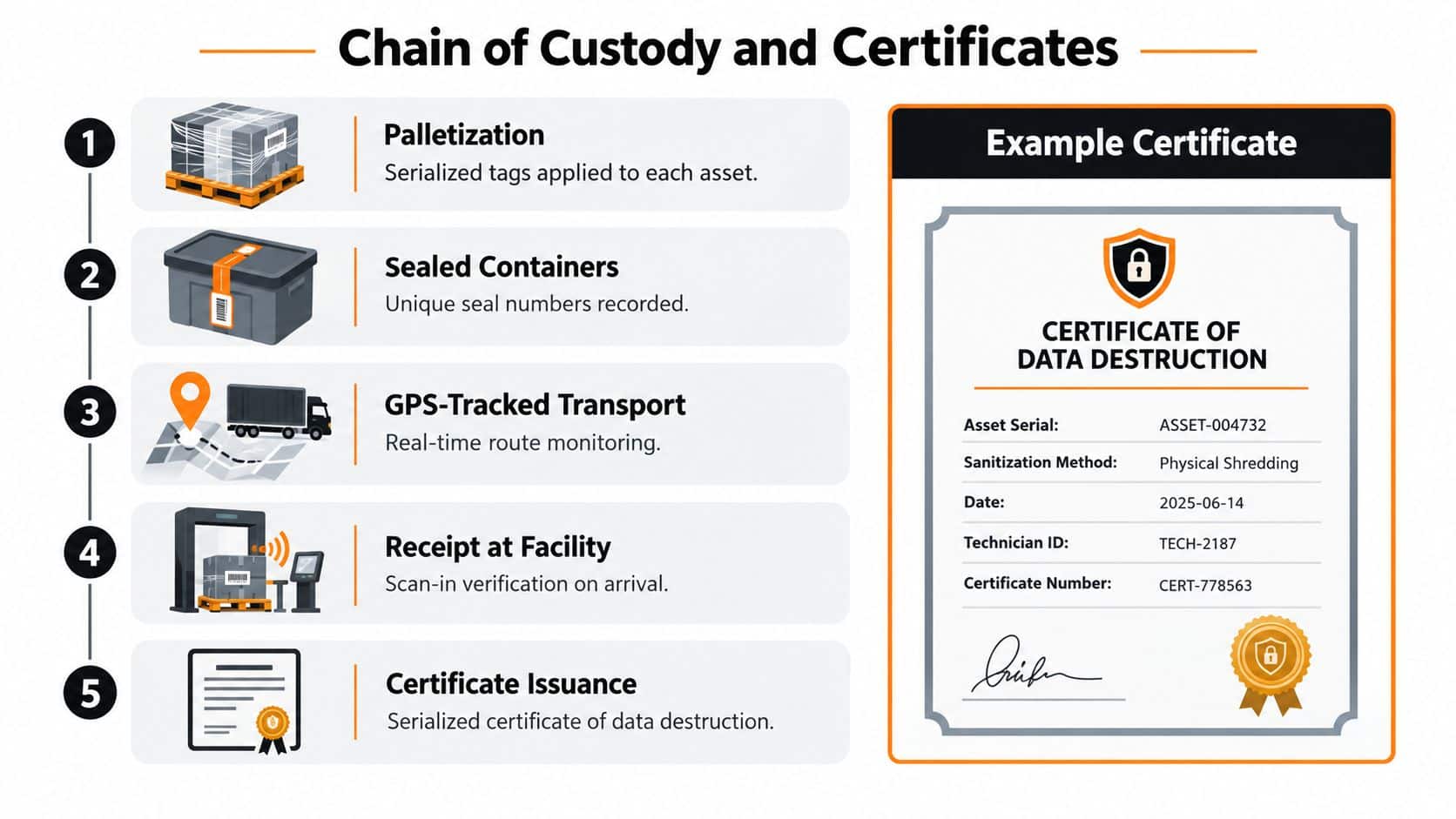
Chain of custody begins before pickup. Apply serialized tags, stage equipment in a restricted area, record seal numbers, and identify the person releasing the assets. At every handoff, capture the sender, receiver, date, location, container or shipment identifier, and condition of the load.
GPS-monitored transport can strengthen visibility, but technology doesn't replace reconciliation. The receiving facility must scan the shipment against the outbound inventory and investigate missing, extra, or substituted items before processing continues.
Know which certificate proves what
A Certificate of Destruction documents that identified media was rendered unreadable or unusable. A Certificate of Recycling documents material processing or entry into an authorized recycling stream. They support different claims and shouldn't be treated as interchangeable.
A weight ticket alone is especially weak. It may show that a shipment contained a certain quantity of material, but it won't identify which laptop, server, or drive was included. If a breach investigation focuses on one serial number, an aggregated weight record leaves the organization trying to prove a negative.
A strong certificate should include:
- Asset identity: Serial number, asset tag, model, and media identifier where available.
- Process detail: Sanitization or destruction method and disposition category.
- Execution record: Date, facility, technician or operator ID, and certificate number.
- Custody reference: Pickup, shipment, seal, or receiving identifier.
- Outcome: Reuse, resale, component recovery, destruction, or recycling route.
Use Beyond Surplus's chain-of-custody guidance to pressure-test the evidence package. In an audit, insurance claim, or incident review, clear records help establish when control transferred and what the provider accepted.
Value Recovery Through IT Buyback
IT buyback isn't a reward for having old equipment. It's a controlled financial decision made after security, condition, demand, and processing cost are known.
Enterprise laptops, recent desktops, server components, memory, networking equipment, and enterprise solid-state drives may retain secondary-market value. Damaged displays, obsolete drives, and heavily worn consumer-grade equipment may be better candidates for parts recovery or recycling. The right disposition can differ within the same pallet.
Use a decision matrix
- Redeploy internally: Choose this when the device meets current requirements, ownership can be reassigned, and sanitization is verifiable.
- Resell: Choose this when the equipment has market demand, condition can be documented, and the data-control method supports release.
- Part out: Choose this when components retain value but the complete unit doesn't justify refurbishment.
- Destroy and recycle: Choose this when media is failed, data sensitivity is high, or reconditioning cost exceeds realistic recovery.
Buyers should ask whether the offer is outright, consignment, or a blended lot price. A blended quote may simplify administration, while per-unit grading gives better visibility into recovery. Compare the proposal with current secondary-market conditions, not original purchase price or internal book value.
Recovery is only successful when the organization can show both the money received and the controls applied before the asset changed hands.
For a structured approach to comparing laptop recovery options, see the business laptop buyback program guide. Require a settlement that ties recovered value to asset identifiers, grading, deductions, and disposition status.
Choosing the Right ITAD Provider
Vendor selection is a risk filter, not a commodity-buying exercise. A low per-pound quote can look attractive until the buyer discovers that the provider can't identify individual assets, explain downstream handling, or accept responsibility for a missing drive.
Procurement checklist
Certifications and controls: Ask whether the provider maintains recognized credentials such as R2v3, e-Stewards, ISO 14001, or NAID AAA, and request current documentation rather than relying on logos.
Processing model: Onsite destruction can reduce transport exposure and suit sensitive projects. Offsite processing can provide better equipment, controlled facility access, and broader refurbishment capability. Select based on data classification and operational requirements.
Logistics and insurance: Confirm how the provider secures loads, tracks shipments, handles exceptions, and covers loss or damage in transit. Ask who controls the vehicle and who signs each custody handoff.
Reporting: Require serial-level inventory reconciliation, sanitization method, certificate identifiers, downstream records, and value recovery settlement. Reports should be exportable and readable without the provider's proprietary portal.
Liability language: Review the contract's treatment of custody, subcontractors, residual data, insurance, breach notification, and downstream processors. The agreement should say what happens when an asset is missing or fails processing.
Commercial transparency: Ask how resale proceeds are calculated and whether commodity, transportation, testing, and processing charges are separated. Murky per-pound pricing can hide markups and weak accountability.
A provider with R2v3 certification, pickup infrastructure around Atlanta and Smyrna, and nationwide logistics can fit a multi-site program, but procurement should still validate the exact service scope and evidence package. The questions to ask before hiring an ITAD company provide a useful diligence checklist.
Engaging an ITAD Partner in Practice
A successful engagement starts with a clean scope. Export the asset list, identify high-risk devices, separate equipment requiring destruction from equipment eligible for reuse, and specify the required certificates before asking for a quote.
Build the project in sequence
- Define the inventory: Include serial numbers, locations, owners, media types, condition, and intended disposition.
- Compare proposals: Evaluate security controls, logistics, processing location, certifications, insurance, reporting, and commercial terms together.
- Prepare the site: Reserve secure staging or cage space, verify power needs for equipment that must be assessed, and prepare the serialized inventory pull.
- Execute the handoff: Confirm the pickup window, container or seal identifiers, loading responsibilities, and signatures before the shipment leaves.
- Close the record: Match the receiving scan to the outbound list, investigate exceptions, and store the completed evidence package with the retirement approval.
The final deliverable should include a serialized certificate of destruction or recycling, an audit trail showing the sanitization method, a weight or commodity disposition summary, and a value recovery settlement when resale occurred. If the engagement includes data center decommissioning, add rack, device, media, and network configuration records to the closeout file.
For an Atlanta-area project, a Smyrna facility can support local drop-off or scheduled pickup, while nationwide logistics can accommodate multi-site enterprise programs. The practical standard remains the same regardless of location: no asset is closed until its identity, custody, disposition, and evidence agree.
Beyond Surplus provides business IT asset disposition, secure data destruction, electronics recycling, product destruction, data center de-installation, logistics coordination, and IT buyback services. Visit Beyond Surplus to plan a documented disposition program that protects sensitive data, supports compliance, and recovers value where appropriate.


