

A Midworld financial services firm is refreshing its Dell PowerEdge fleet before a data-center migration. Dozens of drives still contain client PII, the lease-return deadline is approaching, and the IT lead is trying to determine which Atlanta recycler will provide a certificate that an auditor can readily use. That decision can't be reduced to finding a truck and clearing rack space.
Server Recycling Atlanta: Secure Disposal and Asset Recovery starts with a controlled disposition plan. Each retired server creates a compliance question, a data-security obligation, a choice between redeployment, resale, and scrap, and a record that must survive procurement review or an audit. The right provider should leave you with serialized evidence, a defensible chain of custody, and a clear accounting of recovered value.
Table of Contents
- Why Server Decommissioning Matters for Atlanta Businesses
- Building Your Server Inventory and Disposition Plan
- Choosing the Right Certified Data Destruction Method
- Logistics and Chain-of-Custody for Atlanta and Nationwide Pickup
- Compliance Obligations That Drive Your Documentation
- Asset Recovery Versus Scrap and When Each Pays Off
- Vendor Selection Checklist for a Secure ITAD Partner
Why Server Decommissioning Matters for Atlanta Businesses
Server decommissioning is a liability event, not a logistics task. Drives can retain client records, credentials, financial files, protected health information, and proprietary workloads after the server leaves production. A recycler that only records the number of chassis collected hasn't solved the central problem. You need to know which media left the facility, how it was sanitized, who handled it, and what happened next.
The FTC Disposal Rule, effective June 1, 2005, as part of FACTA, requires businesses and individuals using consumer reports for business purposes to take “reasonable and appropriate” measures when disposing of sensitive information. The FTC says electronic files or media may need to be erased or destroyed so information can't be read or reconstructed, and it recommends due diligence when selecting a destruction contractor, including reviewing independent audits, checking references, and evaluating security policies. Read the FTC guidance on disposing of consumer report information before approving a vendor.
Atlanta adds operational complexity. Healthcare, financial, technology, and logistics organizations operate across Buckhead, the Perimeter, Midtown, and the Cumberland corridor, often with strict access controls, limited loading windows, and multiple stakeholders. Georgia's e-waste policy also matters. The state's E-Waste Law bans disposal of covered consumer electronics in landfills and incinerators, including computers, monitors, printers, scanners, and computer peripherals, as summarized by Green Atlanta's business recycling information.
Operational rule: If a vendor can't reconcile every data-bearing asset to a final certificate, the project isn't complete.
A proper Atlanta electronics recycling project therefore combines secure IT equipment disposal, media sanitization, controlled transportation, asset recovery, and responsible downstream processing. Pickup is only the visible part.
Building Your Server Inventory and Disposition Plan
Start with a manifest before anyone removes a rail kit. Record the physical server and every data-bearing drive separately. The chassis serial number establishes ownership, but drive-level serials establish whether the data-bearing media reached the approved destruction or reuse path.
Capture the following for each asset:
- Manufacturer and model: Distinguishes a Dell PowerEdge from an HPE ProLiant and supports accurate valuation.
- Service tag, asset tag, and serial number: Creates the identifier used on certificates, handoff records, and recovery reports.
- CPU, RAM, and storage configuration: Shows whether the unit has redeployment or resale potential.
- RAID controller and array layout: Helps technicians understand drive dependencies and prevents loose-media errors during removal.
- Hypervisor or workload tag: Confirms that VMware, Hyper-V, storage, backup, and application roles have been retired correctly.
- Rack location: Makes de-racking and final reconciliation faster.
- Media type: Mark each device as HDD, SSD, NVMe, or self-encrypting drive because the correct sanitization method depends on the technology.
A 12-node Hyper-V cluster spread across two cabinets is a useful test. The inventory should identify each node, its rack unit, service tag, drive bay numbers, drive serials, RAID arrangement, and workload status. If three loose SSDs sit on a shelf, list them as individual assets instead of attaching them vaguely to the nearest chassis.
| Field | Example | Why It Matters |
|---|---|---|
| Asset tag | ATL-DC-041 | Links the physical unit to the organization's records |
| Serial number | Chassis and drive serials | Supports serialized certificates and reconciliation |
| Configuration | Dual CPU, RAM, RAID set | Informs redeployment and resale valuation |
| Workload tag | Hyper-V cluster node | Confirms production retirement |
| Rack location | Cabinet B, rack unit 18 | Guides removal and pickup |
| Media type | HDD, SSD, or NVMe | Determines the appropriate sanitization path |
Don't rely on DHCP lease logs as your asset register. Don't lump loose drives with a chassis. Those shortcuts create gaps that become expensive when a certificate omits a drive or procurement challenges a recovery estimate. Use a business technology disposal planning guide to align inventory, disposition decisions, and documentation before scheduling pickup.
Your finished export should support three outcomes: a serialized certificate of destruction, a defensible buyback or redeployment valuation, and an audit-ready report showing the path of every asset.
Choosing the Right Certified Data Destruction Method
The correct method depends on the media, the sensitivity of the data, and whether you need the device to remain usable. NIST's recommended workflow is straightforward: identify the media and sensitivity, select a media-appropriate method, verify the result, and document it with a certificate of media disposition. The NIST SP 800-88 Rev. 2 publication also warns that physical destruction isn't automatically the right answer for every security category, while simple deletion isn't sanitization.
Match the method to the media
HDDs can often be sanitized with an appropriate Clear or Purge process when the security policy permits reuse. Software tools such as Blancco can generate per-drive logs that record the result. DBAN may be used in limited environments, but enterprise buyers should demand a process that supports verification, logging, and technician accountability rather than accepting a screenshot that says “complete.”
SSDs and NVMe devices require different treatment. Degaussing doesn't sanitize flash media because it doesn't use magnetic storage. SSDs generally need a vendor-supported Secure Erase or equivalent irreversible destruction when the risk category requires it. NVMe devices should use the manufacturer's formatted sanitize capability or physical destruction. Self-encrypting drives may be cleared through cryptographic erase, but only when the original encryption key and the drive's capabilities are properly verified.
Compare on-site and off-site work
A mobile shred truck can arrive at an Atlanta loading dock and destroy drives while your representative witnesses the process. Ask about screen size options, including 40 mm and 6 mm, because the output affects downstream handling and proof. The vendor should reconcile serials on the truck and provide supporting photographs or video when included in the scope.
Off-site destruction can handle large HDD lots efficiently. It requires sealed containers, documented handoffs, transport controls, intake verification, and post-destruction certificates. The security is in the evidence chain, not the distance from your server room.
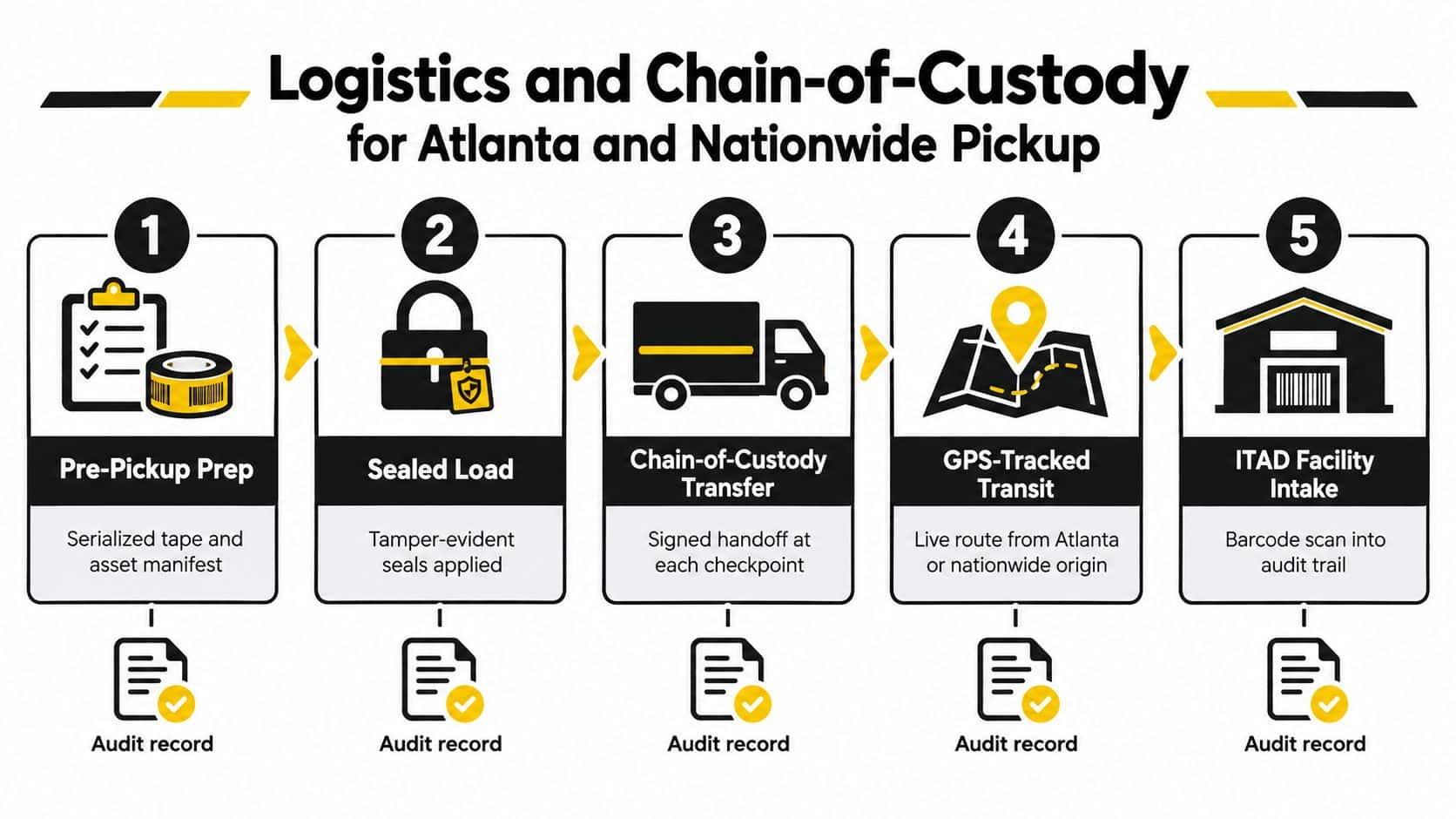
A witnessed on-site shred should produce a serial reconciliation, destruction record, and agreed visual evidence. A received-at-facility shipment should produce seal records, signed transfers, intake confirmation, weight tickets where relevant, and certificates tied to the original manifest. If the vendor can't explain which evidence belongs to which method, don't approve the statement of work.
Logistics and Chain-of-Custody for Atlanta and Nationwide Pickup
Chain of custody begins before the truck arrives. Seal serialized containers, photograph the equipment in the rack, separate loose drives into tamper-evident bags, and assign one person to release the assets. Crates and pallets should match the equipment type and protect units that may still have recovery value.
Atlanta buildings create practical constraints. A high-rise data closet may have a narrow freight-elevator window, while a campus or colocation facility may require advance driver credentials, dock reservations, and security escorts. Give the provider the access rules, pallet dimensions, staging area, and expected loading sequence before pickup day. A late truck is inconvenient. An undocumented handoff is a control failure.
Every pallet should travel with:
- Bill of Lading: Establishes the shipment and carrier terms.
- Serialized asset list: Defines exactly what the carrier is transporting.
- Signed release form: Records who surrendered custody and when.
- Carrier liability coverage: Clarifies responsibility while the load is in transit.
- Seal log: Shows whether the container remained intact between checkpoints.
For nationwide rollouts, regional teams can consolidate pallets into a single master manifest without losing origin details. Keep the originating facility, pallet identifier, seal number, and asset range attached to every transfer. A national project still needs local accountability.
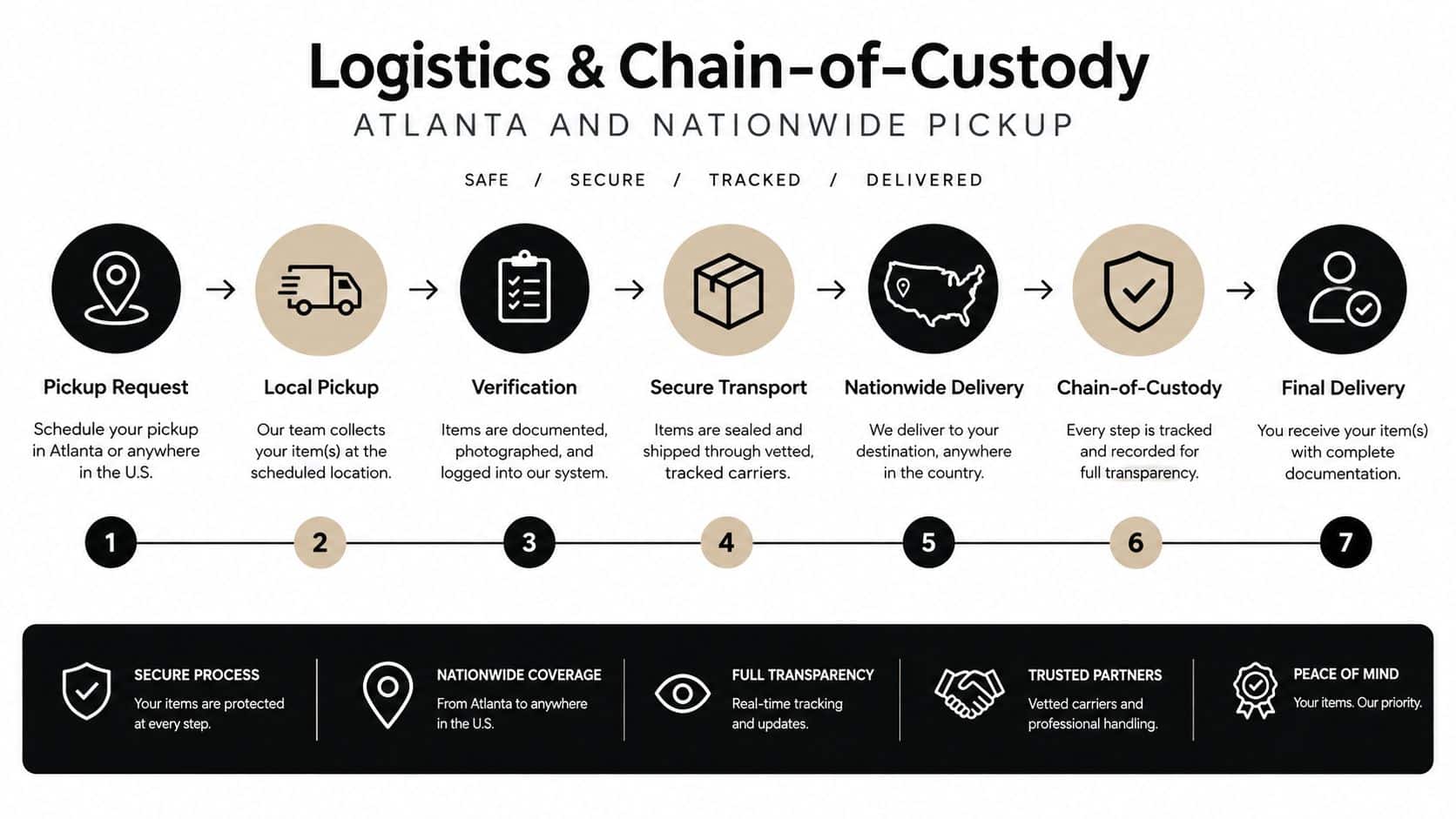
The most common breakdowns are predictable: an unsecured loading dock, a driver without a seal log, or a subcontracted carrier the customer didn't know was involved. Require disclosure of subcontractors and review the provider's chain-of-custody process for IT asset disposal before equipment is released.
Compliance Obligations That Drive Your Documentation
Compliance obligations become manageable when you translate them into records. HIPAA environments need evidence that workforce procedures, business-associate responsibilities, and media handling controls were followed. Financial institutions need vendor-risk documentation and proof that customer information was handled through reasonable safeguards. The FTC Disposal Rule applies where consumer-report information is maintained, requiring reasonable measures that prevent data from being read or reconstructed during disposal.
Georgia's e-waste restrictions add an environmental accountability layer. A server should not disappear into a general waste stream just because its data was erased. The downstream processor should identify how reusable equipment, circuit boards, metals, batteries, and other materials are managed.
| Regulation | Scope | Required Documentation |
|---|---|---|
| HIPAA | Protected health information and associated media | Serial-linked sanitization or destruction certificate, vendor agreement, and disposal procedure |
| FTC Disposal Rule | Consumer-report information used for business purposes | Evidence of reasonable disposal measures, contractor due diligence, and destruction records |
| GLBA | Customer information held by financial institutions | Written vendor-risk assessment, security controls, and disposition evidence |
| Georgia e-waste rules | Covered electronics entering disposal streams | Downstream processor records and responsible recycling documentation |
The certificate should identify the asset, media serial, method used, date, technician or responsible operator, and final disposition. A generic “100 drives destroyed” statement isn't enough for an auditor who asks about one specific drive. The Beyond Surplus compliance documentation resource reflects the practical standard buyers should expect, namely evidence that connects the asset list to the final outcome.
Audit perspective: A certificate is only as strong as the manifest behind it. Missing serials create uncertainty that a vendor's logo can't repair.
Keep the manifest, release forms, carrier records, sanitization logs, certificates, and recycling reports together. This documentation chain supports liability transfer and gives security, legal, procurement, and sustainability teams the same factual record.
Asset Recovery Versus Scrap and When Each Pays Off
Don't send every retired server directly to recycling. First decide whether it belongs in redeployment, wipe-and-resell, or scrap. The right lane depends on age, support status, configuration, demand, condition, data controls, and the total cost of handling it.
Redeployment makes sense when a unit is relatively recent, supported by the manufacturer, and compatible with an internal capacity need. It keeps the hardware useful, but only after a verified sanitization process and a technical inspection. Wipe-and-resell is appropriate when the configuration has a liquid secondary market and the expected recovery exceeds removal, testing, logistics, documentation, and settlement costs.
The value curve is steep. One recent ITAD dataset places enterprise servers at roughly 35% to 45% of original value at two years old, falling to approximately 5% to 10% at five or more years old. See the server sanitization and value study for the cited benchmark. Treat those figures as an industry dataset, not a promise for any individual lot.
Separate components before making the call
CPUs, RAM, drives, and network cards usually drive most resale value. Separate and grade those components before destruction, while maintaining the same chain of custody used for complete systems. A server with intact processors and enterprise memory may justify testing. A unit with failed power supplies, obsolete proprietary parts, or no credible resale channel may not.
Scrap is the honest choice for equipment that has little secondary demand or costs more to process than it can return. A vendor quoting a surprisingly high buyback for aged Dell PowerEdge 2950s should show the assumptions. The apparent offer may exclude deinstallation, transportation, testing, data destruction, recycling, or downstream fees.

Use a net-recovery worksheet:
- Estimate resale or parts value.
- Subtract de-racking, packing, transport, testing, sanitization, and certificate costs.
- Account for rejected assets and commodity-only material.
- Compare the net result with the risk and effort of internal handling.
The fastest route isn't always the recycling route. IT asset recovery planning helps procurement evaluate the full outcome instead of accepting a headline buyback number.
Vendor Selection Checklist for a Secure ITAD Partner
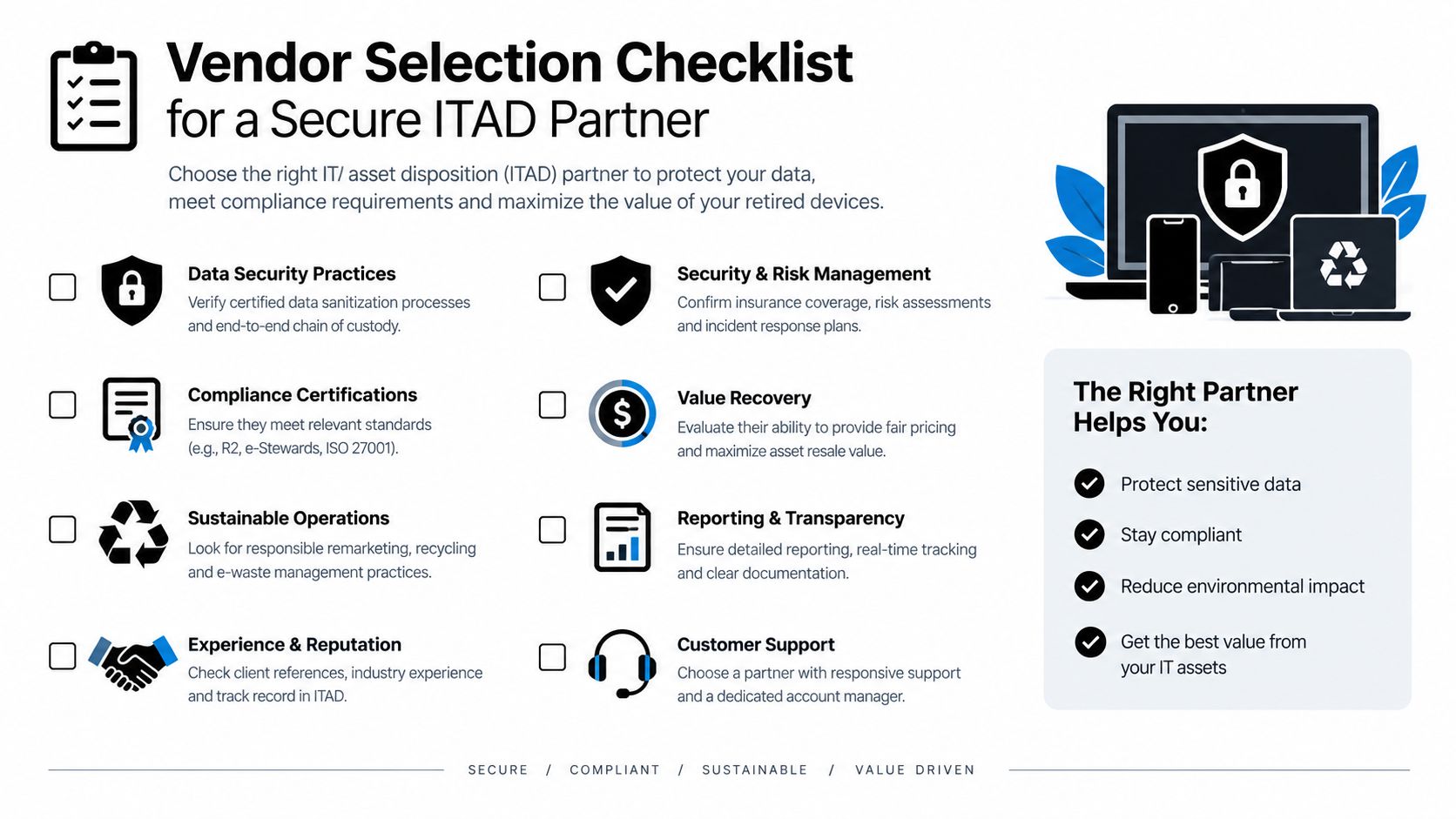
A server room is cleared, the truck leaves, and your team still lacks proof that every drive was controlled. That gap creates audit exposure and leaves liability with your company. Select an ITAD partner as you would a security vendor. A truck and shredder do not prove serialized tracking, trained staff, audited procedures, or accountable downstream processing. Evaluate price only after the provider demonstrates those controls.
Start with certifications and evidence
Use a fixed scorecard and require current evidence for each requirement:
- NAID AAA certification: Verify that an independent assessment covers the provider's physical destruction process.
- R2v3 or e-Stewards certification: Confirm controls for responsible recycling and downstream accountability.
- NIST SP 800-88 alignment: Ask which Clear, Purge, and Destroy methods apply to each media class.
- ISO 27001: Review the provider's information-security management controls.
- Serialized certificates: Request a sample Certificate of Destruction listing each drive serial number.
- Audit summaries: Ask for recent third-party audit information, not only a certification logo.
- Insurance rider: Confirm that liability coverage applies to the work being performed.
Require direct answers about metro Atlanta on-site shredding, partial pallets, missing drives in transit, and subcontractor disclosure. Ask whether the commercial model is revenue share, outright buyout, or fee-based recycling. Those choices affect the budget, documentation, and control environment.
Score the operating model
Give procurement, information security, facilities, and finance one shared scorecard. Weight sanitization evidence and chain of custody heavily. Then assess environmental processing, recovery transparency, logistics capacity, and reporting. Remove vendors that refuse serial-level reporting or send every device to an undisclosed downstream broker.
Beyond Surplus is an Atlanta-based option for server recycling, certified data destruction, IT equipment disposal, buyback, product destruction, and data-center de-installation support, with nationwide pickup available for organizations. Compare its scope with other qualified providers, and require the same documentation standard from every bidder.
Set realistic project expectations
Build the schedule around inventory, collection, processing, and final records. A four- to eight-week project window can serve as a planning range, with inventory and scoping taking one week, an on-site shredding or wipe-and-pull event occurring in one day, and processing and grading requiring seven to fourteen days. Treat these ranges as planning assumptions, not guaranteed service levels, and confirm the provider's commitments in the statement of work.
Request a written quote that separates labor, transportation, media destruction, recycling, certificates, and recovery settlement. For Atlanta projects, ask the vendor to state whether on-site and off-site destruction use different rates, what volume assumptions apply, and which services are included. Do not compare a bundled price with a per-drive price until the inclusions match.
Your final documentation package should include:
- Certificate of Destruction: Asset and drive serial, method, date, and technician.
- Certificate of Recycling: Downstream material disposition and responsible processing record.
- Sanitization logs: Per-drive results for reusable media.
- Chain-of-custody file: Seals, handoffs, carrier records, and intake confirmation.
- Recovery report: Itemized grading, values, deductions, and settlement.
- Settlement record: The agreed payment method and reconciliation.
Treat the serialized certificates, NIST-aligned sanitization records, and liability transfer language as required deliverables. Confirm the payment schedule and require an itemized value report before signing. Schedule a discovery call, then have the provider map its documentation template to your auditor's expectations.
Contact Beyond Surplus to plan Atlanta server recycling, serialized data destruction, secure chain-of-custody logistics, and asset recovery for your next decommissioning. Share your inventory and compliance requirements so the team can scope the right disposition path for redeployment, resale, or certified recycling.


