

A server room is being cleared, laptops are stacked for pickup, and a procurement deadline is approaching. Someone asks whether the drives were sanitized. The answer can't be “the files were deleted” or “the devices were factory-reset.” For a business, retiring equipment without proving what happened to its data can leave customer records, employee information, credentials, and intellectual property exposed.
Secure data destruction turns that uncertain handoff into a controlled business process. It connects technology decisions, compliance obligations, logistics, verification, and responsible electronics recycling. The right method depends on the storage medium, the sensitivity of the information, and whether the equipment will be reused or permanently retired.
Table of Contents
- Understanding Secure Data Destruction
- NIST Framework for Media Sanitization
- Methods of Secure Data Destruction
- Compliance Obligations and Regulations
- Chain of Custody and Documentation
- Choosing a Vendor and Next Steps
Understanding Secure Data Destruction
A company may decommission a file server, return leased copiers, replace employee laptops, or clear a data center floor. In each case, the visible hardware is only part of the asset. Storage media can retain information after a user deletes files, empties a recycle bin, or runs a standard reset.
Secure data destruction means rendering data unreadable and unreconstructable through a controlled sanitization or destruction process. That outcome is different from making files appear absent from an operating system. Deletion changes how the system references information. It doesn't necessarily address every physical location where data may remain.
A practical program begins by identifying every data-bearing device, including servers, hard disk drives, solid-state drives, removable media, and equipment with embedded storage. The organization then assigns a disposition objective. A reusable drive may need a validated purge method, while a defective or high-risk device may need physical destruction.
Disposal is not the same as destruction
A standard reset can be useful for ordinary device preparation, but it shouldn't automatically be treated as secure data destruction. The question isn't whether the device looks empty. The question is whether recovery is infeasible for the level of effort the organization must consider.
The United States established a major legal foundation through the Fair and Accurate Credit Transactions Act of 2003, commonly called FACTA. The Federal Trade Commission's Disposal Rule took effect on June 1, 2005, and applies to businesses and individuals that use consumer reports for a business purpose. The rule requires reasonable and appropriate disposal practices to prevent unauthorized access to information in consumer reports and related records, as explained in the FTC Disposal Rule guidance.
For physical records, the FTC identifies burning, pulverizing, and shredding as examples of methods that can make information unreadable or unreconstructable. For electronic information, the rule includes destroying or erasing files or media so data can't be read or reconstructed.
Practical rule: Treat every storage device as a controlled asset until its identity, location, method, and final disposition have been recorded.
The business decision behind the process
Secure destruction isn't only a technical chore. It affects whether equipment can retain resale value, whether a healthcare provider can demonstrate appropriate handling of electronic protected health information, and whether an IT manager can answer an auditor's question with evidence rather than an assumption.
A sound workflow separates three decisions:
- Identify the medium: Determine whether the asset contains magnetic storage, flash storage, removable media, or embedded memory.
- Classify the information: Consider personal, financial, healthcare, government, credential, and proprietary data.
- Choose the end state: Decide whether the device will be reused after sanitization or permanently removed from service.
That sequence prevents a common failure. Teams sometimes select a wiping tool first and only later discover that the storage technology or risk profile required a different method. Secure data destruction works best when the assurance level is selected before the device leaves the organization's control.

NIST Framework for Media Sanitization
NIST Special Publication 800-88 gives organizations a technical vocabulary for making defensible sanitization decisions. The original guideline was published on September 1, 2006, Revision 1 followed on December 17, 2014, and Revision 2 was published on September 26, 2025, superseding Revision 1 in the current NIST publication.
NIST defines media sanitization by the feasibility of accessing target data for a specified level of effort. That definition matters because a device can look clean while still failing to meet the organization's required assurance level.
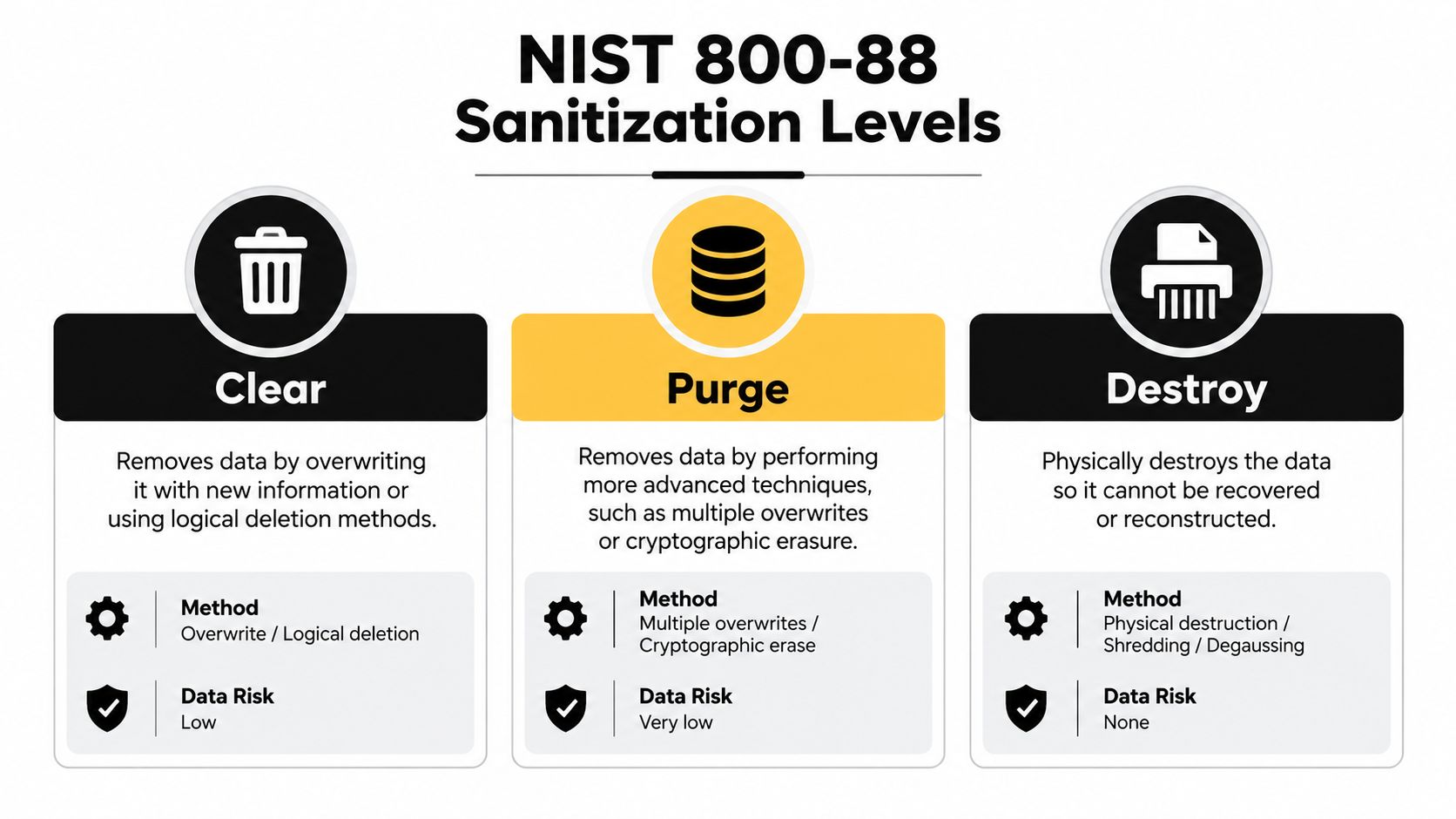
Clear
Clear uses logical techniques, such as standard read and write commands or a factory-reset function, to remove data from user-addressable storage locations. It is intended to address simple, non-invasive recovery attempts.
Clear can be appropriate when an organization understands the device architecture, controls the disposition environment, and has determined that this level of protection matches the information and threat model. It isn't a synonym for permanent destruction. The device remains available for storage and may continue into a reuse or resale workflow.
The operational risk appears when staff document “wiped” without recording what the tool did, which media it handled, or whether the process completed successfully. A generic status message provides less assurance than a device-specific record tied to a serial number.
Purge
Purge uses physical or logical techniques that make recovery infeasible even with state-of-the-art laboratory methods, while potentially preserving the medium for reuse. A device-supported sanitize command, an appropriate cryptographic erase process, or another validated technique may support this outcome when the technology and implementation allow reliable verification.
Purge is often the important middle ground in IT asset disposition. It can protect sensitive information without automatically destroying equipment that still has residual value. The method must match the storage technology, however. A process that works for one type of drive shouldn't be applied indiscriminately to another.
Destroy
Destroy makes recovery infeasible while also preventing the media from being reused for storage. Physical destruction may be the appropriate choice for failed devices, damaged media, storage that can't be verified, or information requiring the strongest finality.
The trade-off is straightforward. Destruction offers a clear end state, but it eliminates the possibility of reuse and can reduce recovery value. NIST's distinction helps decision-makers avoid both extremes, treating every device as disposable or treating every logical wipe as sufficient. Organizations can review NIST 800-88 data destruction standards when building procedures and vendor requirements.
Match the method to the asset
Before processing equipment, document the target outcome, media type, data sensitivity, disposition objective, and verification approach. NIST also emphasizes tracking, documenting, and verifying sanitization or destruction actions, along with periodic testing of equipment and procedures. A defensible record should show more than the word “complete.”
Methods of Secure Data Destruction
No single method fits every device. The right choice balances data assurance, device technology, reuse potential, verification, and environmental handling.
Logical sanitization
Software-based erasure can support reuse when the tool and process are appropriate for the device. It can be efficient for functioning equipment, preserve residual asset value, and create a machine-readable result for each processed serial number.
The limitation is scope. A logical operation must address the actual storage architecture, not merely the locations visible to the operating system. Encrypted devices require particular care because encryption alone doesn't make a drive automatically safe for disposal. The organization must understand how encryption was configured and how the keys will be sanitized.
Solid-state storage deserves separate treatment. Conventional overwriting isn't universally dependable for SSDs because controllers use wear leveling and may retain data in physical flash locations that ordinary host-level writes can't directly address. A single-pass overwrite may change logical blocks while inaccessible, overprovisioned, or remapped blocks remain outside the overwrite path, as described in NIST material on SSD media sanitization.
Device-supported purge methods
Manufacturer-supported sanitize or block-erase commands may provide a better fit for certain SSDs and other modern storage devices. The process still needs reliable completion evidence. If the command fails, the device doesn't respond, or verification can't establish the intended outcome, the asset should move to a destruction decision rather than being marked safe by assumption.
Cryptographic erase also has conditions. NIST's current guidance explains that it depends on the encryption architecture and secure key handling. For federal use, the guidance addresses validated cryptographic modules, protection against plaintext storage before encryption keys were established, a required algorithm security strength, and permanent sanitization of relevant encryption or master-derivation keys, as detailed in the NIST cryptographic sanitization FAQ.
Degaussing and physical destruction
Degaussing exposes suitable magnetic media to a strong magnetic field. It can be useful for certain magnetic storage applications, but it isn't a universal answer for flash storage, and it generally prevents normal reuse of the treated media. The vendor should identify which media types the equipment supports and provide evidence that the process was completed.
Shredding, pulverizing, disintegration, and related physical techniques create a permanent end state. They work well when a drive is defective, when verification isn't possible, or when the organization has selected Destroy rather than Clear or Purge. The trade-off is that the storage device can't return to service, so physical destruction should be deliberate rather than a substitute for asset classification.
A strong workflow may therefore look like this:
- Reusable magnetic drive: Apply a validated method, verify the result, and retain the device for controlled reuse.
- Modern SSD: Use a supported sanitize or cryptographic process when it can be verified. Otherwise escalate it to physical destruction.
- Failed or damaged device: Don't rely on a failed wipe. Isolate and destroy the media.
- High-assurance asset: Select a method that matches the information sensitivity and document the final outcome.
Businesses can compare collection, processing, and verification requirements through commercial data destruction services.
Compliance Obligations and Regulations
A compliance-ready process starts with defined authorization rules, asset identification procedures, data classifications, and evidence-retention requirements. Assign responsibility before equipment leaves the site, and document which roles may approve disposition. Use a compliance documentation framework to align those requirements with the records your program must retain.
The FTC Disposal Rule applies particularly to organizations that use consumer reports for business purposes. Its accountability expectations remain relevant when a third party performs the destruction. The FTC identifies due diligence measures such as reviewing independent audits, checking references, requiring recognized certification, and assessing a provider's information-security policies. Those checks should be completed before collection, then supported by records showing how the provider handled the assets.
NIST media-sanitization guidance gives teams a practical basis for selecting and documenting Clear, Purge, or Destroy outcomes. The method must match the media and the risk. SSDs deserve specific scrutiny because a conventional overwrite may not address all storage locations, including areas managed by the device controller. A process that cannot be verified should be escalated rather than accepted on the strength of a vendor's general statement.
Healthcare requirements
Healthcare organizations need procedures for the final disposition of electronic protected health information and the equipment or media that stores it. The scope should include computers, servers, removable storage, and any other hardware that may contain electronic PHI.
A healthcare team should be able to show:
- Which assets contained or could have contained electronic PHI.
- Whether each medium was cleared, purged, or destroyed.
- Who handled the equipment during every transfer.
- How the organization verified the result.
- Which records support the final disposition.
The HHS guidance on disposing electronic protected health information identifies clearing, purging, and destruction as acceptable categories for electronic media. Its examples include software or hardware overwriting, degaussing or exposure to a strong magnetic field, and physical methods such as disintegration, pulverization, melting, incineration, or shredding.
Finance, government, and state obligations
Financial institutions, public agencies, schools, and enterprises should map internal controls to applicable laws, contracts, and sector requirements. Obligations vary by organization and jurisdiction, so a generic vendor compliance statement does not replace legal or security review.
State privacy and breach-notification rules can affect disposal decisions. Written procedures should define escalation for encrypted drives, failed devices, missing serial numbers, inaccessible systems, and mixed asset lots. Without those rules, staff may make undocumented decisions at the loading dock.
Chain of Custody and Documentation
A destruction process is only as defensible as its asset trail. If a team can't reconcile the drive collected from a server room with the drive recorded as destroyed, the physical method alone doesn't resolve the accountability gap.
Chain of custody starts before pickup. The originating organization should create an inventory, record serial numbers where available, identify the data-bearing components, and define the approved disposition. The logistics partner then records transfers, transport, receipt, processing, verification, and final disposition.
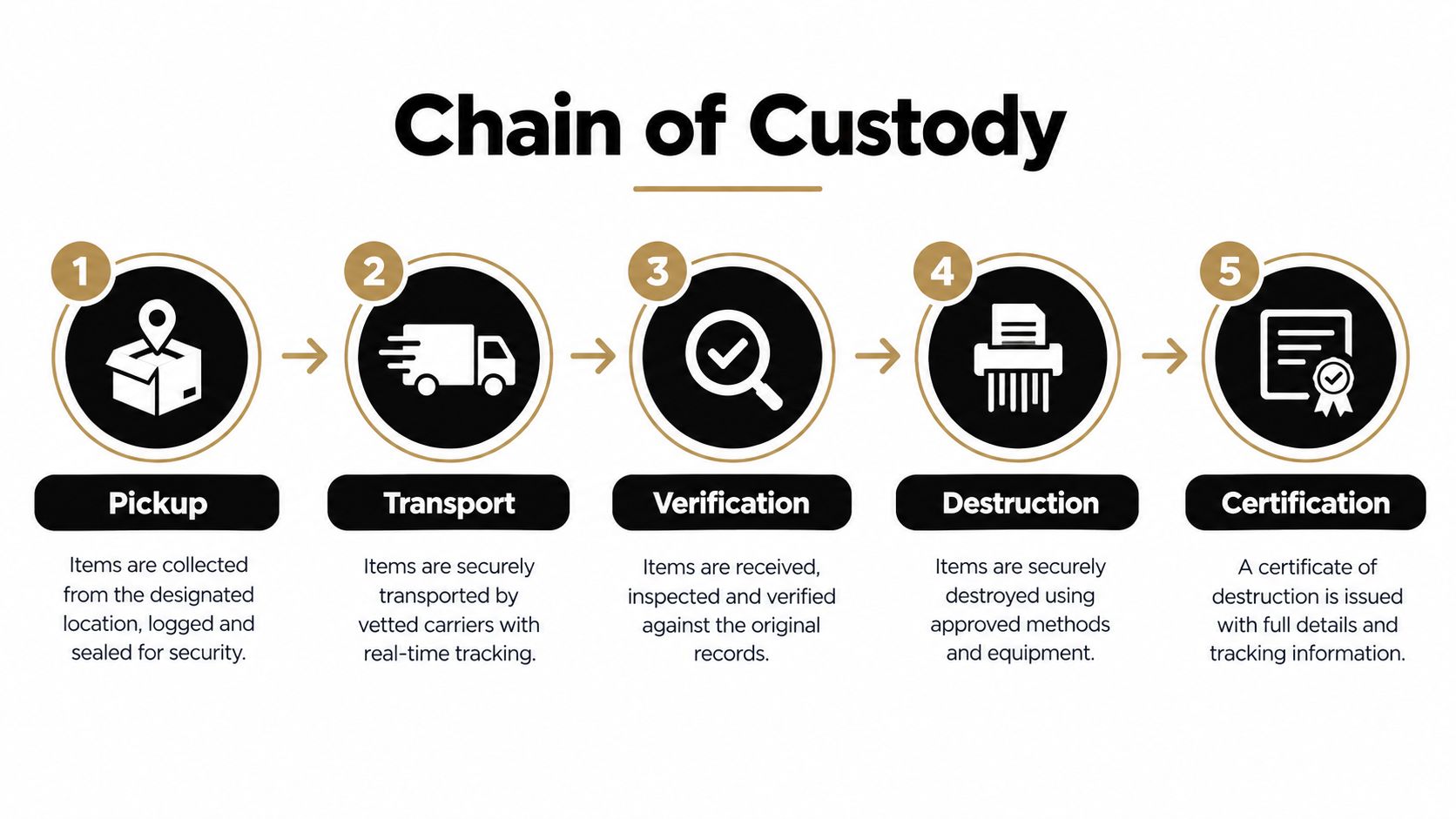
What the record should prove
A certificate of destruction shouldn't merely say that a batch was processed. It should connect the outcome to the equipment and the procedure used. Useful fields include:
- Asset identity: Device serial number, asset tag, manufacturer, model, and media type.
- Processing detail: Clear, Purge, or Destroy outcome, plus the specific technique or equipment used.
- Event record: Operator, processing date, location, and receiving or transfer details.
- Verification result: Confirmation that the intended procedure completed and passed its validation step.
- Exception status: Failed, damaged, unresponsive, unidentified, or otherwise diverted assets.
The chain-of-custody process should also reconcile quantities at each stage. A shipment count, receiving count, processed count, and exception count should tell the same story.
Why certificates aren't the whole control
A certificate is an important final record, but it can't repair an undocumented handoff that occurred earlier. Procurement and security teams should review sample records, escalation procedures, access controls, and reporting formats before awarding the work.
The FTC's due diligence principle supports this approach. Organizations remain responsible for selecting and overseeing providers, so vendor review should include the provider's procedures and evidence, not just a promise that equipment will be recycled.
Choosing a Vendor and Next Steps
Vendor selection should begin with the assets and the required outcome. Ask prospective providers how they distinguish hard disk drives from SSDs, how they handle failed wipes, whether they offer on-site or off-site processing, and what information appears on the final certificate.
A practical evaluation includes these questions:
- Method control: Can the provider explain when it uses Clear, Purge, or Destroy?
- Technology awareness: Does the workflow account for wear leveling, remapped storage, embedded media, and damaged devices?
- Verification: Will the provider supply command logs, test results, or other evidence appropriate to the selected method?
- Inventory discipline: Are serial numbers reconciled from pickup through final disposition?
- Physical security: Are assets secured during collection, transport, staging, and processing?
- Environmental handling: After sanitization or destruction, are remaining materials sent through responsible electronics recycling channels?
- Operational fit: Can the provider coordinate data center decommissioning, equipment removal, transportation, and scheduled pickups?
On-site or off-site processing
On-site destruction gives the client direct visibility and can reduce concerns about transport for especially sensitive assets. It may require suitable access, staging space, safety controls, and scheduling around active operations.
Off-site processing can support larger or mixed equipment volumes when the provider has controlled facilities, serialized intake, secure storage, and auditable processing. The important issue isn't the label. It is whether the chain of custody and verification remain intact during every transfer.
Cost should be evaluated by the full workflow rather than by a single per-drive figure. Collection conditions, access requirements, sorting, asset inventory, on-site labor, transportation, sanitization method, physical destruction, reporting, recycling, and potential asset recovery can all affect the project scope. A low processing price may not include the documentation or exception handling an audit requires.

Build the project around evidence
Before scheduling pickup, prepare the asset list, identify restricted areas, separate devices awaiting decisions, and name the person responsible for approving exceptions. Tell the provider whether equipment may contain healthcare, financial, government, credential, or proprietary information.
A provider such as this ITAD company can be evaluated on its ability to coordinate secure data destruction with equipment disposal, recycling, logistics, and documentation. The same review should apply to any prospective partner.
The final checkpoint is reconciliation. Compare the original inventory with the provider's receipt, destruction or sanitization report, exception list, and certificates. Retain those records with the relevant security or compliance documentation, and investigate every unexplained gap before closing the project.
Beyond Surplus provides secure data destruction, certified data wiping, hard-drive shredding, electronics recycling, IT equipment disposal, and chain-of-custody documentation for business technology assets. Visit Beyond Surplus to discuss a controlled pickup, verified disposition method, and documentation package for your next ITAD project.


