

A room full of retired laptops, servers, monitors, and networking equipment can look like a housekeeping problem. For an Atlanta IT manager, it's a chain-of-custody, data-security, environmental, and value-recovery decision. Atlanta electronics recycling pickup for businesses should transfer more than equipment. It should transfer control through documented custody, verified sanitization, and final disposition records that still make sense during an audit years later.
The difference between a truck receipt and a defensible IT asset disposition record is significant. A weight ticket may show that equipment left your facility. It won't prove which serial-numbered drive was sanitized, which laptop was refurbished, or where a failed server was processed.
Table of Contents
- Preparing for Atlanta Electronics Recycling Pickup
- Assessing Scope and Inventorying Assets
- Evaluating Data Destruction Options
- Staging Equipment and Coordinating Logistics
- Securing Compliance and Chain of Custody
- Maximizing Value Through Certified Recycling
Preparing for Atlanta Electronics Recycling Pickup
An IT manager in an Atlanta office may face a familiar scene: decommissioned servers stacked beside a conference room, laptops waiting for a hardware refresh decision, and monitors occupying valuable storage space. Facilities wants the room cleared. Procurement wants any recoverable value captured. Security wants assurance that no data leaves the building in readable form.
Calling for a pickup without resolving those questions creates avoidable exposure. Informal removal can lead to undocumented resale, landfill disposal, export, or processing by a downstream vendor your team has never reviewed. The United Nations e-waste assessment recorded 62 million metric tonnes of global electronic waste in 2022, while only 22.3%, approximately 13.8 million tonnes, was documented as formally collected and properly recycled. That gap explains why collection volume alone isn't an environmental outcome.

Treat disposition as a controlled project
Before scheduling an Atlanta electronics recycling pickup, identify the business objective:
- Secure retirement: Determine which equipment contains storage media or embedded memory.
- Reuse and recovery: Separate functional assets that may retain resale or redeployment value.
- Material recycling: Identify equipment that cannot be economically repaired or reused.
- Evidence retention: Define which reports, certificates, manifests, and custody records your organization must retain.
The EPA's electronics stewardship guidance identifies reuse as a preferred strategy when equipment remains functional. Recycling is appropriate when repair, donation, or reuse isn't viable. That distinction matters because sending every device directly to destruction can eliminate recoverable value, while reselling devices without documented sanitization can create unacceptable data risk.
A practical preparation file should include the pickup address, responsible site contact, equipment categories, access restrictions, loading requirements, requested disposition paths, and internal approval status. For larger projects, add a target date for inventory reconciliation and the name of the person authorized to sign the custody handoff.
For additional preparation guidance, review how to prepare computers for recycling before equipment is staged.
Assessing Scope and Inventorying Assets
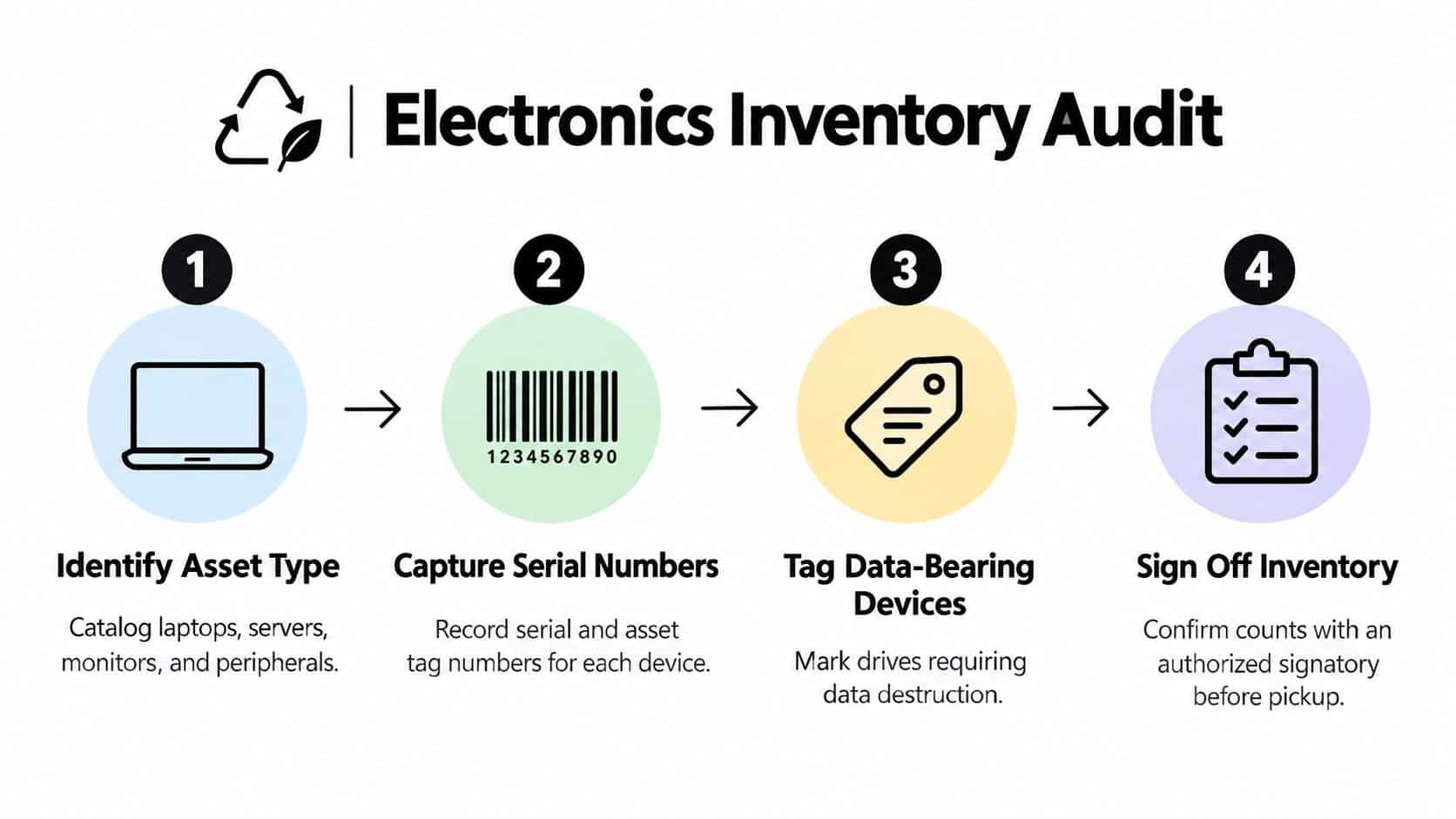
A recycler can't value, sanitize, or reconcile an undefined pile. Start with a physical audit that turns each item into a controlled record. The inventory should cover laptops, desktops, servers, storage arrays, switches, routers, copiers, monitors, medical equipment, laboratory equipment, mobile devices, removable media, and peripherals.
Build the asset record at the device level
Use a spreadsheet, asset-management export, barcode scanner, or approved ITAD portal. Each line should identify one physical asset, not a pallet or category. Capture:
- Asset identity: Manufacturer, model, serial number, internal asset tag, and device type.
- Storage details: Drive serial number where available, storage technology, and whether the device contains removable media.
- Condition: Working, incomplete, damaged, obsolete, or awaiting testing.
- Disposition path: Reuse, resale, certified wiping, cryptographic erasure, physical destruction, or material recycling.
- Location and custodian: Room, department, site contact, and the employee or technician releasing the equipment.
Serial numbers are the bridge between the physical device and the final certificate. If a manifest says “twenty laptops,” it can't prove what happened to a specific laptop later. If it identifies each laptop and its storage media, your team can reconcile pickup, processing, resale, and destruction records.
Separate value decisions from security decisions
A working laptop may have resale potential, but that doesn't make resale the default. First classify the data and determine whether sanitization can meet the required risk threshold. Then assess cosmetic condition, battery health, missing components, age, and marketability.
A failed server may have little resale value but still contain multiple drives. A copier may include embedded storage that isn't obvious during a quick visual inspection. Network appliances, laboratory instruments, and medical equipment can also contain memory, configuration data, user credentials, or local records.
Use equipment condition assessment to support consistent grading and valuation. The goal isn't to inflate a buyback estimate. It's to give the recycler enough accurate information to quote the work, identify exceptions, and keep recoverable hardware from being mixed with material destined for destruction.
Inventory rule: If a device or drive can't be uniquely identified at pickup, it can't be cleanly reconciled at final disposition.
Before the crew arrives, have an authorized employee review the count and sign the inventory. Flag unreadable labels, missing serial numbers, loose drives, and equipment that must remain segregated. Those exceptions should appear in the final report, not disappear inside a generic load description.
Evaluating Data Destruction Options
Data destruction isn't a single button labeled “recycle.” The appropriate method depends on the media type, data sensitivity, device condition, reuse decision, and ability to verify the result.
NIST defines three primary sanitization actions. Clear uses logical techniques to remove data while preserving the device for reuse. Purge uses physical or logical methods intended to make recovery significantly more difficult. Destroy renders recovery infeasible while making the media unusable for storage. NIST's media sanitization guidance provides the framework for selecting and documenting these outcomes.
Match the method to the medium
Magnetic hard drives, SSDs, NVMe devices, phones, removable flash storage, and embedded-memory equipment don't respond identically to the same process. An overwrite approach that may be suitable for a magnetic disk isn't automatically equivalent for flash-based media because of controller behavior and reserved storage areas.
For an SSD or NVMe device containing sensitive information, a program may select cryptographic erasure, an appropriate purge method, or physical destruction. A failed drive that can't complete a reliable operation should move into quarantine, not into a resale batch. Physical destruction may be preferable when the media is damaged, the data sensitivity is high, or the organization can't validate logical sanitization.
The NIST sanitization FAQ connects sanitization choices to information sensitivity and notes that high-powered degaussing is intended for magnetic media. It also identifies more destructive approaches for other media, including solid-state drives.
Compare on-site and off-site processing
On-site destruction offers direct visibility and can reduce the time sensitive media remains in transit. It's useful for high-risk projects, urgent data-center decommissioning, or organizations that require destruction before equipment leaves a controlled area. The trade-off is that on-site work may require specialized equipment, a suitable secure workspace, and careful documentation at the point of service.
Off-site processing can provide controlled facility operations, testing, refurbishment, and material separation at scale. It requires stronger transport controls and a precise custody record. A sealed container isn't enough by itself. The manifest, named custodians, transfer timestamps, scan events, exception notes, and final certificate must connect the pickup to the specific assets.
For every drive or device, require a workflow that:
- Inventories and uniquely identifies the media.
- Classifies sensitivity and selects Clear, Purge, Cryptographic Erase, or Destroy.
- Records the operator, date, method, tool or version, asset identifier, and disposition.
- Verifies completion without errors.
- Independently validates effectiveness before issuing a certificate.
NIST distinguishes verification, checking the immediate operational result, from validation, making the formal decision that residual confidentiality risk is acceptable. A success screen alone isn't independent validation. For detailed support, review data destruction services.
Staging Equipment and Coordinating Logistics
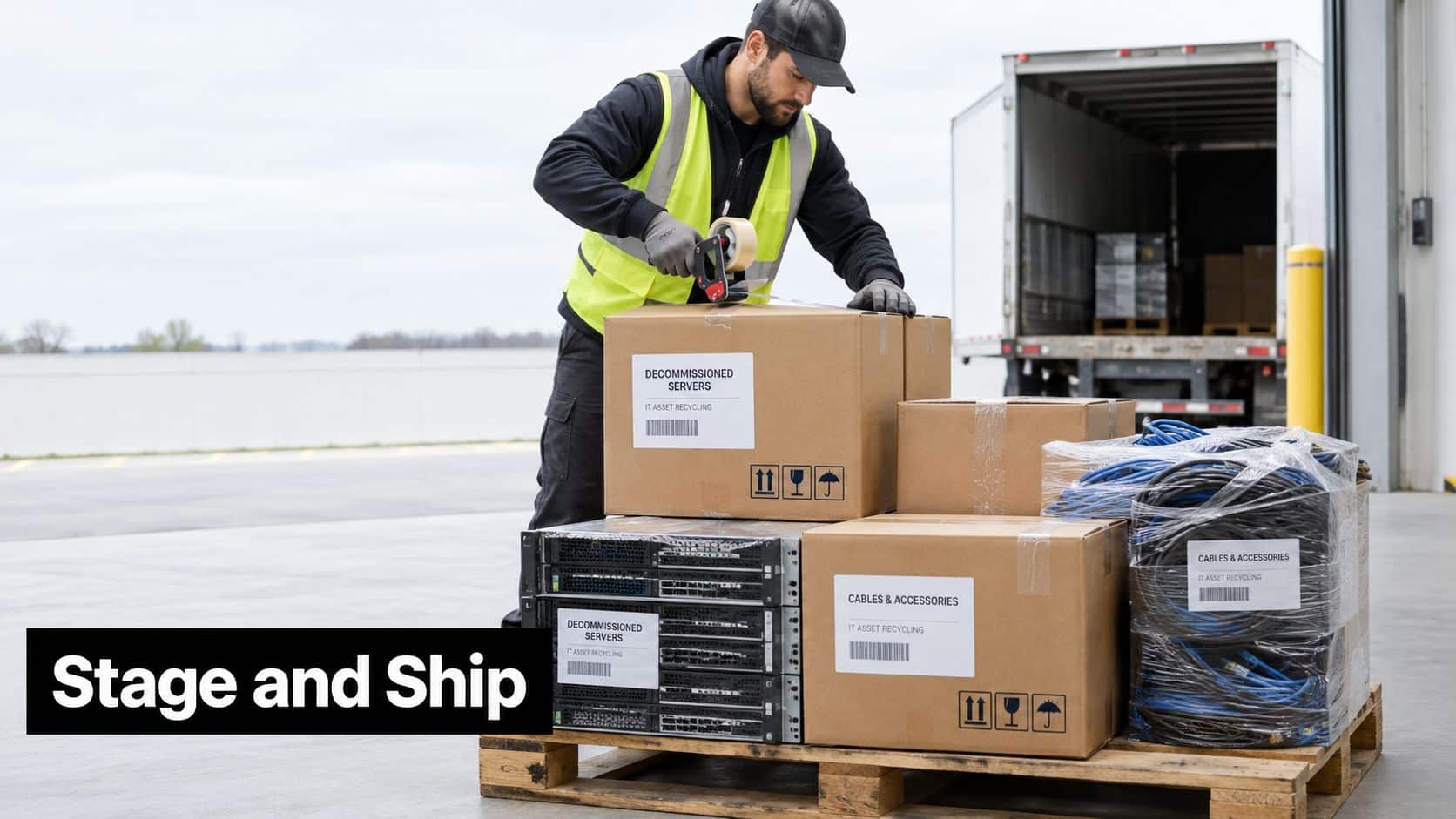
A secure process can still fail operationally if equipment arrives loose, mislabeled, or mixed across disposition categories. Staging should protect the hardware, preserve the inventory, and make the handoff easy for both the site team and the pickup crew.
Start by separating data-bearing devices from non-storage equipment. Keep laptops, desktops, servers, drives, phones, copiers, and network appliances in clearly identified groups. Don't place loose drives inside boxes labeled only “miscellaneous electronics.” That label destroys the connection between the media and the asset record.
Prepare the site for a controlled handoff
Use pallets, carts, gaylords, or approved containers that can support the equipment without exposing screens, drive bays, or circuit boards to unnecessary damage. Remove loose cables only when doing so won't compromise identification. Bag unusual components and attach the related asset or container reference.
Use tamper-evident seals for containers holding storage media or high-sensitivity devices. Record seal identifiers on the handoff document. If a seal is broken, missing, or unreadable, the exception should be reported and investigated before processing continues.
A practical staging checklist includes:
- Access planning: Reserve loading access, elevators, dock space, and security escort requirements.
- Equipment protection: Use stable pallets, edge protection, stretch wrap, and labels that remain legible during transport.
- Disposition segregation: Keep resale candidates, destruction-required media, and general recycling in separate marked areas.
- Custody readiness: Have the serialized manifest, signatory, container count, and seal records available before loading.
- Exception control: Photograph or document assets with missing labels, unreadable serials, or unexpected contents.
Coordinate the pickup window
Share building rules, parking limitations, loading instructions, insurance requirements, and contact details before the truck arrives. A data-center project may also require de-installation coordination, power-down confirmation, rack access, cable removal, and a sequence that protects live infrastructure.
Don't let the driver infer which equipment is authorized for removal. The site representative should identify the approved inventory and confirm the count before the vehicle departs. The signed document should record the actual handoff, including exceptions, rather than just confirming that a vehicle was present.
For broader office cleanout planning, use the office cleanout and electronics recycling guide.
Securing Compliance and Chain of Custody
A certificate is only as useful as the records behind it. A document stating that “electronics were recycled” may establish that a vendor accepted material, but it doesn't necessarily establish that a particular drive was sanitized, destroyed, or transferred through an approved downstream processor.
The FTC Disposal Rule applies to organizations and individuals that use consumer reports for a business purpose, including employers, lenders, insurers, government agencies, landlords, and service providers handling information for covered organizations. The FTC's disposal guidance requires disposal practices that are reasonable and appropriate to prevent unauthorized access or use. Electronic files and media must be destroyed or erased so the information can't be read or reconstructed, and organizations may conduct due diligence when selecting a contractor.
Define what the certificate must prove
A defensible certificate package should reconcile the original manifest to final disposition. Require:
- Asset identifiers: Device type, manufacturer, model, serial number, and internal asset tag.
- Media identifiers: Drive serial number or another unique identifier when the device contains storage.
- Sanitization evidence: Clear, Purge, Cryptographic Erase, or Destroy result, with the method and relevant tool or equipment details.
- Personnel records: Responsible technician, operator, reviewer, date, and processing location.
- Custody history: Pickup site, named custodians, transport events, facility receipt, and downstream transfers.
- Final disposition: Reuse, resale, recycling, destruction, or another approved outcome.
- Exceptions: Missing serial numbers, failed validation, damaged media, and assets placed in quarantine.
A failed validation should trigger a repeat using another technique or escalation to a more secure method. Sampling can support quality control when full media verification isn't practical, but it must be meaningful. NIST guidance describes pseudorandom inspection locations across addressable space, including reserved areas where applicable. A written acceptance test should document the sample design, independent operator or tool, results, and treatment of failed samples.
Prepare for multi-state and sector requirements
An Atlanta pickup may not remain in Atlanta. Equipment can cross state lines, pass through multiple processors, or enter a resale channel. Recent compliance guidance identifies 25 states plus Washington, D.C., with electronics-recycling laws and 32 states with data-disposal statutes in a multi-state ITAD compliance field guide. A nationwide program therefore needs consistent records, not just local familiarity.
Healthcare, financial, government, and data-center teams should align the disposition workflow with their own privacy, retention, contractual, and sector controls. Chain-of-custody documentation for IT asset disposal should show where liability and physical control changed hands. It can't erase every legal obligation, but it gives auditors and compliance teams evidence to evaluate.
Documentation test: If your team can't trace one serial-numbered drive from pickup through its final outcome, the certificate package has a gap.
Maximizing Value Through Certified Recycling
Certified recycling is a value-recovery strategy, not merely a disposal charge. Functional laptops, servers, networking equipment, and monitors may retain value after an internal refresh, while non-reusable equipment can enter responsible material recovery. The financial result depends on condition, demand, testing, data treatment, logistics, and the quality of the inventory.
That makes accurate asset records commercially important. A recycler can't make a credible buyback assessment from an uncounted pallet. A complete manifest supports valuation, identifies equipment suitable for reuse, and separates assets that require destruction from those that can move into refurbishment.
The environmental case also depends on documented outcomes. The global assessment cited earlier estimated that improperly managed e-waste represented about US$62 billion in recoverable natural-resource value. A business program should therefore measure more than the amount collected. It should track reuse, recycling, destruction, downstream processing, and exceptions.
Look for a partner that can provide:
- Asset recovery reporting: Clear identification of equipment returned for value, refurbished, or sold.
- Certified recycling records: Documentation tied to the equipment received and its final processing path.
- Data destruction evidence: Asset-level certificates that don't rely on a generic truck weight.
- Operational coordination: Pickup, transportation, de-installation, and reporting handled as one controlled project.
- Responsible downstream processing: Visibility into processors used for material recovery and specialized equipment.
R2-certified electronics recycling options in Atlanta can help procurement teams evaluate environmental controls alongside security and recovery requirements. The right comparison isn't the lowest pickup quote. It's the total value of recovered assets, reduced internal handling, defensible documentation, and lower risk after the equipment leaves your facility.
Beyond Surplus provides Atlanta business pickups, secure data wiping, on- or off-site hard-drive shredding, IT equipment disposal, asset recovery, and documented electronics recycling for organizations managing office, healthcare, financial, government, and data-center equipment. Visit Beyond Surplus to request a pickup and discuss a serialized, chain-of-custody disposition plan for your retired technology.


