A branch manager in Atlanta has a loaner laptop waiting for collection after a financial analyst receives a replacement device. The laptop appears wiped, the asset tag is recorded, and a pickup receipt is ready. Yet the device is only one part of the disposition decision. Backups, snapshots, cached files, removable media, vendor access, and legal holds may still preserve the same information elsewhere.
That's why financial services ITAD in Atlanta must combine secure electronics recycling with verified data destruction, documented logistics, and complete vendor offboarding. A defensible program protects information, supports audits, and preserves recoverable value without treating every device as ordinary e-waste.
Table of Contents
- Understanding the Hidden Risks of IT Disposal
- Navigating Compliance and Data Breach Costs
- Choosing the Right Data Sanitization Method
- Establishing a Verifiable Chain of Custody
- Addressing the Hidden Risks of Vendor Offboarding
- How to Select a Certified Atlanta ITAD Vendor
- Next Steps for Secure and Sustainable IT Disposal
Understanding the Hidden Risks of IT Disposal
IT asset disposition often starts as a facilities task. A branch replaces laptops, a data center retires storage equipment, or procurement clears a staging room. In a financial institution, each action also affects data governance, evidence, and access control.
A device can appear ready for retirement while still holding locally cached documents, authentication tokens, downloaded reports, or remnants of customer work. A logical wipe may suit one laptop, but only after the organization confirms its storage technology, classifies the information, and verifies the result. The same review must identify equipment that cannot be reliably sanitized, including damaged drives and failed RAID members.
The operational failure usually happens before the recycler receives the equipment. Staff may leave an unprocessed laptop in an open closet, combine a retired server with ordinary electronics, or send equipment to a third party without recording its serial number. Once custody becomes unclear, the organization cannot easily prove which assets were handled, which method was used, or whether every data-bearing component was included.
Practical rule: Treat every retired storage device as a data-bearing asset until a documented sanitization or destruction decision is complete.
Why the risk continues after pickup
A certificate for one shredded drive does not prove that a cloud replica was deleted. It does not show whether a contractor retained a backup, whether a loaner device remained in circulation, or whether a service account still grants access to a shared repository. Physical disposition and digital deprovisioning must operate as one control, covering the vendor relationship as well as the hardware.
Financial institutions should connect each asset to:
- An accountable owner: Record the business unit, data owner, location, and person authorizing disposition.
- A media profile: Identify hard drives, SSDs, NVMe devices, removable media, RAID members, and other storage components.
- A retention decision: Check backup locations, snapshots, legal holds, and contractual retention requirements before destruction.
- A disposition outcome: Document reuse, resale, recycling, purge, or physical destruction.
- Evidence: Retain custody records, operator details, verification results, certificates, and exception records.
The data security risks of improper computer disposal show why disposal belongs inside the security program, rather than at the edge of the recycling process.
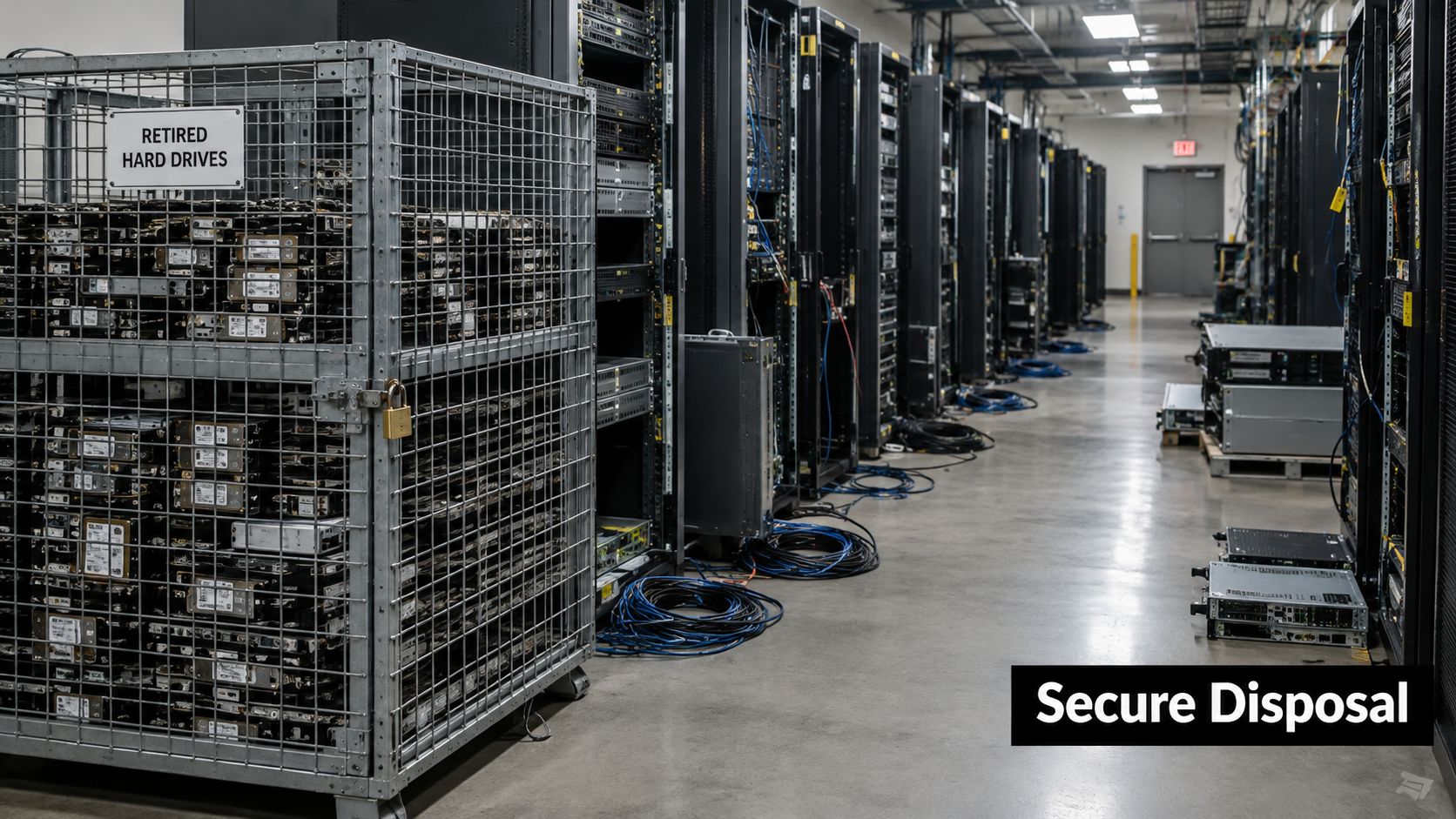
The environmental obligation is also material. The global e-waste stream reached 62 million metric tonnes in 2022, while only 22.3%, approximately 13.8 million tonnes, was documented as formally collected and recycled, according to the UNITAR and ITU e-waste findings. Secure ITAD therefore has two responsibilities: prevent unauthorized information access and direct equipment into controlled reuse or recycling channels.
Navigating Compliance and Data Breach Costs
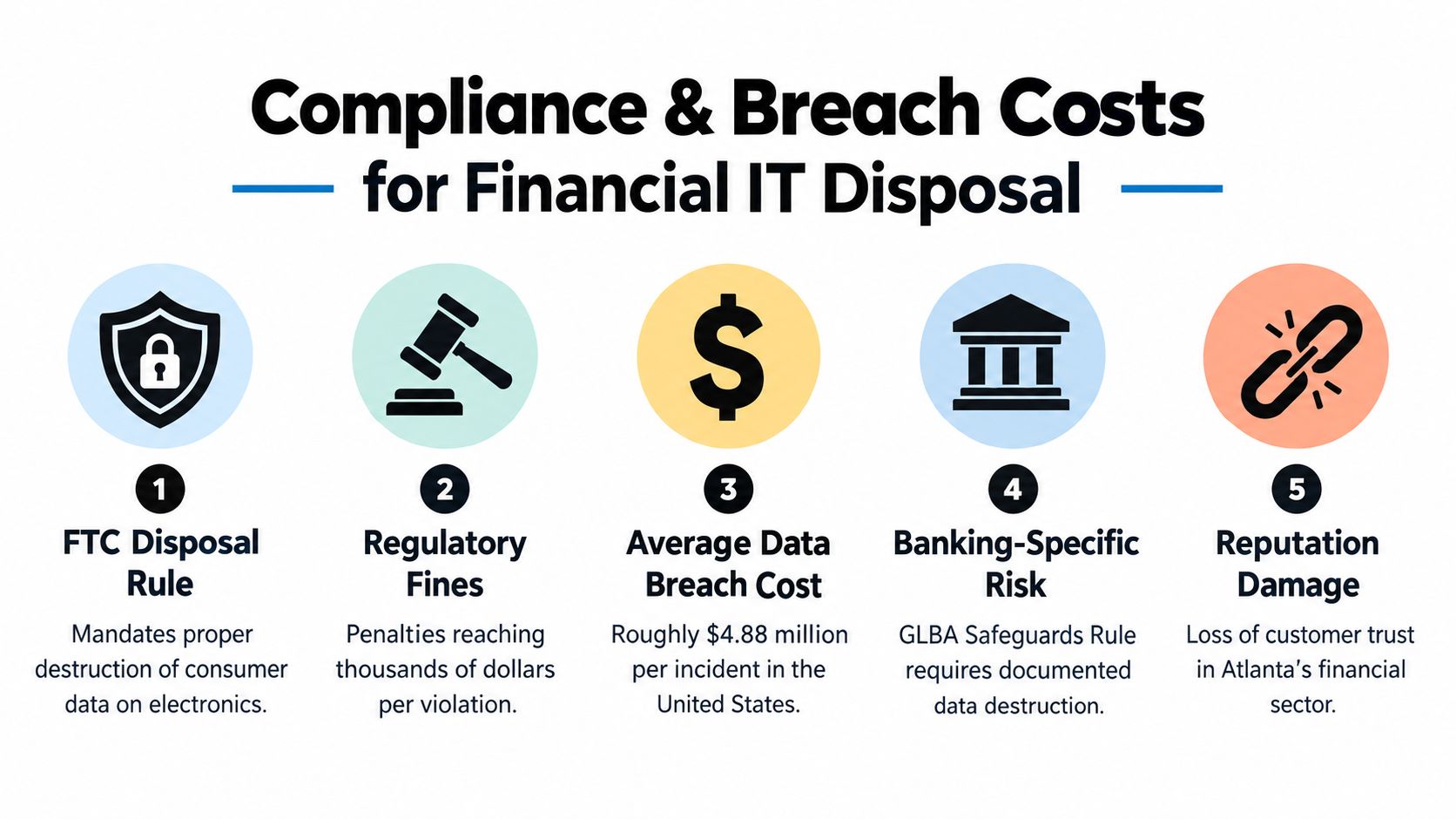
The FTC Disposal Rule gives financial organizations a direct reason to control the retirement of electronics. It covers businesses and other organizations that use consumer reports for business purposes, including lenders, insurers, employers, and service providers. The rule requires reasonable measures to prevent unauthorized access to or use of consumer-report information during disposal, including information stored on electronic media and computer equipment.
For a financial institution, that means selling or transferring a laptop, server, backup device, or hard drive is a data-governance event. Electronic files or media must be erased or destroyed so information can't be read or reconstructed. The FTC explanation of disposal requirements also makes clear that disposal includes equipment transferred or sold while consumer information remains stored on it.
The financial exposure extends beyond regulatory scrutiny. IBM's 2025 research examined 600 organizations studied from March 2024 through February 2025 and reported a global average breach cost of US$4.44 million. The same report placed the United States average at US$10.22 million, with healthcare averaging US$7.42 million. Those figures come from IBM's 2025 Cost of a Data Breach executive summary.
What auditors need to see
A policy statement isn't enough. Auditors typically need evidence that the organization applied the policy consistently across branches, offices, data centers, remote workers, and third-party logistics movements.
A defensible record should show:
- Asset identity: The serial number or other identifier ties the device to the inventory record.
- Custody history: Each handoff includes the releasing party, receiving party, date, location, and authorization.
- Technical action: The record identifies the sanitization or destruction method and the operator or system used.
- Verification: The organization records whether the selected method completed successfully.
- Final outcome: The asset is assigned to reuse, resale, recycling, or destruction, with supporting documentation.
Incident response should also include clear escalation and testing procedures. Teams looking to formalize those controls can review escalation and testing procedures as a practical reference for connecting an ITAD exception to the wider response process.
Financial institutions shouldn't argue that secure disposal is merely an environmental expense. The stronger business case connects data loss prevention, FTC compliance, audit readiness, environmental recovery, and liability reduction in one lifecycle control. Guidance on FINRA-compliant IT asset disposal can help IT and compliance teams align disposition records with financial-services expectations.
Choosing the Right Data Sanitization Method
NIST does not treat every deletion method as equivalent. It defines media sanitization as rendering access to data infeasible for a specified level of effort and separates the outcomes into Clear, Purge, and Destroy.
The selection depends on the data, the storage technology, the device condition, and whether the organization intends to reuse the equipment. A wipe that works for a supported desktop drive may not provide the same assurance for an encrypted SSD, NVMe device, self-encrypting drive, removable medium, or failed RAID member.
NIST Media Sanitization Methods
| Method | Definition | Best For |
|---|---|---|
| Clear | Uses logical techniques, such as supported read/write commands or a factory reset, to protect against simple non-invasive recovery. | Routine reuse when the device and method support reliable logical sanitization. |
| Purge | Uses physical or logical techniques intended to make recovery infeasible with state-of-the-art laboratory methods while potentially preserving the medium. | Higher-assurance sanitization when verified reuse remains appropriate. |
| Destroy | Makes recovery infeasible and leaves the medium unable to store data. | Failed, damaged, unsupported, or highly sensitive media where verification or reuse isn't acceptable. |
NIST states that purge should be used instead of clear when possible because purge provides stronger protection while potentially preserving the storage medium for reuse. Its guidance also distinguishes physical media from logical or virtual storage, which requires a different treatment. The NIST SP 800-88 guidance provides the technical foundation for this decision.
Match the method to the asset
For a functioning laptop scheduled for approved reuse, an organization may select a supported logical or device-level method after confirming that it addresses the relevant storage architecture. A modern SSD can require a different command path from a traditional hard disk because controller behavior, overprovisioning, and flash translation can affect what a conventional overwrite reaches.
A damaged drive creates a different problem. If the controller won't respond, the device can't complete verification, or the organization can't establish that every storage component was addressed, physical destruction becomes the lower-risk endpoint. The resulting material should then move through controlled recycling with a documented chain of custody.
Certificates should identify the asset or serial number, date, sanitization method, and disposition outcome. A certificate alone isn't a substitute for a defensible technical process. IT managers can use this NIST 800-88 data destruction guide for Atlanta to structure decisions around media type, confidentiality, reuse plans, and verification.
Establishing a Verifiable Chain of Custody
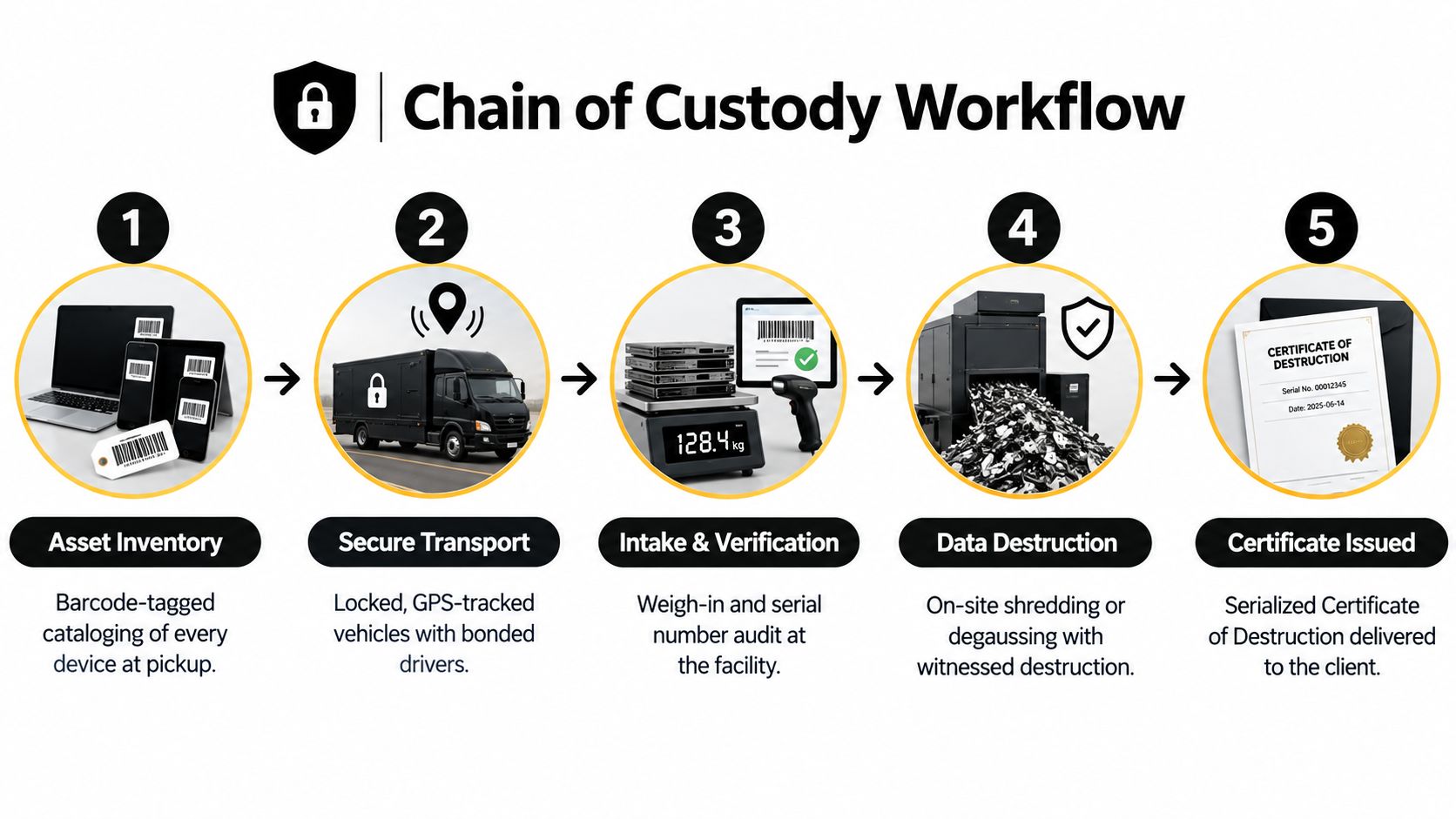
A certificate of destruction is only as credible as the records created before it. The process starts when a department identifies equipment for retirement and ends when the organization receives evidence of sanitization, destruction, resale, or recycling. That record should follow the asset, its storage media, and any exception through each stage.
Staging sets the baseline. Separate data-bearing assets from ordinary peripherals, limit access to the holding area, and reconcile equipment against the authorized pickup list. Photograph or scan labels where appropriate, record missing accessories or visible damage, and flag any item that requires an exception decision.
Five controls that preserve accountability
- Authorize the release. A named employee confirms the asset list, business owner, destination, and approved disposition path.
- Secure the load. Use controlled pickup procedures, restricted staging, sealed containers or loads where appropriate, and documented transport handoffs.
- Reconcile at intake. The receiving facility compares serial numbers and quantities with the pickup record, then logs discrepancies before processing.
- Process exceptions separately. Failed drives, unidentified media, damaged equipment, and assets subject to a hold must stay out of routine resale or recycling.
- Close the record. Issue method-specific destruction or sanitization evidence, then connect recycling or resale documentation to the original asset record.
Transport documentation should identify the person or carrier that accepted the load, the protection used during transit, and the facility's intake reconciliation. Those details resolve disputes that a pickup receipt cannot.
The chain of custody for IT asset disposal should distinguish the asset from its media. A server may contain multiple drives, a storage array may contain removable members, and a laptop may include internal and removable storage. Auditors need evidence that each component was tracked, not only the outer chassis. This same inventory discipline also helps reveal devices that sit outside the expected retirement batch, including loaners or equipment assigned to a former service provider.
A clean inventory at pickup, a verified intake, and an exception process are more valuable than a polished certificate issued at the end.
Addressing the Hidden Risks of Vendor Offboarding
Returning equipment to a vendor doesn't automatically return control of the data. A contractor may have copied files into a project workspace, retained a backup, stored a snapshot, cached information on a loaner device, or maintained service credentials after the contract ended.
Many ITAD programs become too narrow here. The physical drive receives attention because it can be counted and shredded. The digital copies remain harder to see, especially in hybrid environments that combine local infrastructure, cloud platforms, shared services, and third-party applications.
The offboarding review
A financial institution should require the service owner and vendor manager to review the entire information lifecycle before approving final destruction.
- Returned data: Identify what the vendor must return, in what format, and to which data owner.
- Backups and snapshots: Locate copies in backup platforms, cloud storage, disaster recovery environments, and shared repositories.
- Cached datasets: Check laptops, loaner devices, removable media, local exports, and temporary workspaces.
- Access paths: Revoke accounts, tokens, service accounts, shared-resource permissions, and administrative access.
- Retention status: Confirm what can be destroyed and what must remain under a legal, regulatory, or contractual hold.
- Evidence package: Obtain destruction certification and preserve records showing residual-copy review and access removal.
The New York Department of Financial Services advises covered entities to obtain destruction certification, verify deletion of residual copies, revoke third-party access, and preserve information subject to litigation or regulatory holds. Its guidance on managing third-party risk also supports treating contract termination as a control point rather than an administrative closeout.
FINRA identifies procedures for returning or destroying firm data when a third-party contract ends as an effective practice. That principle applies whether the provider managed a branch technology refresh, hosted a platform, supplied loaner hardware, or operated a data-processing service.
The certificate proves what happened to identified media. It doesn't prove that unidentified copies never existed.
The practical record should link each asset serial number to a data owner, retention decision, backup location, destruction method, certificate, and final access review. That connection exposes omissions before an auditor or incident investigator does.
How to Select a Certified Atlanta ITAD Vendor
Vendor due diligence should start with process evidence, not marketing language. Ask to see how the provider identifies assets, controls access, handles failed media, documents subcontractors, verifies downstream processors, and separates resale from recycling.
A financial-services provider should be able to explain the difference between logical sanitization, higher-assurance purge, and physical destruction. It should also show how operators record device identifiers, method selection, verification results, and final disposition. If the answer is only “we issue a certificate,” the control is incomplete.

Questions worth asking during procurement
- Security controls: How are data-bearing assets isolated, tracked, and protected at pickup, in transit, at intake, and before processing?
- Technical capability: Can the provider handle hard drives, SSDs, NVMe media, self-encrypting drives, RAID members, removable media, and failed devices?
- Evidence quality: Do certificates identify the asset, method, date, outcome, and responsible operator or facility?
- Downstream oversight: Which parties receive equipment after processing, and how does the provider verify responsible reuse or recycling?
- Exception handling: What happens when an asset is missing, unrecognized, damaged, encrypted, or subject to a hold?
- Insurance and accountability: Does the contract define responsibility, incident notification, transport controls, and evidence retention?
- Local logistics: Can the provider support Atlanta branch pickups, secure staging, data center de-installations, and on-site or off-site destruction?
Local capability can reduce unnecessary handoffs, but proximity alone isn't a security control. The provider still needs documented transport, controlled facilities, trained personnel, and a clear escalation path. Financial institutions also benefit from aligning ITAD ownership with the people who understand local technology operations. Organizations building those teams can browse Atlanta fintech staffing experts while separately evaluating their disposition partner.
For a practical procurement framework, use this guide on how to choose an ITAD vendor in Georgia. Beyond Surplus is one Atlanta-area option that provides secure data wiping, physical hard-drive shredding, electronics recycling, IT equipment disposal, buyback, product destruction, and data center de-installation services, with certificates for relevant destruction and recycling activities.
Next Steps for Secure and Sustainable IT Disposal
Start by sampling recent disposals. Compare the asset inventory, media classification, custody history, sanitization evidence, residual-copy review, and final recycling record. Improve the weakest handoff first, then formalize the workflow across branches, remote workers, vendors, and data centers.
Accurate labeling supports that control. An asset-management reference such as the Evright Industrial asset labelling guide can help facilities and IT teams connect physical identifiers to accountable records. The result is a program that protects data while directing reusable equipment and recoverable materials into controlled channels.
Beyond Surplus provides Atlanta-area secure electronics recycling and IT asset disposition for financial institutions, including data wiping, hard-drive shredding, equipment pickup, data center de-installation, and certificates of destruction and recycling. Review your current chain of custody and vendor offboarding process, then visit Beyond Surplus to discuss a documented disposition workflow for your retired technology.