

You've just approved a data-center refresh. The replacement racks are arriving, the old servers are being disconnected, and someone has asked for a recycling pickup. That request sounds simple until you count the storage media, assign data-handling decisions, confirm transport controls, preserve asset value, and prepare records that can withstand an audit.
Secure server recycling is not a single disposal event. It's a controlled IT asset disposition process that connects data sanitization, chain of custody, reuse, material recovery, and documented final outcomes. The strongest programs don't stop at “the equipment left the building.” They prove what was wiped, what was destroyed, what was reused, what was recycled, and where the remaining materials went.
Table of Contents
- Why Secure Server Recycling Matters Now
- Pre-Decommission Inventory and Media Classification
- Data Destruction Options, Wiping, Purging, and Physical Destruction
- Chain of Custody and Certificate Documentation
- Logistics, Asset Recovery, and Environmental Disposal Streams
- How to Choose a Certified ITAD Partner
- Putting It All Together, A Server Recycling Playbook
Why Secure Server Recycling Matters Now
A server retirement often starts with a maintenance window and ends with a loading dock handoff. In between, a rack may contain operating-system volumes, database storage, backup media, spare drives, and equipment that still has resale or redeployment value. If the team treats the entire rack as scrap, it can destroy recoverable value. If it treats the pickup as routine logistics, it can lose control of sensitive data.
The European Union's WEEE framework established producer-responsibility and separate-collection principles for electrical and electronic equipment. The recast directive entered into force on 13 August 2012 and formalized requirements for collection, treatment, recovery, recycling, and preparation for reuse across equipment categories that include servers. Its collection target began at 45% in 2016 and increased to 65% from 2019, or an alternative benchmark equivalent to 85% of WEEE generated. The EU WEEE policy summary shows why controlled channels and documented processing matter.

A loose process creates three risks at once:
- Compliance risk: A missing drive or generic certificate can leave unanswered questions about sensitive records.
- Financial risk: Functional servers, memory, processors, and storage components may be routed to destruction without a reuse assessment.
- Reputational risk: A vendor's undocumented downstream practices become your problem when an auditor, customer, or regulator asks where equipment went.
Practical rule: Treat every decommission as an asset-control project first and a recycling project second.
The EU's reported figures reinforce the operational challenge. Equipment placed on the EU market rose from 7.6 million tonnes in 2012 to 14.4 million tonnes in 2022, while the 2022 WEEE collection rate was 40.1%, below the 65% target. These figures cover all WEEE, not servers alone, but the Eurostat WEEE statistics establish a useful benchmark: rising equipment volumes don't automatically produce equivalent recovery rates.
For enterprise teams, the answer is a documented workflow. Beyond the environmental case for reducing the impact of retired technology, controlled server recycling protects information, preserves value, and creates evidence of responsible disposition.
Pre-Decommission Inventory and Media Classification
Start before anyone pulls a power cable. Build an asset register that links each server, chassis, drive, tape, and removable component to an owner, location, sensitivity classification, and planned disposition. The register should remain useful after the equipment leaves the facility, so capture identifiers that can be reconciled against certificates later.
Build the register before the move
Record at least:
- Asset identity: Manufacturer, model, serial number, service tag, rack position, and ownership.
- Storage configuration: Drive type, capacity, serial number, controller arrangement, removable media, and spare units.
- Data context: Business system, tenant, application owner, classification, encryption status, and retention requirements.
- Disposition path: Redeploy, remarket, parts recovery, material recycling, or destruction.
- Control status: Sanitization method, verifier, exception, transfer date, and receiving location.
A pre-decommission scan can expose drives that aren't visible in the original purchase record. RAID configurations, hot spares, boot media, and components stored in nearby cabinets are common sources of reconciliation gaps. Teams that want a broader organizing framework can also review how to organise IT assets before building the project register.
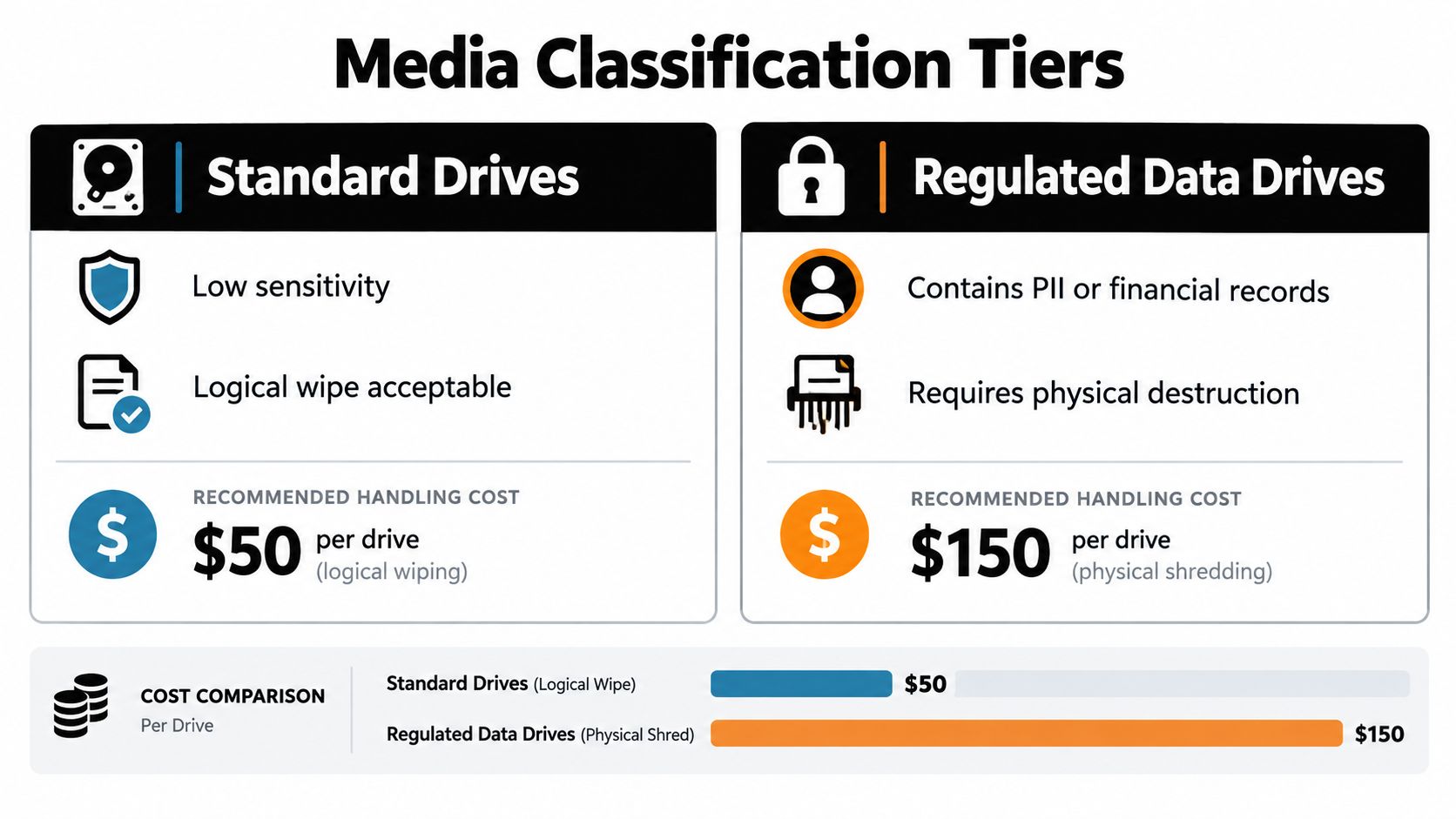
Classification should drive the sanitization decision, not the other way around. NIST distinguishes Clear, Purge, and Destroy. Clear uses logical techniques to protect against basic, non-invasive recovery. Purge aims to make recovery infeasible using state-of-the-art laboratory techniques while potentially preserving the medium. Destroy makes the media unusable as storage.
| Outcome | Definition | Typical Use Case |
|---|---|---|
| Clear | Logical techniques protect against basic recovery attempts. | Lower-sensitivity media with an approved logical sanitization method. |
| Purge | Logical or physical methods make advanced recovery infeasible while reuse may remain possible. | Supported drives headed for redeployment or remarketing. |
| Destroy | The storage medium can no longer function for future data storage. | Defective, inaccessible, classified, or high-risk media. |
Avoid planning errors
File deletion, reformatting, and removal of file pointers don't establish that underlying data is unrecoverable. A factory reset may remove access paths while leaving recoverable content behind. Encryption can support cryptographic erasure, but only when the organization can trust the encryption implementation and key-management history.
Assign an owner for every exception. If a drive can't be identified, accessed, or verified, route it to the more conservative disposition and record why. Use the server disposal checklist for IT managers as a practical control point before equipment moves.
Data Destruction Options, Wiping, Purging, and Physical Destruction
A decommissioned server may contain working drives, failed media, or storage that cannot be trusted outside the facility. The destruction decision should therefore protect the data while preserving value where the technical evidence supports reuse. Treat the outcome as a documented choice, not a default setting in a recycling workflow.
Match the method to the risk
Clear fits media where policy and the threat model permit protection against basic, non-invasive recovery. It can suit lower-risk equipment, but it does not automatically meet the requirements for sensitive enterprise data.
Purge supports reuse when the drive and sanitization method are compatible. Manufacturer-supported secure erase, approved cryptographic erase, and other validated techniques can make recovery infeasible with state-of-the-art laboratory methods while preserving the medium. Confirm that the process covers the entire device, including reserved and remapped areas.
Destroy applies when a medium is defective, inaccessible, unsupported, classified, or outside an acceptable trust boundary. Shredding or another approved physical process eliminates future storage functionality. That improves finality but removes resale and redeployment value.
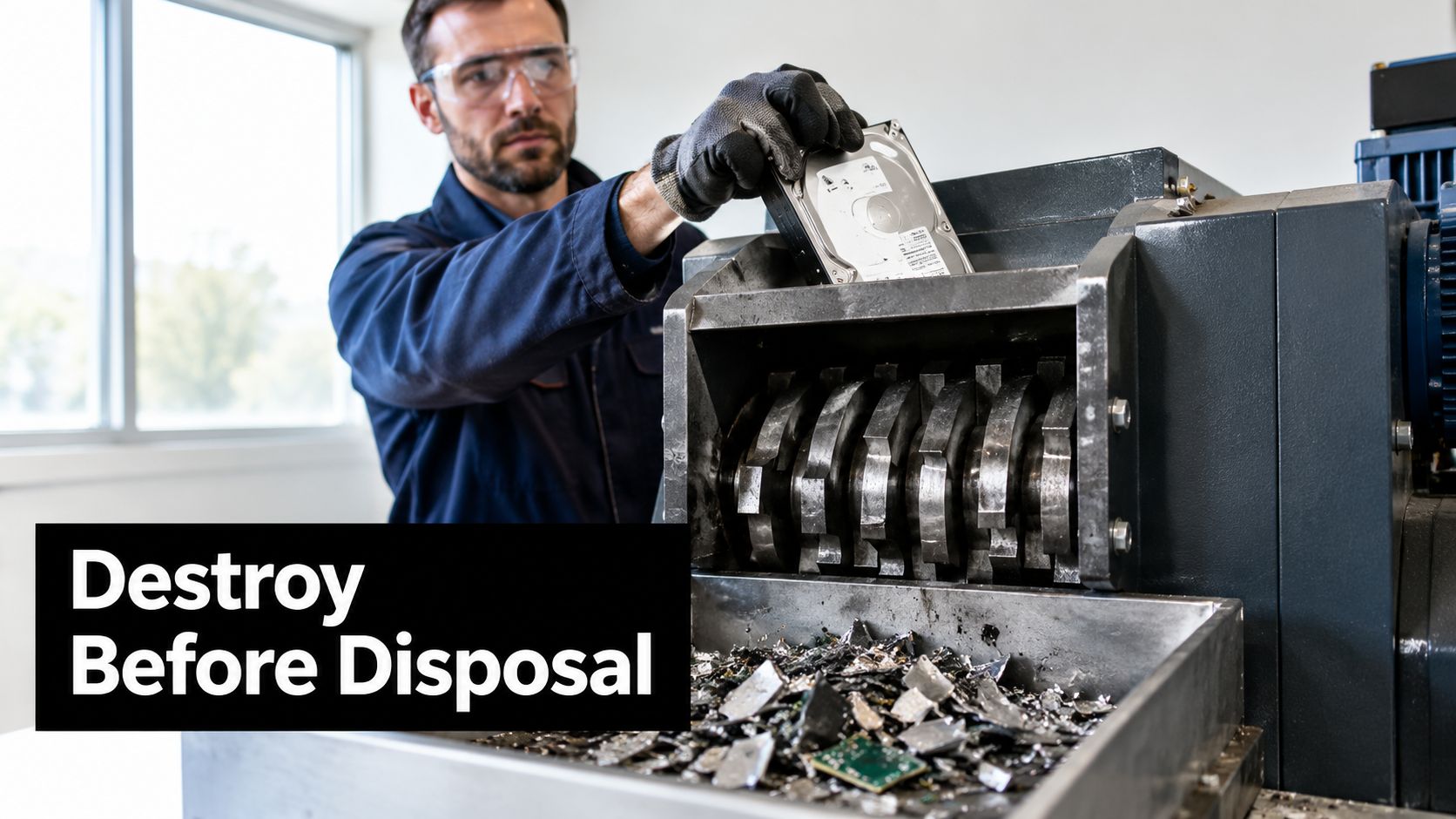
The NIST SP 800-88 guidance provides the foundation for matching sanitization outcomes to media and risk. See NIST 800-88 data destruction standards explained for how Clear, Purge, and Destroy apply to different storage media.
SSDs and complex arrays require particular care. A tool can report success while data remains in hidden, reserved, or remapped regions. Full verification is preferred. If that is impractical, sample pseudorandom locations across user-addressable and reserved areas. NIST recommends, where possible, that personnel who did not perform the sanitization conduct the sampling. The NIST verification FAQ explains the quality-control purpose of that separation.
Use a decision record
For each medium, record the selected outcome, technical method, tool result, failures, retries, exceptions, verification approach, verifier, date, and final disposition. Disposition should identify reuse, resale, parts recovery, recycling, or destruction.
A defensible record links the method to the media and risk, then shows how the result was checked. A certificate that only says equipment was processed is a receipt, not audit evidence. It cannot prove which storage device was treated or whether reuse was justified.
Chain of Custody and Certificate Documentation
A certificate matters only when it reconciles to the physical asset. A generic statement that “all equipment was recycled” won't answer which drive was sanitized, who verified it, when custody changed, or what happened after processing.
Track every transfer
Use a handoff record at each control point. The shipping manifest should match the inventory register, container seals should be recorded, and the receiving party should acknowledge the asset count and condition. For multi-site or multi-tenant projects, separate manifests can prevent one client's media from being mixed with another's.
The final package should connect four records:
- Asset register: Identifier, owner, location, and original classification.
- Sanitization record: Method, tool result, verifier, date, and exception.
- Custody record: Pickup, transport, receipt, staging, and downstream transfer.
- Disposition record: Reuse, resale, component recovery, recycling, or destruction.
| Document Element | Purpose | Common Gaps |
|---|---|---|
| Device identifier | Ties the record to a physical asset. | Batch descriptions without serial numbers. |
| Sanitization method | Shows why the selected control was appropriate. | “Wiped” with no method or media type. |
| Verification result | Demonstrates quality control. | Tool success accepted without independent checking. |
| Custody timeline | Establishes control during movement. | Missing handoff dates, names, or seal details. |
| Final disposition | Proves the outcome beyond pickup. | “Recycled” without reuse, material, or residual detail. |
Measure the outcome, not just the pickup
A serious ITAD partner should report mass balance by asset category, the share reused versus materially recycled, residual waste, downstream processor location, recovered materials, and the calculation behind any diversion claim. Microsoft reported a 90.9% reuse-and-recycling rate in 2024 in the cited roadmap material, but that figure alone doesn't show how much was reused, how much was materially recycled, or how results varied by facility and hardware type. The Sustainable Data Centers Roadmap material illustrates why organizations should request the underlying categories rather than rely on one headline percentage.
Use chain-of-custody documentation to define the evidence package before the first pickup. That makes missing fields a project failure to correct, not a paperwork surprise after the assets have disappeared.
Logistics, Asset Recovery, and Environmental Disposal Streams
Good server recycling separates secure movement from value assessment without losing control of either. The crew should know which equipment can move toward reuse, which media must remain segregated, and which components require specialized environmental handling.
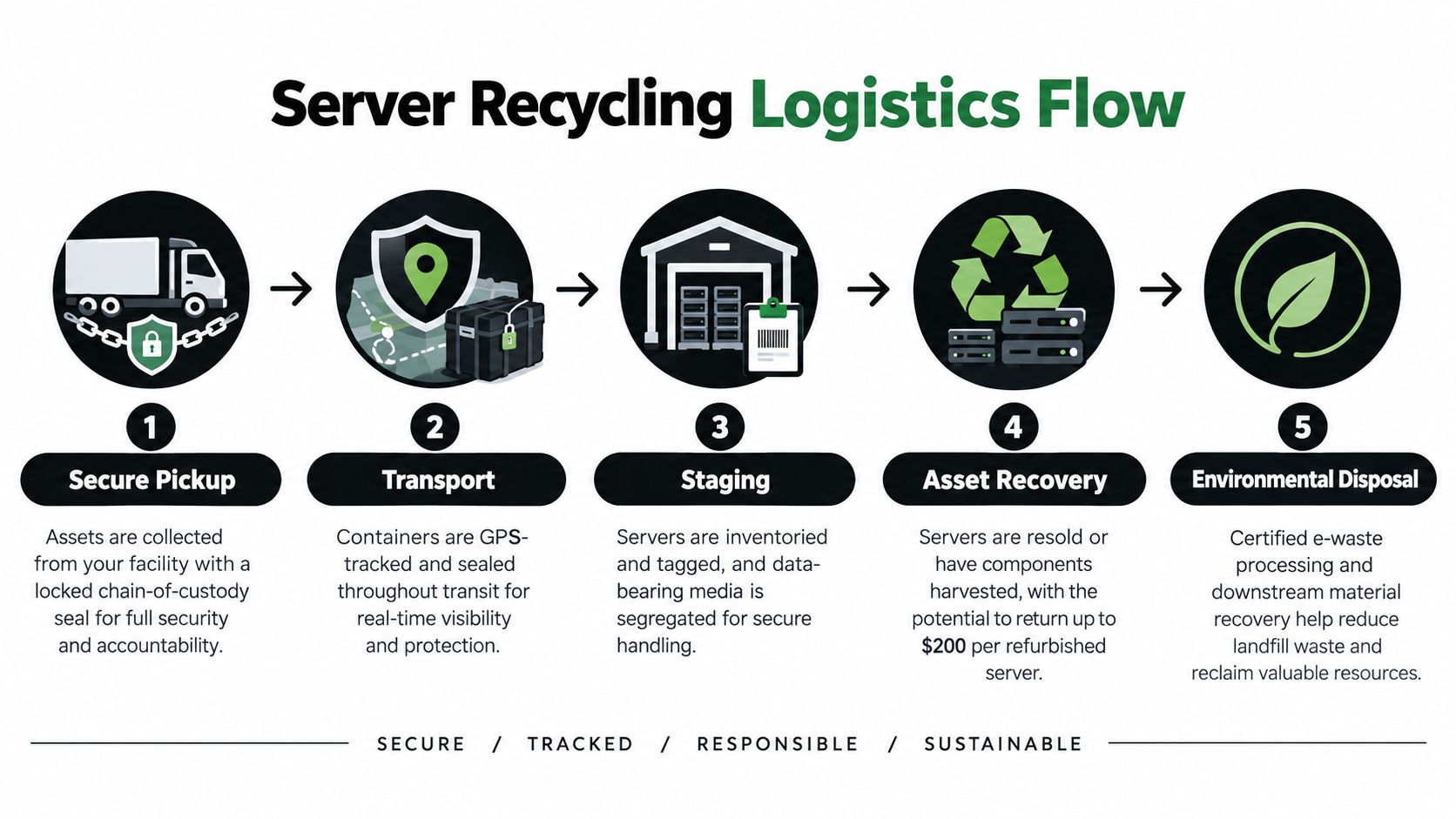
A workable flow looks like this:
- Secure pickup: Confirm the manifest, seal containers, and record custody at the loading point.
- Transport: Use sealed, controlled loads and document the transfer to the receiving facility.
- Staging: Tag assets, separate data-bearing media, and preserve the inventory relationship.
- Asset recovery: Test eligible servers, harvest components where appropriate, and record the route selected.
- Environmental disposal: Send non-reusable equipment to qualified processing streams and retain downstream evidence.
Decide reuse before shredding
Reuse generally preserves more embedded value than immediate material recycling, but it's only preferable when security and reliability controls hold. A server with supported hardware, verifiable sanitization, known configuration, and a suitable redeployment path may deserve testing or remarketing. A failed drive, inaccessible encrypted device, or asset with uncertain custody may not.
Microsoft describes a circular-center model in which some decommissioned equipment moves toward internal reuse, external electronic supply chains, or technician-training programs, while data-bearing components that can't be reused or recycled are shredded in accordance with privacy requirements. Its circular data-center infographic supports a practical choice architecture: retain value when controls are reliable, and destroy media when residual risk is unacceptable.
The environmental case extends beyond landfill diversion. Research cited in that same source projects that expanding U.S. AI-server deployment could add 24 to 44 million metric tons of annual carbon emissions and consume 731 to 1,125 million cubic meters of water between 2024 and 2030. The source estimates that best practices could reduce those footprints by 73% and 86%, respectively. These are projections, not current universal outcomes, but they show why extending useful hardware life and recovering components can support climate strategy.
Keep batteries, lamps, and other regulated components in the right stream. EPA's universal-waste program under 40 CFR Part 273 covers batteries, pesticides, mercury-containing equipment, lamps, and aerosol containers. Damaged or leaking batteries require closed, compatible containers, while lamps must be packaged to minimize breakage. The EPA universal-waste requirements explain the handling controls that apply to those categories.
For businesses seeking a combined path for pickup, recovery, and processing, IT asset recovery services can be evaluated alongside the organization's security and reporting requirements.
How to Choose a Certified ITAD Partner
The cheapest pickup quote often excludes the controls that make the project defensible. Evaluate an ITAD partner against the complete lifecycle, not the truck arrival.
Compare the evidence, not the brochure
Ask prospective providers to show how they handle:
- Certification status: Request current certification details and verify them with the issuing organization.
- Sanitization coverage: Confirm support for HDDs, SSDs, self-encrypting drives, tapes, failed media, and legacy formats.
- Verification practice: Ask whether every operation is checked, when sampling is used, and who performs the verification.
- Downstream transparency: Require named processing locations or qualified downstream facilities where policy permits disclosure.
- Asset reconciliation: Confirm that every serial number appears in the final report, including exceptions.
- Outcome reporting: Request separate totals for reuse, resale, material recycling, residual waste, and destruction.
You should also examine the provider's security posture before handing over access, inventory, or customer data. A practical vendor security assessment process can help structure questions about access controls, incident response, personnel, documentation, and subcontractors.
Test the hard cases
Don't evaluate a partner only on clean, working rack servers. Ask what happens when a drive fails its wipe, a serial number is unreadable, a shipment count differs from the manifest, or a tenant requires witnessed destruction. The answer should include an escalation path, a quarantine process, a documented exception, and a revised disposition record.
“Zero landfill” is not enough by itself. A high diversion figure can conceal downcycling, export, or weak material accounting, while a strong reuse percentage can hide unreported residuals. Ask how the provider defines diversion and whether the result distinguishes reuse from recycling.
The Federal Trade Commission's Disposal Rule requires reasonable and appropriate practices for consumer report information, including destroying or erasing electronic media so information can't be read or reconstructed. It also covers computer equipment that is sold, donated, or transferred with consumer information. The FTC Disposal Rule guidance makes sanitization relevant even when equipment isn't headed directly to a recycler.
Putting It All Together, A Server Recycling Playbook
A repeatable program follows a clear sequence:
- Inventory every server, drive, tape, and removable component.
- Classify data and assign Clear, Purge, or Destroy outcomes.
- Isolate equipment and record the pre-move condition.
- Sanitize using an approved method matched to the media.
- Verify each operation, or document a defensible sampling approach.
- Seal, transport, receive, and reconcile every asset.
- Assess reuse before material recycling or destruction.
- Capture certificates, downstream details, recovered materials, and residuals.
- Review exceptions and improve the next decommission plan.
The bottleneck isn't choosing between wipe and shred. It's proving that each choice matched the risk and produced the reported outcome. A successful server recycling project leaves you with fewer unknowns, stronger evidence, and a clear account of what happened to every asset.
Beyond Surplus provides business-focused server recycling, secure data wiping, hard-drive shredding, IT equipment disposal, asset recovery, and data-center decommissioning support. Visit Beyond Surplus to discuss a documented pickup and disposition plan that protects data, preserves recoverable value, and supports audit-ready reporting.


