

[ ]
A guest-room refresh is underway. Housekeeping is clearing televisions, engineering is pulling network gear, IT is staging replacement laptops, and procurement is asking where the old payment terminals should go. Without one controlled process, those assets can end up on mixed pallets, in temporary storage, or with a transporter that can't explain what happened after pickup.
Table of Contents
- Why Atlanta Hotels Need a Real Electronics Recycling Program
- The Five-Step Disposition Workflow for Hospitality Properties
- Certified Wiping or Physical Destruction, Matching the Method to the Device
- What the FTC Disposal Rule Means for Atlanta Hotels
- Handling Batteries, PCBs, and Other Regulated Components
- Choosing an Atlanta-Area Recycling and ITAD Vendor
- Logistics, Training, and an Atlanta-Ready Rollout Checklist
Why Atlanta Hotels Need a Real Electronics Recycling Program
A renovation, property acquisition, or point-of-sale overhaul can move a large volume of equipment through an Atlanta hotel at once. Guest-room televisions, POS terminals, key-card systems, switches, routers, laptops, printers, access-control devices, and back-office hardware don't share the same data, handling, or recycling requirements.
A pallet pickup alone isn't a program. It may remove equipment from the loading dock, but it doesn't prove which assets left, whether storage media were sanitized, whether regulated components were segregated, or where materials went afterward. The property can still be holding information-security, environmental, and reputational exposure.
The global context is substantial. The Global E-waste Monitor 2024 reported that the world generated 62 billion kilograms of e-waste in 2022, equal to 7.8 kilograms per person. Only 22.3%, or 13.8 billion kilograms, was documented as formally collected and recycled in an environmentally sound manner, leaving approximately 48.2 billion kilograms outside documented formal recycling channels. The report also identified about US$62 billion in recoverable natural resources that weren't accounted for through formal recycling systems.
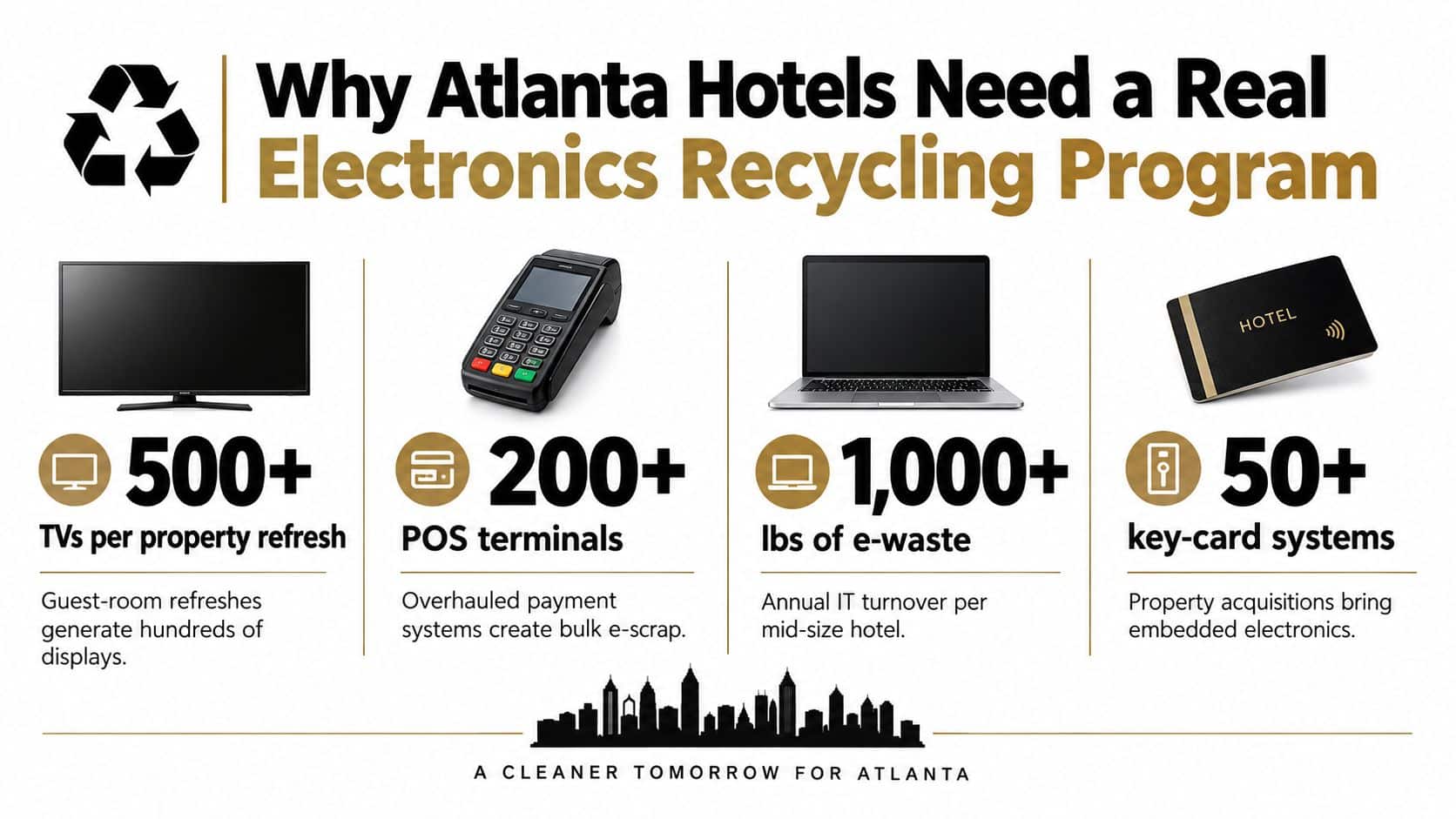
Renovation planning starts before removal
The same report projects global e-waste generation could reach 82 billion kilograms by 2030, while the documented formal recycling rate could fall to 20% under a business-as-usual scenario. For hotel operators, that makes electronics disposition part of a broader materials and risk-management program, not merely a housekeeping task.
Replacement planning should begin before equipment reaches the dock. A useful hospitality resource is Simply Hospitality's replacement strategy, which places equipment decisions in the context of planned operational change rather than emergency replacement.
The property should assign ownership before work starts. IT usually controls data-bearing equipment, engineering sees embedded systems and building hardware, housekeeping encounters room equipment, procurement manages vendors, and sustainability or facilities teams often need downstream reporting. One manifest and one escalation path keep those groups from making incompatible decisions.
For Atlanta properties, documented inventory, chain of custody, data destruction, and recycling certificates turn a chaotic renovation into an auditable disposition project. The Atlanta electronics recycling and ESG resource offers additional context for connecting material outcomes with broader environmental reporting. Electronics retirement is a recurring operational discipline for hospitality, not a one-off cleanup task.
The Five-Step Disposition Workflow for Hospitality Properties
A hotel-wide process works when every department follows the same sequence. The equipment may differ between a guest room, front desk, kitchen office, conference area, and server room, but the control points remain consistent.
Start with an asset-level inventory
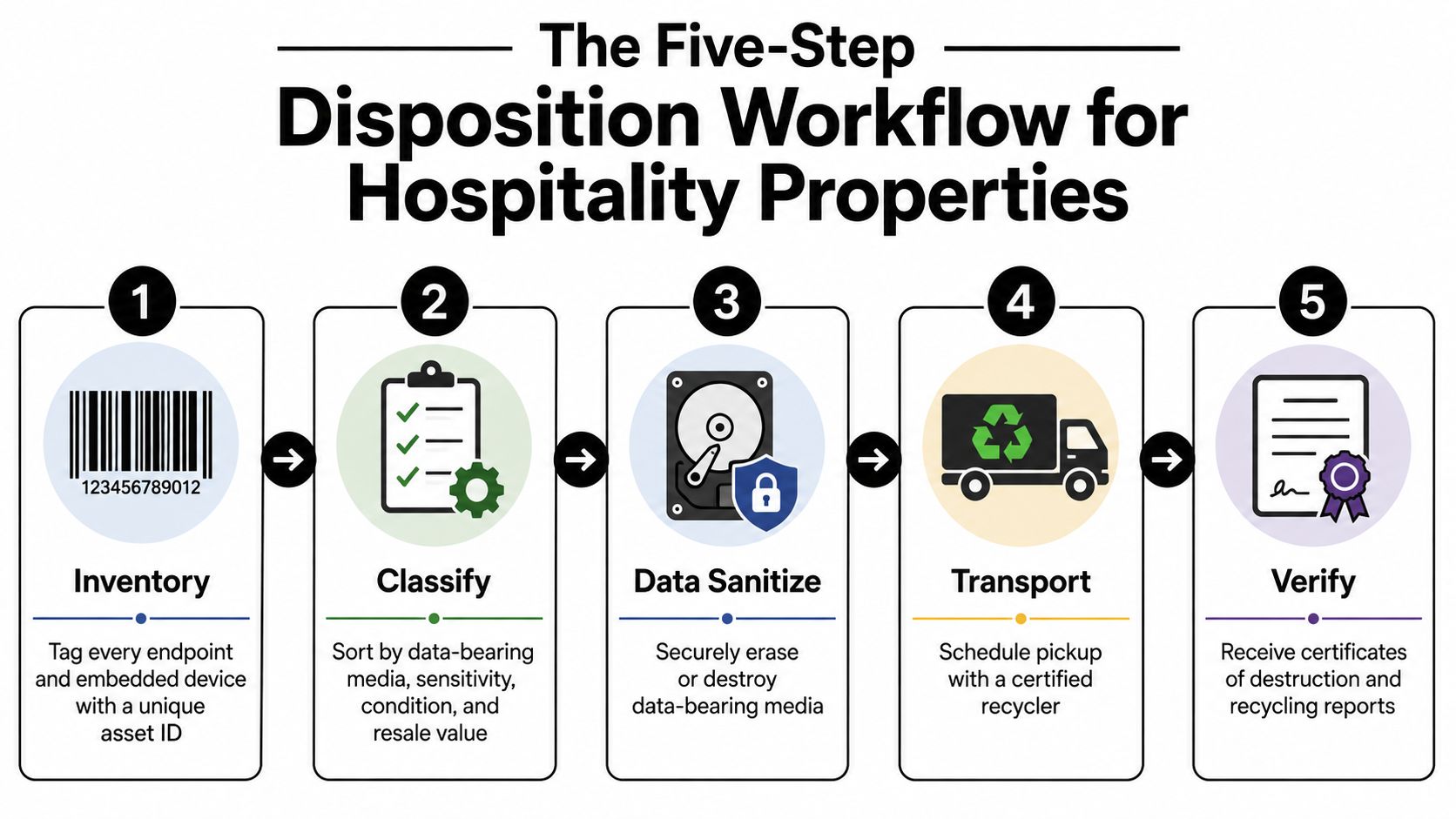
1. Inventory: Record every endpoint and embedded device, including front-desk PCs, POS terminals, office copiers, access-control systems, televisions, routers, switches, servers, removable media, printers, and network appliances. Give each item a unique asset ID and capture its location, make, model, serial number, and department.
2. Classify: Mark whether the device contains data-bearing media, what business sensitivity applies, its physical condition, and whether resale or reuse is realistic. A working laptop and a damaged POS terminal shouldn't enter the same disposition lane just because they share a pallet.
3. Select treatment: Choose a NIST-aligned Clear, Purge, or Destroy method. NIST Special Publication 800-88 Revision 1 explains that the appropriate choice depends on the media, intended reuse, information sensitivity, and whether effective sanitization can be verified. A factory reset isn't a universal sanitizer. SSDs, multifunction printers, POS devices, and network appliances can retain information in overprovisioned, cached, or embedded storage.
Verify, reconcile, and preserve evidence
4. Verify: Check that the selected treatment occurred, then reconcile the physical count against the manifest. NIST says verification is essential and recommends per-device verification where practical, or representative sampling when that approach is appropriate. Its detailed sampling guidance calls for non-overlapping samples covering at least 5% of each subsection, with two samples reaching at least 10% coverage where applicable. These figures come from NIST Special Publication 800-88 Revision 1.
5. Retain records: Keep the asset identifier, serial number, treatment method, operator, date, chain-of-custody events, and certificate. The final file should let a manager trace an item from room or department to final processing without relying on memory.
A portfolio operator should use the same fields across Atlanta and other properties. The business technology disposal planning guide can help teams formalize scope, scheduling, inventory, and documentation before equipment begins moving.
Certified Wiping or Physical Destruction, Matching the Method to the Device
Certified wiping and physical destruction solve different problems. Certified wiping can preserve resale value when the device and media support reliable sanitization. Shredding or crushing makes recovery infeasible with state-of-the-art laboratory techniques, but it eliminates reuse and therefore ends the device's remaining resale path.
A wipe is appropriate only when the process matches the media and the result can be verified. That distinction matters in hotels because a laptop, POS terminal, server, printer, access-control panel, and network appliance may store information differently. A physical destruction decision is more defensible when the device is damaged, the media type resists effective sanitization, verification fails, or the data sensitivity outweighs reuse value.
Use four questions before choosing
Ask these questions for every asset group:
- Data sensitivity: Does the device hold employee, payment, guest, access-control, corporate, or client information?
- Equipment condition: Is the device operational, damaged, incomplete, locked, or contaminated?
- Resale potential: Can the hardware realistically be tested, wiped, and remarketed?
- Processing location: Does the hotel require witnessed on-site treatment, or can controlled off-site processing provide sufficient evidence?
| Device Category | Recommended Method | On-Site Option | Resale Potential |
|---|---|---|---|
| Business laptops with healthy drives | Certified wipe after inspection | Possible, subject to workflow and equipment | Often present |
| Servers and storage arrays | Purge when supported and verified, otherwise destroy | Available for selected projects | Depends on configuration and condition |
| POS terminals | Device-specific sanitization, or destruction if embedded storage can't be verified | Project-dependent | Limited when locked or obsolete |
| SSDs and removable media | Verified purge when effective, otherwise physical destruction | Shredding may be arranged | Depends on media and condition |
| Damaged drives and inaccessible devices | Physical destruction | On-site or controlled off-site | None after destruction |
| Network appliances and multifunction printers | Review embedded storage before purge or destruction | Depends on device and site controls | Variable |
A credible service record should identify what was processed, which method was used, whether the work occurred on-site or off-site, and how verification was performed. Ask whether hotel personnel can witness the process, whether video evidence is available, and whether certificates list individual serial numbers or only a broad lot.
The Atlanta data wiping versus hard-drive shredding guide provides a practical comparison for teams weighing security, reuse, and evidence.
What the FTC Disposal Rule Means for Atlanta Hotels
The FTC Disposal Rule applies to any business or individual that maintains or possesses consumer reports or information derived from consumer reports for a business purpose. In hotel operations, that may include employment records, tenant or applicant information, credit-related records, chargeback materials, corporate-billing files, and other records containing consumer-report information.
The rule requires reasonable measures to prevent unauthorized access to or use of that information during disposal. That obligation doesn't stop at the hotel's trash room. If a laptop, server, POS system, or other medium still stores covered information, the property must address the data before the hardware leaves its custody.
Transfer doesn't remove the responsibility
Selling, donating, recycling, or otherwise transferring equipment can still qualify as disposal. The FTC guidance on disposing of consumer report information explains that covered organizations may require electronic files or media to be destroyed or erased so the information can't be read or reconstructed, and may use a disposal contractor after conducting due diligence.
That means a hotel can't treat resale as an exception. A working laptop may have financial value, but it still needs a defensible sanitization decision before it goes to a buyer, donation partner, or recycler.
Build a reasonable-measures file
The rule became effective on June 1, 2005, under the Fair and Accurate Credit Transactions Act of 2003, as described by the FTC's Disposal Rule announcement. It uses a flexible reasonable-measures standard rather than prescribing one universal destruction technology.
For a hotel, reasonable measures should include:
- Written procedures: Define who identifies data-bearing equipment and who approves the treatment.
- Method selection: Match wiping, purging, or destruction to the device and information sensitivity.
- Contractor due diligence: Confirm capabilities, controls, insurance, certifications, and reporting before pickup.
- Custody records: Preserve manifests, transfer events, serial numbers, certificates, and exception notes.
- Exception handling: Document missing assets, failed verification, damaged devices, and changes to the approved scope.
The destruction certificate matters because it is evidence of a process, not a substitute for one. A certificate that can't be reconciled to the hotel's asset list leaves the property with an incomplete defense.
Handling Batteries, PCBs, and Other Regulated Components
Georgia doesn't generally mandate business electronics recycling or ban most electronics from landfills. That doesn't mean every item can share one gaylord or mixed pallet. Batteries, printed circuit boards, and other hazardous e-waste remain subject to Georgia Environmental Protection Division requirements and federal Resource Conservation and Recovery Act expectations.
Hotels encounter these components in ordinary operations. A guest-room television may contain circuit boards, a maintenance cart may hold batteries, a key-card system may include embedded electronics, and engineering may discover damaged lithium-ion packs during a room refresh. The operational boundary is the point at which the team stops treating an item as ordinary equipment and routes it for controlled handling.
Give each department a clear handoff
Use a simple segregation path:
- Housekeeping identifies: Staff place found electronics in the designated hotel collection area and never place loose batteries or damaged devices in general e-scrap.
- Engineering assesses: Engineering checks for swelling, leakage, damage, exposed conductors, or unusual heat and separates items requiring special handling.
- IT reviews data: IT identifies laptops, phones, tablets, POS units, access-control devices, and other equipment that may contain information.
- The waste coordinator escalates: The coordinator confirms the category, container, labeling, transporter, and downstream requirements with the selected recycler.
- Procurement records the decision: Procurement retains vendor instructions, service terms, manifests, and certificates with the project file.
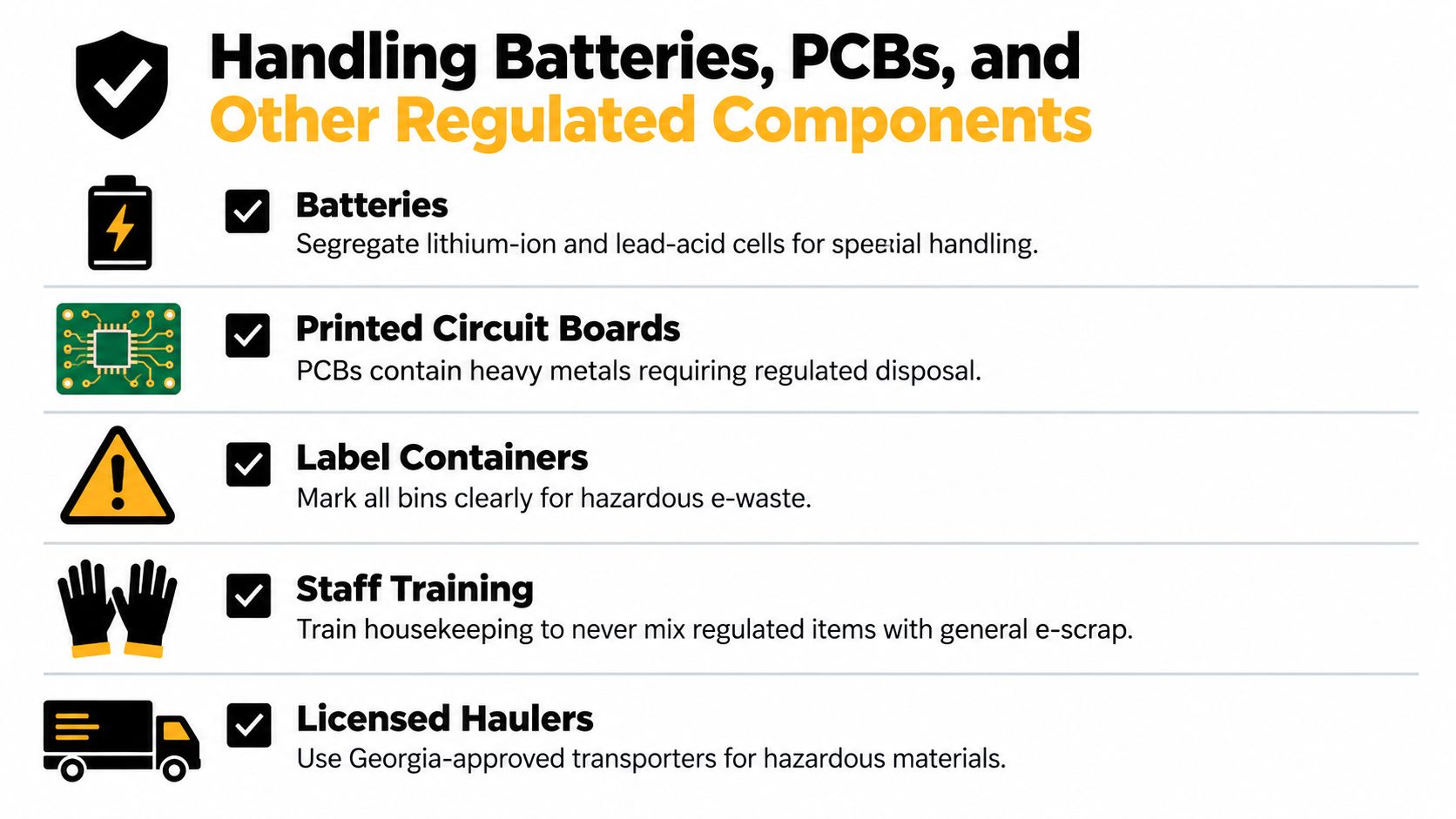
Prevent mixed loads during renovation
Post department-specific signage near linen rooms, engineering shops, IT staging areas, and loading docks. The sign should distinguish ordinary electronics from batteries, damaged devices, lamps, chemicals, and other materials that require a separate decision.
Practical rule: If staff can't identify the component or its condition, isolate it and escalate it. Don't solve uncertainty by mixing the item into a general pallet.
For multi-property portfolios, use one segregation standard with state-specific appendices. A central sustainability or procurement team can define the minimum record set, while each property's engineering lead handles local staging and emergency escalation. Guidance on lithium battery recycling can support procedures for battery-heavy equipment and maintenance inventories.
The objective isn't to make housekeeping personnel interpret hazardous-waste rules. It's to give them a safe first action, a labeled destination, and a named person who owns the next decision.
Choosing an Atlanta-Area Recycling and ITAD Vendor
Vendor selection should begin with evidence, not a pickup price. A hotel needs a processor that can manage ordinary electronics, data-bearing assets, regulated components, transportation, reporting, and exceptions without forcing the property to coordinate separate handoffs for every category.
Put these questions in the scorecard
- Certifications: Which third-party certifications does the processor hold, and which facilities and processes do they cover?
- Chain of custody: Does each lot receive a manifest with asset identifiers, custody events, dates, and receiving details?
- Certificates: Are certificates of recycling and data destruction itemized, or do they identify only a broad weight or pallet count?
- Coverage: Does the pickup service cover the hotel, its Atlanta-area properties, metro counties, and other states in the portfolio?
- Destruction options: Is on-site shredding available when the property's sensitivity, witness requirements, or schedule calls for it?
- Value recovery: How is IT buyback value calculated, approved, credited, and paid?
- Exceptions: What happens when a serial number is missing, a device fails testing, or the manifest doesn't match the physical count?
- Turnaround: When will the hotel receive final certificates and recycling reports?
A vendor should also explain secure transport packaging, loading controls, seal or container procedures, and the point at which custody transfers. Ask who can access equipment between pickup and processing. If the answer is vague, the service agreement needs more detail.
Make the agreement operational
Lock the asset list before pickup, but allow a documented variance process for equipment discovered during the work. Define whether hotel staff can witness wiping or shredding, whether video records are available, and how the vendor handles devices that can't be sanitized.
For a portfolio, require consistent report fields across locations. A central team should be able to compare asset counts, data-destruction outcomes, recycling certificates, buyback credits, and exceptions without rebuilding each property's records.
The Georgia ITAD vendor selection guide gives procurement teams a framework for comparing certifications, security controls, logistics, and reporting.
A defensible choice is the vendor whose process remains clear when the project becomes inconvenient. Renovations rarely produce a perfect asset list, and a capable partner should show how it handles the imperfect cases.
Logistics, Training, and an Atlanta-Ready Rollout Checklist
The cleanest program connects scheduling, staff behavior, transportation, and records. For a single Atlanta property, that may mean a staged pickup aligned with room blocks and loading-dock access. For a national hospitality group, it may require one manifest template, one escalation process, and coordinated pickups across multiple properties.
Housekeeping and engineering staff need short, practical instructions. Tell them which bins accept ordinary electronics, where batteries go, what to do with damaged devices, and whom to call when a laptop or POS terminal appears unexpectedly. IT should own data-bearing decisions, while facilities or engineering controls staging and safe movement. Procurement should confirm the vendor scope, and sustainability should receive the final material and certificate reports.
The EPA reported that the U.S. consumer-electronics recycling rate rose from 30.6% in 2012 to 40.4% in 2013, an increase of 9.8 percentage points, or roughly 32% relative to the 2012 rate, in a report on progress in e-recycling. The result was associated with broader efforts that included the Sustainable Materials Management Electronics Challenge, which encouraged responsible donation and recycling through recognized third-party certified recyclers and public reporting.
Use this Monday-morning checklist
- Scope approved: Confirm the renovation, refresh, acquisition, or replacement project and responsible department leads.
- Asset inventory complete: Reconcile rooms, departments, staging areas, serial numbers, and unique asset IDs.
- Data decisions recorded: Mark each data-bearing device as Clear, Purge, Destroy, or pending technical review.
- Regulated items segregated: Separate batteries, damaged components, and other materials requiring special handling.
- Pickup scheduled: Confirm loading-dock access, packaging, transport, site contacts, and the approved manifest.
- Staff briefed: Train housekeeping, engineering, IT, facilities, and procurement on their handoffs.
- Certificates collected: Obtain itemized certificates of data destruction and recycling reports.
- Audit binder updated: File manifests, custody records, certificates, exceptions, and approvals together.
- Buyback credit applied: Reconcile approved recovery value with the vendor statement and project accounting.
- Portfolio report issued: Send consistent outcome data to IT, sustainability, finance, and legal stakeholders.
Some hotels also manage battery-powered maintenance equipment and transportation assets. When that work intersects with golf-cart fleet maintenance, a resource on charger types for golf carts can help engineering teams distinguish charging hardware and battery systems before adding them to an electronics disposition scope.
Certified electronics recycling works when the hotel controls the handoff, not merely the pickup. Contact Beyond Surplus for business electronics recycling, secure data wiping or hard-drive shredding, IT asset recovery, certificates, and coordinated ITAD logistics for Atlanta properties or multi-site hospitality programs. Visit Beyond Surplus to arrange a documented pickup and build a disposition workflow your team can use before the next renovation begins.


