You're staring at a spreadsheet that keeps growing. A batch of recalled connected devices sits in your distribution center, but the same lot also shows up at a third-party warehouse in another state, a returns depot, and a dozen customer sites that never reported back. Nobody can tell you, with confidence, how many units you control. That's the moment nationwide recalled product destruction stops being a disposal task and becomes an accounting problem you have to solve in public, under a regulator's timeline.
Table of Contents
- When a Recall Outgrows a Single Warehouse
- Verifying Scope and Regulatory Exposure
- On-Site Versus Off-Site Destruction and NIST Sanitization
- Quarantine, Lot Reconciliation, and the Vendor Workflow
- Secure Logistics Across State Lines
- Cost, Timeline, and Scheduling Realities
- Closing the Recall With Audit-Ready Records
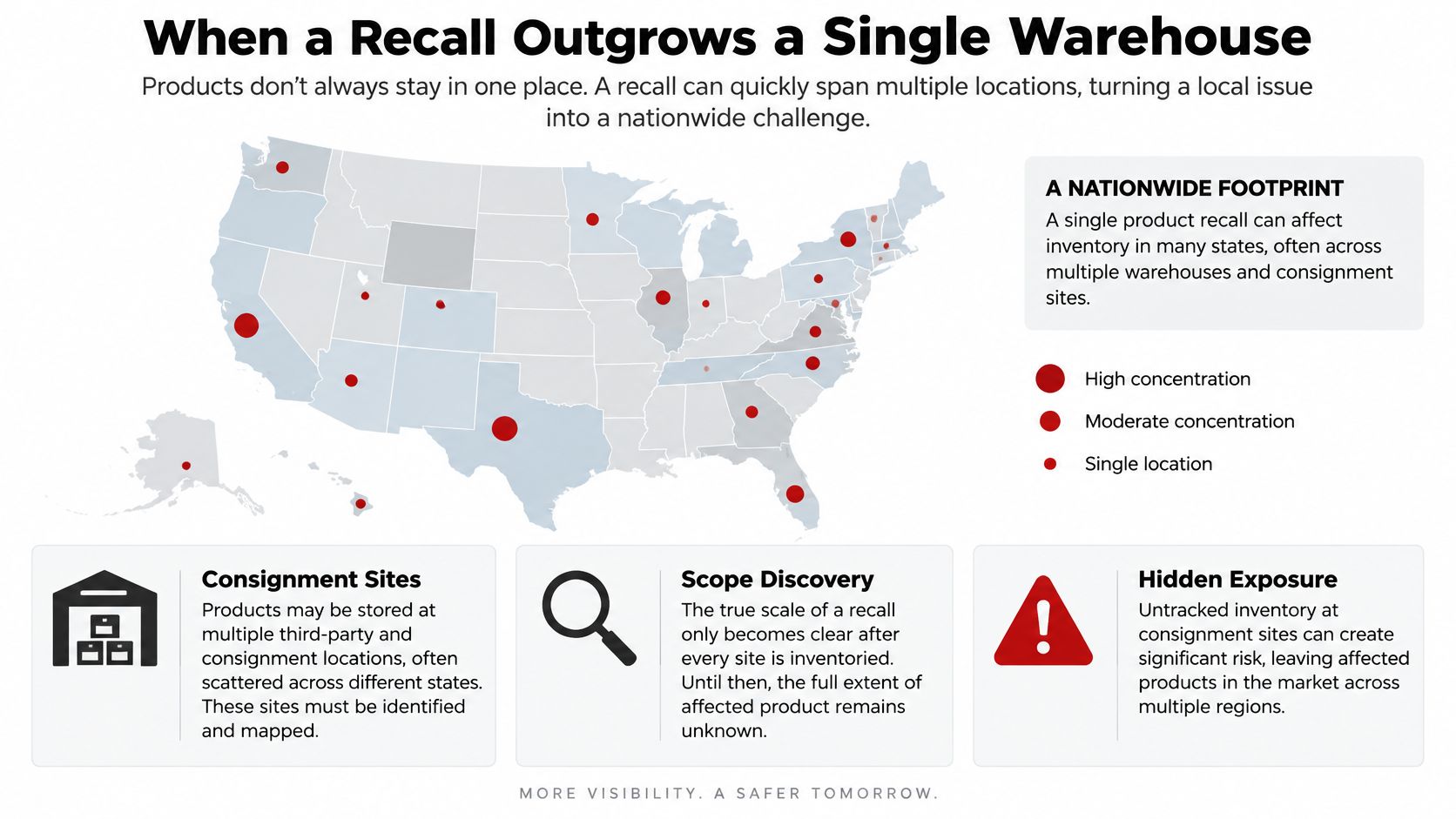
When a Recall Outgrows a Single Warehouse
Recalls rarely outgrow a warehouse because of volume. They outgrow it because of variance. The day your recorded count and your physical count stop agreeing, every downstream decision rests on a number nobody can defend. Operations schedules trucks. Quality drafts a notice. Legal watches the calendar. Meanwhile, nobody has built a single reconciled count of affected units by SKU, lot, and location. When the regulator asks how many units remain unaccounted for, you hand over an estimate and call it an answer.
Fix the sequence before you touch a single truck. Map first, move second. Location mapping means every place product could physically be, not just places your ERP says it should be: consignment stock, demo units, units in transit, units held by installers, and returns already received but never logged against the recall.
Put the Scale in Perspective Before You Commit Resources
Recall volume in the United States is large enough that ad hoc handling breaks fast. In fiscal year 2019, the U.S. Consumer Product Safety Commission coordinated 259 voluntary recalls affecting approximately 20 million product units, and CPSC staff completed 313 cooperative recalls in fiscal year 2023, including 167 through the Fast-Track program, as documented in the Government Accountability Office review of CPSC recall activity. That's hundreds of corrective actions in a single year from one regulator, before you count FDA, USDA, or EPA activity.
For enterprise teams managing recalled electronics, that scale translates into practical requirements. You need scalable transportation, item-level reconciliation, secure processing, and certificates documenting final disposition. Miss any one of those four and you're running a pickup schedule that only looks like a program.
Destruction Is One Remedy, Not the Default
Destruction is the most expensive remedy in the CPSC data set, and the least common. A recall doesn't automatically mean every unit gets destroyed. Across CPSC's five-year remedy data, the outcomes were 1,102 refunds (54.7%), 531 repairs (26.3%), 340 replacements (16.9%), and 23 disposal remedies (1.1%), per the GAO analysis cited above.
The lesson is that disposal is the rare outcome, not the routine one, so treat destruction as a decision you justify lot by lot. Destruction earns its cost when products present safety risks, can't be economically repaired, contain confidential information, or must be kept out of commerce. If a unit can be safely repaired under an approved corrective action, shredding it buys you cost and emissions with no compliance gain.
Decision rule: Destroy when the hazard travels with the product itself. Repair or replace when the hazard can be removed and verified. If you can't articulate which condition applies, lot by lot, you're not ready to call a vendor.
That remedy distinction holds outside CPSC jurisdiction. FDA and EPA led recalls follow the same underlying logic, which is that disposition must match the hazard. A data-bearing laptop with a defective battery is a different problem from a mislabeled accessory with no storage and no chemical risk. Treat them identically and you get blown budgets on one side and auditors asking sharper questions on the other.
What a Defensible Program Produces
A defensible nationwide recalled product destruction program produces evidence, and it produces four specific artifacts: a reconciled unit count, documented custody at every transfer, an approved destruction or disposition method, and a certificate that ties back to serial or lot detail.
The count deserves extra weight. Regulators rarely accept a single-source total, so build a three-way reconciliation across your inventory records, your physical counts at each location, and the confirmations your custodians and vendors sign. When those three agree lot by lot, the downstream paperwork writes itself. When they don't, nothing else you produce will close the file. Quarantine discipline, NIST media-sanitization choices for data-bearing units, and transport controls all exist to make those artifacts hold up under questioning.
A defensible program also produces speed where speed counts. The fastest programs I've managed shared three traits: scope was frozen early, quarantine instructions went out in writing on day one, and exceptions were investigated while units were still moving instead of after the final certificate arrived. Slow programs almost always trace back to count variances discovered too late to fix cheaply.
So before you schedule anything, answer three questions in writing. How many units are in scope, by lot and location? Which lots require destruction versus another remedy, and who approved that call? What evidence will close the recall, and who signs it? Until those answers exist on paper, your first deliverable is a reconciliation, and every pickup waits behind it.
Verifying Scope and Regulatory Exposure
Scope verification is unglamorous, and it's where your legal exposure is decided. Start with positive identification, which means affected SKUs plus serial or lot ranges, cross-checked against shipping records, service records, and consignee lists. Serial ranges from the factory rarely match field distribution perfectly. Assume gaps exist and go find them.
Next, classify the waste before you move it. EPA guidance is clear that when FDA directs destruction of recalled retail items, or CPSC authorizes destruction, materials classified as hazardous waste must be managed under the Resource Conservation and Recovery Act, including generator requirements, as set out in the EPA memorandum on recalled products and RCRA status. That classification decision belongs to you as the generator. It doesn't transfer to your destruction vendor because they signed a service agreement.
Where Routine Recalls Turn Into Hazardous Waste Events
Batteries, chemical reservoirs, lamps, and contaminated devices change the regulatory picture entirely. A recalled product that looks like ordinary e-waste on a packing list may trigger storage, transport, and approved facility requirements once it's discarded. Households generally get an exemption from federal hazardous waste rules, but retailers, manufacturers, and other commercial generators don't.
- Document the determination: Record who classified each waste stream, on what basis, and on what date.
- Check state rules separately: State requirements can be stricter than federal minimums, and a multi-state pickup crosses several regimes.
- Confirm downstream approval: Verify the receiving facility can legally accept the specific waste profile, not just electronics generally.
Getting this wrong doesn't just create a compliance finding. It creates litigation exposure when a plaintiff argues you knew the risk and handled the product carelessly anyway, which is why understanding the basics of protecting companies from litigation matters before the first shipment leaves your dock.
Regulated medical and laboratory equipment adds another layer. FDA defines removal as physically taking a device from its point of use to another location for repair, modification, adjustment, relabeling, destruction, or inspection, per the FDA medical device reporting requirements. Log it that way. Origin, transfer, purpose, final disposition. Calling it scrap in your shipping system doesn't make it scrap in the regulator's reading.
Before contacting any vendor, assemble your packet. That means the recall authorization, affected lot list, consignee list, waste determinations, safety data where relevant, and your notification records, informed by a working grasp of what businesses should know about e-waste laws. Vendors quote faster and more accurately when that packet exists. They guess when it doesn't, and you pay for the guessing.
On-Site Versus Off-Site Destruction and NIST Sanitization
On-site destruction buys you witnessability. Your team watches units get destroyed, custody never leaves your control, and there's no transport leg to defend. It costs more per unit, it requires space and scheduling discipline, and throughput is limited by what a mobile unit can process in a day. For high-sensitivity media or small, concentrated lots, that trade is usually worth it.
Off-site processing buys you capacity and specialized equipment. Large volumes, disintegration, and incineration in a licensed facility generally happen off-site. The trade is custody risk, which you manage with seals, tracking, and reconciliation, not with trust. For distributed pickups across many states, off-site consolidation is usually the only realistic model.
Pick the Sanitization Outcome Before You Pick the Machine
For recalled devices that store data, NIST SP 800-88 gives you three defined outcomes, and conflating them is a common audit finding. The distinctions are spelled out in the NIST SP 800-88 media sanitization guidelines, and they're summarized below.
NIST Sanitization Outcomes for Recalled Electronics
| Outcome | Technique Type | Reuse Possible | Use When |
|---|---|---|---|
| Clear | Logical techniques such as standard read/write commands or factory reset | Yes | Low sensitivity data, product will be corrected and redeployed internally |
| Purge | Physical or logical techniques making recovery infeasible against laboratory methods | Potentially yes | Sensitive data, but media may legitimately remain in service |
| Destroy | Shredding, disintegration, pulverizing, or licensed incineration | No | Media must never store data again, or the product itself must be eliminated |
Read that table carefully. Clear protects against simple, non-invasive recovery. It is not a destruction method, and vendors who sell it as one are telling you something about themselves. Destroy means recovery is infeasible using state-of-the-art laboratory techniques and the media can't be reused for storage. If your recall requires the product kept out of commerce permanently, Destroy is your outcome, and the method should render both the product and its stored information unusable.
Align your internal policy language with the standard by reviewing how NIST 800-88 data destruction standards map to your device classes. Then ask vendors three blunt questions. Which NIST outcome are you contracting for, in writing? Who performs the work, and are they trained and authorized? How do you verify the result on failed or non-functional drives that can't respond to logical commands? Weak providers go vague on question three. That's your signal.
Quarantine, Lot Reconciliation, and the Vendor Workflow
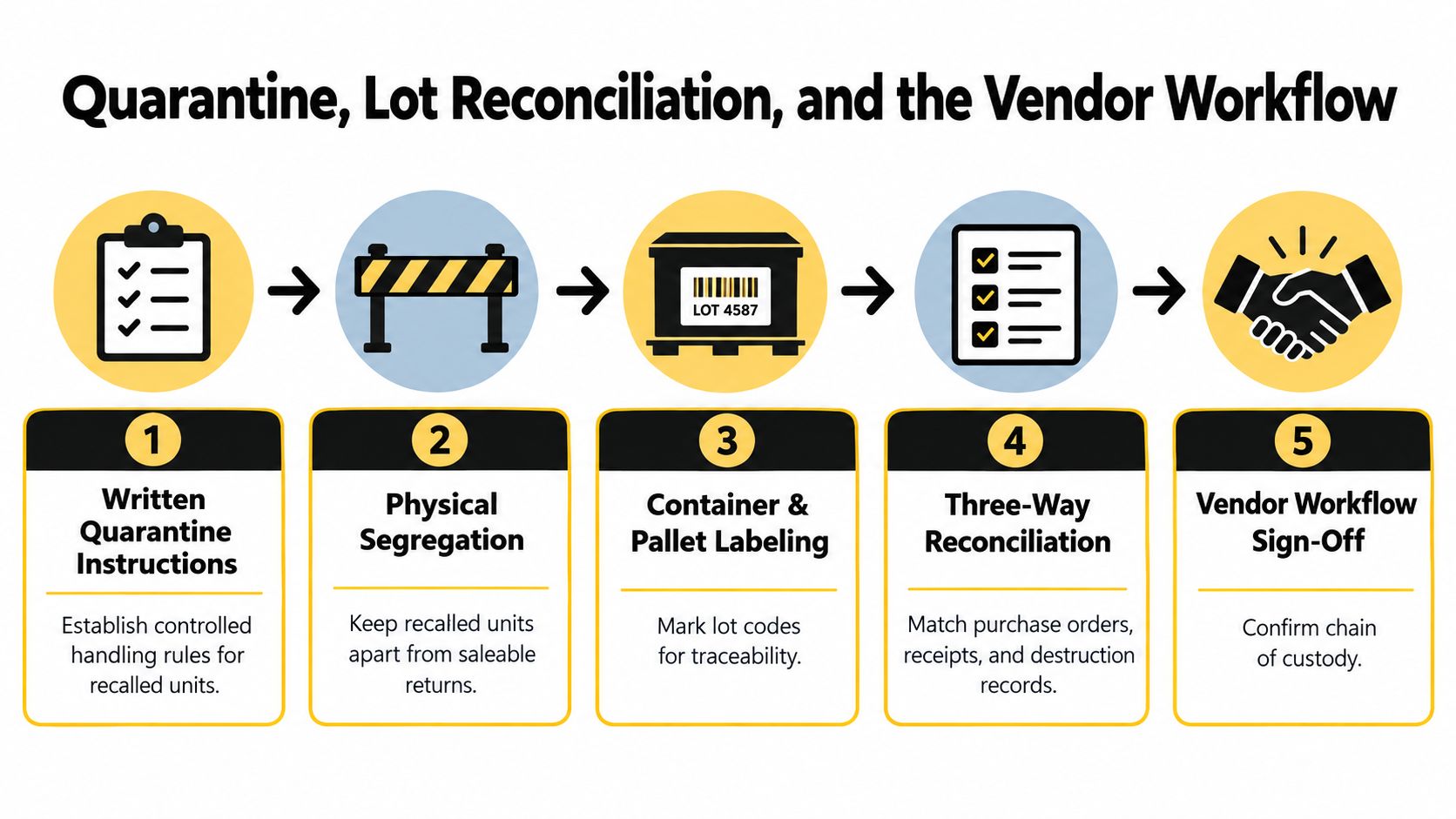
Quarantine fails when it's verbal. CPSC advises recalling firms to keep products quarantined throughout the distribution chain, monitor any third-party destroyer, prevent commingling, request a certificate of destruction, and update inventory records, as laid out in CPSC guidance on corrective action and product disposition. Every word of that needs to be a written instruction your warehouse leads can execute without calling you.
Your quarantine instruction should name the affected lots, the physical location where units get staged, who may access them, and what happens when a unit shows up without a readable serial. Segregation means physically apart from saleable returns and salvage, not a different corner of the same pile. Salvage is the single most dangerous destination for recalled stock, because salvage channels exist to put product back into commerce.
The Three-Way Reconciliation
Label every carton, pallet, or container with lot identifiers, then reconcile at three points. Units authorized, units received, units destroyed. Investigate every variance, however small, while the trail is warm. A short count discovered at the processing facility is a manageable exception. The same short count discovered six weeks later, after your staging area has been cleared and reused, is an unresolved quantity you'll have to explain to a regulator.
Weight is not a count. A certificate reporting pounds destroyed tells an auditor nothing about whether the specific recalled serials were in that load.
That point deserves emphasis because weight-based reporting is the most common shortcut vendors offer and the one most likely to get a certificate rejected. Recalled product accountability is unit and lot based. If your vendor can't report at that level, they can't support a regulated recall, whatever their price.
For on-site destruction, build the record at the time of work. It should state the destruction date, product description, quantity, the employee performing the work, and witness signatures. CPSC may witness destruction or arrange another verification method, so don't schedule destruction as an undocumented downstream recycling activity and hope nobody asks.
Vendor selection belongs inside this workflow, not after it. A structured vendor due diligence checklist keeps you honest about insurance, downstream facilities, and reporting capability. Providers such as Beyond Surplus offer commercial product destruction with documented custody and certificates of destruction as one option among several. Evaluate whichever vendors you shortlist against the same criteria, and get the reporting format agreed in writing before the first pickup, not after the last one.
Secure Logistics Across State Lines
Custody breaks in transit more often than it breaks at destruction. Your transport controls need to prove that what left each site is what arrived at the processor, with no undocumented access in between. That means tamper-evident seals with recorded seal numbers, GPS-tracked trailers, and driver handoff signatures at both ends. Seal numbers go on the bill of lading and get verified at receipt, every load, no exceptions for familiar carriers.
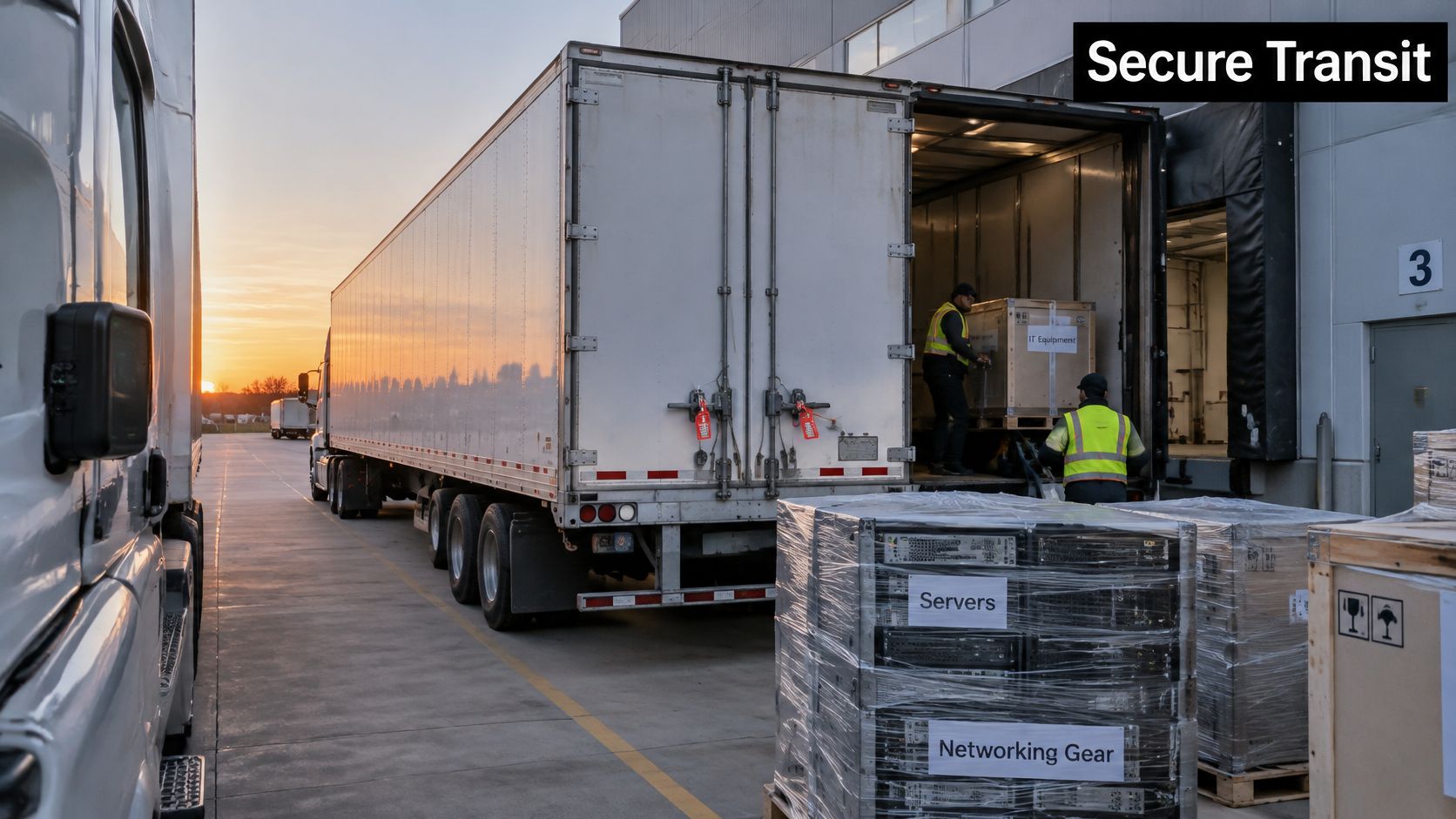
Contamination and exposure controls matter before final destruction, not just during it. FDA advises that when a recalled product can't be returned, it must be disposed of properly under local disposal laws, and contaminated items belong in a secure container placed so people and animals can't access them, according to FDA guidance on product recalls and proper disposal. Apply that same containment logic commercially. Damaged batteries, leaking devices, and contaminated laboratory equipment need packaging and segregation decisions at pickup, not improvised on the dock.
Multi-state campaigns add manifest and routing complexity that compounds quickly. Waste classification from your scope work determines which loads need formal transport documentation and which facilities can accept them, and state rules layer on top. Broader planning for carrier failures, facility outages, and route disruption is worth reviewing in a supply chain disruption risk guide before you commit to a single-carrier, single-facility design with no fallback.
Coordinate pickups to protect serial-level visibility. Consolidation saves freight money, but consolidating uncounted product from five sites into one trailer destroys your ability to reconcile by origin. Count and seal at origin, consolidate sealed containers if you must, and keep the origin identity intact through receipt. Companies running distributed operations should review how secure electronics recycling for multi-location companies structures that coordination. Your transportation agreement should spell out seal integrity duties, incident notification timelines, and who owns the custody record when a load is refused or damaged.
Cost, Timeline, and Scheduling Realities
I won't give you a per-unit price, and you shouldn't trust anyone who quotes one without seeing your lot profile. Pricing for nationwide recalled product destruction swings on identifiable variables, and understanding them lets you budget accurately instead of approving a number that doubles on contact with reality.
Hazardous classification is the biggest swing factor. A load that requires hazardous waste handling, approved facilities, and formal manifests costs materially more to move and process than ordinary electronics. Data-bearing media is next, because NIST Destroy outcomes with serial-level reporting take more labor than bulk shredding. On-site service carries a premium for mobilization and lower throughput. Certificate detail matters too, since lot-level reconciliation and exception investigation are real work that somebody performs.
- Volume concentration: Many small pickups across many states cost more per unit than a few dense ones, mostly in freight and crew time.
- Product construction: Embedded batteries, sealed devices, and mixed materials slow processing and can require disassembly before destruction.
- Minimums and scheduling windows: Vendors price around route density, so flexible pickup windows generally buy better rates than fixed-day demands.
- Verification requirements: Witnessed destruction and regulator observation add coordination time that shows up in the quote.
Timeline follows the same logic. The clock isn't dominated by destruction itself, which is fast. It's dominated by consignee response, quarantine confirmation, freight scheduling, and certificate turnaround. Build your internal commitments around those four, and get certificate delivery timing in the contract so your regulatory updates aren't waiting on a vendor's back office.
There's also an environmental decision embedded in the budget. Destruction is not automatically the most compliant outcome. CPSC presents disposal or recycling as possible remedies on its CPSC recalls and product safety resources, and disposition should be proportionate to the hazard. Classify lots by hazard, resale risk, data-bearing components, battery or chemical content, and feasibility of safe refurbishment. Where recycling or component recovery is authorized and safe, taking it can offset cost and emissions. Where re-entry risk or data sensitivity is real, destruction is the only defensible path and you should say so plainly in the budget request rather than apologizing for it.
Closing the Recall With Audit-Ready Records
Destroying units doesn't close a recall. Proving effectiveness closes it. FDA recommends effectiveness checks for every recall to verify consignees received notification, followed handling instructions, stopped further distribution, and notified downstream recipients, as described in FDA guidance on recall effectiveness checks. FDA considers a recall complete only when reasonable efforts have removed or corrected the product and disposition matches the hazard. Throughput at your processor proves none of that.
Sample by Risk, Reconcile Everything
Use a risk-tiered approach. Confirm 100% of high-hazard products, critical healthcare or regulated devices, and every custody exception. For lower-risk populations, statistically justified sampling can work, but you still reconcile every physical receipt. Sampling tests whether the field followed instructions. Reconciliation proves what you physically control. Confusing the two is how programs report strong activity while stock sits quarantined, or worse, saleable, at a distributor nobody checked.
Track metrics that describe the recall, not the shredder. That means notification reach, consignee response rate, units located, units quarantined, units destroyed, downstream notifications completed, unresolved quantity variance, and days from authorization to final disposition. Don't claim a universal destruction success rate to your leadership. Regulators define effectiveness through reasonable removal or correction and documented consignee action, not a single benchmark, and inventing one will undercut your credibility when the numbers get examined.
What the Records Package Must Contain
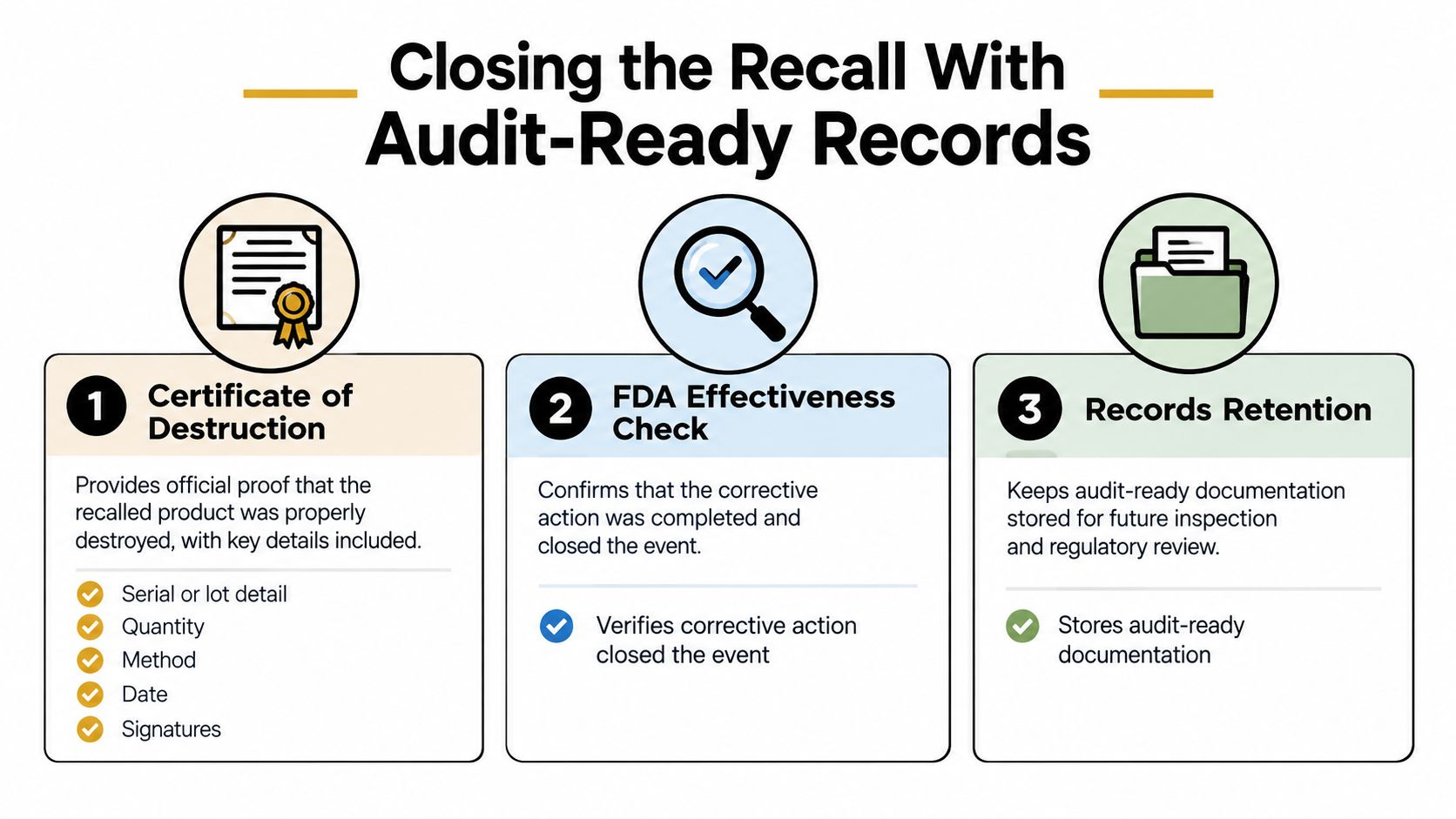
Your certificate of destruction needs serial or lot detail, quantity, method, date, and signatures, tied back to the reconciliation. Around it, retain quarantine instructions, custody and transport records, waste determinations, effectiveness check results, and exception investigations in one structure. FDA may review the proposed destruction method or witness destruction, and destruction records should be retained accordingly. Organizing that package against a clear compliance documentation standard means one source of truth serves the regulator, your customers' due diligence, and your own audit team.
The last discipline is the hardest. Investigate unreturned and unverified units instead of writing them off. Every unresolved variance gets a documented disposition, whether that's a consignee attestation, evidence of prior disposal, or an escalation. Programs that close with unexplained gaps don't stay closed. They reopen at the worst possible time, usually during an unrelated audit, when the people who ran the recall have moved on and the records are all anyone has left.
If you're managing recalled electronics across multiple states, Beyond Surplus provides commercial product destruction with nationwide pickup, documented chain of custody, and certificates of destruction that support your reconciliation and audit requirements. Visit Beyond Surplus to discuss your recall scope and get a documented disposition plan built around your lots, locations, and regulatory timeline.