
Most recall dashboards stop at units collected. That number doesn't prove a recalled laptop, server, or medical workstation was sanitized, repaired correctly, recycled, or destroyed. Product recall reverse logistics services close that gap by tying every serial number to a verified final outcome.
That's the standard buyers should apply. A pickup confirmation shows movement. A disposition record shows the risk is gone.
Table of Contents
- What Product Recall Reverse Logistics Services Cover
- Six Stages From Notification to Certified Disposal
- Tracking Each Unit Through Chain of Custody
- Choosing Repair, Resale, Harvest or Destruction for Each Unit
- Matching Data Sanitization Levels to Returned Devices
- Compliance Rules That Shape Recall Programs
- Measuring Recall Performance and What Drives Cost
- Choose a Recall Reverse Logistics Partner Before the Next Notice
What Product Recall Reverse Logistics Services Cover
The U.S. Consumer Product Safety Commission statement on its 2024 recall record reports 369 recalls and safety warnings in 2024. That volume makes recall readiness an operating requirement, not a rare contingency.
A recall program connects affected products to a documented outcome. For a defective book edition, that means logging withdrawn copies by barcode and documenting destruction when copies are discarded. The same principle applies to electronics, where each unit needs a traceable record through collection, handling, and disposition.
Forward logistics sends products to customers along planned routes. Reverse logistics must recover units dispersed across sites and account for those that are difficult to locate. For example, a firmware fault affecting point-of-sale terminals across 400 retail sites requires mapping serial numbers to locations, collecting devices that may not appear in store records, separating them from unaffected stock, and recording each unit's outcome.
Core components buyers should expect
- Retrieval: Map locations, notify holders, arrange pickup or drop-off, and scan units at collection.
- Transport and receiving: Track sealed shipments into quarantine and record each unit's condition on arrival.
- Sanitization and disposition: Match data handling to device sensitivity, then document the decision to repair, recycle, or destroy each unit.
- Certification: Require records tied to individual serial numbers, rather than relying on an overall return count.
For operational context, FLYP insights on reverse logistics discuss how returns workflows are structured. IT managers, facility managers, and procurement leads should ask providers to show how records connect each unit to its final disposition. Those records help auditors, insurers, and legal teams assess what happened, not just whether a shipment arrived.
Six Stages From Notification to Certified Disposal
A workable recall runs as six linked stages. Each stage produces evidence the next stage depends on. Skip one, and the file has a hole an auditor will find.
- Notification. Confirm affected serial numbers or lot numbers against the asset register, notify every holder, and set a return deadline. Proof is the affected-asset list and notice log.
- Collection. Arrange prepaid shipping, drop-off, or on-site retrieval, and scan each unit at pickup. Proof is the pickup manifest tied to serials.
- Chain of custody. Move units in sealed, tracked transport with signed transfers at every handoff. Proof is a custody log that never goes blank between sites.
- Data security. Sanitize storage media at receiving, before units go anywhere else. Proof is a sanitization record per device.
- Repair or disposition. Route each unit to repair, resale, component harvesting, or destruction using a recorded decision. Proof is the disposition entry for that serial number.
- Disposal and certification. Send units to a recycler or destruction facility and receive a certificate listing every serial number. Proof is the certificate itself.
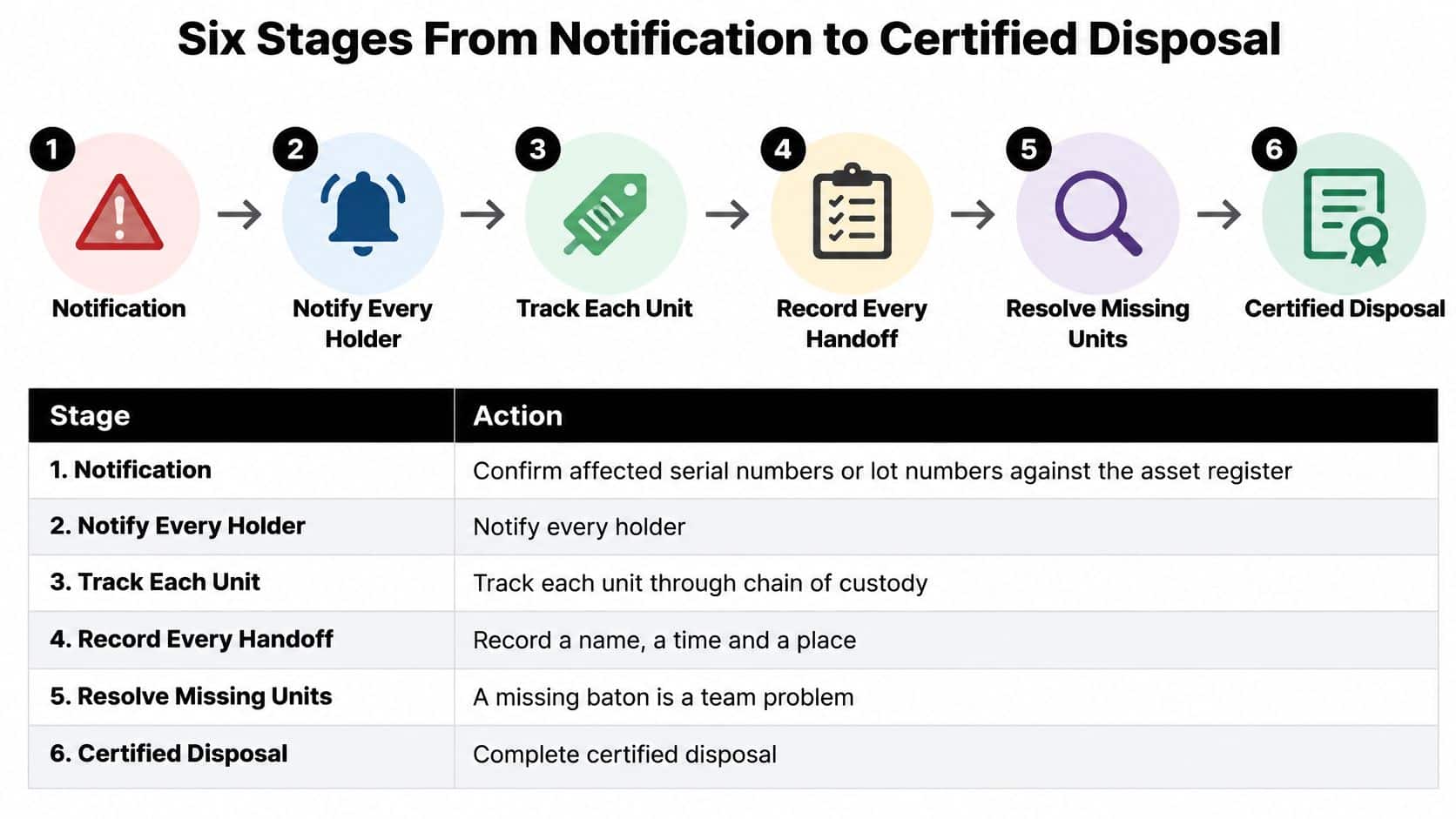
The failures are predictable. Notification breaks when the asset register is months out of date. Collection breaks when retrieval stalls and nobody maintains an exception list for what's missing. Data security breaks when a device powers on, looks clean, and skips sanitization. Certification breaks when a processor issues a batch certificate with no serial detail, leaving you unable to prove any specific unit was destroyed.
| Stage | Core action | Evidence produced | Common failure |
|---|---|---|---|
| 1. Notification | Confirm affected serials or lots and notify every holder with a return deadline | Affected-asset list and notice log | Asset register out of date |
| 2. Collection | Prepaid pickup, drop-off or on-site retrieval | Scan at pickup and pickup manifest | Units missed at remote sites with no exception list |
| 3. Chain of custody | Sealed, tracked transport with signed transfers at each handoff | Custody log by serial number | Gaps between carrier and receiving facility |
| 4. Data security | Sanitize storage media at receiving | Sanitization record per device | Relying on a factory reset alone |
| 5. Repair or disposition | Route each unit to repair, resale, harvest or destruction | Disposition decision per serial number | Resale without a recorded decision |
| 6. Disposal and certification | Recycling or destruction by an audited processor | Certificate of recycling or destruction listing each serial | Batch certificate with no serial detail |
Use this table as an interview script. Ask any provider to walk through it stage by stage and show a sample record for each row. Vague answers at any stage mean that stage doesn't exist in their process.
Tracking Each Unit Through Chain of Custody
Chain of custody works like a relay race. Every handoff of the baton needs a name, a time, and a place. A missing baton is a team problem with an owner, not a shrug and a closed ticket.

What the custody record contains
Each transfer should capture the serial or lot identifier, sender, carrier, receiving site, receipt time, and condition on arrival. That record links shipment, return authorization, receipt, quarantine, correction, and final disposition into one searchable trail. Detailed guidance on structuring these records is covered in the chain-of-custody documentation for IT asset disposal resource.
Reconciliation against the register
Compare expected units from the asset register against units received. Every gap becomes an exception with a named owner and a deadline. Take a clinic network example with 46 affected workstations where three devices were missing at one branch. Reconciliation against the register located two units in a storage closet and one in a transfer batch logged under the wrong site. Without the exception process, all three stay in service.
A unit that isn't reconciled isn't lost. It's unaccounted for, and there's a difference when a regulator asks.
When serial capture isn't possible
Damaged labels and unserialized lots happen. In those cases, use bin-level or lot-level tracking with tamper-evident seals, photographed contents, and counts verified at each transfer. It's weaker than serial tracking, but it still produces an auditable trail.
Regulated programs depend on this detail. FDA recall reporting guidance requires identifying domestic and foreign consignees, contact details, distribution quantities, and, where feasible, lot numbers and shipment dates, and it recommends effectiveness checks to verify consignees acted.
Ask to see five fields in any provider report: serial or lot ID, last known holder, custody status, current location, and open exception status. If a report can't show those, it can't support closure.
Choosing Repair, Resale, Harvest or Destruction for Each Unit
Recall programs are often judged by how many units come back. The stronger test is whether each unit reaches a verified final disposition, with a record tied to its serial number. Collection alone does not prove the hazard was addressed. A returned unit may still be repaired incorrectly, resold without authorization, or destroyed without documentation.
Each unit needs a documented decision based on the failure and its permitted end use. The CPSC recall remedy information provides recall information, but it does not establish a universal remedy mix. Check the recall notice and applicable requirements before setting a disposition rule.
Four decision questions in order
First, is the failure mode confirmed, or is the cause still uncertain? Second, does the unit contain sensitive data that limits where it can go? Third, is there residual value worth recovering? Fourth, does the recall notice allow reuse? That final question controls the decision, even when repair or resale appears practical.
Use the refurbish or recycle decision guide to assess reuse options. For teams evaluating secondary-market channels, compare alternatives to Peak Design Marketplace to understand differences in resale controls and documentation.
| Disposition path | Use when | Proof required | Main risk |
|---|---|---|---|
| Repair and return | A validated fix resolves the hazard | Repair record and serial-level retest | Repaired units re-enter circulation without retest |
| Resale or refurbishment | The notice permits reuse and the hazard is removed | Sanitization record, grading report and written approval | Selling recalled product without authorization |
| Component harvesting | The unit cannot be safely reused, but parts retain value | Harvest log tied to each part and unit | Parts reused without traceability |
| Recycling | The unit has no reuse value and contains no sensitive data requiring another process | Recycler certificate listing each serial number | Batch certificates without serial detail |
| Destruction | The unit is hazardous, sensitive or cannot be verified | Destruction certificate tied to each serial number | Units leave custody without a record |
Consider a hypothetical batch of 120 returned units: 90 could require destruction because of the hazard, 18 could qualify for a confirmed repair followed by retesting, and 12 could yield components under a documented harvest log. Those figures illustrate one possible allocation, not a typical outcome. Units that remain unlocated must stay open as exceptions. The provider should report them rather than close the batch without notice. Verify the final disposition and matching serial-level record for every unit.
Matching Data Sanitization Levels to Returned Devices
A factory reset is not sanitization. It isn't verified, it isn't documented per device, and it doesn't tell you what's recoverable from the drive afterward. Recalled devices carry whatever data they held in service, and that data doesn't stop being your liability because the hardware failed.
NIST SP 800-88 media sanitization guidance defines three outcomes. Clear uses logical techniques across user-addressable storage and protects against simple, non-invasive recovery through standard read and write commands. Purge makes recovery infeasible using state-of-the-art laboratory methods while potentially preserving the medium for reuse. Destroy also makes recovery infeasible, but renders the media unusable for future storage.
| Sanitization outcome | What it protects against | Media reusable | Use when |
|---|---|---|---|
| Clear | Simple, non-invasive recovery through standard read and write commands | Yes | Low-sensitivity devices staying in internal use |
| Purge | Recovery with state-of-the-art laboratory methods | Yes | Devices leaving the organization with sensitive data, such as units bound for refurbishment |
| Destroy | Recovery with state-of-the-art laboratory methods, by rendering media unusable | No | Failed drives, highly sensitive storage and any media that cannot be validated |
| Factory reset only | Nothing verified; not a NIST sanitization outcome | Yes, but unverified | Never as the sole step for recalled devices with stored data |
The legal floor is real. The FTC guidance on the Disposal Rule states the rule applies to any business or individual that uses a consumer report for a business purpose, including service providers maintaining that information, and requires reasonable measures to prevent unauthorized access during disposal. For electronic media, destroying or erasing files so they can't be read or reconstructed is an acceptable control.
Two examples show the matching logic. A returned laptop holding HR files that's headed for reuse gets a purge, verified and recorded before it moves. A failed SSD that can't be validated goes straight to destruction, because you can't prove a purge worked on media that won't respond. The overview of NIST SP 800-88 requirements explains how these levels map to device types.
Practical rule: The sanitization level follows the data's sensitivity and the device's future, not the convenience of the workflow.
NIST's updated sanitization framework treats this as a risk-based program decision, with documentation of method, asset identity, and custody. That's the record that holds up when a customer asks what happened to their data.
Compliance Rules That Shape Recall Programs
A recall closes only when each affected unit has a documented outcome that can be matched to its serial number. Return totals alone do not establish that every unit reached a verified final disposition.
Three regulatory areas can shape a commercial recall, sometimes at the same time:
- Medical and healthcare devices: The GAO report on FDA medical-device recall oversight records 3,934 medical-device recall events from fiscal years 2020 through 2024, all initiated voluntarily by manufacturers, including 1,017 in fiscal year 2024. Only 26.1% were terminated within the FDA's 90-day goal, while 73.9% exceeded it. Of 2,433 ongoing recalls, 1,553 began in fiscal years 2023 and 2024. Delays can leave a growing backlog and extend the period before a recall is formally terminated.
- Consumer-report data: The FTC Disposal Rule applies to covered consumer-report information. It requires reasonable measures to prevent unauthorized access during disposal. Set controls appropriate to the device and document the result.
- Consumer product safety: The CPSC recall process may involve identifying affected products, halting distribution, notifying customers, and arranging a remedy. Confirm the steps that apply to the specific recall, and require records supporting actions taken.
Traceability also has trade-offs. Academic research on traceability and safety investment examines how lower traceability costs may lead firms to prioritize tracking over safety investment, potentially increasing risk. Location records show where units are; they do not establish the failure cause or verify that it was corrected.
What a defensible recall file contains
Create the file as work proceeds: the recall notice, affected-asset list, notification and acknowledgment logs, custody records, disposition decisions, and certificates tied to serial numbers. Use a compliance documentation guide for asset disposal to structure the evidence.
For global recalls, reconcile customs paperwork and transfer records against the custody log as a sound operating practice. Requirements vary by sector and product, so have legal or compliance teams confirm the applicable rules before issuing the notice. Verify that each unit's final disposition is supported by a record matching its serial number.
Measuring Recall Performance and What Drives Cost
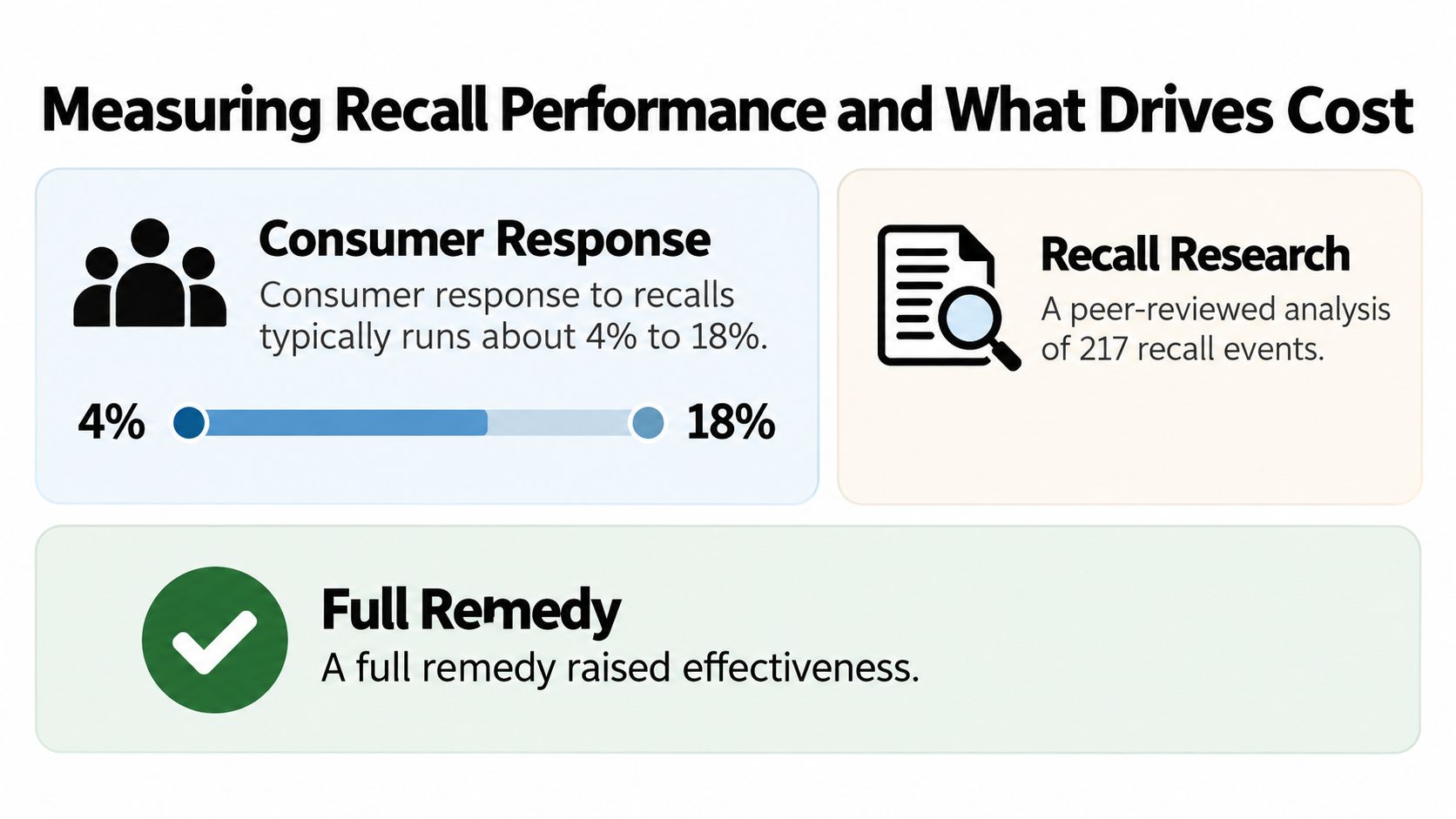
For historical context, a 2008 industry presentation reviewing CPSC recall information reported consumer response rates of approximately 4% to 18%. Treat that range as historical, not a current benchmark. Recall programs are often judged by units returned, but the stronger test is whether every unit reaches a verified final disposition and its record matches the serial number. Prepaid labels, convenient pickup, fast replacement authorization, and automated reminders can help bring more products back.
KPIs worth tracking
- Notification coverage: Holders reached compared with the full affected population.
- Acknowledgment and recovery rates: Confirmed responses and units physically recovered, measured against the affected population, not shipments completed.
- Reconciliation rate: Serials received and matched against expected serials.
- Verification rates: Sanitization verified for each device, with certificates matched to serials.
- Open exceptions and days to closure: Unresolved units past deadline and time to auditable closure, measured against the FDA termination goal noted earlier.
Cost drivers to price separately
- Volume and spread: Unit count and geographic distribution across sites.
- Collection method: On-site pickup costs more than drop-off or mail-in.
- Data-bearing share: The number of devices requiring sanitization and the selected level. Destruction generally costs more than purge, which generally costs more than clear.
- Documentation depth and exception rate: Serial-level reporting and follow-up on missing units both require labor.
Request quotes by unit category, not as one blended rate. A laptop, server, and medical workstation have different handling, testing, and documentation needs. A single rate can conceal which category is subsidizing another. Measure success by matched, verified final dispositions, not return volume alone.
Choose a Recall Reverse Logistics Partner Before the Next Notice
Selecting a provider during an active recall means accepting whoever answers the phone. Run the evaluation now, while you can still demand evidence. Use this checklist in a request for proposal.
- Serial-level reporting: Each unit tied to custody, sanitization method, disposition, and certificate in one record.
- Sanitization choice: Documented clear, purge, and destroy options matched per device.
- Due diligence evidence: The FTC describes reviewing an independent audit, obtaining references, requiring recognized trade-association certification, and evaluating information-security policies. A structured vendor due diligence checklist helps organize those requests.
- Coverage and surge capacity: Pickup in every affected region, with room for a recall larger than expected.
- Exception service level: A stated timeline and escalation path for units that don't come back.
- Documented end pathway: Named recycling or destruction route, not a promise to figure it out later.
| Recall need | What to require | Beyond Surplus capability |
|---|---|---|
| Serial-level custody | Custody log for each unit from pickup to certificate | Transparent chain-of-custody documentation |
| Data sanitization | Method per device matched to sensitivity and reuse plan | Certified data wiping and on- or off-site hard drive shredding |
| Proof of disposal | Certificate listing every serial number | Certificates of recycling and data destruction |
| Nationwide retrieval | Pickup in every affected region, with a single coordinating team | Business pickups across the contiguous United States using own fleet and transportation partners |
| Value recovery | Documented buyback or harvest decision per unit | IT buyback for value recovery |
| Product destruction | Destruction of units that cannot be reused | Product destruction services |
| Large-scale decommissioning | Planned de-installation and logistics coordination | Data center de-installations and logistics coordination |
| Sector compliance | Records that meet healthcare, finance, government or education requirements | Tailored solutions for healthcare, finance, government, schools and manufacturers |
Beyond Surplus is an Atlanta-based IT asset disposition and electronics recycling company offering business pickups across the contiguous United States through its own fleet and transportation partners. Its services relevant to recall work include transparent chain-of-custody documentation, certified data wiping, hard drive shredding, certificates of recycling and data destruction, IT buyback, product destruction, and data center de-installations for business, enterprise, and institutional clients.
Judge a partner by the sample closure file they show you, not the service list on their website.
The next step is simple. Assemble your affected asset list and deadline, then request a scoped proposal with pickup, sanitization, and certification defined per serial number. If a provider can't quote at that level of detail, they can't deliver at it either. Contact Beyond Surplus for certified electronics recycling and secure IT asset disposal.
If a recall notice landed tomorrow, Beyond Surplus can coordinate nationwide business pickups, document chain of custody by serial number, sanitize or destroy data-bearing media, and issue certificates of recycling and data destruction for every unit. Visit Beyond Surplus to share your affected asset list and get a scoped proposal before the deadline pressure starts.


