A recall notice lands in your inbox, and somewhere in a storage room, loading dock, or mechanical closet sit portable generators your team bought for outages and job sites. Nobody's sure which ones match the notice, whether they still hold fuel, or who last ran them. That's the moment recalled generator disposal services stop being an abstract compliance topic and become a facilities problem with a deadline. For commercial, institutional, and facility fleets, the job isn't hauling. It's deciding, unit by unit, between a manufacturer remedy and controlled disposal, then proving what you did.
Table of Contents
- Decide Between Manufacturer Repair and Disposal
- Vetting a Certified Recycler Before You Sign
- How to Isolate and Prepare a Recalled Generator
- Handling Fuel, Batteries and Other Hazardous Parts
- Documentation and Compliance Records to Keep
- Costs, Timelines and Booking Certified Pickup
Decide Between Manufacturer Repair and Disposal
| Situation | Recommended path | Why it matters |
|---|---|---|
| Serial matches recall, unit runs, dealer repair available | Stop use and book the manufacturer repair | The remedy is free and avoids replacing working equipment |
| Serial matches recall, unit damaged or leaking fuel | Disposal through a certified hazardous-waste channel | Damage may make repair impractical, and leaking fuel creates an immediate hazard |
| Serial matches recall, repair refused or uneconomic | Disposal with documented chain of custody | Records show the unit was removed from operational inventory |
| Serial unverified or model unknown | Quarantine, tag and verify before any movement | Recall status determines the path and should not be guessed |
| Unit not on any recall list | Standard equipment disposal under facility policy | Records should show that recall status was checked |
A facilities manager identifies three generators in storage after a recall notice arrives. The decision is not automatically repair or recycling: first confirm which units are affected, then document whether the manufacturer's remedy is practical or the equipment will be disposed of.
Where the manufacturer remedy stops
The CPSC's current Generac recall notice tells owners of affected units to stop using them and arrange a free dealer repair. It does not set out how a business should handle a unit that will not be repaired and still contains gasoline or oil. Earlier Generac recalls also show that affected units may remain in storage while a remedy is being addressed.
Assess each unit against three points: serial number, condition, and operational fit. Check the serial number against the notice rather than relying on the model name alone. Look for fuel leaks, cracked housings, fire damage, or missing guards, then weigh dealer access, downtime, transport, and the unit's remaining value. If you are comparing replacement options during downtime, backup power insights from Blue Gas Express can help you consider fixed backup systems alongside another portable purchase.
A recall does not automatically mean recycling. Repair and disposal are separate outcomes, and either decision belongs in the unit's record.
Contact the manufacturer or recall program for each matched unit. Log the reference number, contact date, and remedy offered, including when the remedy is declined. Report any injury, fire, or fuel leak to the CPSC. Keep repaired or stored units in the same record trail; storage does not resolve the recall.
Vetting a Certified Recycler Before You Sign
Start with certification, not price. The EPA page on certified electronics recyclers identifies two accredited electronics-recycling certification standards in the United States, the Responsible Recycling (R2) Standard and the e-Stewards Standard, and EPA recommends organizations use certified electronics recyclers for unwanted business electronics. That gives you a concrete screening criterion for recalled generator equipment just as you'd apply it to IT asset disposal or laptop disposal.
Your vetting checklist
- Certificate scope: Confirm the certificate is current and covers the work you need, including batteries and fuel-containing equipment, not just circuit boards.
- Named downstream processors: Ask where each stream ends up, by processor name, for metals, plastics, oil, fuel, and batteries.
- Subcontractor disclosure: Require the recycler to name any subcontractor and produce the transfer records that follow your units.
- Audit and insurance proof: Request a recent audit summary or insurance certificate before the first pickup, not after a problem.
- Site access: Ask whether a site visit is possible. A confident processor rarely refuses a scheduled tour.
The same diligence applies across related work, such as recalled power tool destruction services, where preventing re-entry into commerce matters as much as recycling the materials. I would treat certification as the entry ticket and downstream transparency as the decisive test. A certificate tells you a system exists. Named processors and signed transfers tell you it's working on your load.
Beyond Surplus, for example, issues certificates of recycling and destruction, keeps transparent chain-of-custody documentation, and coordinates pickup with its own fleet and transportation partners. Whatever provider you choose, get those commitments in writing before units leave your dock.
Three red flags should end the conversation: no certificate on request, refusal to name downstream processors, and an offer of cash payment for scrap metal.
How to Isolate and Prepare a Recalled Generator
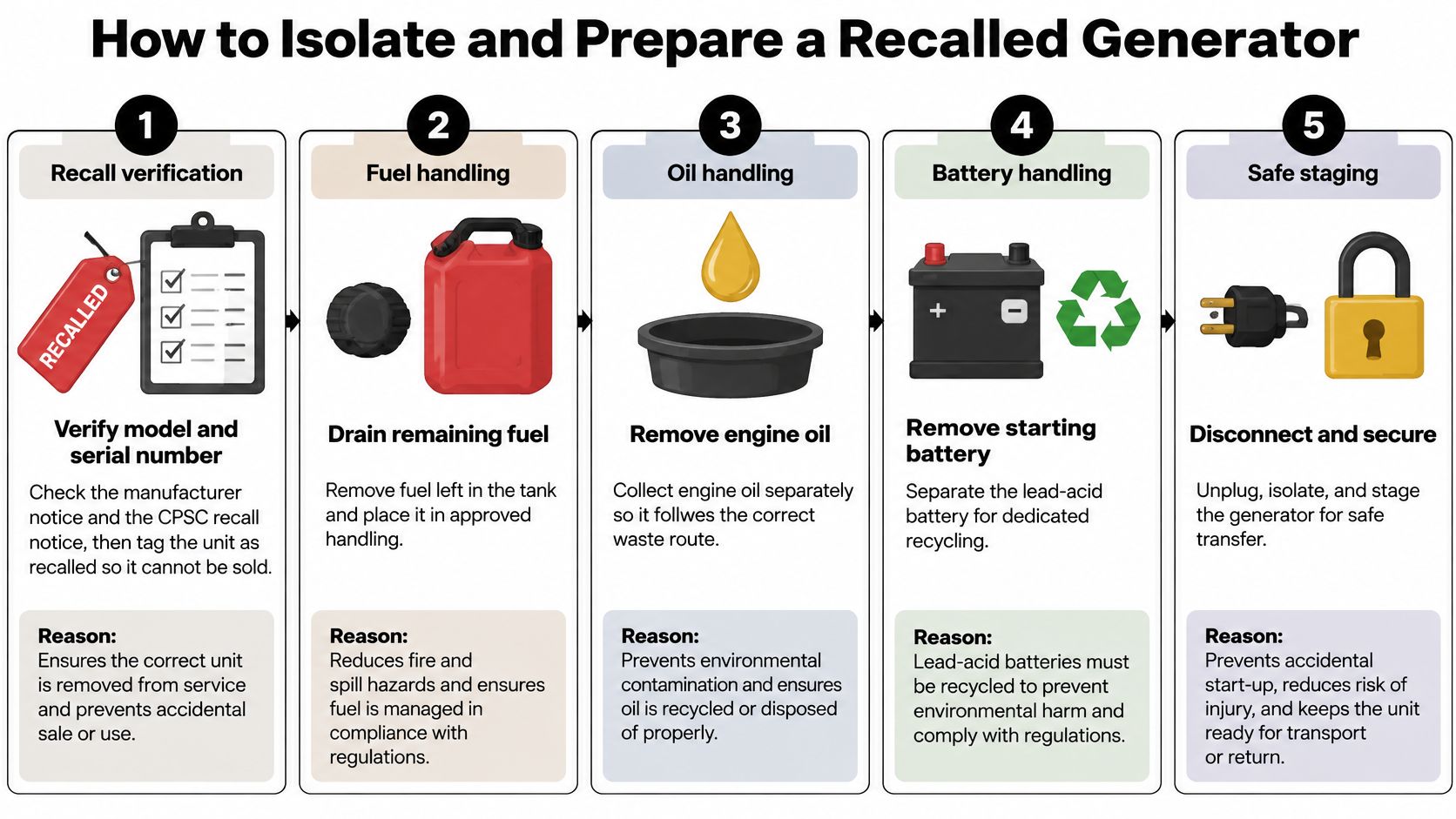
Work this sequence in order. Each step exists because skipping it creates a specific failure downstream, from a unit returning to service to a fuel spill in a box truck.
- Verify and tag. Check the model and serial number against the manufacturer notice and the CPSC recall notice. Tag the unit as recalled and electrically isolate it so it can't be sold, loaned, or redeployed by someone who didn't see the notice.
- Move it to a ventilated area. Trained personnel should move the generator outdoors or into a well-ventilated controlled area. Generators must never operate in enclosed spaces, and carbon monoxide can linger after shutdown.
- Shut down and cool. Let the engine cool fully before anyone touches fuel lines, the exhaust, or the crankcase. Hot surfaces plus fuel vapor is the combination you're trying to avoid.
- Inspect and photograph. Check for fuel, oil, battery condition, and physical damage, then photograph the unit as found. Those photos settle later disputes about leaks or missing parts.
- Drain fuel and lubricants to procedure. Only trained staff should do this, under hazardous-material procedures, into approved and labeled containers. The OSHA guidance on portable generator safety recommends approved, correctly marked and vented containers for generator fuels and warns that vapors can travel to ignition sources, and it notes CPSC recommends outdoor placement at least 20 feet from buildings with exhaust directed away from openings.
- Remove batteries and regulated components. Pull the starting battery and any other regulated parts so each follows its own route instead of riding along with scrap metal.
- Package against leaks and movement. Cap openings, secure the unit so it can't shift in transit, and contain any residual seepage before it reaches the truck floor.
- Record every custody transfer. Log each handoff from your site to the processor, with names, dates, and unit counts.
The slip that causes most trouble
The most common mistake is leaving fuel in the tank because the unit looks inactive. A generator that hasn't run in a year can still hold enough gasoline to create fire, spill, and transport risk, especially if a fuel line has degraded while sitting. The second mistake is functional testing indoors to see if the unit still works. Don't. If it starts, you've filled an enclosed space with exhaust to answer a question that doesn't change the disposal path.
The same isolation discipline applies to other fuel-burning equipment covered by recalled lawn equipment disposal services, where residual fuel and undocumented resale create identical risks.
A handover-ready unit is easy to recognize: tagged, drained to procedure, photographed, batteries removed, sealed, and logged with a serial number. If any one of those six is missing, the unit isn't ready to move, no matter how convenient the pickup window looks.
Handling Fuel, Batteries and Other Hazardous Parts
Fuel and batteries never go into general scrap. A recalled generator isn't one waste item, it's a bundle of streams, and each stream has its own authorized route. Sort them at intake, because untangling a mixed load later costs more and proves less.
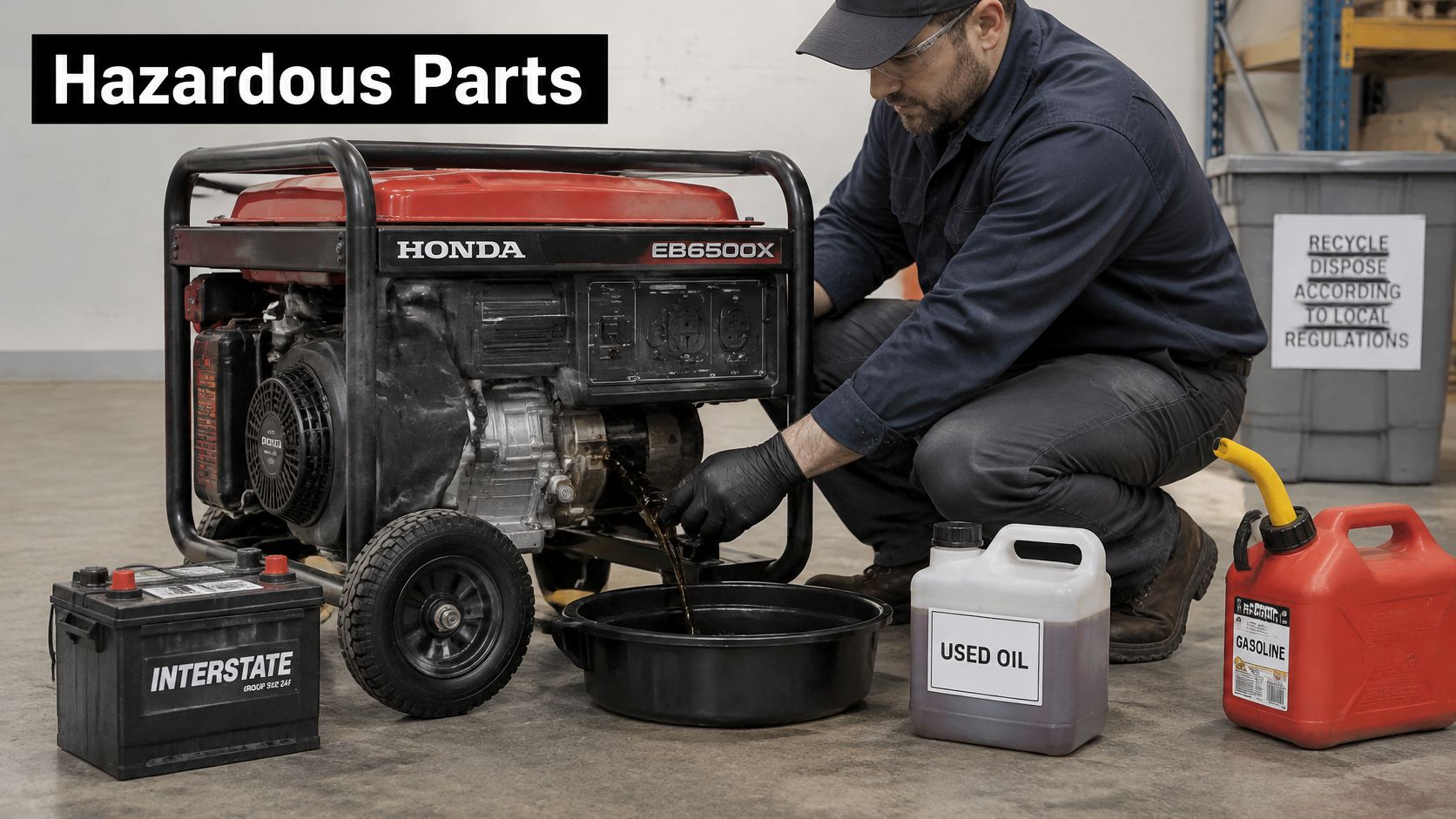
| Material | Handling at intake | Management route |
|---|---|---|
| Gasoline or diesel left in tank | Drain only by trained staff into an approved, labeled container | Hazardous-waste channel under federal and state rules |
| Engine oil | Drain into a separate labeled container, never with fuel | Used-oil recycler or hazardous-waste facility |
| Lead-acid starting battery | Remove, keep upright, store under cover | Universal Waste route to an authorized recycler |
| Lithium-ion battery | Tape terminals, isolate from metal and heat sources | Specialized battery recycler; confirm acceptance with processor |
| Steel frame, copper windings, plastic housing | Separate after depollution is complete | Certified metals and plastics recycler |
How the Universal Waste route works
Under the federal Universal Waste regulations in 40 CFR Part 273, EPA's Universal Waste guidance explains that certain hazardous waste streams commonly generated by businesses may be managed under less stringent requirements. Those materials can generally be stored for up to one year, don't usually require a hazardous-waste manifest or hazardous-waste transporter, and must be labeled, managed to prevent releases, and delivered to a permitted or designated facility. Lead-acid starting batteries are the stream most likely to fit this route on a generator job. Lithium-ion packs need a confirmed acceptance conversation first, and dedicated lithium battery recycling channels exist precisely because damaged or swollen cells don't belong in standard battery bins.
State rules can be stricter than federal rules, so confirm the route with your processor before the first pickup, not while the truck is loading. Ask which streams they'll accept, in what containers, and with what labels.
For every stream, answer three questions in writing: who's authorized to handle it, where it's delivered, and what document proves delivery.
The failure I see described most often in incident reviews is mixing. A fuel container lands in a general scrap bin, oil gets poured into the fuel drum, or batteries of different chemistries share one staging pallet. Separate fuel, oil, and batteries at intake, keep each in its own labeled staging area, and the rest of the job stays simple.
Documentation and Compliance Records to Keep
A recalled-generator program is judged on one thing: whether every unit can be traced from intake to final disposition. Recycling percentages don't prove that. Records do.
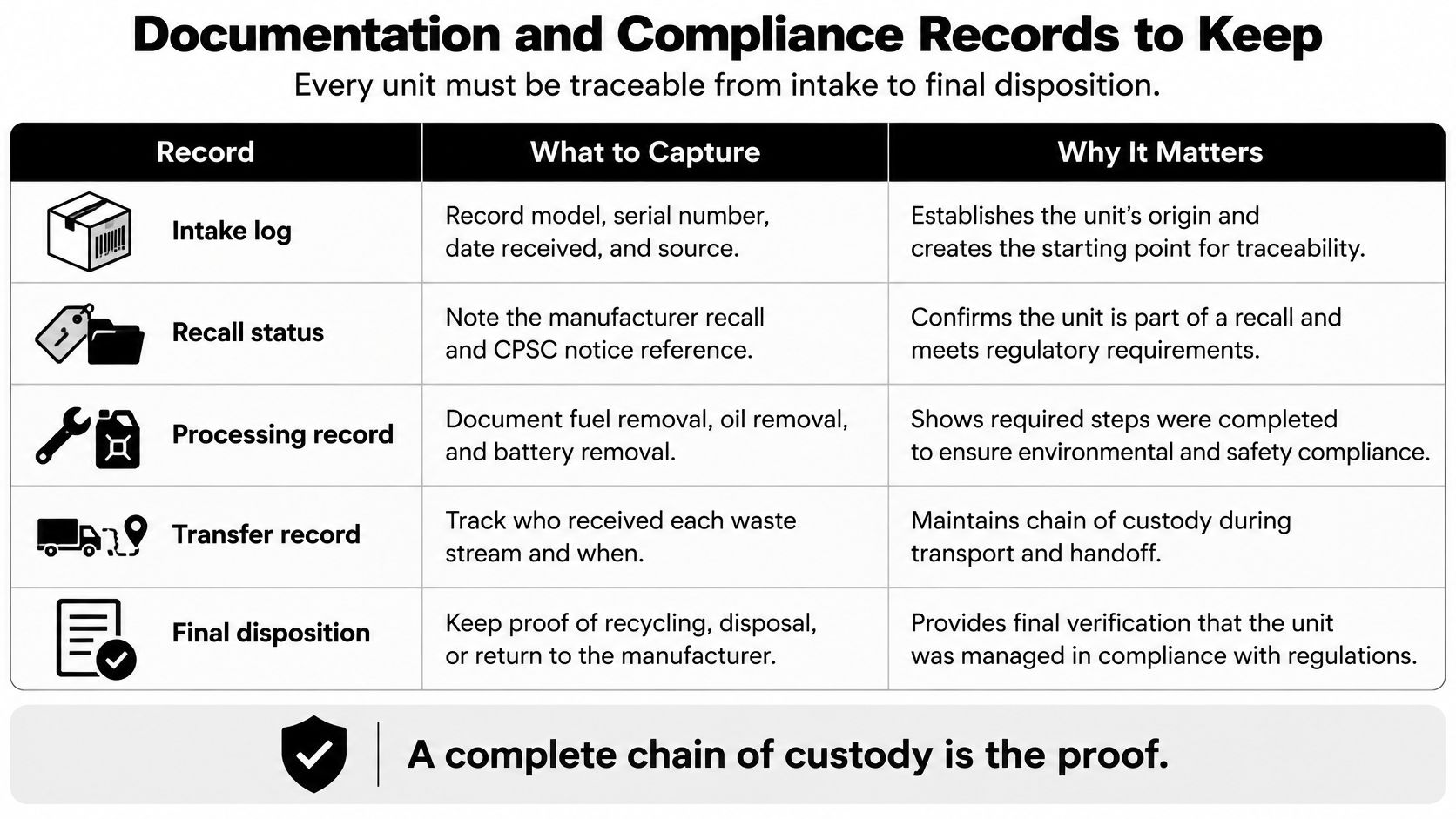
| Record | What it proves | Completed by |
|---|---|---|
| Recall notice copy | Recall status was checked at intake | Facilities or IT lead |
| Serial and model log | Each unit is identified by serial number | Receiving staff |
| Condition photographs | State of the unit before handling | Receiving staff |
| Custody transfer log | Every handoff from site to processor | Each party signing the transfer |
| Weight or unit count ticket | Quantity received and sent | Processor |
| Destruction or recycling certificate | Final disposition of each unit | Processor |
| Monthly hazardous-waste quantity tally | Aggregate generation for the calendar month | Environmental or facilities lead |
Why the monthly tally matters
EPA's hazardous waste generator guidance states that EPA regulates hazardous-waste generators according to the quantity generated in a calendar month, rather than facility size. That means recurring recalls must be assessed by aggregate monthly quantities against federal, state, and local requirements. A small site running several recall pickups in one month can cross a threshold a larger site wouldn't. The same guidance supports a defensible method built on a pre-acceptance checklist, segregation by fuel type and battery chemistry, labeled staging, documented pickup, and processor-issued weight and disposition records.
Three record-level failures break traceability: incomplete depollution, recalled units mixed into resale inventory, and subcontractor transfers with no signed record. Serial-level tracking prevents all three, which is why it suits commercial fleets and regulated organizations. A formal certificate of destruction for recalls closes the loop for units the manufacturer requires destroyed rather than repaired.
Set one pass or fail test: 100% reconciliation of received units to final disposition records, with zero unexplained serial numbers, fuel containers, batteries, or transfer gaps. That's an internal control target, not a government-certified success rate, and it's the number your auditor will care about.
Costs, Timelines and Booking Certified Pickup
There's no single price for a recalled generator, and any quote given without asking about fuel status should worry you. Cost follows a short list of drivers, and you control several of them before the truck arrives.
What drives the price
- Unit count and location: More units at one site lower the per-unit logistics cost. Scattered sites raise it.
- Pickup logistics: Dock-level loading is cheaper than sending a crew to carry units out of a basement or rooftop enclosure.
- Fuel status: Units arriving full of gasoline need drainage labor, containers, and a hazardous-waste route for the fuel itself.
- Battery types: Lead-acid starting batteries are routine. Lithium-ion packs, especially damaged ones, need specialized handling and confirmed acceptance.
- Documentation depth: Serial-level tracking, condition photography, and individual destruction certificates take more labor than a single weight ticket for a bulk load.
I would ask for a written quote that separates pickup, depollution, processing, and certification into distinct lines. Bundled quotes hide where the money goes and make competing bids impossible to compare. If a provider can't break out depollution, they may not be doing it as a defined step.
How the timeline runs
Think in stages, not hours. Verification and quarantine come first, and that work is mostly yours: serial checks, tagging, photos. Pickup scheduling follows once the processor knows unit counts, fuel status, and battery types. Processing happens at the facility, where depollution, dismantling, and material routing take place. The destruction or recycling certificate arrives last, after the processor completes the work and reconciles serial numbers. A certificate issued at the dock, before processing, isn't proof of anything except pickup.
Gather three things before you request service: the recall notices, the serial numbers, and condition photos for every unit. With those in hand, a certified provider can quote accurately and schedule recalled product pickup and destruction without a second site visit. Commercial pickup is available across the contiguous United States, and certificates of recycling and destruction close out each job. Send the serial list first. It's the fastest way to turn a storage room problem into a scheduled, documented removal.
Contact Beyond Surplus for certified electronics recycling and secure IT asset disposal, including documented pickup and destruction for recalled generators your organization can no longer repair or safely store. Send your recall notices, serial numbers, and photos, and the team will coordinate commercial pickup and issue the certificates that close your records. Start today at Beyond Surplus.