

For IT managers and business owners in Connecticut, that stack of old hard drives in a storage closet is more than just clutter—it's a significant liability. Many organizations mistakenly believe that a simple file deletion or a quick reformat is sufficient to wipe the slate clean. This creates a false sense of security, leaving sensitive corporate data dangerously exposed and easily recoverable.
For true data security, a permanent solution is required. That's where professional Connecticut hard drive shredding becomes essential. It’s the only method that guarantees your confidential information is irretrievably destroyed.
Why Simply Deleting Files Is a Major Business Risk

It’s a common misconception that hitting 'delete' or performing a standard format function actually erases information from a hard drive. This reflects a fundamental misunderstanding of how data storage technology works. When a file is deleted, the data itself isn't removed. Instead, the operating system is simply instructed that the space the data occupies is now available to be overwritten.
Think of it as removing the table of contents from a book. All the chapters remain intact, but the index to find them is gone. A knowledgeable individual, however, can still manually review the pages to locate the information they seek. Similarly, your "deleted" data remains on the hard drive platter until, eventually, new data is saved over that specific sector.
The Illusion of a Clean Slate
This digital ghost can persist for months or even years, easily accessible with commercially available data recovery software. For a business, this represents a massive vulnerability. A single improperly disposed-of hard drive can be a goldmine of confidential information, including:
- Financial Records: Corporate tax documents, payroll details, and banking information.
- Customer Data: Names, addresses, credit card numbers, and other personally identifiable information (PII).
- Intellectual Property: Trade secrets, proprietary research, and unique product designs.
- Employee Information: Social Security numbers, private contact details, and performance evaluations.
If that data falls into the wrong hands, the consequences can be devastating, ranging from financial fraud and identity theft to catastrophic brand damage and severe legal penalties. Understanding the security risks of delayed data destruction is the first critical step toward building a secure IT asset disposal plan for your enterprise.
A formatted hard drive is not an empty hard drive. It's a device waiting to become a data breach. Physical destruction is the only way to ensure retired IT assets don't become a massive corporate liability.
Physical Destruction Is the Only Guarantee
This is precisely why professional Connecticut hard drive shredding is essential for commercial operations. Unlike software-based wiping, which can fail or be incomplete, physical destruction is absolute. An industrial-grade shredder pulverizes the drive—including the platters and internal components—into tiny, unsortable metal fragments.
This process renders the data completely and permanently unrecoverable, closing the significant security loophole that formatting leaves open. It's not just about erasing data; it's about annihilating the physical media it was stored on. This provides your business with ultimate peace of mind and an auditable Certificate of Destruction for compliance purposes.
Meeting Connecticut's Strict Data Privacy and E-Waste Laws
For any Connecticut business, navigating the complex landscape of data security and e-waste regulations can be overwhelming. However, non-compliance is not an option, which is why professional hard drive shredding has become a non-negotiable component of responsible corporate governance. The state has a strict framework covering both data protection and the disposal of obsolete electronics.
Understanding these regulations is the first step in protecting your company from significant fines and reputational damage. For businesses operating in Connecticut, two major legislative frameworks are paramount.
The Connecticut Data Privacy Act (CTDPA)
The Connecticut Data Privacy Act (CTDPA) fundamentally changed how businesses must handle the personal data of state residents. This law grants consumers specific rights, including the right to have their data deleted. Disposing of end-of-life IT equipment without ensuring data sanitization is a clear violation of the CTDPA.
The act mandates that businesses implement "reasonable administrative, technical, and physical data security practices." The physical destruction of old hard drives is widely regarded as a cornerstone of these practices because it offers a 100% guarantee that customer data cannot be recovered from retired equipment.
DEEP E-Waste Regulations
In addition to data privacy, Connecticut’s Department of Energy and Environmental Protection (DEEP) has stringent rules for e-waste. These regulations are designed to prevent hazardous materials from consumer and commercial electronics from entering landfills, where they can contaminate the environment. Your company's old hard drives and other IT assets fall directly under these e-waste mandates.
This dual legal framework means every business must address two critical challenges simultaneously:
- Data Security: Ensuring all sensitive information is permanently destroyed.
- Environmental Compliance: Disposing of the physical hardware in an environmentally responsible manner.
A certified Connecticut hard drive shredding service addresses both of these requirements in a single, streamlined process. The shredding makes data irretrievable and ensures the resulting materials are properly recycled, keeping your business compliant with DEEP’s environmental standards. To learn more, see our guide on compliant Connecticut electronics recycling solutions for enterprises.
The High Cost of Non-Compliance
The demand for secure hard drive shredding has accelerated due to the stringent 2025 data privacy laws under the CTDPA and DEEP e-waste regulations. These rules require physical destruction methods like shredding for any device containing high-risk data, as it is the only way to certify that data is truly eliminated.
Compliance guides specify that organizations must adhere to NIST 800-88 'Destroy' standards and maintain proof, such as a Certificate of Destruction, for audit purposes. Failure to comply can result in significant fines, with penalties reaching as high as $7,500 per violation under the CTDPA. You can even review local press releases to understand the state's focus on secure disposal.
A Certificate of Destruction is more than a receipt; it is a legal document that formally transfers liability from your organization to your certified disposal partner. It serves as your official proof of compliance in the event of an audit.
This document serves as your defense, linking Connecticut's regulations with federal laws like HIPAA (for healthcare) and GLBA (for financial services), which also mandate secure data handling. Working with a certified vendor provides a serialized audit trail, proving due diligence and protecting your business from the consequences of a data breach or an environmental fine.
Choosing Between On-Site and Off-Site Shredding
Once you have committed to physical destruction, the next decision is where the shredding will occur. For businesses in Connecticut, this choice typically involves two primary options: on-site (mobile) shredding and off-site (plant-based) shredding.
Each method offers distinct advantages, and the optimal choice depends on your company's security policies, budget, and logistical requirements. There is no single "best" answer; the goal is to align the service with your internal risk management protocols and workflow.
On-Site Shredding: The Ultimate in Transparency
On-site shredding, also known as mobile shredding, brings the entire destruction process to your location. A specialized, high-security vehicle equipped with an industrial-grade shredder is dispatched to your facility. Your hard drives are destroyed on your premises before being transported for recycling.
This method provides an unparalleled level of transparency and complete peace of mind.
- Direct Verification: Your team can personally witness the entire process, from scanning serial numbers to observing the drives being physically destroyed. This creates a solid, verifiable chain of custody without any gaps.
- Immediate Destruction: Data is eliminated on-site, eliminating the risks associated with transporting intact data-bearing devices.
- Maximum Security: This is the preferred choice for organizations handling highly sensitive information, such as healthcare providers, financial institutions, and government contractors subject to the strictest compliance mandates.
Because it involves dispatching specialized equipment and a dedicated crew, on-site services are priced at a premium. However, for businesses where a data breach would be catastrophic, the additional cost is a prudent investment in total security assurance. To learn more, explore the details of professional on-site shredding services.
This decision tree provides a visual guide for assessing your data disposal needs, from determining risk levels to understanding the significant penalties for non-compliance.
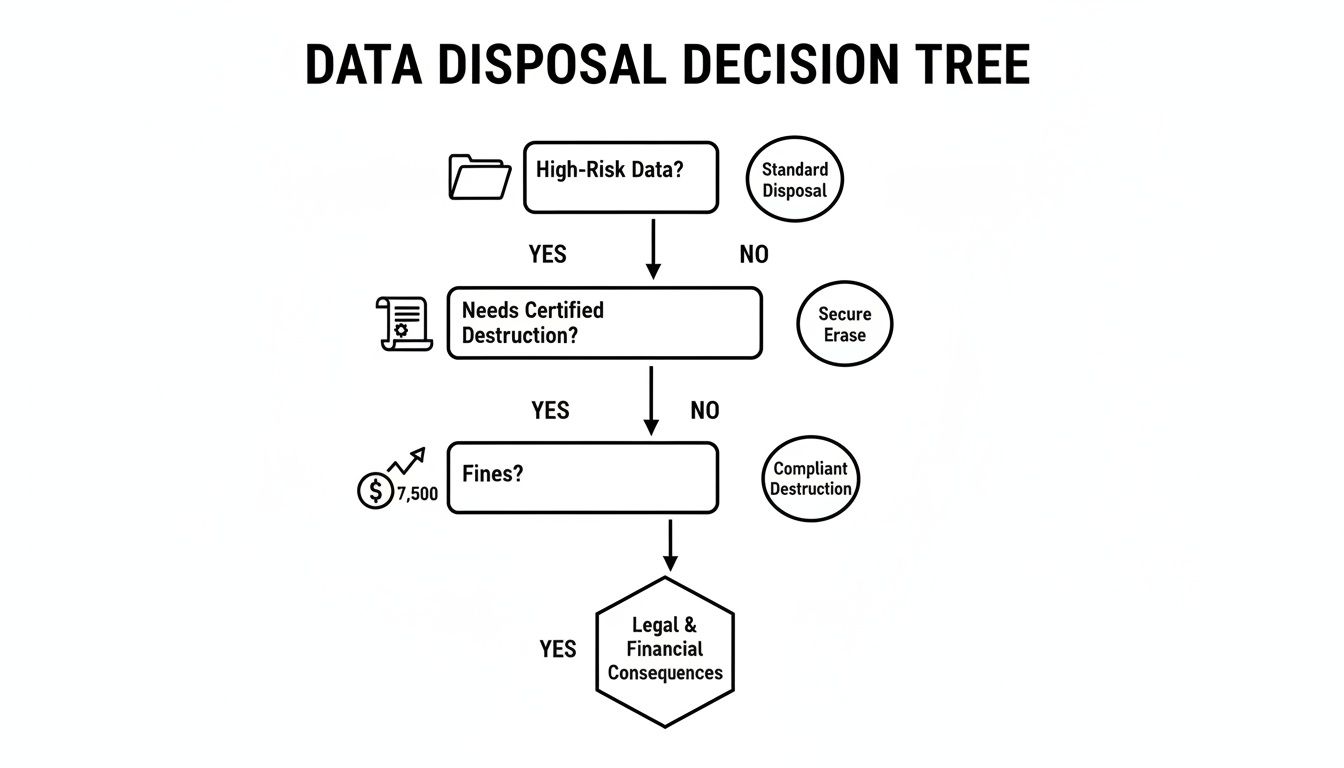
As the chart illustrates, for high-risk data requiring certified proof of destruction, utilizing a professional shredding service is essential for avoiding severe financial penalties.
Off-Site Shredding: Efficient and Cost-Effective
Off-site shredding, or plant-based shredding, offers a more streamlined and budget-friendly solution. With this service, a certified vendor collects your hard drives in securely sealed, GPS-tracked containers and transports them to a dedicated, high-security destruction facility.
Although the shredding is not witnessed directly, a reputable partner will maintain a strict, fully documented chain of custody from collection to final destruction.
Off-site shredding is not less secure; it relies on a documented, audited process rather than direct visual confirmation. Security is integrated into the vendor's certified procedures—from locked containers and GPS tracking to 24/7 facility surveillance.
This approach is often the most practical choice for businesses with a large volume of drives or those not bound by internal policies requiring witnessed destruction.
The primary benefits are:
- Cost-Effectiveness: Because vendors process large volumes of media from multiple clients at a central plant, they can offer more competitive pricing.
- Scalability: Off-site shredding can easily accommodate large-scale projects, such as a complete data center decommissioning, without disrupting your daily operations.
- Certified Security: The entire process occurs within a secure facility with controlled access, continuous video surveillance, and regular, unannounced third-party audits (a key requirement for NAID AAA Certification).
Upon completion, you receive the same official Certificate of Destruction as with on-site shredding. This document serves as your audit trail and proof of compliance, confirming your assets were destroyed according to industry best practices. The key is to select a certified vendor who provides transparent documentation at every stage.
To help you evaluate the options, here is a direct comparison of the two services.
Comparing On-Site vs. Off-Site Hard Drive Shredding Services
This table outlines the key differences between on-site and off-site shredding, enabling Connecticut businesses to determine which service best aligns with their security, budget, and compliance needs.
| Feature | On-Site (Mobile) Shredding | Off-Site (Plant-Based) Shredding |
|---|---|---|
| Location of Destruction | At your business location | At a secure, specialized facility |
| Chain of Custody | Unbroken visual confirmation | Documented and audited, with tracking |
| Security Level | Highest; direct witnessing | High; relies on certified processes |
| Cost | Premium pricing | More budget-friendly |
| Best For | Maximum security, compliance needs | Cost-effectiveness, large volumes |
| Convenience | Minimal disruption, immediate results | Requires scheduled pickup |
| Verification | Witness the process firsthand | Relies on a Certificate of Destruction |
| Ideal Client | Healthcare, finance, government | Businesses of all sizes, IT asset managers |
Ultimately, whether you choose the absolute transparency of on-site shredding or the efficiency of an off-site service, partnering with a certified vendor is what truly matters. Both paths lead to the same secure, compliant outcome: your data is permanently destroyed, and you have the documentation to prove it.
The Hidden Failures of Wiping and Degaussing
On the surface, software wiping and degaussing appear to be secure methods for data destruction. However, a closer examination reveals serious weaknesses that could leave your Connecticut business exposed. These methods are not as foolproof as they seem and can create a false sense of security—a dangerous liability when sensitive corporate information is at stake.
Understanding their shortcomings is key to recognizing why physical destruction is the only true guarantee.
The Limits of Software Wiping
For any IT manager or business owner, relying solely on software to erase data is a significant gamble. Wiping utilities work by overwriting existing data with random characters, but the process itself can be surprisingly fragile.
Software-based erasure can fail for several critical reasons, leaving recoverable data behind. If a drive has minor physical damage, such as bad sectors, the wiping process may halt before completion. The software might even report a successful wipe when, in reality, it simply skipped over the damaged areas where sensitive data could still reside.
Furthermore, human error is a factor. An employee might accidentally select the wrong wiping standard, use an outdated program, or misinterpret the results. These small mistakes can lead to an incomplete wipe, leaving behind data fragments that a determined individual with forensic tools could reconstruct. To better understand proper data sanitization, you can learn more about how to completely clean a hard drive and the steps involved.
The core problem with wiping is its dependency on two factors: a perfectly functioning drive and flawless execution by the operator. Physical shredding eliminates both variables by destroying the drive itself, leaving zero room for error.
Degaussing's Critical Flaw in the Modern Era
Degaussing, which uses powerful magnets to scramble data on traditional hard disk drives (HDDs), was a reliable method for older technology. However, modern advancements have rendered it almost completely obsolete.
The fatal flaw of degaussing is its total inability to erase data from Solid-State Drives (SSDs). SSDs do not store data magnetically; they use flash memory chips. A degausser will have absolutely no effect on the information stored on an SSD, making the method useless for any organization using modern computer hardware.
As the Connecticut business landscape demonstrates, relying on outdated methods creates significant vulnerabilities. Physical Connecticut hard drive shredding is now the gold standard because it offers total certainty. Industrial shredders grind both HDDs and SSDs into tiny, unrecognizable fragments—a stark contrast to wiping, which fails in 42% of forensic recovery tests, according to NIST 800-88 data.
This is precisely why state e-waste compliance laws now mandate physical destruction for high-risk industries like finance and healthcare, which often require on-site events to process thousands of devices while maintaining compliance with HIPAA and SOX.
These hidden failures make it clear why physical destruction is the superior choice. It is the only method that delivers the 100% certainty demanded by compliance standards like NIST 800-88, completely removing any doubt or risk from your IT asset disposal process.
Getting Your Hard Drives Ready for Secure Destruction
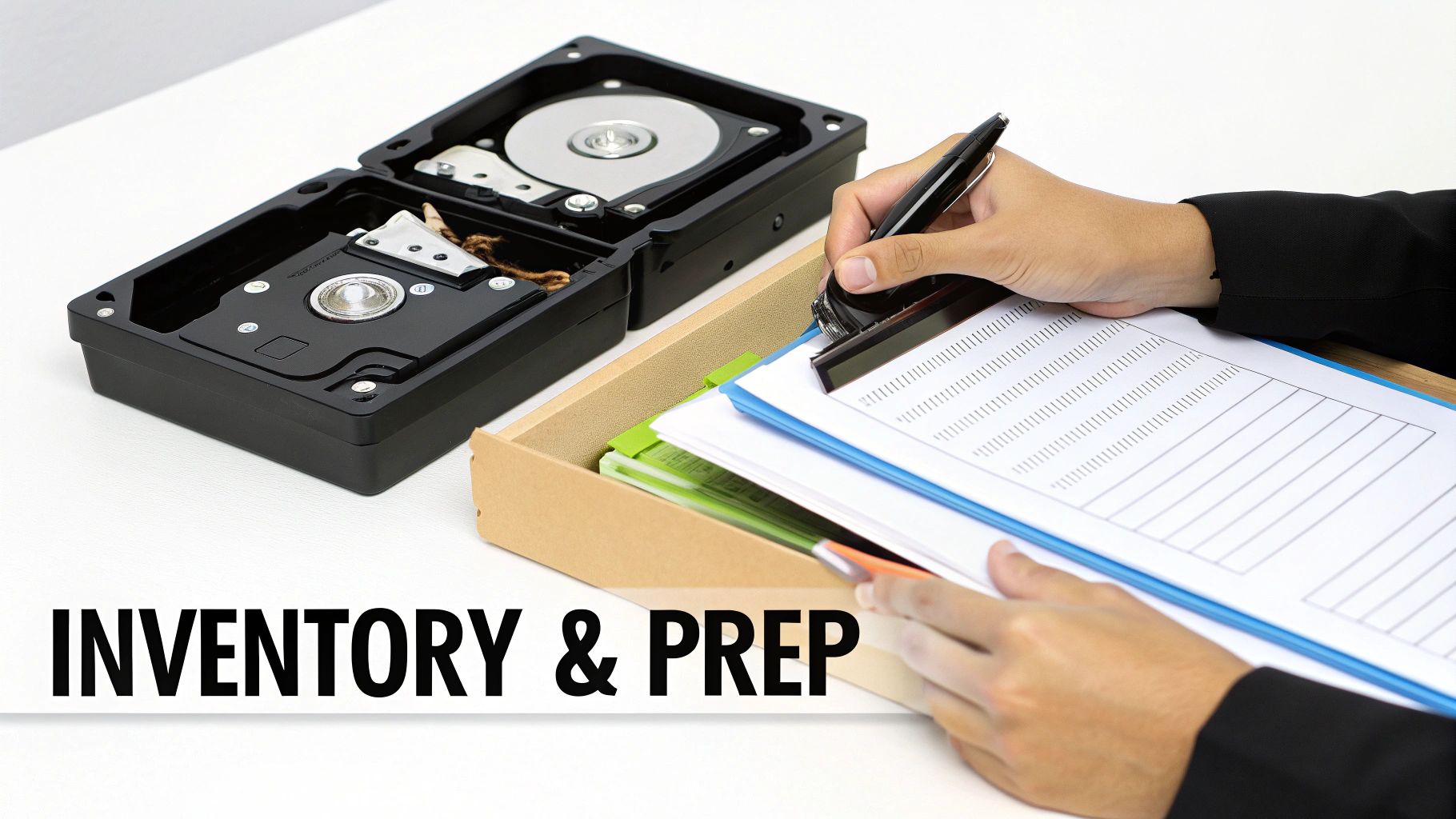
A successful Connecticut hard drive shredding project begins long before our vehicle arrives at your facility. Organizing your devices beforehand is the key to a smooth, efficient, and fully auditable process. Taking a few preparatory steps ensures that every data-bearing device is accounted for and that the chain of custody is solid from the start.
Rushing this preparation can lead to overlooked drives, gaps in your audit trail, and logistical challenges on the day of service. A methodical approach ensures nothing is missed.
Create a Detailed Asset Inventory
First, create a comprehensive list of every device slated for destruction. This is not just about a headcount; it's about building an unbreakable audit trail that proves each asset was handled responsibly. This inventory is your first line of defense during a compliance audit.
Your inventory should include, at a minimum:
- Asset Type: Specify whether it is a desktop, laptop, server, or loose drive.
- Serial Number: Record the unique serial number of each hard drive or SSD.
- Location: Note the device's origin, such as "Marketing Department" or "Server Room 3."
- User/Owner: If possible, link the asset to the last person or department that used it.
This detailed record forms the basis for the Certificate of Destruction you will receive, ensuring a one-to-one match between the assets you released and those that were destroyed.
Safely Remove and Consolidate Drives
With your inventory complete, the next task is to physically remove the hard drives from their machines. This significantly expedites the shredding process, especially for high volumes of desktops, laptops, and servers.
While this is a routine task for most IT teams, care must be taken if you plan to repurpose or resell the computer chassis. If your team lacks the bandwidth for a large-scale removal project, let us know, as this is a service we can often provide.
Key Takeaway: Consolidating all hard drives in one location is a critical security measure. Once removed, all drives should be gathered and stored in a secure, access-controlled area—such as a locked IT closet or storage room—while awaiting pickup. This simple step prevents an inventoried drive from being misplaced or accidentally returned to service.
Secure Storage and Final Verification
Once all drives have been removed and consolidated, perform a final check against your inventory list. This final verification is your last opportunity to confirm that every drive intended for destruction is present and accounted for before our arrival.
This organized approach does more than streamline the day of service; it demonstrates a serious commitment to due diligence. When everything is inventoried, removed, and securely stored, our technicians can proceed directly to the critical task of complete and secure data annihilation.
When it comes time to shred your hard drives in Connecticut, choosing the right vendor is as critical as the shredding process itself. Your data destruction partner is your first line of defense against liability. A reputable provider ensures every step is secure, compliant, and—most importantly—documented.
Failure to properly vet vendors can lead to corner-cutting, creating a fast track to a data breach and its associated legal consequences. You are not just procuring a service; you are engaging a security partner to protect your data and your reputation.
The Gold Standard: NAID AAA and R2v3 Certifications
When evaluating potential partners, certain credentials are non-negotiable.
NAID AAA Certification is the premier standard in the secure data destruction industry. This certification means the vendor is subject to rigorous, unannounced audits covering everything from hiring practices to operational security. It is your guarantee that they adhere to the highest security benchmarks.
Additionally, R2v3 Certification focuses on responsible electronics recycling. It ensures that after your drives are shredded, the resulting materials are managed in an environmentally sound and ethical manner. A partner holding both certifications offers a complete solution: ironclad data security and responsible e-waste management.
Essential Paperwork: Chain of Custody and Certificate of Destruction
A secure process is a documented process.
A documented chain of custody is the log that tracks your hard drives from the moment they leave your control until they are officially destroyed. This detailed record, complete with serial numbers and signatures at each handoff, creates an auditable trail that withstands scrutiny.
After the shredding is complete, you must receive an official Certificate of Destruction. This legal document formally transfers liability from your company to the vendor. It is your proof of compliance, detailing what was destroyed, when, and how, protecting you in the event of an audit. Your company's security hinges on finding a partner that provides these essential ITAD services in Connecticut.
Your choice of a data destruction partner directly impacts your company's risk profile. A certified vendor with robust liability insurance doesn't just shred drives; they absorb the risk, providing a critical layer of financial and legal protection for your organization.
The market for secure destruction is expanding. The acquisition of Secure Eco Shred by Infoshred in August 2025 highlights the growing demand in Connecticut as businesses work to comply with regulations like the CTDPA. These laws mandate certified physical shredding for both SSDs and HDDs to meet NAID AAA and R2v3 standards, as simple wiping is no longer sufficient for high-security needs.
With reports showing that a staggering 68% of data breaches in 2024 resulted from improperly disposed media, it is clear why Connecticut firms are increasingly relying on on-site shredding to ensure their data is permanently destroyed. You can find more details about Connecticut's data destruction compliance on datadestruction.com.
Common Questions About Hard Drive Shredding
Even after committing to the process, it is natural to have some final questions before booking a hard drive shredding service in Connecticut. Addressing these details is key to ensuring confidence in your data security strategy.
We have compiled answers to the most common questions from businesses to make the entire process transparent and straightforward.
What Does Hard Drive Shredding in Connecticut Typically Cost?
Generally, you can expect professional hard drive shredding in Connecticut to cost between $10 and $20 per drive. The final price, however, depends on several key factors.
- Volume: As with most services, larger quantities typically result in a lower per-unit cost. We often provide significant discounts for bulk projects.
- Service Type: On-site shredding, where a mobile destruction truck comes to your office, usually falls at the higher end of the price range due to the convenience and real-time verification it offers.
- Additional Services: If you require drive removal from machines or a detailed, serialized report, be sure to request these services for a complete and accurate quote.
Off-site shredding is almost always the more budget-friendly option and is an excellent fit for large projects where witnessed destruction is not a strict compliance requirement for your industry.
Are SSDs Shredded the Same Way as Traditional HDDs?
Yes, they are, for a critical reason. While the internal technology is different, the only guaranteed way to destroy data on both types of drives is through complete physical annihilation.
Older methods like degaussing (using powerful magnets) are effective on traditional Hard Disk Drives (HDDs) but are 100% ineffective on Solid-State Drives (SSDs). This is because SSDs use non-magnetic flash memory chips.
Even software-wiping can be unreliable with SSDs due to their data management architecture. This is why physical shredding is the only certified, foolproof method that works on all drive types, ensuring total security regardless of your hardware.
What Proof Do I Get After My Hard Drives Are Destroyed?
Upon completion of the service, your shredding vendor must provide you with a formal Certificate of Destruction. This is not just a receipt—it is a critical legal document that serves as your official proof of secure and compliant data disposal.
The Certificate of Destruction is your essential audit trail. It formally transfers liability from your organization to the vendor and demonstrates your adherence to data privacy laws like CTDPA, HIPAA, and FACTA.
This document should clearly state the date, method, and location of the destruction and include a serialized list of every asset that was destroyed. It is your ultimate protection in the event of a regulatory audit, proving you took all necessary steps to safeguard sensitive information.
Contact Beyond Surplus for certified Connecticut hard drive shredding and secure IT asset disposal. We provide compliant and documented data destruction services for business audiences. Schedule your secure pickup today by visiting us at https://www.beyondsurplus.com.


