
A lot of Johns Creek businesses are dealing with the same scene right now. Old laptops are stacked in a back office. A few retired servers are sitting on a rack with drives still installed. Networking gear from the last upgrade is waiting for “someone” to decide what to do with it.
That delay creates risk. Devices don't stop holding sensitive data because they've been unplugged. They become a liability the moment your team loses visibility into where they are, what data is on them, and who's responsible for retiring them properly.
If you're searching for ITAD services in Johns Creek, what you need isn't a junk hauler with a recycling trailer. You need a documented process for inventory control, data destruction, compliance support, and value recovery.
Why ITAD is a Critical Business Function in Johns Creek
Johns Creek isn't a market where IT disposal is a niche problem. It's a recurring business function. The city's open-data portal reports that 46.2% of its workforce is in professional and technical services (Johns Creek workforce data). That kind of local business mix usually means heavy use of laptops, workstations, servers, storage devices, and networking hardware.
That matters because these environments generate regular refresh cycles. Devices age out. Employees leave. Offices consolidate. Departments replace systems in batches. None of that is unusual. What's dangerous is treating the retirement of those assets like an occasional cleanup project instead of an operational process.
Disposal is the wrong frame
Calling ITAD “disposal” undersells the problem. A retired laptop can expose customer records, employee files, saved credentials, and internal documents. A decommissioned server can still contain regulated data. A pallet of old gear can create audit headaches if your company can't show what happened to each asset.
For Johns Creek companies, especially those operating in healthcare, education, finance, and other sensitive sectors, ITAD sits at the intersection of:
- Security risk
- Compliance obligations
- Environmental responsibility
- Asset value recovery
The real question isn't “How do we get rid of this equipment?” It's “How do we retire it without creating a data, legal, or financial problem?”
Why local businesses should care now
In suburban business hubs, technology retirement isn't a one-time event. It keeps coming back. That's why smart organizations build a repeatable ITAD policy instead of making one-off decisions every quarter.
A good place to start is understanding why ITAD services matter for Georgia companies in 2026. The specifics vary by company, but the core issue stays the same. If your business depends on technology, then end-of-life management belongs in your risk program.
Foundational ITAD Services for Secure Asset Retirement
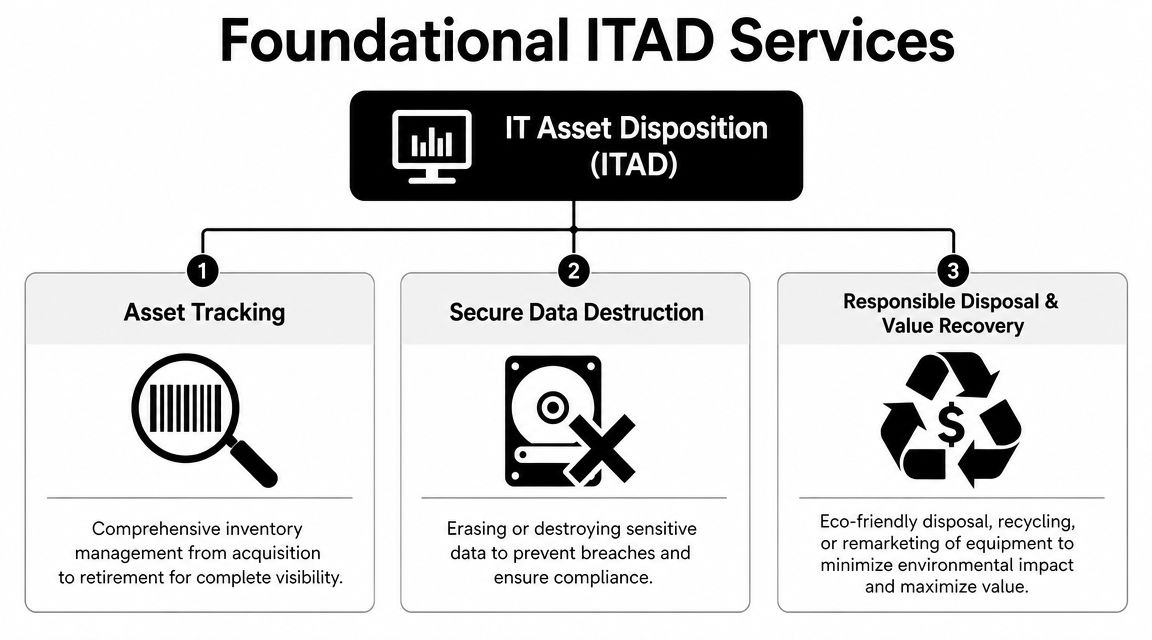
A real ITAD program rests on three pillars. If a vendor can't handle all three, keep looking.
Asset tracking
The first job is basic but essential. Build a clear inventory of what's leaving service.
That means recording device type, manufacturer, model, serial number, asset tag, and final disposition path. Without that record, your company can't prove what was picked up, what was destroyed, what was wiped, or what was remarketed.
A lot of businesses skip this step because it feels administrative. That's a mistake. Inventory control is what turns ITAD from “equipment removal” into a governed process.
Secure data destruction
Data destruction is where many buyers get sloppy. They ask, “Do you wipe drives?” when they should be asking, “Which media types do you wipe, which do you destroy, and what documentation do you provide?”
Secure data destruction can include software-based erasure, degaussing in limited use cases, or physical destruction. The right method depends on the media, the condition of the device, the sensitivity of the data, and your internal policy.
Practical rule: If the vendor can't explain its destruction methods in plain language, don't trust the process.
Responsible disposal and value recovery
The final pillar is downstream handling. Some assets should be refurbished and remarketed. Some should be harvested for parts. Some should be recycled through certified channels because reuse isn't viable or appropriate.
That's why responsible ITAD combines environmental controls with financial common sense. Throwing everything into a shred stream is easy, but it can destroy recoverable value. Reusing everything is reckless if the data risk is high. A competent provider knows the difference.
Here's the baseline you should expect:
- Clear intake procedures so nothing disappears between pickup and processing
- Defined destruction paths for storage media
- Certified recycling channels for non-remarketable equipment
- Disposition reporting that your finance, compliance, and IT teams can all use
If you want a Georgia-specific view of how those pieces fit together, review Georgia ITAD solutions that reduce risk and recover asset value.
Mastering Compliance and Chain of Custody Documentation
Most businesses focus too much on the truck and not enough on the paperwork. That's backward. The paperwork is what protects you when an auditor, customer, insurer, or regulator wants proof.
Chain of custody is liability control
Chain of custody means you can document where each asset was, who handled it, when it changed hands, and what happened at the end of the process. Pickup logs, serialized inventories, custody transfers, destruction records, and final certificates all belong in that trail.
If any part of that chain is fuzzy, liability stays with you. Not with the recycler. Not with the downstream vendor. With you.
That matters because old devices often hold personal, financial, medical, employee, or proprietary information. If your company can't show a disciplined retirement process, it's much harder to defend your actions after a loss event or compliance review.
Certificates are evidence, not souvenirs
A Certificate of Data Destruction and a Certificate of Recycling aren't decorative PDFs. They're evidence that your business followed a documented process and transferred equipment into a controlled end-of-life stream.
Ask every vendor these questions:
- What documents do we receive after pickup?
- Do certificates tie back to serialized inventory records?
- How long are records retained?
- Can you support audit requests later?
A company that takes security seriously should also think broader than disposal alone. If you're tightening your operational controls, this guide to protecting your small business is a useful companion resource because ITAD failures usually show up alongside weak asset governance, poor access controls, and incomplete audit practices.
A documented chain of custody is how you prove that retired equipment didn't drift into an uncontrolled gray market.
What to demand from a provider
Don't settle for vague assurances. Require:
| Requirement | Why it matters |
|---|---|
| Serialized inventory | Proves which assets entered the process |
| Custody records | Shows who handled devices and when |
| Destruction documentation | Supports compliance and internal governance |
| Recycling certificates | Confirms downstream processing path |
| Record retention | Protects you during later audits or disputes |
If you're evaluating vendor qualifications, start with what to know about R-2 certified ITAD providers in Georgia. Certification alone doesn't solve every problem, but it's a useful filter.
Deciding Between Data Wiping and Physical Shredding
Many Johns Creek businesses make bad decisions. They assume one method works for every device. It doesn't.
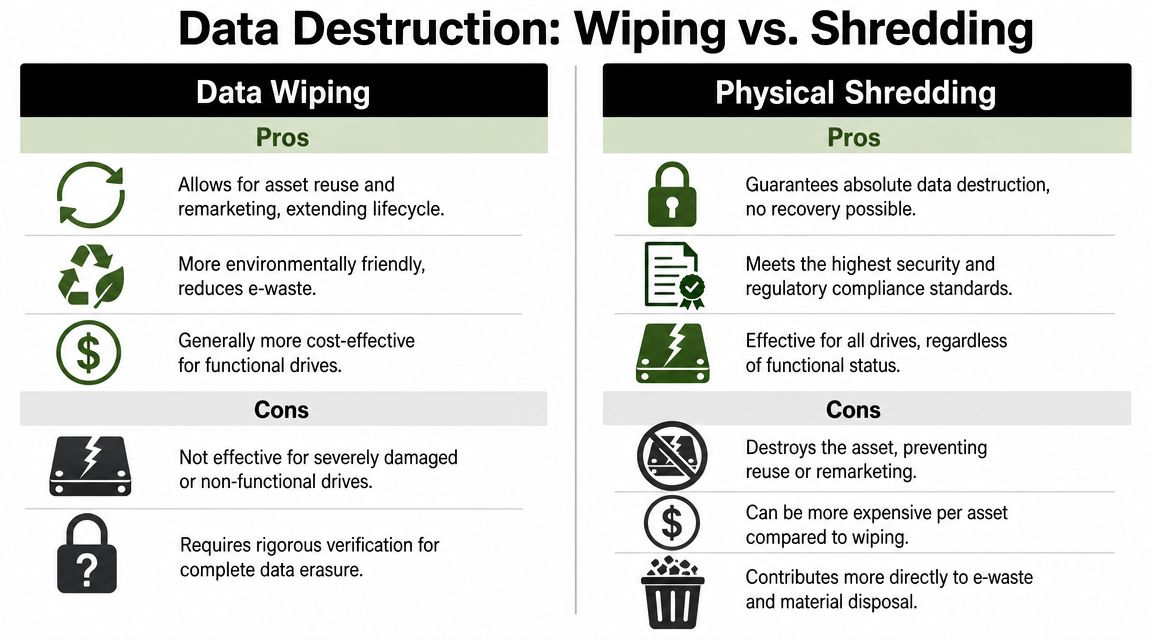
Industry guidance is clear that storage media require different destruction methods. Secure erasure can preserve resale value for assets like HDDs, while physical destruction and documented chain-of-custody are often necessary for regulated data on devices like SSDs, which are harder to wipe completely (industry guidance on choosing a reputable ITAD vendor).
When wiping makes sense
Wiping is the right call when the drive is functional, the data risk is manageable under your policy, and the business wants to preserve resale value.
For hard disk drives, secure erasure is often a practical option because the media structure is more predictable for sanitization workflows. If the drive passes the process and the vendor can verify erasure properly, you may be able to remarket the device or redeploy it.
Choose wiping when:
- The asset still has market value
- The drive is operational
- Your policy allows sanitization instead of destruction
- You need a balance between security and recovery value
That's often the smarter route for standard corporate laptops and desktops that don't hold the most sensitive class of information.
When shredding is the better choice
Shredding is the right answer when certainty matters more than resale. It's also the safer option for damaged media, failed drives, and high-risk data sets.
For solid-state drives, caution is justified. SSD architecture makes complete sanitization harder to validate in some situations. If the assets contain regulated data, legal records, sensitive customer information, or mission-critical intellectual property, physical destruction gives you a cleaner risk position.
Use shredding when:
- The media is damaged or non-functional
- The data is regulated or highly sensitive
- Your retention and compliance teams need a defensible hard-stop outcome
- The device type makes sanitization less reliable
Don't maximize resale value on assets that could trigger a breach investigation. That tradeoff rarely looks smart after the fact.
A workable decision framework
Use this simple approach:
| Media type | Lower-risk use case | Higher-risk use case |
|---|---|---|
| HDD | Verified secure wipe if policy permits | Physical destruction if data sensitivity is high |
| SSD | Specialized erasure only if policy explicitly allows it and verification is strong | Physical destruction is usually the safer choice |
If your internal team doesn't already have a media-specific policy, fix that now. General instructions like “erase all drives” are too vague. For practical background on sanitization, see how to erase a hard drive. Then build a policy that separates HDDs from SSDs and standard assets from regulated ones.
Streamlining Logistics and Maximizing Asset Value
A good ITAD program has to work effectively in practice. That means pickups, packing, scheduling, site coordination, and reporting can't be chaotic.
A useful Johns Creek benchmark is that some local providers offer free business pickup at 10 eligible electronic items and maintain tracking records for at least 3 years (Johns Creek electronics recycling benchmark). That tells you two important things. First, structured commercial service is accessible even for modest refreshes. Second, recordkeeping isn't optional in a mature ITAD workflow.
Make logistics easy on your team
The best process is boring. Your staff shouldn't have to improvise packing plans or argue over where old assets should sit until pickup day.
Use a repeatable logistics model:
- Stage assets by category such as laptops, servers, network gear, and loose drives
- Separate media for special handling if some devices require destruction while others qualify for wiping
- Assign one internal owner who signs off on counts and release
- Require pickup documentation at the moment equipment leaves your control
That approach reduces mistakes and speeds up reconciliation later.
Don't leave asset value on the floor
Retired equipment isn't always scrap. Functional business hardware may still have remarketing value, especially when it's clean, complete, and retired in an organized batch.
A buyback program usually works like this:
- Assets are inventoried and evaluated.
- Devices suitable for reuse are tested and processed.
- Equipment with no reuse path goes to responsible recycling.
- The recovery value offsets service costs or returns value to the client.
One provider that fits this model is Beyond Surplus asset recovery services in Georgia, which handles secure data removal alongside remarketing and recycling workflows.
If you mix valuable assets with scrap and ship everything blindly, you're paying to destroy equipment that may still have financial value.
The key is discipline. Sort first. Set destruction rules by policy. Recover value where the risk profile allows it.
Your Vendor Selection Checklist for ITAD in Johns Creek
Most ITAD vendor mistakes happen during procurement. The buyer asks about pickup speed and price, but skips the questions that matter once data, audits, and liability enter the room.
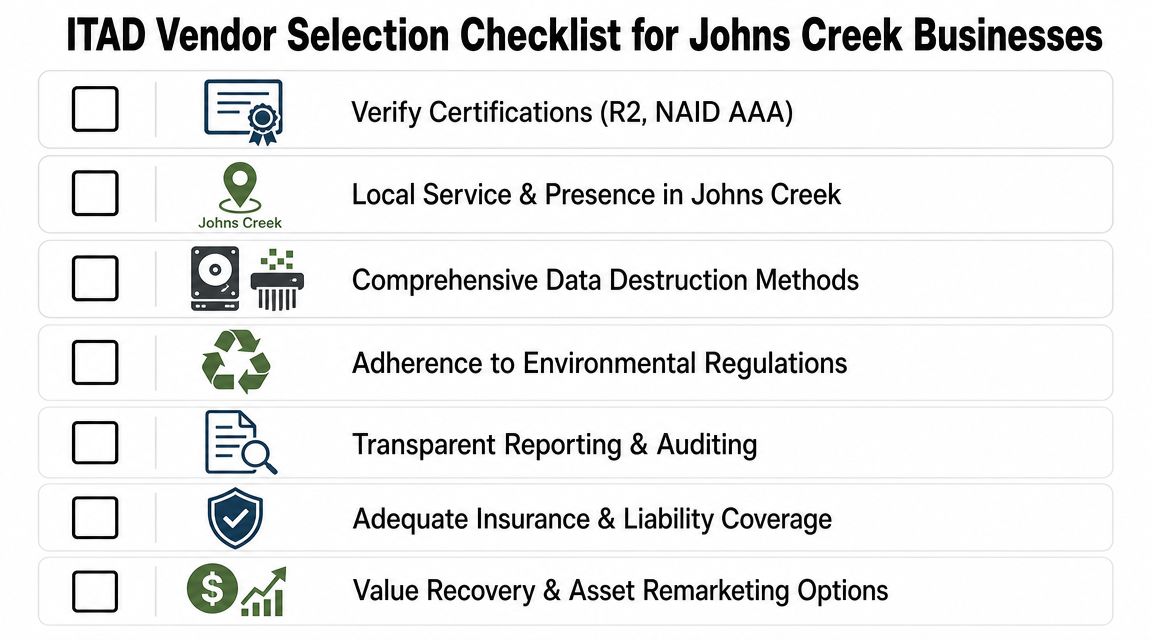
Use this checklist before you sign anything.
What to verify before pickup
- Certifications and standards: Ask which certifications the vendor holds and which data sanitization standards it follows. Don't accept hand-waving.
- Media-specific destruction options: The vendor should explain when it recommends wiping, shredding, or another method, and why.
- Chain-of-custody reporting: Require serialized inventory and documented custody transfer.
- Certificates after completion: Confirm you'll receive data destruction and recycling documentation.
- Insurance coverage: Ask about data breach, general liability, and pollution-related coverage.
- Downstream transparency: Find out where assets go after pickup, including recycling and remarketing channels.
- Local service capability: Make sure the company can support Johns Creek logistics without outsourcing every critical step.
Questions that expose weak vendors
Ask these directly:
- How do you handle HDDs versus SSDs?
- What records do you provide after processing?
- How long can you retain documentation?
- Can you support on-site service if our policy requires it?
- What happens to assets that still have resale value?
If the answers are vague, move on. A serious ITAD partner should make your compliance position stronger, not murkier.
Partner with Beyond Surplus for Certified ITAD Solutions
If your Johns Creek business needs secure retirement of laptops, servers, storage devices, networking gear, or mixed office electronics, choose a provider that can handle the full chain. That means pickup logistics, inventory control, data destruction, downstream processing, and final reporting in one managed workflow.
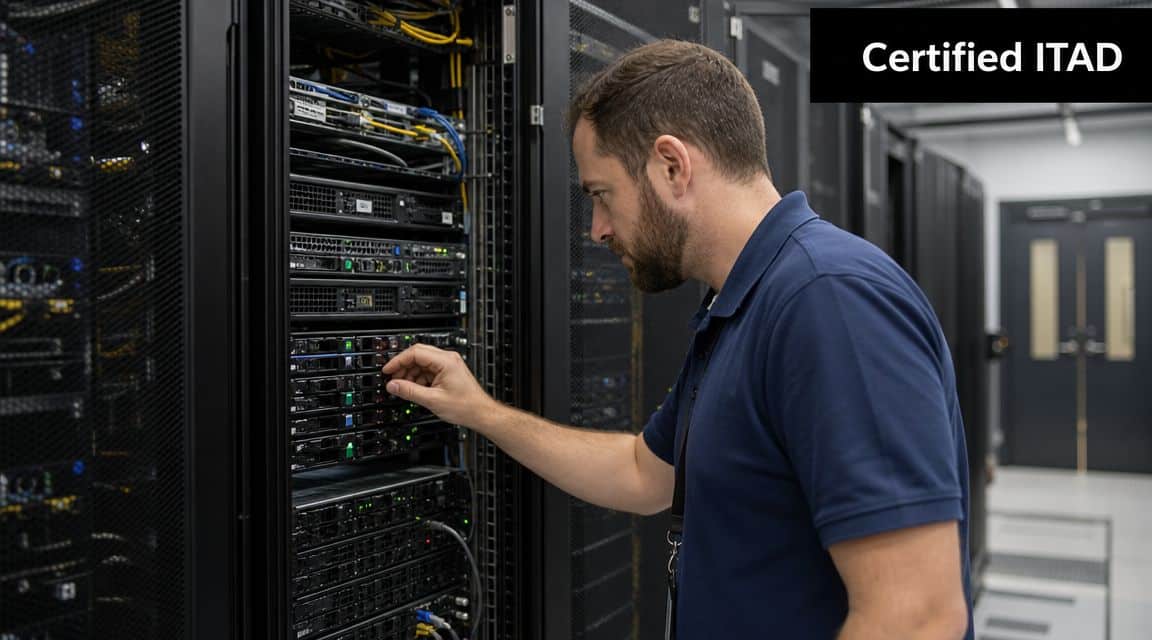
The right partner should also help you make the hard calls. Which drives should be wiped. Which should be shredded. Which assets belong in resale channels. Which ones should go straight to certified recycling. Those decisions affect risk, compliance posture, and financial recovery.
For business owners and IT teams, that's the core value of professional ITAD services in Johns Creek. You get a process you can defend, not just a truck that removes old equipment.
If your current approach still depends on ad hoc cleanouts, handwritten counts, or blind trust that drives were “taken care of,” it's time to tighten the system.
Contact Beyond Surplus for certified electronics recycling and secure IT asset disposal for your Johns Creek business.


