A lot of Georgia IT managers run into the same moment at the worst possible time. Equipment has already left the building, someone asks whether the drives were destroyed, and the next question lands fast: Where is the proof?
That question changes the conversation. It's no longer about recycling old laptops or clearing space in a server room. It's about whether retired assets still carry legal, security, and audit exposure. For businesses handling customer records, payment data, employee files, patient information, or internal IP, data-bearing devices stay risky until the organization can prove they were sanitized or destroyed properly.
Why Secure Data Destruction is a Boardroom Issue
When a storage device reaches end of life, the risk doesn't disappear with a refresh ticket or disposal pickup. It follows the asset until the organization has an auditable record showing what happened to the data, who handled the media, and when the process was completed.
That's why GA certified data destruction services belong in boardroom conversations, not just IT operations. Security leaders care about breach exposure. Finance cares about liability. Legal cares about defensible documentation. Internal audit cares about chain of custody. All of them end up looking at the same retired assets.
The question leadership asks
A decommissioned drive becomes a governance problem the minute someone can't answer four basics:
- What device was it
- What data destruction method was used
- Who controlled it from pickup through processing
- What document proves completion
If you can't produce those answers quickly, the problem isn't just missing paperwork. It usually means the workflow itself was weak.
Retired hardware is harmless only after the data is rendered unreadable or irrecoverable and the record is complete.
The scale of the category shows why mature organizations now treat this as a formal control. The data destruction service market was valued at USD 12 billion in 2025 and is projected to reach USD 39.3 billion by 2035, implying a 12.6% CAGR over 2026 to 2035. One industry estimate also places the 2026 market at USD 13.5 billion. Those figures indicate that certified destruction is now a major compliance and security function, not a niche disposal task, according to Research Nester's data destruction service market analysis.
Georgia companies planning refresh cycles, relocations, lease returns, and server retirements should treat destruction the same way they treat access control or endpoint policy. It's a core risk decision. A broader ITAD framework matters too, which is why this overview of why ITAD services matter for Georgia companies in 2026 is worth reviewing before your next disposition project.
What Certified Data Destruction Really Means in Georgia
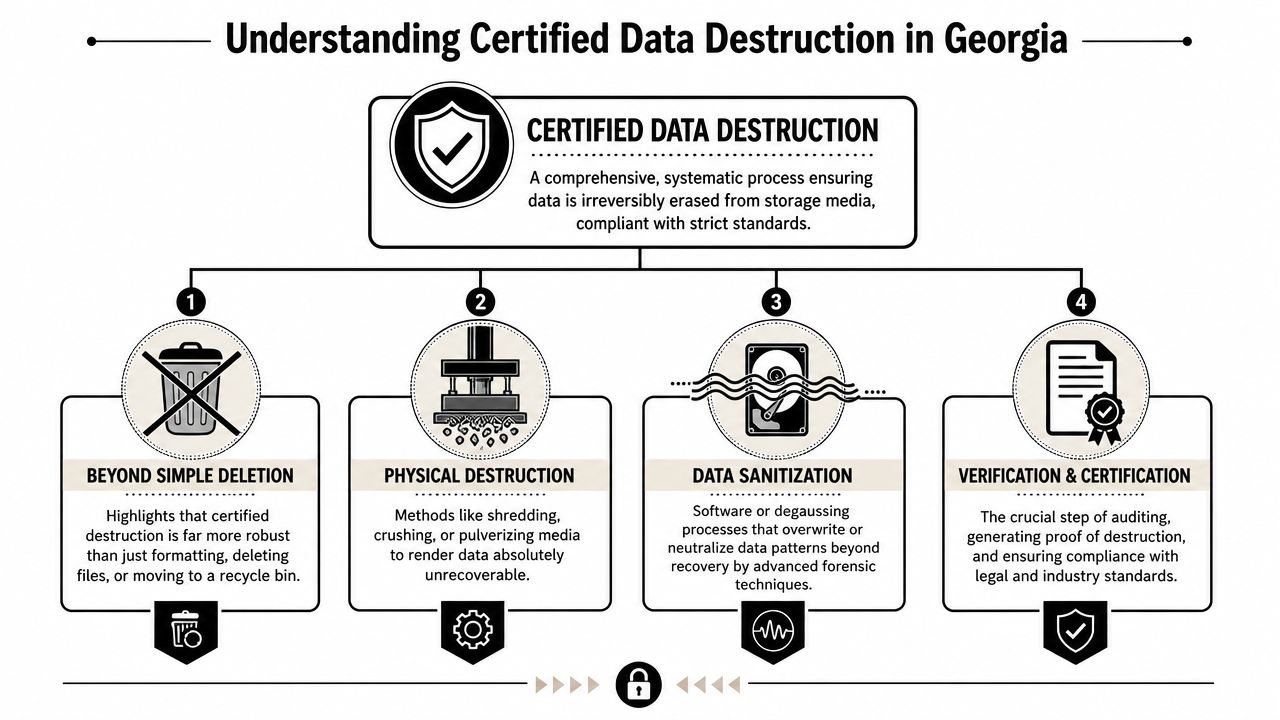
“Certified” doesn't mean someone says the drives were handled securely. It means the process ends with documentation that stands up to audit. Deleting files, reformatting a drive, or tossing failed media into a scrap stream doesn't meet that standard.
A proper certified workflow ends with a Certificate of Destruction or similar auditable record. Industry guidance also notes that the certificate should identify the items destroyed, method used, date of service, and chain of custody, which is what allows organizations to demonstrate secure disposal for frameworks such as HIPAA, GDPR, FACTA, and PCI DSS, as described in this overview of certified data destruction benefits for enterprises.
What “certified” includes
For Georgia businesses, the practical standard is simple. If the provider can't give you a document package that ties each asset to a completed destruction outcome, it isn't enough.
A defensible record usually includes:
- Serialized asset tracking so each drive, laptop, server, or backup unit can be traced individually
- The destruction or sanitization method used for that exact media
- The service date and processing details
- Chain-of-custody evidence from collection through final handling
What doesn't count
Several common internal habits create false confidence:
- Quick deletion: Files vanish from the user view, but that isn't the same as sanitization.
- Factory reset only: Useful for device turnover workflows, not enough on its own for regulated disposition.
- Undocumented shredding: Physical damage without inventory and reporting leaves a proof gap.
- Bulk pallet removal with no serial capture: Convenient, but hard to defend when one asset later goes missing.
Operational rule: If a regulator, auditor, or customer asked you to prove what happened to one specific serial-numbered asset, you should be able to answer without guesswork.
That's the core value of certification. It doesn't just confirm destruction happened. It turns the event into evidence. Georgia buyers comparing vendors should also understand the broader qualification picture, including process discipline and recycler controls, which is covered in this guide to R2 certified ITAD providers in Georgia and what to know.
Navigating Key Data Privacy Laws for Georgia Businesses
Most Georgia organizations don't need a law that says “destroy hard drives this exact way” to face real exposure. Liability usually arrives from another direction. A device leaves control, recoverable data remains on it, and the business now has a breach, an audit problem, or both.
That's why certified destruction is a compliance control, not just a cleanup step. Federal and industry rules often focus on protecting sensitive information and proving proper handling. End-of-life media sits directly inside that obligation.
Where risk shows up first
The practical pressure points are easy to recognize:
- Healthcare environments have to control patient information across the full device lifecycle.
- Financial and payment environments need documented disposal practices that support their broader security program.
- HR and legal departments often forget that retired endpoints can still hold employee records, tax files, and scanned identity documents.
- Mergers, moves, and closures create rushed asset exits, which is when chain-of-custody failures usually happen.
A business may think the problem is old hardware. In reality, the problem is unverified data removal.
Why proof matters more than intent
Good intentions don't satisfy an auditor. Neither does an internal note that a batch of equipment was “recycled.” The question is whether the organization can show that data-bearing media was controlled, sanitized or destroyed appropriately, and documented in a way that can be retrieved later.
That's why organizations subject to frameworks such as HIPAA, FACTA, PCI DSS, or internal governance rules usually require formal destruction records. If the company can't produce them, it may still end up having to explain the gap even when no public incident occurred.
The legal risk in disposition comes from two failures at once: recoverable data and missing documentation.
For Georgia companies, policy and operations must align. Your written disposal policy should match what the warehouse, desktop team, data center staff, and ITAD vendor perform on collection day. If those don't match, compliance exists only on paper.
A useful starting point is this secure data destruction in Georgia ITAD compliance guide, especially for organizations trying to align security, records retention, and disposition procedures across multiple departments.
Data Destruction Methods Under NIST SP 800-88
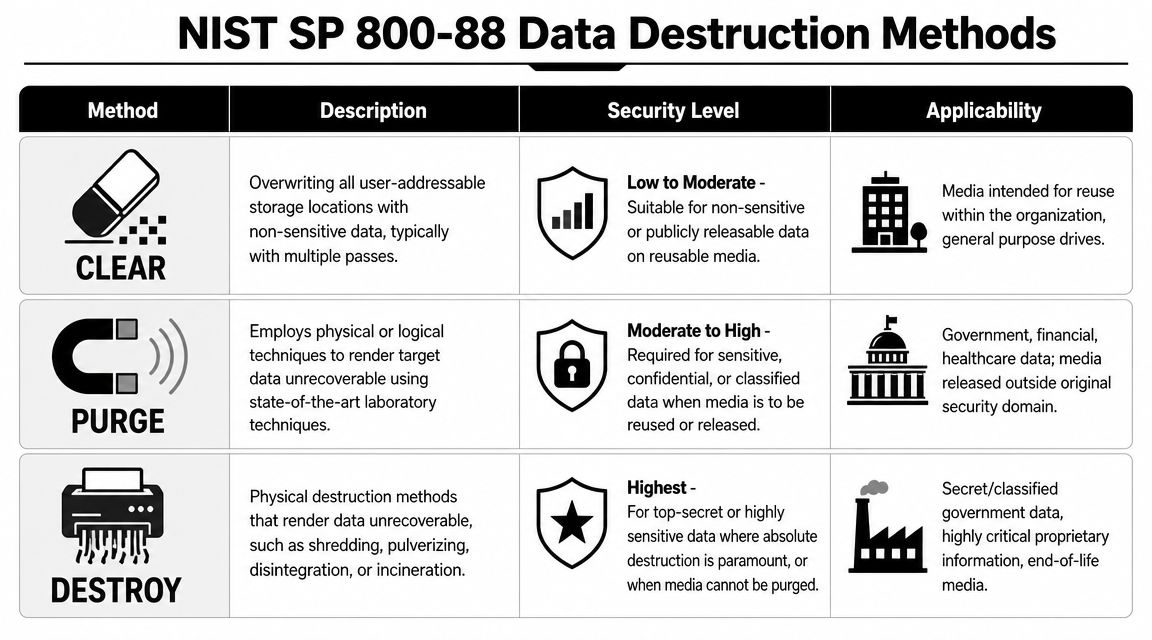
If you want one technical framework that cuts through opinion, it's NIST SP 800-88. It defines three sanitization outcomes: clear, purge, and destroy. It also draws a hard line between simple deletion and methods that make data unreadable or irrecoverable, as summarized in this discussion of current data destruction standards.
Clear
Clear is the lowest of the three outcomes, but that doesn't mean it's casual. It means the media has been sanitized in a way appropriate for certain reuse cases, typically through logical methods that address user-addressable storage.
For some ATA drives manufactured since 2001, clearing may be sufficient in the right context. The key phrase is in the right context. If the device stays within a controlled environment and the workflow supports verification, clear may fit.
What doesn't work is assuming every drive, every failure mode, and every risk class can be handled the same way.
Purge
Purge is stronger. Hence, media-specific methods matter. Depending on the device, purge may involve secure erase behavior, degaussing, or another approach suited to that storage type.
For magnetic media, one method may be valid. For flash-based media, the same method may be ineffective or impossible to verify. That's why NIST-based decision-making depends on the actual device in front of you, not the label on the gaylord box.
Destroy
Destroy is the endpoint when the media can't be reliably sanitized by software, when the risk profile is high, or when policy requires permanent physical destruction.
That often applies to:
- Failed drives that won't boot or mount
- Damaged media with uncertain controller behavior
- Devices leaving secure control permanently
- High-sensitivity workloads where the organization wants finality instead of reuse
Shredding is not just “break it into pieces.” The guidance cited in industry practice goes down to 2 to 5 mm edge length for shredded hard-disk media, which matters because particle size affects forensic recovery risk.
Practical rule: If software can't verify completion because the storage stack is inaccessible, software erasure isn't your control. Physical destruction is.
Why SSDs change the decision
A key area where many destruction programs fall behind involves modern storage media. SSDs, USB devices, and other flash media don't behave like magnetic HDDs. Wear leveling, controller logic, trim behavior, and garbage collection complicate assumptions that were once common in HDD-only environments.
A provider should be able to tell you, clearly, when wiping is suitable, when purge is appropriate, and when SSD media should go straight to physical destruction. If the answer is “we shred everything” or “we wipe everything,” the process probably isn't media-specific enough.
For teams building policy around mixed inventories, this deeper reference on NIST SP 800-88 is useful because it connects technical categories to operational handling.
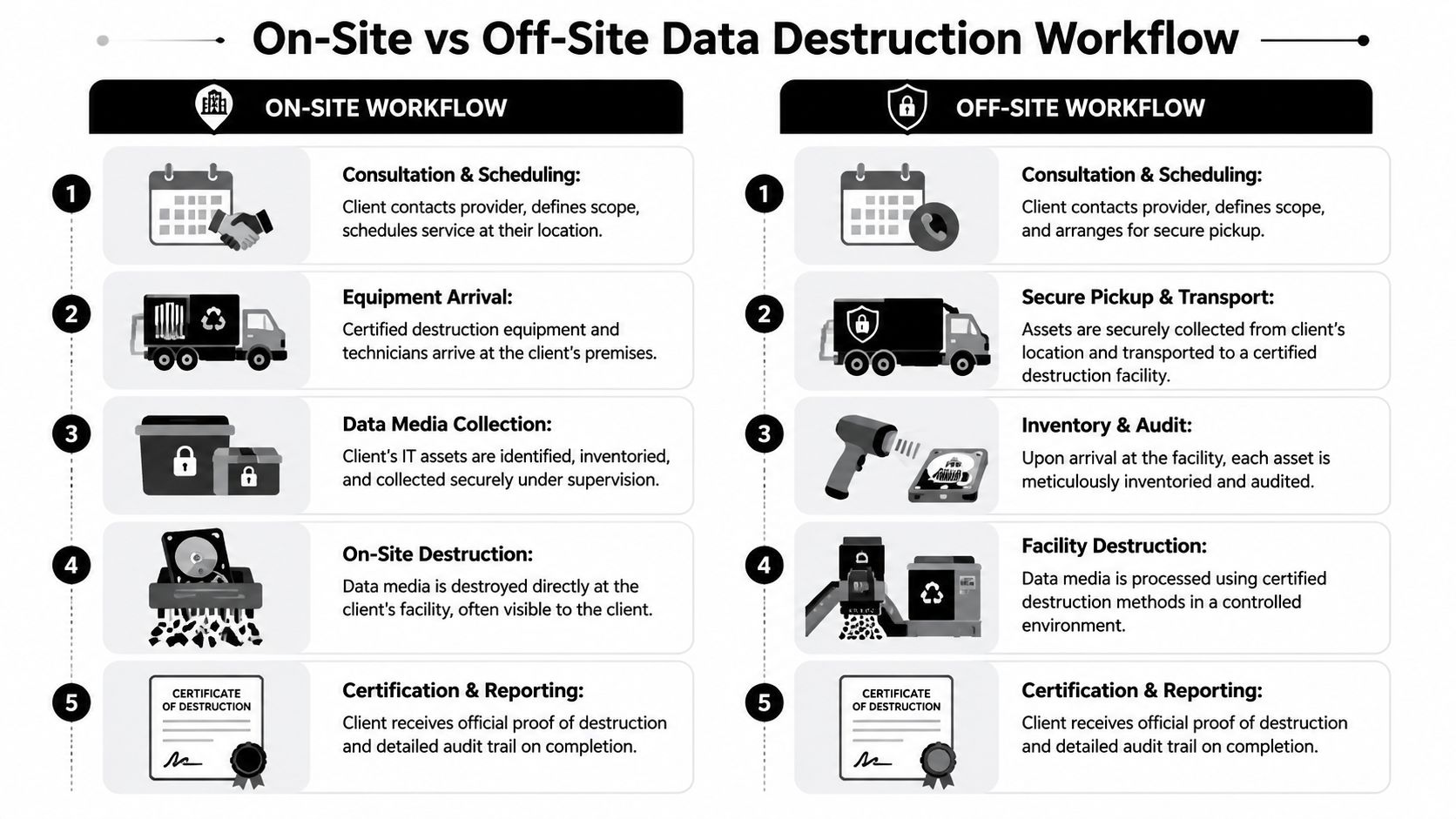
On-Site vs Off-Site Destruction A Workflow Comparison
The on-site versus off-site decision isn't about which model sounds more secure in marketing copy. It's about where your organization wants risk to exist during the process.
A strong workflow combines software sanitization and physical destruction as needed, and industry guidance notes that on-site destruction further lowers exposure by reducing transport risk before media is rendered unreadable, which is why it is often preferred for high-sensitivity workloads such as healthcare, finance, government, and data-center decommissioning, as described in this review of certified data destruction services.
Where on-site fits
On-site works well when the main concern is keeping media under direct observation until it is unreadable. That usually fits:
- Hospitals and clinics
- Financial institutions
- Government contractors
- Large server and storage decommissions
The trade-off is logistics. On-site destruction can require more scheduling discipline, facility coordination, and staging.
Where off-site fits
Off-site works when the provider's facility process is tighter or more scalable than what can be deployed in the field. It often makes sense for routine refreshes, multi-site pickups, and projects where serialized intake, audit processing, and downstream recycling all happen within one secure chain.
The trade-off is obvious. Media exists in transit before final processing, so transport controls and custody records matter more.
Simple workflow comparison
| Model | Main advantage | Main concern |
|---|---|---|
| On-site | Media is destroyed before transport | Requires facility access and tighter coordination |
| Off-site | Centralized processing and reporting | Media must remain secure during pickup and transit |
What matters in either model is the handoff discipline. Who sealed the containers. Who scanned the serials. Who signed for custody. Who processed the exceptions. A weak chain of custody can undermine either approach.
How to Select a Certified Data Destruction Partner in Georgia
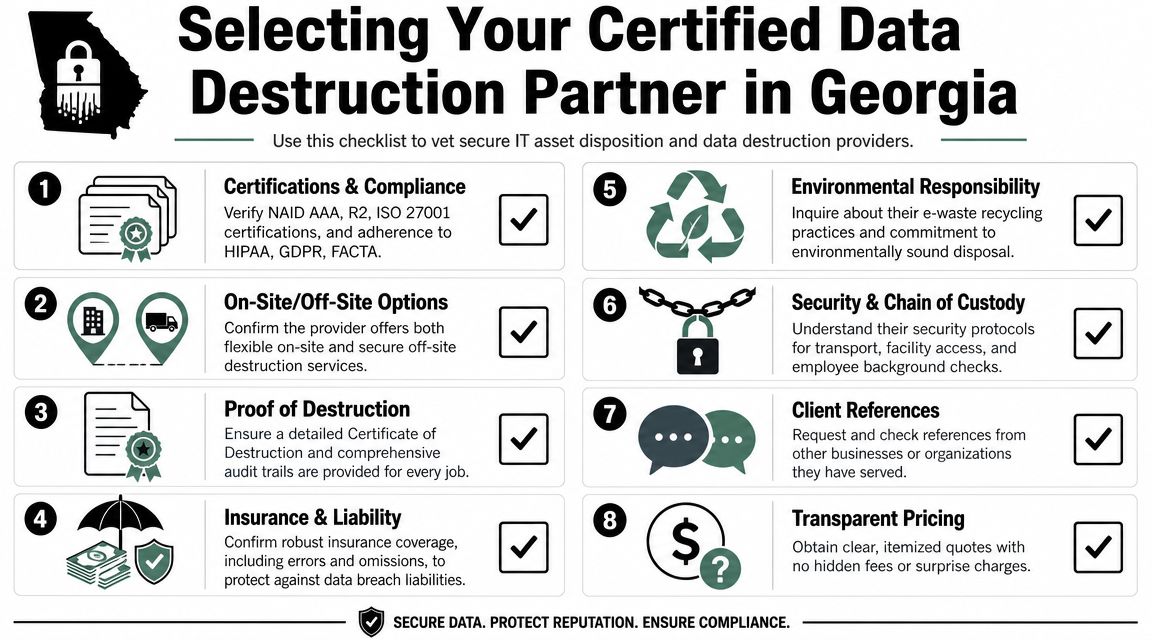
Vendor selection gets easier when you stop asking broad questions and start asking operational ones. Don't ask whether a provider takes security seriously. Ask how they document inaccessible SSDs, how they handle failed drives, and what appears on the final certificate.
A major gap in the market is SSD and flash-media sanitization. Many public data destruction pages still focus on hard drives, shredding, and degaussing even though NIST SP 800-88 Rev. 1 treats SSDs differently. Buyers increasingly need clear answers about whether wiping is sufficient and when physical destruction is required, as noted in this discussion of SSD and flash-media destruction issues.
Questions that expose weak vendors
Use this checklist during procurement or renewal:
- Ask for media-specific methods. A qualified partner should explain different handling for HDDs, SSDs, tapes, mobile devices, and failed storage.
- Review the certificate format in advance. If the sample doesn't show serialized assets, method, and date or location details, that's a problem.
- Check chain-of-custody depth. Intake logs, serialized tracking, sealed transport practices, and exception handling should all be visible in the workflow.
- Press on failed media. Weak programs frequently fail at this stage. If a drive doesn't mount, what happens next, and how is that documented?
- Confirm on-site and off-site options if your environment varies. One static service model rarely fits every location or project type.
- Tie destruction to downstream recycling. Secure destruction and environmentally sound processing should work as one controlled program.
What good answers sound like
Strong providers usually answer in specifics, not slogans. They describe whether the device is wiped, purged, shredded, or otherwise processed based on condition and media type. They can tell you what the report contains. They can explain how auditors trace one serial number from pickup through final certificate.
One Georgia option in this category is Beyond Surplus, which provides on-site and off-site data destruction, secure wiping and shredding, and certificate-based documentation as part of broader ITAD and electronics recycling services.
If a vendor can't explain its exception handling, certificate fields, and SSD decision logic in plain language, don't trust the process behind the sales sheet.
Final buyer checklist
Before signing, make sure you've seen:
- A sample Certificate of Destruction
- Serialized reporting detail
- Documented chain-of-custody steps
- A clear answer on SSDs and failed media
- An explanation of when on-site is recommended
- How destruction integrates with final recycling or disposition
In this category, clarity is a security feature. The best buying decision usually comes from the vendor willing to be the most specific.
Georgia organizations don't need more vague promises around “safe disposal.” They need auditable chain of custody, media-specific destruction methods, and certificate-backed proof that stands up to compliance review. Contact Beyond Surplus for certified electronics recycling and secure IT asset disposal.