Atlanta, Georgia businesses are growing into a more complex operating environment in 2026. New hiring, more connected devices, tighter compliance expectations, and heavier dependence on cloud systems all create the same problem. Growth only works when the support layer is strong enough to carry it. That's why Atlanta's most in-demand business services this year aren't just back-office purchases. They're the services companies use to protect data, keep systems running, move products faster, and prove they can meet buyer expectations.
The pressure is especially clear in sectors adding scale quickly. Healthcare led Atlanta's business service demand by adding 23,500 jobs in the most recent reporting period, while professional and business services employed 485,000 people across the region. More people, more locations, and more devices mean more vendors, more handoffs, and more room for risk if a process breaks down.
Here's where smart Atlanta operators are investing now.
1. Secure IT Asset Disposition and E-Waste Recycling
Secure ITAD has moved from occasional cleanup task to year-round operational requirement. In Atlanta, that shift tracks with healthcare expansion, data center growth, and the amount of regulated hardware moving through offices, hospitals, labs, and enterprise campuses. If a company retires laptops, servers, mobile devices, or medical tech without documented control, it creates exposure that procurement and compliance teams can't ignore.
Atlanta's local business coverage still misses this category even as the city hosts over 1,200 data centers and saw a 34% annual increase in enterprise data center expansions in 2024 to 2025. That gap matters because generic recycling advice doesn't answer the actual business question. How do you document custody, verify destruction, and close out liability?
What good ITAD looks like
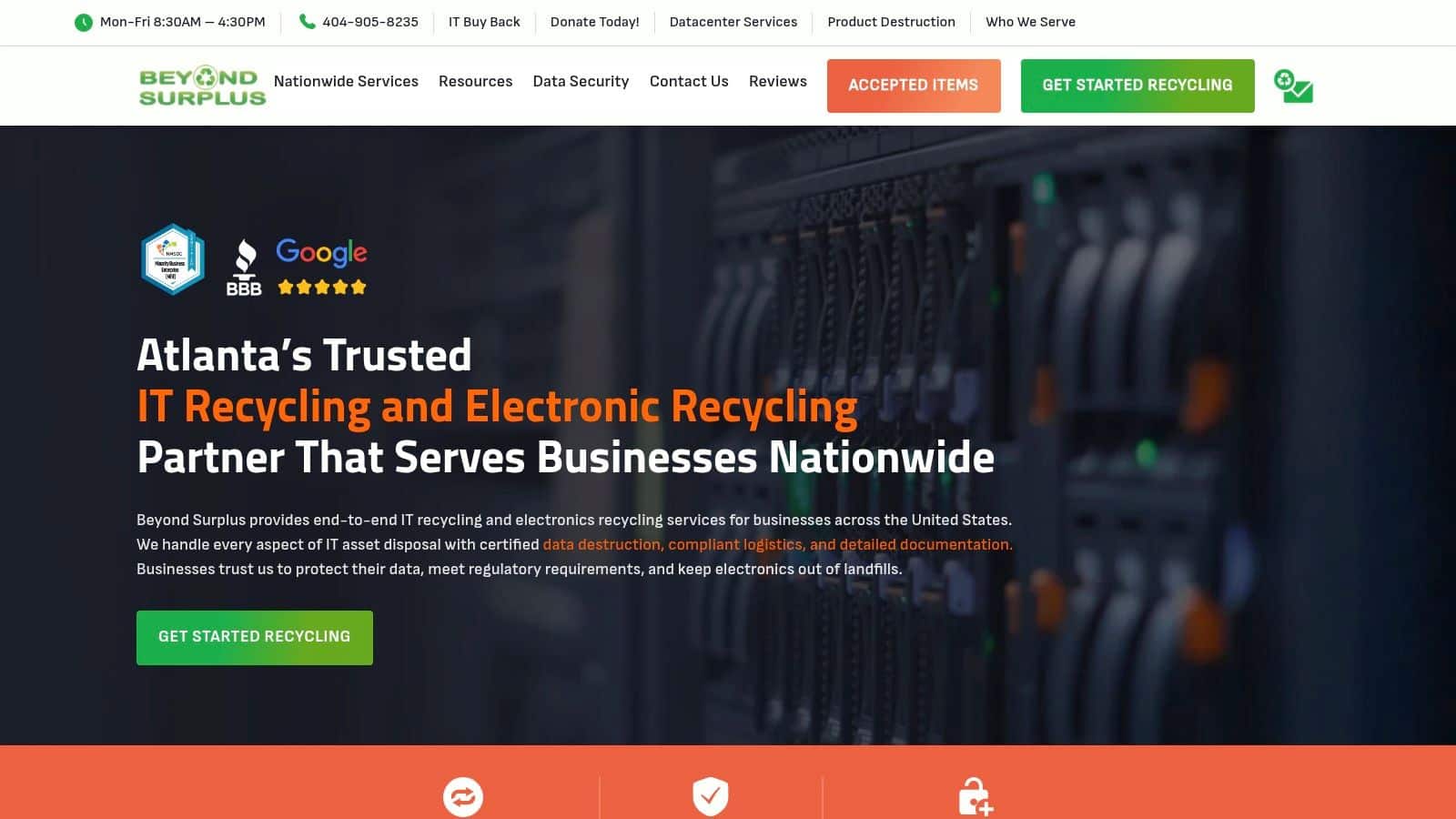
A serious provider gives you serialized tracking, secure pickup, data destruction documentation, and downstream recycling records. Beyond Surplus is one example of an Atlanta ITAD and electronics recycling provider built for business pickups, hard drive shredding, data wiping, product destruction, and logistics coordination.
The service gets more important when battery-powered devices are in the mix. Under hazardous waste rules, lithium-ion batteries and devices containing them must go to designated recycling bins or facilities rather than trash, so facility managers need a vendor that knows how to separate and process mixed loads correctly.
Practical rule: If a vendor can't explain chain of custody, certificates of destruction, and battery handling in plain language, they're not ready for enterprise work.
What works and what doesn't
What works:
- Certified processes: Ask for documented wiping or shredding workflows, asset inventories, and certificates tied to the pickup.
- Value recovery options: Buyback can offset part of refresh costs when equipment still has resale value.
- Compliance fluency: Teams in healthcare, finance, and education should review Georgia ITAD compliance requirements and disposal rules before scheduling a project.
What doesn't:
- One-bin “recycling days”: They're fine for households, not for enterprise environments with regulated data.
- Untracked pallet pickups: If devices disappear into a truck with no itemized record, your liability didn't disappear with them.
The broader market supports this demand. The U.S. e-waste recycling market was valued at USD 14.53 billion in 2025 and is projected to reach USD 19.84 billion by 2035. For Atlanta businesses, the main point is simpler. Retiring hardware safely is now a core business service.
2. Managed Cybersecurity Services
A ransomware alert at 2:13 a.m. creates a simple test. Either someone is watching, triaging, and containing the issue, or the problem waits until business hours. That gap explains why managed detection and response, XDR, and outsourced security operations remain high-priority purchases across Atlanta.
The pressure is not theoretical. Analysts at CompTIA found that 78% of firms outsource at least one function to an IT-focused third party, and security monitoring is often one of the first responsibilities companies move outside the building. The reason is practical. Buying tools is easier than staffing a 24/7 team that can tune alerts, investigate suspicious behavior, and document response steps for auditors and customers.
Best fit for Atlanta buyers
Platforms like Secureworks Taegis XDR fit companies that need detection, triage, and response support without building a full internal SOC. That matters in Atlanta because many businesses are managing mixed environments at once: office endpoints, remote devices, cloud workloads, and third-party systems tied to logistics, healthcare, finance, or professional services.
The trade-off is straightforward. An outsourced provider can give broader coverage and faster time to operation. Internal teams still need to own identity controls, vendor access, escalation paths, and recovery decisions. Managed cybersecurity works best when companies buy a service with clear runbooks, named response contacts, and defined handoffs, not just another dashboard.
Security coverage and hardware retirement belong in the same operating plan. A missed laptop during employee offboarding or an unmanaged server left online after a migration can undercut a strong monitoring stack. Teams comparing infrastructure options should review how Atlanta businesses are weighing colocation vs. cloud decisions alongside cybersecurity threats targeting Atlanta companies, because architecture, device lifecycle control, and threat response now affect each other directly.
3. Hybrid Cloud and Colocation Services
A common Atlanta scenario looks like this. Finance data needs tighter control, customer-facing apps need room to scale, and backup systems need a separate home that does not depend on the main office. That mix is why hybrid cloud and colocation have become a standard planning discussion, not a niche infrastructure choice.
The best setup usually combines environments with different jobs. Core systems may stay in a controlled facility. Variable workloads can run in public cloud. Backup, disaster recovery, or replication often fit well in colocation, especially when teams want more control over hardware, network paths, or data residency.
Where hybrid infrastructure wins
QTS Data Centers is one of the providers businesses review when they need carrier options, physical resilience, and space to grow without committing every workload to a full cloud migration. That matters for companies handling regulated records, latency-sensitive applications, or separate production and recovery environments.
The trade-off is operational complexity. A hybrid design can improve resilience and cost control, but only if the team is clear about what belongs where and who manages each layer. Poorly defined ownership creates familiar problems: duplicated backups, rising egress costs, stale failover plans, and hardware that stays powered on long after the workload has moved.
Hiring pressure shapes these decisions too. Teams planning migration or colocation projects often run into the same local skills gap discussed in Atlanta IT hiring trends and in-demand infrastructure skills. Capacity planning, cloud architecture, network design, and decommissioning rarely sit with one person.
Buyers should map application dependencies, retention rules, and exit timelines before signing a colo contract or expanding cloud spend. In practice, hybrid infrastructure works best as part of a larger operating plan that also covers security monitoring, staffing, records retention, and end-of-life equipment handling. That is the core connection across Atlanta's service market. Infrastructure decisions affect how fast a company can recover, scale, stay compliant, and retire risk.
4. Specialized IT and Professional Staffing
A migration is approved, security tooling is in place, and the infrastructure plan looks solid. Then the project stalls because no one on staff can handle identity design, cloud cutover work, or retirement of the old hardware.
That hiring bottleneck is one of the clearest links across Atlanta's business services market. Companies can buy cybersecurity coverage, colocation capacity, records storage, and logistics support, but those services still depend on people who can implement, coordinate, and document the work. The pressure is especially high in security hiring. The U.S. Bureau of Labor Statistics projects strong growth for information security analyst roles through 2034, which helps explain why Atlanta employers often compete for the same narrow skill sets.
When staffing firms add real value
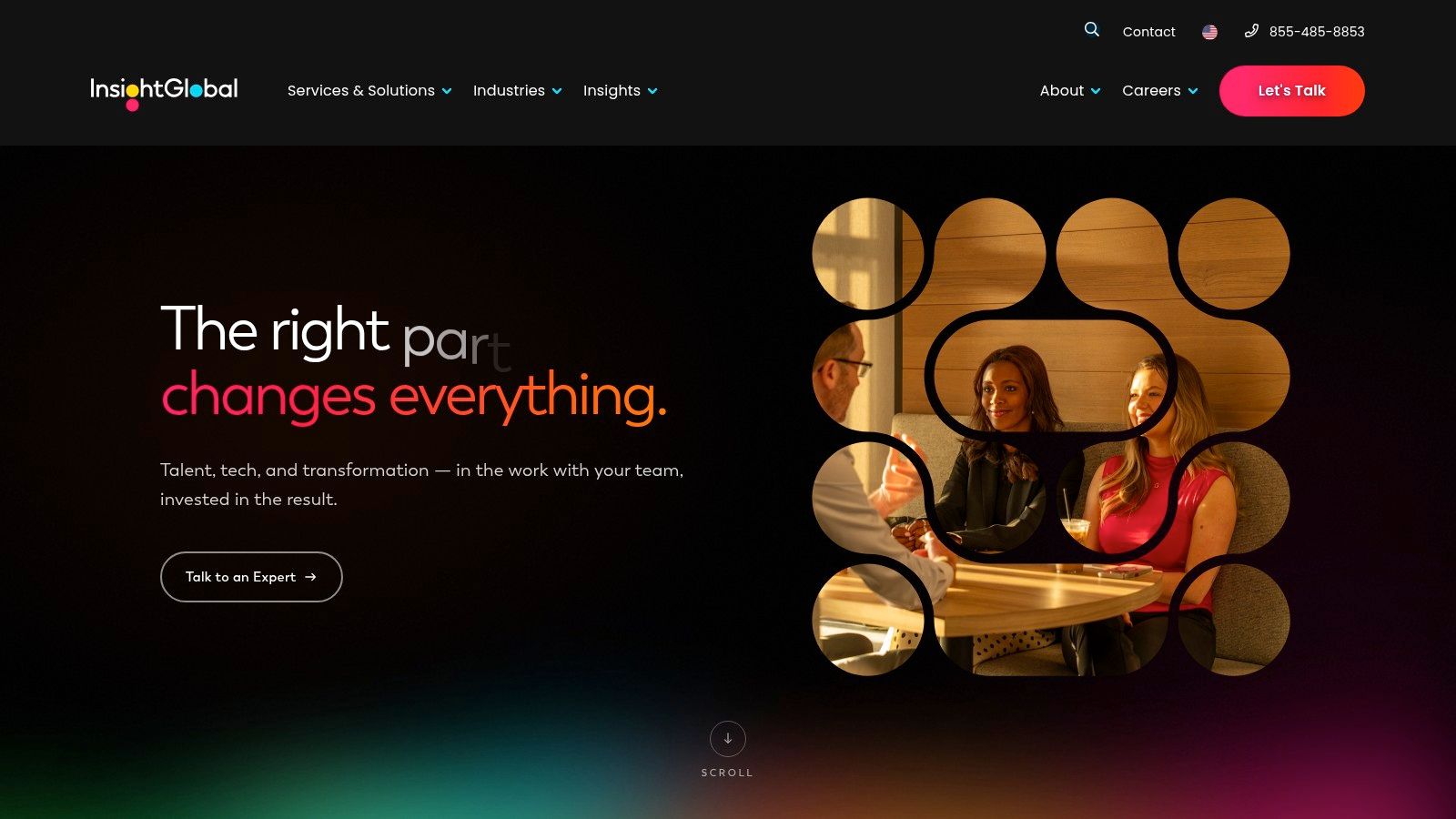
A firm like Insight Global earns its place when the need is specific and time-bound. Contract talent can cover a cloud migration, audit remediation effort, ERP rollout, or site consolidation without forcing a permanent hiring decision before the operating model is settled.
The trade-off is fit.
A resume that looks strong on paper can still miss the underlying need. Some projects need an architect who can make design decisions. Others need an operator who can execute runbooks, coordinate vendors, and close out tickets for eight weeks straight. Hardware lifecycle projects add another layer. Teams handling refreshes, office closures, or data center exits often need staff who understand chain of custody, asset tracking, and NIST SP 800-88 media sanitization requirements well enough to keep disposal work aligned with security and compliance policies.
The better staffing partners screen for that context, not just certifications. In practice, that is what turns staffing from a stopgap into part of a larger operating plan.
5. Secure Information and Records Management
Digital-first businesses still drown in paper when legal holds, HR archives, healthcare records, finance files, and legacy contracts start piling up. The highest-value providers in this category don't just shred boxes. They help organizations govern physical and digital records together.
Iron Mountain remains the recognizable benchmark because mature records management requires storage, retrieval, destruction, and digitization under one policy framework. For regulated organizations, that matters more than a low pickup price.
The real trade-off
Cheap shredding is easy to buy. Information governance is harder. If a vendor can destroy files but can't align retention schedules, audit trails, and media sanitization standards, the client still has an incomplete compliance program.
That's where standards-based thinking helps. Teams responsible for both documents and drives should understand NIST SP 800-88 media sanitization guidance so physical records destruction and digital media disposal don't run on conflicting rules.
6. On-Demand and Last-Mile Logistics

Not every business needs its own fleet. Many need dependable overflow capacity, route flexibility, and better visibility on urgent deliveries. That's why on-demand and last-mile services keep showing up in vendor reviews across healthcare, retail, field services, and B2B distribution.
Platforms like Roadie appeal to operators who need flexible delivery coverage without carrying fleet overhead year-round. The strongest use case is variable demand. Peak days, same-day replacement shipments, location-to-location transfers, and project-based transport all fit.
Where buyers get it wrong
They compare only per-delivery price. The better lens is service fit. Can the provider handle exception management, proof of delivery, damage claims, and irregular item sizes?
For a broader buying perspective, these insights for delivery business buyers are useful because they frame logistics as service design, not just transportation.
7. Compliance and Attestation Audits
A common Atlanta buying scenario looks like this: a company is ready to close a larger customer, procurement sends the security packet, and the deal slows down because no one can produce a current SOC report, control narrative, or formal evidence package. At that point, the audit is no longer a finance or compliance exercise. It is part of revenue operations.
That pressure is stronger in Atlanta because enterprise buyers, logistics operators, healthcare groups, fintech teams, and security-conscious tech firms often share the same vendor pool. In practice, that means your controls need to stand up not just to one questionnaire, but to repeated scrutiny across IT, legal, risk, and procurement. Compliance connects directly to the other services on this list. Cloud design, records handling, cybersecurity monitoring, communications systems, and even device retirement all create audit evidence or audit gaps.
What to buy before you buy the audit
Schellman is the kind of firm buyers review for SOC 2, ISO-related assurance work, and other attestation engagements. The trade-off is straightforward. A strong assessor can test controls, point out weaknesses, and confirm readiness. They cannot build your policies, clean up access reviews, or fix inconsistent evidence collection after the fact.
Companies get better results when they scope the audit backward from customer requirements. Start with the report your buyers ask for. Then check whether the controls are operating consistently, whether owners are assigned, and whether evidence is easy to produce under pressure.
If your stack includes voice systems, location-based routing, or regulated communications workflows, SnapDial's E911 compliance guide shows how a narrow technical requirement can turn into a procurement blocker faster than expected. That is the broader lesson here. Operational excellence in Atlanta is cumulative. The vendors handling infrastructure, security, logistics, and communications all affect whether an audit goes smoothly or stalls at the worst possible time.
Top 7 In-Demand Atlanta Business Services, Quick Comparison
| Service | 🔄 Implementation Complexity | ⚡ Resource Requirements | 📊 Expected Outcomes | 💡 Ideal Use Cases | ⭐ Key Advantages |
|---|---|---|---|---|---|
| Secure IT Asset Disposition (ITAD) & E‑Waste Recycling | 🔄 Moderate, certified processes, logistics coordination | ⚡ Physical shredding equipment, secure transport, certified downstream partners | 📊 Secure data destruction, documented chain of custody, residual value recovery | 💡 Data center decommissions, healthcare/finance asset retirement | ⭐ Regulatory compliance, liability transfer, zero‑landfill policy |
| Managed Cybersecurity Services (MDR/XDR) | 🔄 High, 24/7 SOC integration, continuous monitoring | ⚡ Skilled analysts, XDR/MDR platform subscriptions, threat intel feeds | 📊 Faster detection & containment, reduced dwell time, incident response | 💡 Mid‑market to enterprise lacking in‑house SOC, regulated environments | ⭐ Access to enterprise talent and continuous threat hunting |
| Hybrid Cloud & Colocation Services | 🔄 High, network design, migration, compliance alignment | ⚡ Data center space/power, high‑bandwidth connectivity, architects | 📊 Scalable capacity, high availability, low latency interconnects | 💡 Disaster recovery, high‑performance workloads, multi‑cloud architectures | ⭐ Carrier neutrality, large scale infrastructure, compliance certifications |
| Specialized IT & Professional Staffing | 🔄 Low–Moderate, sourcing, vetting, onboarding workflows | ⚡ Recruiter network, candidate screening tools, flexible contracts | 📊 Faster time‑to‑hire, skill gap closure, project scalability | 💡 Short‑term projects, rapid scaling, niche technical roles | ⭐ Rapid access to vetted talent and flexible engagement models |
| Secure Information & Records Management | 🔄 Moderate, chain‑of‑custody, storage and digitization processes | ⚡ Secure storage sites, NAID‑certified shredding, scanning tech | 📊 Compliance with privacy laws, reduced physical footprint, searchable archives | 💡 Legal, healthcare, finance records retention and litigation readiness | ⭐ Integrated shredding, storage, and digitization with robust custody |
| On‑Demand & Last‑Mile Logistics | 🔄 Moderate, routing complexity, real‑time dispatching | ⚡ Driver network, delivery platform integrations, tracking systems | 📊 Same‑day/next‑day delivery, improved customer experience, peak handling | 💡 Retail/e‑commerce, urgent shipments, peak season fulfillment | ⭐ Local agility combined with national scale and integrations |
| Compliance & Attestation Audits | 🔄 Moderate–High, control mapping, evidence collection, auditor coordination | ⚡ External auditor fees, internal compliance resources, remediation effort | 📊 Independent assurance, market access, accelerated sales cycles | 💡 SaaS providers, regulated industries, vendors needing enterprise trust | ⭐ Credibility from recognized reports and ability to bundle frameworks |
Building Your Strategic Vendor Portfolio in Atlanta
Atlanta's most in-demand business services this year point to a bigger pattern. Buyers aren't just filling gaps. They're building operating systems made up of specialist vendors who can reduce risk, move faster than internal teams alone, and support growth without creating compliance debt.
The best vendor portfolios usually combine prevention, execution, and proof. Managed cybersecurity helps detect problems early. Colocation and cloud partners keep infrastructure flexible. Staffing firms close urgent capability gaps. Records management and audit firms help organizations prove they operate responsibly. Logistics providers keep the physical side of the business moving.
Secure IT asset disposition sits in the middle of that mix more often than many companies realize. Hardware retirement touches cybersecurity, environmental compliance, facilities, legal review, and procurement. It also affects brand trust. A company can't claim disciplined operations if retired devices, storage media, and battery-powered equipment leave the building without documentation.
The stronger approach is to choose vendors that understand adjacent functions, not just their own lane. An ITAD partner should know how pickups intersect with compliance reporting and chain of custody. A cyber provider should understand offboarding risk. An audit firm should recognize where vendor processes become customer-facing control issues.
That standard matters even more in Atlanta, where healthcare growth, enterprise density, and infrastructure investment keep raising the operational bar. If you're reviewing providers now, prioritize documented processes, responsive service teams, and partners that can work cleanly with your legal, IT, facilities, and procurement stakeholders.
For organizations managing transportation, fleet, or regulated movement of equipment, these third-party DOT compliance solutions can help frame another layer of vendor oversight that often gets missed.
For secure, compliant, and sustainable end-of-life technology management, Beyond Surplus remains a practical choice for Atlanta businesses that need certified electronics recycling, secure data destruction, IT buyback, and coordinated logistics.
Contact Beyond Surplus for certified electronics recycling and secure IT asset disposal in Atlanta, Georgia. If your business is planning a device refresh, office closure, data center decommissioning, medical equipment disposal project, or recurring e-waste pickup, Beyond Surplus can help you protect data, document chain of custody, recover asset value where possible, and keep retired equipment out of the wrong hands.