

A telecom refresh usually doesn't end when the new gear goes live. It ends months later, when someone opens a storage room and finds stacked switches, retired routers, desk phones, gateways, and a PBX nobody wants to touch because nobody is fully sure what's still on it.
That's where business telecom equipment resale solutions either create value or create risk.
Most organizations start with the obvious question: what can we sell? The better question is broader. Which assets can be remarketed safely, which need certified data destruction first, and which channel fits your timeline, documentation requirements, and internal labor limits? If you treat telecom gear like ordinary surplus, you can lose recoverable value, break chain of custody, and create a preventable compliance problem.
Your Decommissioned Telecom Gear Is More Than Just Surplus
A typical telecom closet tells a mixed story. Some assets are still supportable and marketable. Others are incomplete, obsolete, or tied to a system migration that left behind power supplies, handsets, modules, and cables in different buildings. That's why resale isn't just a cleanup task. It's an asset recovery decision wrapped inside a security decision.
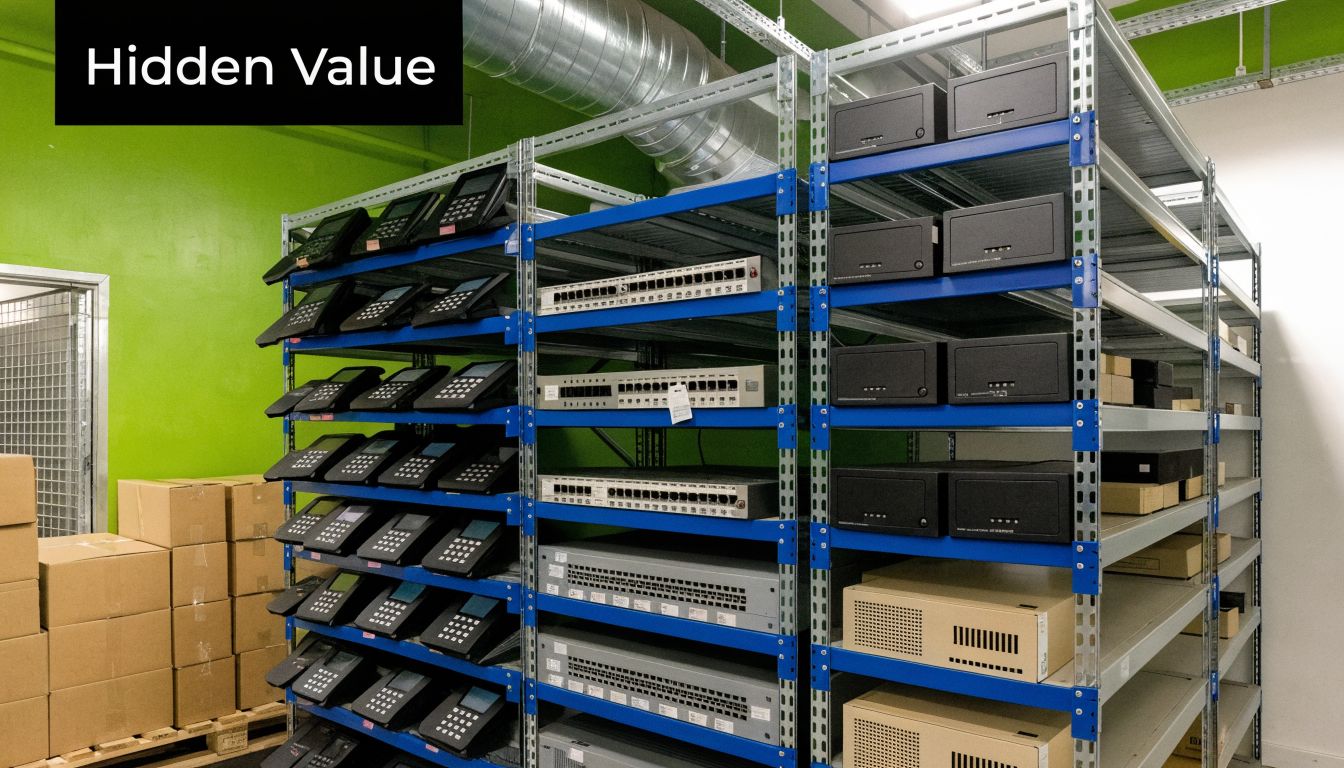
The secondary market is large enough to justify a disciplined process. The U.S. Telecommunications Resellers industry was a $23.4 billion market in 2025, comprised of over 2,300 businesses, according to IBISWorld's telecommunications resellers industry data. That scale matters because it confirms there are real downstream buyers for properly handled telecom assets.
What IT teams usually miss
The first miss is assuming old telecom equipment has little value because it's no longer strategic internally. Buyers don't think that way. They look for supportable models, usable spares, tested condition, and complete kits.
The second miss is assuming a factory reset closes the security issue. It often doesn't answer the documentation question, and in regulated environments documentation is what procurement, legal, and compliance teams care about later.
Practical rule: If a device ever held credentials, call data, customer information, or network configuration, treat it as a data-bearing asset until a documented process proves otherwise.
For teams moving from legacy voice to cloud calling, it also helps to understand how newer communications environments change what gets retired and what still has remarketing potential. A quick review of Nutmeg Technologies cloud communication resources is useful context when you're mapping old on-premise telecom gear against newer VoIP estates.
A resale program is an ITAD decision
Good outcomes come from separating three streams early:
- Remarketable assets that can be tested, sanitized, and sold
- Parts and incomplete units that may still have component value
- Non-remarketable equipment that should move to destruction or recycling
That's the difference between a random sell-off and a managed disposition program. For a practical starting point, many IT teams use a telecom-specific checklist like this guide on what to do with old telecom equipment.
Choosing Your Path ITAD Partners vs Marketplaces
Not every resale channel solves the same problem. Some are designed for speed and compliance. Others reward teams that can handle listing, buyer screening, packing, and dispute management internally. The mistake is choosing a channel based only on headline offer price.
What each channel is built for
A full-service ITAD partner is usually the right fit when you have mixed inventory, multiple sites, data-bearing assets, or internal teams that can't spend weeks managing disposition logistics.
A B2B marketplace can work when your equipment is already inventoried, sanitized, tested, and packaged, and when your staff can manage direct buyer interactions.
A specialized broker sits in the middle. Brokers can be useful when the lot includes in-demand telecom hardware and you want help finding buyers without running a full in-house sales motion.
Here's the trade-off in a practical format.
Comparison of Telecom Resale Channels
| Criteria | Full-Service ITAD Partner | B2B Marketplace | Specialized Broker |
|---|---|---|---|
| Speed of disposition | Usually faster for bulk projects and multi-site pickups | Often slower because listings, inquiries, and buyer coordination take time | Moderate, depends on buyer network and asset type |
| Data security control | Strong when sanitization and chain of custody are built into the workflow | Depends on what your team does before listing | Varies by broker process and documentation standards |
| Internal labor required | Lower, partner handles more of the workflow | Higher, your team manages listing, packing, and issue resolution | Moderate |
| Compliance documentation | Usually stronger and more standardized | Often limited unless you build it internally | Mixed |
| Best use case | Regulated industries, office closures, refresh cycles, large lots | Clean, tested, supportable gear with internal resale capacity | Niche telecom gear with a definable buyer audience |
What works and what doesn't
What works is matching the channel to your operational reality.
- Choose ITAD when your priority is documented sanitization, secure pickup, and auditable reporting.
- Choose marketplace sales when you control the prep work and can tolerate a longer sales cycle.
- Choose a broker when you need market access for specific telecom categories but don't need a full downstream recycling and destruction program.
What doesn't work is trying to run a marketplace strategy with poor inventory records. It also doesn't work to use a lightweight buyer when your legal team expects certificates, serial-level reporting, and a clean custody trail.
The highest theoretical resale price isn't always the best business outcome. A slower channel can cost more in staff time, storage, and unresolved risk than it returns in cash.
Another common issue is fragmentation. One vendor handles pickups, another wipes devices, a third sells the gear, and no one owns the final reconciliation. That structure creates count disputes and weak reporting.
If your retired inventory includes network hardware, this overview of where to sell used network switches and routers is a useful reference point when comparing channels.
The End-to-End Resale Process A Compliance-First Workflow
Strong telecom resale programs follow a sequence. They don't start with listing equipment. They start with control.
A high-performing telecom resale program is fundamentally an ITAD workflow problem. Value is maximized by sequencing tasks correctly: identify data-bearing devices, sanitize them to a documented standard like NIST SP 800-88, and only then remarket cleared assets. This compliance-first approach minimizes risk while preserving the value of reusable equipment, as outlined in Beyond Surplus's enterprise telecom equipment resale guidance.
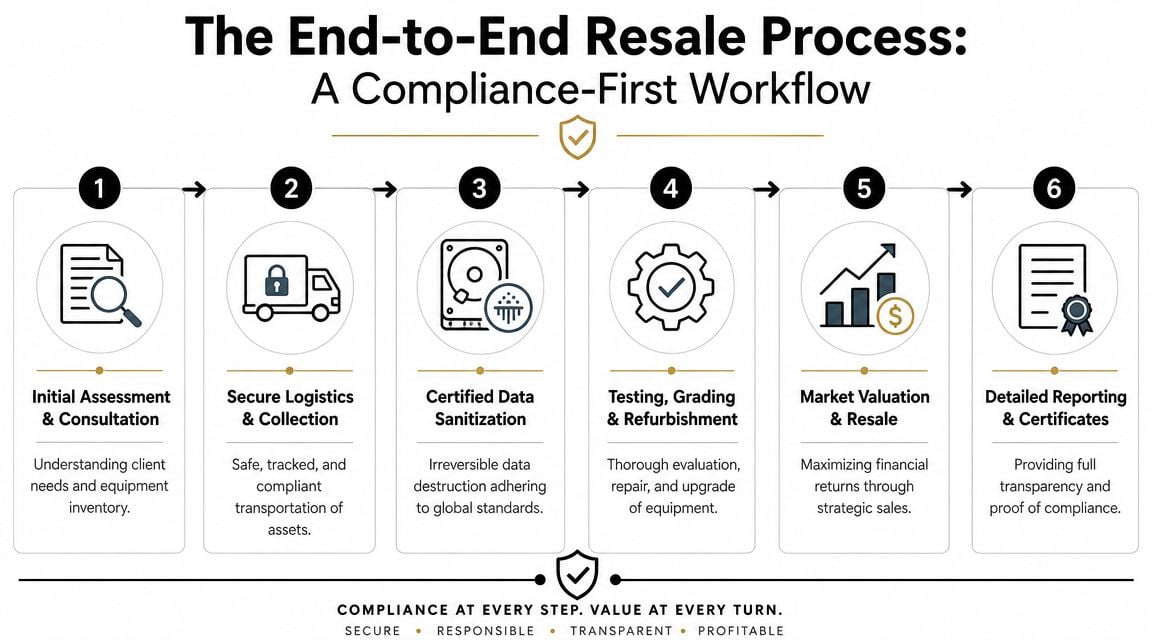
Start with inventory, not assumptions
The first pass should identify what you have on hand. That sounds obvious, but telecom projects regularly fail here because assets are spread across MDFs, IDFs, branch offices, lab shelves, and storage cages.
A usable intake record should capture:
- Model and manufacturer for every identifiable unit
- Asset or serial references where available
- Accessory completeness, including power supplies, rack ears, handsets, and modules
- Data-bearing status, especially for appliances, gateways, phones with storage, and management hardware
Incomplete intake data causes downstream problems fast. Buyers price defensively when counts shift midstream.
Secure data sanitization comes before resale
This is the step many organizations rush through. Telecom devices can retain credentials, configuration files, call detail information, and customer data. If a device can store information, it needs to be evaluated for sanitization or destruction before anyone thinks about resale.
A professional workflow usually separates assets into:
- Sanitize and remarket
- Sanitize but hold for parts
- Destroy or recycle because sanitization failed or resale isn't appropriate
Assets don't become low-risk because they're old. They become low-risk when you can prove how they were handled.
Logistics and custody matter more than most teams expect
Once equipment leaves your building, your problem doesn't disappear. It changes shape. Now the question is whether the shipment remains traceable and controlled.
That means using documented pickups, count verification, and receiving reconciliation. Bulk telecom projects often involve pallets of mixed hardware, and mixed loads create easy opportunities for count errors, accessory loss, and confusion over which units were intended for remarketing.
Testing, grading, and strategic remarketing
After sanitization and intake reconciliation, remarketable units should be tested and sorted by condition. Working pull, complete pull, cosmetic grade, missing accessories, and non-functional parts inventory all belong in different buckets.
Disciplined operators recover more value through this exact approach. They don't treat every switch, gateway, or desk phone as equal.
- Supportable gear usually moves through standard resale channels more easily
- Incomplete but desirable models may sell as spares or repair stock
- Low-demand legacy platforms may be better liquidated quickly instead of held
For larger projects, a bulk workflow like large-scale telecom equipment liquidation often makes more operational sense than piecemeal sales.
Final reporting is where liability gets transferred
The closeout package is not administrative clutter. It's the evidence trail.
A proper file should include asset reporting, data destruction confirmation where applicable, disposition outcomes, and custody records. If your finance or compliance team asks what happened to a batch of retired telecom equipment six months from now, this is the package that answers the question cleanly.
Without it, resale may have happened. But from a governance standpoint, the work is unfinished.
Maximizing ROI The True Drivers of Telecom Equipment Value
The resale value of telecom hardware doesn't come from age alone, and it doesn't come from original purchase price. Buyers pay for current usefulness.
That's why some organizations are disappointed after a large refresh. They remember what the equipment cost. Buyers care about support status, demand, completeness, and how much rework a lot will require before resale.

According to BT Resale's overview of telecom equipment value drivers, value recovery is maximized when equipment is tested, sorted by model and condition, and shipped with all accessories intact. The same guidance notes that enterprise spending is moving to IP and cloud-managed systems, so older legacy platforms are losing value faster. Lifecycle timing matters.
What buyers actually reward
A buyer looking at used telecom inventory usually screens for a few practical questions:
- Is the model still supportable
- Does the lot include the right accessories
- Was the gear tested
- Can it be redeployed without hunting for missing parts
- Is there still downstream demand
A complete, tested switch with rails, power supplies, and clean labeling is easier to buy than the same switch tossed loose in a gaylord with no accessories. The hardware may be identical. The resale outcome isn't.
Timing can help or hurt
Holding equipment too long is one of the most common value mistakes. Teams delay disposition because they may need spares, or because no one has time to sort the lot. Sometimes that's rational. Often it just lets the market move on.
Keep what you have a documented reason to keep. Liquidate the rest while buyers still care about the platform.
There's also a packaging issue that gets overlooked. Telecom gear is dense, fragile at the connector level, and easy to downgrade through careless handling. Bent ears, cracked faceplates, and separated accessories all reduce what a buyer is willing to offer.
A short value checklist
Before asking for bids, check these items:
- Model alignment with current demand, not historical cost
- Operational status based on actual testing, not assumption
- Completeness including handsets, cords, optics, rails, and power supplies
- Lot quality with clean counts and segregated condition grades
For teams preparing lots for sale, this guide to selling surplus telecom hardware is a practical next read.
Navigating Compliance and Security Risks in Telecom Resale
Telecom equipment often holds more sensitive information than general office electronics. A router can retain configuration data. A firewall appliance can hold credentials and policies. A VoIP phone system can involve user information and call records. That's why resale has to start with risk classification.
Enterprise buyers increasingly need a compliance-first exit path because telecom devices can contain credentials, call records, and customer information. The FTC Disposal Rule requires “reasonable measures” to protect this data, and NIST SP 800-88 provides the benchmark for auditable media sanitization, making documentation a critical part of reducing downstream liability, as explained in this telecom equipment disposal and resale overview.
Why factory reset is not enough
A factory reset may restore default settings. It does not automatically answer whether the device was sanitized to a documented standard, whether all storage components were addressed, or whether your organization can prove what happened if questions arise later.
That proof matters most in healthcare, finance, education, and government environments, but it also matters in ordinary commercial settings. Security reviews happen after incidents, not before them.
Documentation is the control, not the afterthought
A compliance-first workflow should produce records your internal stakeholders can utilize.
- Chain-of-custody records show who handled the equipment and when
- Asset reports reconcile what was received and processed
- Certificates of data destruction support audit and legal review
- Disposition records show what was remarketed versus destroyed
If a vendor can't show you sample reporting before pickup, that's a warning sign.
If the only proof of disposal is an email saying “all set,” you don't have proof of disposal.
For organizations standardizing their sanitization policy, this NIST SP 800-88 resource is a useful baseline.
How to Choose the Right Telecom Resale Partner
Selecting a partner is less about who offers the most optimistic recovery estimate and more about who can execute cleanly under scrutiny. Procurement may focus on price. IT usually has to live with the operational consequences.
Questions worth asking before you sign
Start with direct questions that expose process maturity.
- How do you identify data-bearing telecom devices that need sanitization or destruction?
- What does your chain of custody look like from pickup through final disposition?
- Can you provide sample reporting with serial-level or asset-level reconciliation?
- How do you separate resale, parts harvesting, destruction, and recycling streams?
- Who handles logistics, and how are pickups documented?
- What happens to unsellable units?
A strong provider answers these without hand-waving.
What to request in writing
Don't rely on verbal assurance. Ask for documentation before any project starts.
Review these items
- Data destruction standard used for media sanitization
- Sample certificate formats for destruction and recycling
- Insurance and logistics details for transportation and handling
- Escalation path if counts don't reconcile or unexpected devices appear
- Settlement structure for value recovery and reporting cadence
This is also where certifications and downstream transparency matter. You want a provider that can explain where remarketable equipment goes, how residual materials are handled, and how exceptions are documented.
One practical option in this category is Beyond Surplus, which states that it provides business pickup, data destruction documentation, and telecom equipment buyback and resale workflows for commercial clients. That matters when your project needs recovery value and auditable disposition in the same engagement.
Your Telecom Asset Disposition Action Plan
Retired telecom gear shouldn't sit in limbo. It ties up space, loses value with time, and can keep sensitive data inside equipment your team no longer monitors. A workable plan balances resale, destruction, documentation, and timing.
The bigger market context supports taking this seriously. The global telecom equipment market is valued at over USD 695 billion in 2026, with continuous upgrade cycles for 5G, fiber, and cloud infrastructure, according to Mordor Intelligence's telecom equipment market outlook. That steady refresh means more enterprise equipment will keep moving into the secondary market, and organizations that handle disposition well will make cleaner decisions than those that improvise.
A practical next-step checklist
- Build a preliminary inventory of retired switches, routers, phones, gateways, PBX gear, and related hardware
- Flag data-bearing devices early so sanitization decisions happen before resale discussions
- Define your internal requirements for reporting, custody, and legal defensibility
- Choose the right channel based on staff time, speed needs, and compliance exposure
- Request a full scope proposal that covers pickup, sanitization, testing, remarketing, and final certificates
Good telecom resale is disciplined. The organizations that recover the most value usually aren't the ones chasing the highest headline offer. They're the ones that know what they have, move it before the market softens, and document every handoff.
Contact Beyond Surplus for certified electronics recycling, secure IT asset disposal, and a compliance-first path for business telecom equipment resale solutions.


