

A facility manager calls at the end of a hardware refresh. The storage room is full, the data center decommissioning date is approaching, and nobody wants to approve a truck pickup without knowing where every laptop, server, drive, and medical workstation will go. For an Atlanta, Georgia business, Corporate Electronics Recycling has to solve more than a space problem. It must protect data, preserve recoverable value, document custody, and route unusable equipment through responsible recycling.
The practical model is reuse first, recycle last. A device should be evaluated for redeployment, refurbishment, or resale before it enters a material recycling stream. That hierarchy gives IT managers a more defensible outcome than treating every retired asset as scrap.
Table of Contents
- The Reuse-First Corporate Electronics Recycling Process
- Planning Your IT Asset Retirement Timeline
- Data Security and Regulatory Compliance Standards
- Selecting the Right ITAD Vendor Partner
- Logistics and Chain-of-Custody Management
- Value Recovery and Performance Reporting
- Implementing Your Corporate Electronics Recycling Program
The Reuse-First Corporate Electronics Recycling Process
A corporate electronics recycling project often begins after an office refresh, when retired laptops, servers, storage devices, and monitors are labeled “recycle” and placed in a locked room. That temporary solution can create avoidable risk. Without an asset-level plan, a business may lose resale value, delay collection, or lack the records needed to demonstrate secure handling.
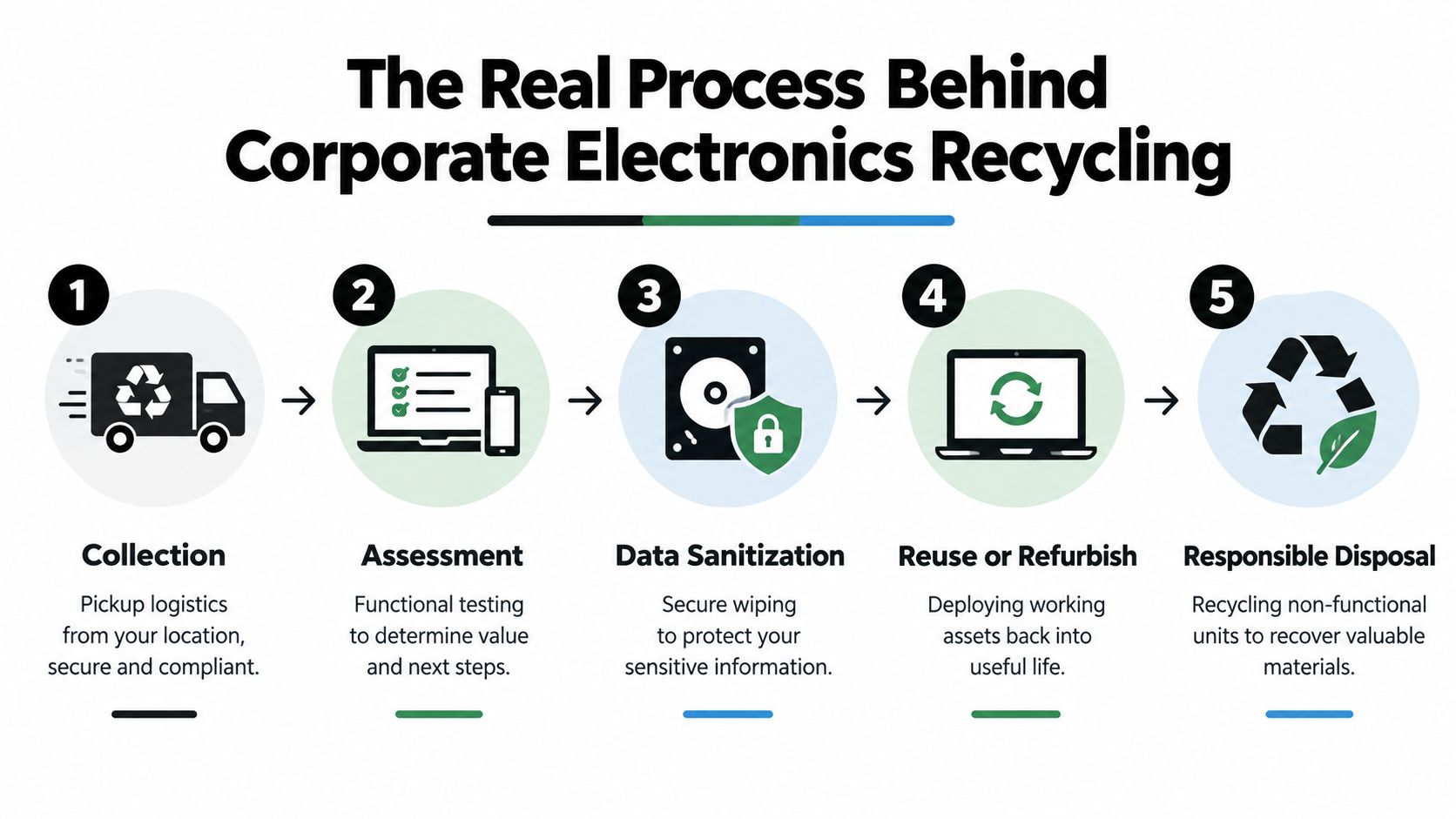
A reuse-first workflow assigns each device a controlled destination:
- Collect and identify it.
- Assess its condition, data exposure, and business value.
- Sanitize or destroy its data-bearing media.
- Redeploy, refurbish, or remarket suitable equipment.
- Recycle the remainder through approved downstream processing.
A linear destruction pipeline treats every asset alike. A tiered evaluation routes each device according to condition, data sensitivity, and potential value. For an Atlanta business, that means coordinating loading access, pickup timing, and facility requirements while maintaining serial-level records for enterprise reporting. A functional laptop may return to service or enter resale after verified sanitization. A server may need a detailed inspection before data center retirement. A damaged storage array may require physical destruction when its media cannot be reliably sanitized for reuse.
Why the waste stream changes the decision
The global volume of retired electronics makes disciplined disposition important. In 2022, the world generated 62 billion kilograms of e-waste, equal to 7.8 kilograms per person, while only 22.3% was formally collected and recycled in an environmentally sound way, according to the Global E-waste Monitor data. The same source projects an annual stream of 82 million tonnes by 2030.
Enterprise programs cross markets with very different collection infrastructure. Europe generated 17.6 kilograms per capita and recorded a 42.8% collection and recycling rate, while Africa had less than 1% formally collected and recycled in the same dataset. A national program therefore needs consistent vendor controls, documented downstream routes, and clear approval rules for local handoffs.
Material recovery adds another reason to evaluate equipment before disposal. Global e-waste contained recoverable material worth about US$91 billion in 2022, including roughly US$19 billion in copper, US$15 billion in gold, and US$16 billion in iron, according to the International Telecommunication Union's e-waste backgrounder. Reuse and responsible recovery can support sustainability objectives while preserving financial value.
For a practical explanation of downstream processing, review what happens to recycled electronics. The right question is which outcome provides the safest, highest-value route for each serial-tracked asset.
Planning Your IT Asset Retirement Timeline
Late planning creates avoidable cost and control problems during a lease end, office closure, server migration, or equipment refresh. A rushed project can narrow resale options, shorten the data sanitization window, and leave devices in uncontrolled storage. In Atlanta, even a short local move can become a coordination issue when facility access, loading schedules, and multiple departments are involved.
Enterprise ITAD benchmarking recommends starting six to twelve months before retirement to support stronger recovery and compliance outcomes, as described in enterprise IT asset recycling measurement guidance. Set the retirement date as a project milestone while equipment remains in service, not after it has been stacked beside the loading dock.
Build the inventory before scheduling transport
The inventory controls every later decision. Record the manufacturer, model, serial number, asset tag, location, assigned user or department where appropriate, device class, and storage-media details. Include laptops, desktops, monitors, network equipment, servers, storage arrays, printers, laboratory equipment, medical equipment, and accessories that fall within the project scope.
Use the inventory to apply a reuse-first hierarchy:
- Redeployment candidates: Assets that can return to service after approved sanitization, testing, and configuration.
- Remarketing candidates: Functional equipment that no longer fits the company's needs but may retain resale value.
- Recycling candidates: Units that are damaged, obsolete, incomplete, or too costly to refurbish.
- Destruction candidates: Media or products requiring controlled destruction because of sensitivity, condition, or business policy.
This sequence prevents usable equipment from entering the recycling stream too early. It also separates the handling requirements for laptops, servers, storage arrays, and other asset classes. Their data risks, packaging needs, resale markets, and recovery outcomes are different.
Establish the retirement sequence
Assign an owner to each control point:
- Inventory review: Confirm what exists and reconcile the list against procurement, asset management, and facility records.
- Access removal: Coordinate with IT administrators to retire devices from endpoint management, identity systems, and operational networks.
- Data classification: Determine whether each media type requires Clear, Purge, or Destroy treatment under company policy.
- Pickup preparation: Consolidate equipment, protect screens and components, and stage assets in a controlled area with practical carrier access.
- Disposition reporting: Require serial-level outcomes, sanitization evidence, certificates, and recovery information.
Your organization should define the sanitization standard, approve the method, reconcile the results, and retain the records. A disposition vendor may perform the work, but vendor execution does not replace internal oversight or documented acceptance criteria.
A detailed business technology disposal planning guide can help facilities, procurement, and IT teams align the physical move with the compliance process. Build pickup windows, staging capacity, approval checkpoints, and reporting deadlines into the same project plan. That approach supports reuse where practical, controlled recycling where necessary, and verified destruction when policy or risk requires it.
Data Security and Regulatory Compliance Standards
Recycling a computer doesn't sanitize the information stored on it. A device can be physically damaged, sent to a recycler, or removed from a building while its media still contains recoverable business data. Secure disposition starts with identifying every data-bearing component, then selecting a method that matches the media type and information sensitivity.
NIST SP 800-88 provides the framework most enterprise programs use for planning, executing, verifying, and documenting media sanitization. Enterprise ITAD guidance describes three distinct levels:
- Clear: Standard read and write commands address data through the device's normal interface. This may suit lower-risk media approved for reuse, subject to the organization's policy and verification requirements.
- Purge: Advanced methods, such as cryptographic erasure, degaussing, or device-specific secure erase functions, make recovery infeasible while potentially preserving the media for reuse.
- Destroy: Physical shredding or disintegration renders the media unusable. This is appropriate when sensitivity is highest, the media cannot be reliably sanitized, or reuse isn't permitted.
The correct method depends on whether the asset contains a magnetic hard drive, SSD, removable media, embedded storage, or another type of device. A wiping method designed for one medium shouldn't be applied automatically to another.
Verify the result at device level
A defensible process records the asset serial number, media identifier where available, sanitization method, completion status, date, operator or system evidence, and final disposition. The record should connect the physical asset to its Certificate of Erasure or Certificate of Destruction.
One industry source citing NAID data reports that certified providers achieve an eradication success rate of over 99%, compared with 85% for non-certified vendors, as described in data destruction guidance for businesses. The important lesson isn't to accept a percentage without examining the methodology. It's to ask how the provider verifies completion, handles exceptions, and produces auditable evidence.
The FTC Disposal Rule requires covered organizations to take reasonable measures so consumer information can't be read or reconstructed after disposal. Practical controls include written procedures, serial-number records, certificates for wiping or destruction, and oversight of vendors and downstream providers, as outlined in this business electronics disposal compliance guidance.
Practical rule: A generic recycling receipt doesn't prove what happened to a specific drive. Require documentation tied to the asset identifier.
For a detailed explanation of the framework, use NIST 800-88 data destruction standards. Healthcare, finance, government, laboratory, and research environments should also align the disposition policy with their internal data classification and legal obligations.
Selecting the Right ITAD Vendor Partner
Price matters, but it shouldn't be the first screening criterion. A low quote can become expensive if the vendor can't provide serial-level reporting, uses inconsistent downstream processors, or treats data wiping as an informal step.
Compare vendors against the controls your audit, security, facilities, and sustainability teams require.
ITAD Vendor Evaluation Criteria
| Evaluation Criterion | Enterprise Requirement | Risk of Non-Compliance |
|---|---|---|
| Certification and auditing | Evidence of applicable certification and accredited third-party review | Unsafe processing, weak controls, and limited audit defensibility |
| Data sanitization | Documented Clear, Purge, or Destroy methods matched to media and sensitivity | Recoverable data, incomplete erasure, or unsupported destruction claims |
| Asset tracking | Serial-number inventory from pickup through final outcome | Missing devices and inability to reconcile the disposition report |
| Chain of custody | Signed or system-recorded transfers at every custody change | Unexplained gaps during transport or downstream handling |
| Reuse and recycling separation | Distinct reporting for redeployment, resale, refurbishment, and material recycling | Overstated diversion, lost resale value, or unclear environmental results |
| Downstream oversight | Named or verifiable downstream processors and documented controls | Limited visibility after the first vendor receives the equipment |
| Reporting package | Certificates, inventory reconciliation, disposition results, and exception records | Audit delays and weak evidence of compliance |
The EPA recommends using certified electronics recyclers and says recyclers should demonstrate through an accredited third-party auditor that they meet standards for safe electronics management. Its electronics management guidance is a useful baseline for evaluating environmental controls.
Ask prospective partners to explain what happens when a drive fails sanitization, when a serial number is unreadable, or when equipment arrives with undocumented accessories. Strong vendors have an exception process instead of forcing every asset into a clean, convenient category.
A vendor should also distinguish refurbishment and resale from commodity recycling. Those streams have different controls and different outcomes. Reworx guidance emphasizes that process data and economic data are separate inputs, so a company shouldn't claim strong value recovery because equipment was diverted from disposal.
Before signing, review questions to ask before hiring an ITAD company. Request sample reports, confirm insurance and contractual responsibilities, and ask who performs the final processing. Beyond Surplus is one Atlanta-based option that provides business electronics recycling, secure data destruction, certificates, and pickup coordination for corporate clients.
Logistics and Chain-of-Custody Management
A secure disposition program can fail during transport even when the final recycler has excellent equipment. The pickup plan must control what leaves the facility, who accepts it, how it's counted, and where it's stored before processing.
For an Atlanta-area office, begin with a site walk-through or detailed pickup brief. Identify loading docks, freight-elevator rules, parking restrictions, security requirements, pallet or cart needs, and any areas where equipment must be staged. Data center decommissioning requires additional coordination because racks, storage arrays, network equipment, batteries, and cabling may need different handling.

Control each transfer
Before the truck arrives, reconcile the expected inventory with the equipment staged for collection. At pickup, record the date, location, responsible representatives, asset count, serial list, and any exceptions. Both parties should retain a custody record.
At the processing facility, the provider should document receipt, reconcile the shipment, segregate data-bearing equipment, and record the next disposition event. If a third party handles transportation or downstream recycling, that transfer belongs in the audit trail too.
- Stage securely: Keep retired electronics in a controlled area that unauthorized staff and visitors can't access.
- Protect media: Prevent drives, laptops, and storage arrays from being mixed into untracked containers.
- Record exceptions: Note missing serials, damaged labels, unexpected equipment, and assets that arrive without media.
- Match final outcomes: Reconcile every collected asset to reuse, resale, recycling, or destruction documentation.
A material traceability system guide offers useful context on linking physical movement with digital records. The same principle applies to ITAD. A spreadsheet, barcode system, or specialized platform can work, provided it preserves an accurate asset history.
Atlanta businesses may use local pickup or facility drop-off arrangements depending on volume, security, and equipment type. Organizations with offices beyond Georgia should decide whether one national ITAD partner can apply the same documentation and sanitization policy across all locations. Fragmented local handling often creates inconsistent certificates and reporting formats.
For a closer look at custody controls, review chain of custody for IT asset disposal. The objective is simple: at any point in an audit, your team should be able to answer where a specific device was, who controlled it, and what happened next.
Value Recovery and Performance Reporting
A weight-only recycling report cannot guide an enterprise retirement program. Business leaders need to see which equipment returned to service, which assets generated resale value, which units required destruction, and whether every data-bearing device received verified treatment. A reuse-first hierarchy makes those outcomes visible before material recycling becomes the default.
One practical benchmark uses a reuse-to-resale ratio: the number of assets redeployed or resold divided by the total number of retired assets. This shows how much of the fleet avoided the recycling stream. Enterprise ITAD measurement guidance provides context for measuring recovery performance. Define each category internally, then report results by device class so laptops, servers, and storage arrays are not blended into a misleading total.
Build a report that supports decisions
A monthly or project-level report should give security, finance, and sustainability teams information they can act on:
- Inventory reconciliation: Compare assets collected with the approved retirement list.
- Security completion: Report devices with verified sanitization or destruction records.
- Disposition mix: Separate redeployed, refurbished, resold, materially recycled, and destroyed assets.
- Financial outcome: Show gross resale proceeds, program fees, and value recovered by equipment category.
- Traceability status: Identify complete records, open exceptions, and confirmed downstream outcomes.
The Global E-waste Monitor illustrates why material recovery and formal processing deserve separate attention. Its cited global figures show that formal recycling can avoid primary ore extraction and CO2-equivalent emissions. Those figures describe the broader system, not an individual company's performance. Enterprise reporting should therefore rely on documented outcomes from the company's own assets.
Atlanta operations may require separate reporting for local pickups, facility drop-offs, and shipments from offices outside Georgia. Use consistent disposition definitions across locations, especially where equipment moves between redeployment, resale, and recycling channels.
A reliable report gives security teams evidence of proper treatment, finance a clear recovery picture, and sustainability teams records for internal reporting.
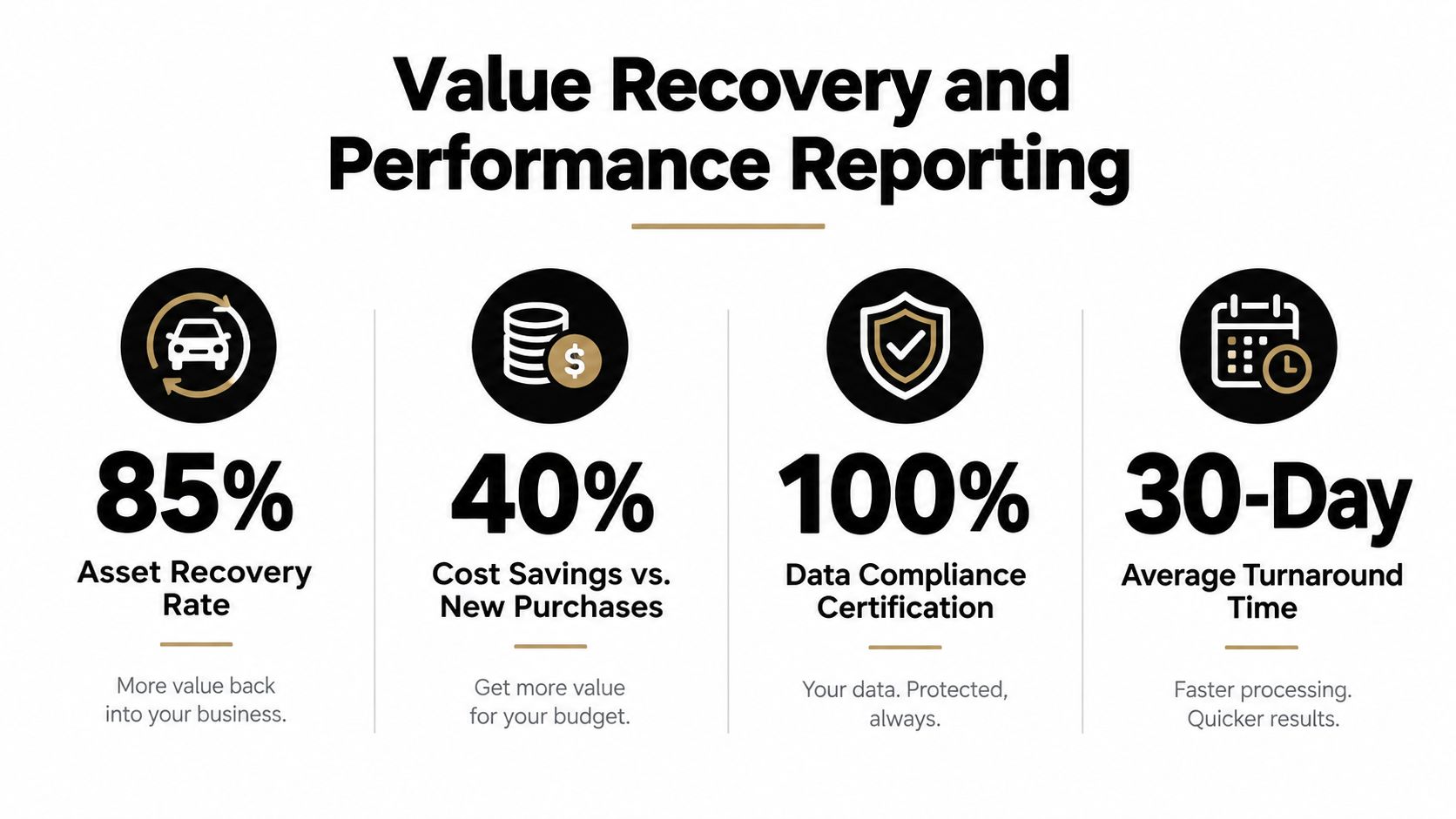
Do not use one diversion figure as proof of program quality. Resale, secure destruction, and material recovery represent different outcomes, controls, and risks.
Implementing Your Corporate Electronics Recycling Program
In the first 90 days, issue a written policy covering asset ownership, data classification, approved sanitization, pickup controls, vendor oversight, and required records. Train facility staff to stage equipment securely and prevent disposal through general waste channels.
Days 1-30: assign owners, define approval gates, and shortlist vendors for Atlanta pickups and nationwide shipments. Days 31-60: run a pilot pickup on one floor, reconcile the manifest, and review custody exceptions with security and facilities.
Days 61-90: secure sign-off on the report template, then expand by site. Require each report to match assets with disposition, custody records, and downstream documentation. Prioritize reuse and resale where condition and risk allow, then send unsuitable equipment to documented recycling.
Beyond Surplus (https://www.beyondsurplus.com) coordinates Atlanta and nationwide recycling, IT disposal, data destruction, and chain-of-custody services.