

Atlanta, Georgia businesses aren't dealing with hypothetical cyber risk. Georgia ranked 11th nationally for cybercrime complaints in 2024 according to Cybergl's Atlanta cybersecurity overview. That matters in Atlanta because the city concentrates finance, healthcare, logistics, legal operations, and payment-heavy business processes in one metro market. Attackers don't need exotic tactics when common weaknesses still open the door.
For many companies, the primary issue isn't just malware. It's the chain reaction that follows a compromised inbox, a reused password, an unpatched server, or a retired laptop that still holds sensitive data. Digital compromise and physical asset exposure are part of the same risk picture.
A practical security program for Atlanta leaders has to cover both. That includes prevention, monitoring, incident response, and secure end-of-life handling for hardware through services such as Atlanta IT asset disposition and electronics recycling.
Atlanta's Growing Cybersecurity Challenge
Atlanta companies face a concentrated risk problem. The same conditions that make the metro area commercially strong also make it efficient for attackers. High transaction volume, regulated data, distributed workforces, third-party access, and fast-growing cloud environments all increase the number of points where a routine control failure can turn into a business interruption.
In practice, many serious incidents still start with something mundane. A user approves a malicious login prompt. A stale admin account stays active after a role change. A retired laptop sits in storage with unencrypted data still intact. Security failures in Atlanta are rarely confined to one system because finance, operations, legal, customer service, and vendor management often share the same identities, inboxes, and devices.
That last point gets missed too often. Cyber risk does not end when hardware leaves daily use.
For Atlanta leadership teams, secure offboarding of technology should sit in the same conversation as phishing resistance, patching, and access control. If old laptops, servers, mobile devices, or network gear leave your custody without documented sanitization and chain of custody, the exposure is no longer theoretical. It becomes a preventable data security gap, which is why many organizations build Atlanta IT asset disposition and electronics recycling services into their security and compliance process instead of treating disposal as a facilities task.
Why this hits Atlanta harder
Many Atlanta businesses operate inside dense partner and payment relationships. One compromised mailbox can affect wire approvals, vendor communications, contract data, or client records. One weak endpoint can provide a path into file shares, ERP platforms, HR systems, or remote administration tools.
The trade-off is real. Companies want speed, accessibility, and low friction for employees and partners. Attackers want the same connectivity because it shortens the path from initial access to financial fraud, operational downtime, or reportable data exposure.
A useful rule for executives is simple: controls around identity, email, privileged access, and end-of-life device handling protect revenue, not just IT. In Atlanta, that is an operational issue, a legal issue, and for many firms, a board-level risk.
The Dominant Threats Facing Atlanta Businesses Today
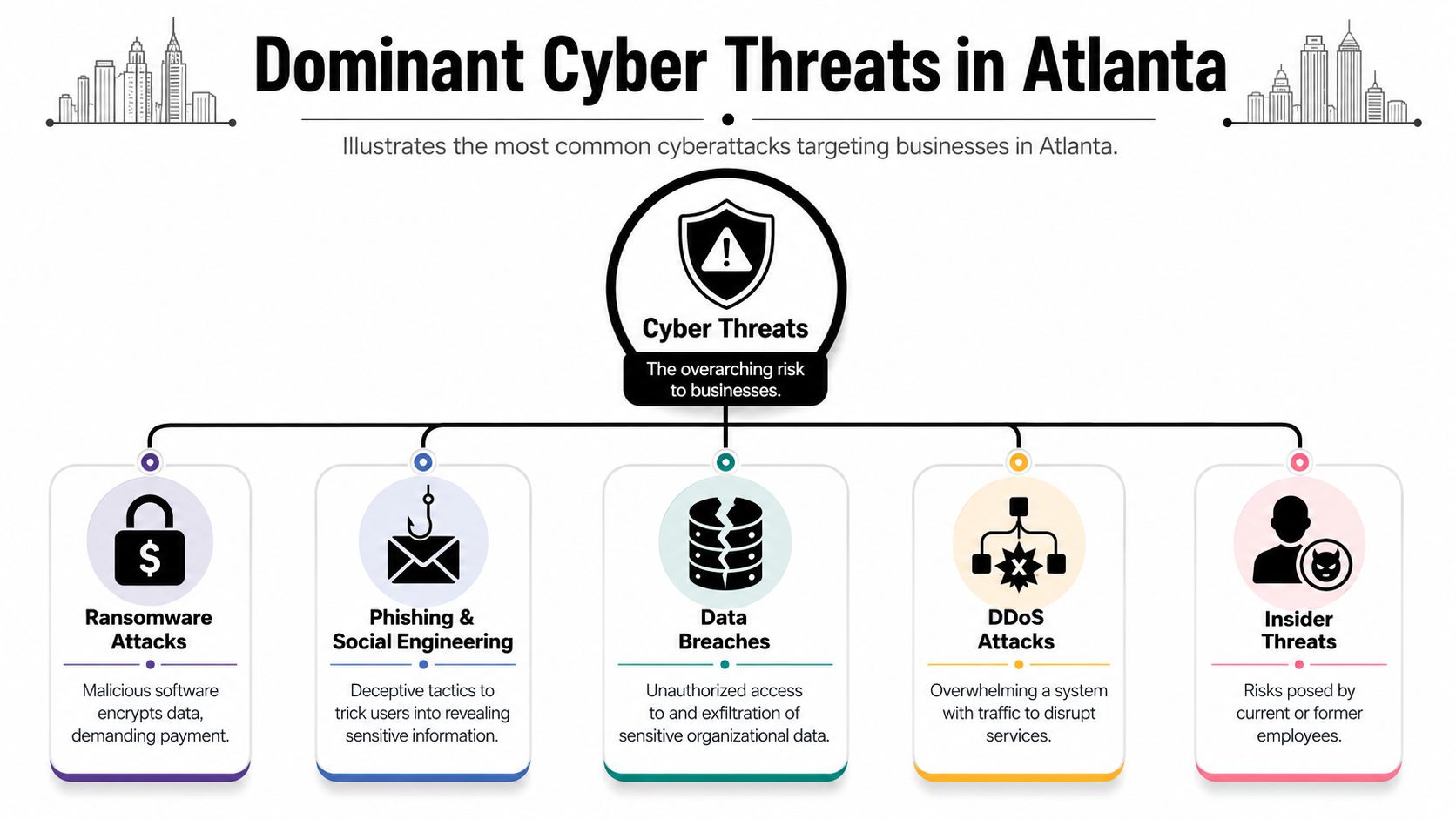
Three attack patterns show up repeatedly in business environments. They differ in method, but they often overlap during the same incident.
Ransomware starts with access
Ransomware is usually the visible end of a longer failure chain. An employee clicks a phishing email, a password gets reused, or a vulnerable system remains exposed too long. Attackers conduct their reconnaissance before encryption begins, looking for backups, admin tools, and sensitive files.
What works:
- Fast patching: Attackers exploit delay.
- Protected backups: Recovery depends on backups you can trust.
- 24/7 monitoring: You need someone watching for suspicious movement before encryption spreads.
What doesn't:
- Assuming antivirus alone is enough
- Leaving privileged accounts broadly assigned
- Treating backup success messages as proof of recoverability
BEC turns email into a fraud channel
Business email compromise is less noisy than ransomware and often more financially immediate. The attacker gets into an executive, finance, or vendor-facing mailbox and manipulates trust. Payment details change. Urgent wire requests appear legitimate. Staff act quickly because the message fits existing workflow.
This is one reason mailbox security matters as much as server security. Technical controls help, but approval discipline matters just as much.
For retired devices that once stored mailbox caches, saved credentials, or exported financial records, data sanitization closes a gap many teams leave open after refresh cycles.
Identity-driven attacks scale fast
Modern environments run on identity. If attackers compromise a cloud admin, a federated account, or a privileged help desk credential, they can bypass traditional network boundaries and move directly into systems that matter.
A compromised identity is often more valuable than compromised hardware because it can unlock the hardware, the cloud tenant, and the business process behind both.
That's why MFA, role limits, session review, and continuous logging outperform one-time perimeter projects.
Why Atlanta's Key Industries Are Prime Targets
Atlanta's economy gives attackers a clear monetization path. The issue isn't only data volume. It's the business value attached to each identity, account, and workflow.
Atlanta security guidance notes that companies in the city are disproportionately exposed to identity-driven attacks because of the concentration of fintech, healthtech, and payment-processing operations. That same guidance ties the risk to business email compromise, account takeover, lateral movement against cloud and identity infrastructure, and the need to harden Active Directory, AWS, and Azure while mapping controls to frameworks such as SOC 2, HIPAA, NYDFS, ISO, and NIST.
Fintech and payment operations
In fintech and payment-heavy businesses, a single compromised account can lead directly to fraud workflows, transaction manipulation, or access to systems that authorize money movement. Attackers don't need to steal everything. They need one identity with enough trust attached to it.
Healthcare and regulated data
Healthcare and healthtech environments hold regulated records and often involve many users, many systems, and many third parties. That raises the chance of privilege creep, stale accounts, and overlooked devices holding patient-related information. Companies dealing with regulated equipment retirement should also understand HIPAA-compliant ITAD services in Georgia.
Logistics, legal tech, and cloud-heavy operations
These sectors rely on timing, document integrity, and shared systems. Attackers know disruption itself has value. If they can interrupt dispatch, alter communication, access legal documents, or move through cloud control planes, they can create immediate pressure on the business.
A short way to think about Atlanta risk:
| Industry profile | What attackers want | Why identity matters |
|---|---|---|
| Payment-intensive operations | Access to financial workflows | Trusted users can approve or redirect actions |
| Regulated data environments | Sensitive records and compliance leverage | Credentials often unlock broad data access |
| Cloud-reliant teams | Control over infrastructure and admin functions | Privileged identities bypass old perimeter assumptions |
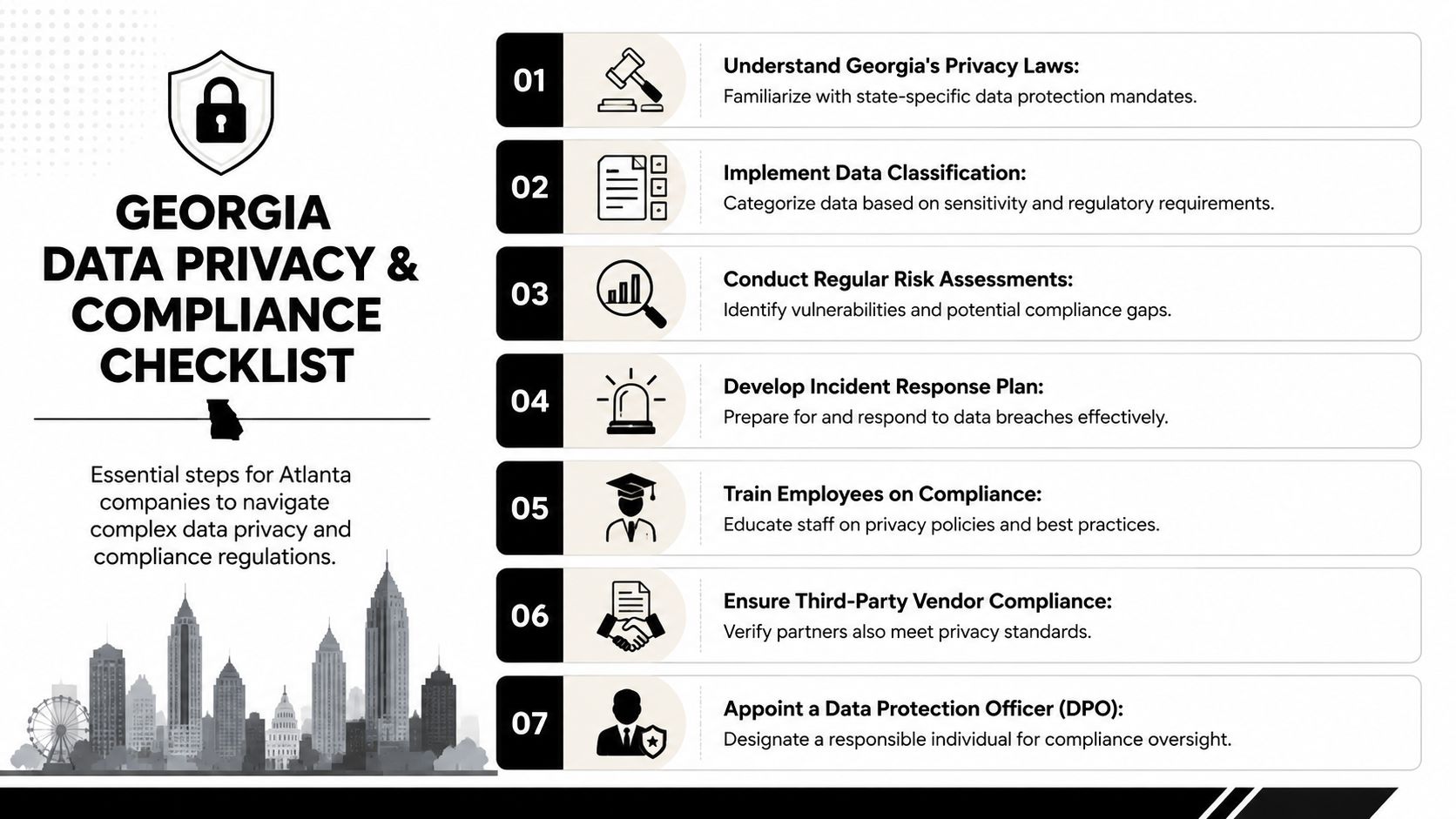
Navigating Georgia's Data Privacy and Compliance Rules
A breach rarely stays inside the IT department. It quickly turns into a legal, financial, and evidence-handling event.
A common Atlanta scenario looks like this. Finance receives an email that appears to come from an executive or trusted vendor. Payment instructions change. Staff process the request. Only later does the company discover that the mailbox or conversation thread was compromised.
Georgia's Attorney General specifically highlights business email compromise and other cyber-enabled thefts and directs victims to coordinate with financial providers, local law enforcement, and the FBI IC3, as explained on the Georgia Attorney General cybersecurity page. That should change how leadership teams classify BEC. It isn't just an email issue. It's a fraud response issue with reporting and recovery implications.
What leadership should decide before an incident
- Who calls the bank first: Treasury, finance leadership, and legal should know the trigger.
- Who preserves evidence: Don't let staff delete messages, wipe devices, or reset accounts without direction.
- Who owns regulator and customer analysis: Compliance can't start after panic takes over.
Preserve the mailbox, preserve the device, preserve the timeline. Early evidence handling often determines whether recovery and reporting go smoothly.
Compliance isn't separate from operations
Healthcare entities have HIPAA obligations. Many businesses handling consumer information also face disposal and data handling obligations. If retired equipment still contains customer files, employee records, or regulated data, weak disposal practices can turn a contained event into a broader reportable problem.
Teams that want cleaner documentation and defensible end-of-life handling should review secure data destruction in Georgia and ITAD compliance.
Building a Layered Defense for Your Atlanta Business
The strongest Atlanta security programs aren't built around one tool. They're built around layers that assume one control will eventually fail.
Start with the controls that break common attack chains
A practical stack usually includes:
- Advanced email security: Filter malicious attachments, links, spoofing attempts, and suspicious message patterns.
- MFA on meaningful accounts: Prioritize admin roles, finance access, remote access, and cloud consoles first.
- Patch discipline: Measure delay, not intent. Risk lives in the gap between release and deployment.
- Continuous monitoring: Watch endpoints, identities, and cloud logs together, not in separate silos.
Limit damage after compromise
Mature teams distinguish themselves. They plan for containment, not just prevention.
Consider these design choices:
| Control area | Weak approach | Strong approach |
|---|---|---|
| Access | Shared admin habits | Role-based access with review |
| Endpoints | Inconsistent retirement and redeployment | Standardized build, logging, and disposition |
| Response | Ad hoc decisions in a crisis | Named owners and preserved evidence |
| Backup | Untested assumptions | Recovery testing tied to business priorities |
Train people on workflow abuse, not just phishing slogans
Security awareness often fails because it stays generic. Finance teams need fraud escalation procedures. HR teams need rules for document handling. IT staff need to know when not to wipe a device. Executives need approval discipline when requests involve urgency, secrecy, or payment changes.
Field observation: The best training is role-based. Staff retain examples that match the exact approvals, tools, and exceptions they handle every week.
Secure ITAD is part of cyber defense
This is the gap many companies underestimate. A laptop can be retired from inventory but still contain local files. A decommissioned server may hold logs, credentials, exports, or regulated records. Storage pulled from a data center can retain business value for whoever gets physical possession next.
That means secure IT asset disposition is not a sustainability chore at the edge of operations. It is a control that closes exposure after the device leaves production use.
Effective ITAD includes:
- Documented chain of custody: You should know who handled the asset, when, and under what authorization.
- Certified data destruction: Wiping or shredding should match the sensitivity of the media and the compliance context.
- Asset tracking and reconciliation: Retired assets should be matched against inventory so nothing is unaccounted for.
- Disposition records: Certificates and transfer documentation help support audits, investigations, and internal accountability.
For organizations building process around retirement, redeployment, and value recovery, IT asset lifecycle management is the right framework. In Georgia, one operational option is Beyond Surplus, which provides certified data destruction, chain-of-custody documentation, IT asset disposition, and electronics recycling for business hardware.
What usually fails in practice
Companies get into trouble when they:
- Delay hardware retirement projects: Old assets pile up in closets, cages, and branch offices.
- Rely on informal wiping: “It was probably erased” is not defensible.
- Split ownership too many ways: Facilities, IT, security, procurement, and compliance each assume someone else handled it.
- Treat decommissioning as logistics only: It's also a data governance event.
Securing Your Company's Future with a Proactive Stance
Atlanta companies face a specific mix of risk. Identity abuse, ransomware, fraud, and compliance exposure all connect back to everyday business systems such as email, cloud access, payment approval, stored records, and retired hardware.
Leaders who handle Cybersecurity Threats Targeting Atlanta Companies well usually do three things. They tighten identity and email controls, they rehearse response before a crisis, and they treat asset disposal as part of security instead of an afterthought.
That last point matters more than many teams realize. If you secure production systems but lose control of drives, laptops, servers, or network equipment at end of life, you leave a final opening behind. A proactive program closes that opening with documented custody, verified data destruction, and environmentally responsible processing. For companies aligning risk reduction with environmental reporting, sustainable IT disposal in Georgia is part of the same governance conversation.
The goal isn't perfection. It's reducing the number of easy wins available to attackers and reducing the blast radius when something goes wrong.
Atlanta organizations that need a defensible end-of-life process for IT equipment can contact Beyond Surplus for certified electronics recycling and secure IT asset disposal.


