

You pulled the old drives, stacked the laptops, and cleared the server closet. Then the problem shows up. There's no sanitization log, no serial-number trail, and no agreement on which assets should be wiped, shredded, or redeployed. In Atlanta, that gap turns an ordinary refresh into a compliance problem fast.
Data Destruction Services in Atlanta: Protecting Your Business is not about cleanup for its own sake. It's about making sure retired technology leaves your control with a defensible end state, whether that means reuse, resale, or irreversible destruction. If your team handles customer files, employee records, patient data, or financial systems, the disposal decision matters as much as the retirement date.
When an Atlanta IT Refresh Suddenly Becomes a Risk Problem
A mid-size Atlanta IT director can do everything right on the refresh itself and still inherit a mess at the end. The servers are decommissioned, the drives are bagged, and procurement wants the floor clear by Friday. Then someone asks for the destruction certificate, and nobody can produce one.
The failure is usually process, not equipment
That is the pattern I see in Atlanta refresh projects that go off the rails. A lease ends, a relocation schedule gets compressed, or a merger team inherits half-documented storage rooms, and the disposal plan gets reduced to a pickup request. I have seen a 40-laptop office sweep turn into a compliance scramble because the team could not say which units were wiped, which were headed for resale, and which were supposed to be shredded. One missed handoff is enough to break the chain of custody.
Practical rule: If you can't tie each drive to a final disposition, you don't have a disposal program. You have a liability pile.
The pressure gets worse when a project spans offices, storage rooms, and a server cage no one has inventoried properly in years. A laptop buyback program can be just as risky as a server-room refresh if someone skips the sanitization decision and sends everything out the door as a bulk lot. That is where the choice between reuse, resale, wiping, and destruction has to be made before the pallets move, not after. Atlanta teams that are already planning an upgrade cycle should start with the refresh strategy outlined in how Atlanta companies are upgrading IT in 2026, then map each asset to the right sanitization path.
The right response is to stop treating retired assets as orphaned equipment. A defensible process starts before pickup, not after.
Why Secure Destruction Is a Risk Control, Not an IT Cleanup
A disposal lapse is expensive because the damage doesn't end when the truck leaves. One 2026 industry summary puts the global average cost of a breach at $5.0 million per incident and $175 per record, with financial-sector breaches averaging $6.25 million and $250 per record. The same source says post-breach impacts can last 2 to 3 years or more, which is why certified sanitization belongs in risk planning, not in the janitorial budget. Secure data destruction cost context
Finance approves what you can defend
CFOs don't want to hear “recycling fee.” They want to hear “documented control.” IT directors get budget approval faster when they frame destruction as a way to reduce breach exposure, support compliance, and close off downstream notification costs. That argument lands because the downside is measurable, while the upside is mostly invisible until something goes wrong.
Certified sanitization is not just removal of old media. It is evidence that the company took reasonable steps before devices left control.
That's the clean internal memo line. Use it.
The important move is to connect the spend to the same risk bucket as endpoint protection and cyber insurance. If a few pallets of drives can trigger a long tail of incident response, then disposal needs a hard control, not a soft promise. Atlanta firms that buy this logic stop arguing about whether secure destruction is “extra.” It isn't.
The Four-Step Workflow Atlanta IT Teams Should Follow
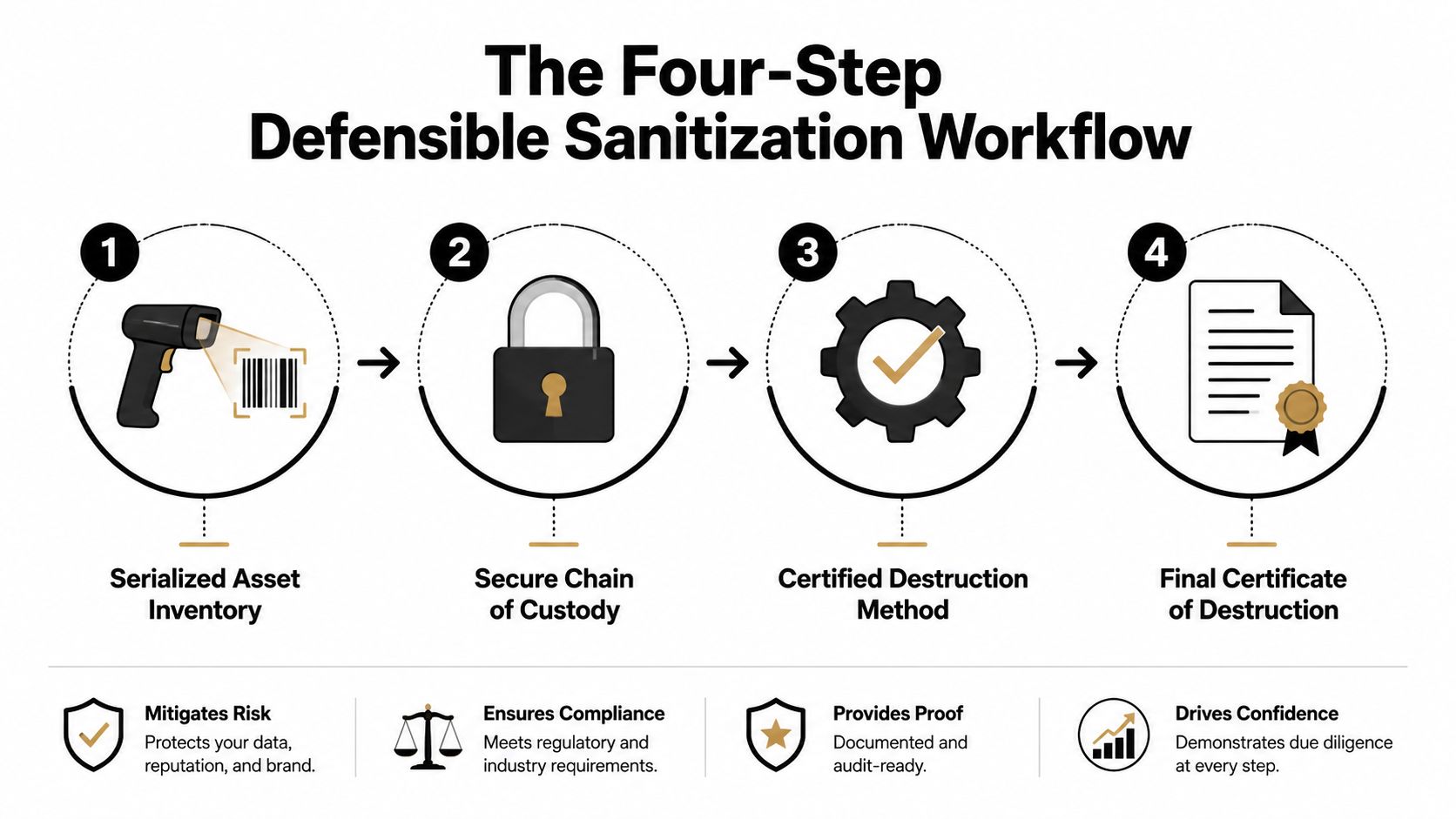
Start with a serialized asset inventory. If a drive, SSD, laptop, backup device, or tape leaves the closet without an identifier, you have already weakened the chain of custody. Atlanta IT teams that handle refreshes cleanly do the boring work first, then everything else becomes defensible.
Inventory, classify, choose, document
After inventory, classify each device by data sensitivity and media type. HDDs, SSDs, backup units, and mixed loads do not get the same treatment, and treating them as interchangeable is how gaps show up later. Then match the sanitization path to the risk profile using NIST SP 800-88 Rev. 1 categories, which define Clear as standard overwrite, Purge as stronger overwrite or degauss, and Destroy as physical media destruction. NIST SP 800-88 Rev. 1 guidance
The choice is not abstract. A recent laptop that still has resale value belongs in a different path than a retired drive from a regulated system, and a mixed pallet of equipment should not be forced into one method just because it is convenient. If you want a practical model for that tradeoff, the IT asset recovery workflow for distributed workforces shows how recovery and sanitization decisions should be made before pickup, not after.
The last step is documentation. Chain-of-custody records need to track each transfer point, so every serial number can be tied to a final disposition record. If a vendor cannot show where the device was handled, when it changed hands, and what happened to it, that vendor is not controlling risk.
For teams that need a clean sequence, follow this order:
- Inventory first. Tag every asset before transport.
- Sort by media and sensitivity. Do not treat an SSD like a tape archive.
- Match method to risk. Use Clear, Purge, or Destroy based on the device and the policy.
- Close the loop in writing. Keep the record that ties serial number to final outcome.
The internal policy should mirror that sequence. Anything else creates confusion when the next refresh starts, and confusion is where compliance gaps come from.
Choosing Between On-Site Shredding, Off-Site Destruction, and Certified Wiping
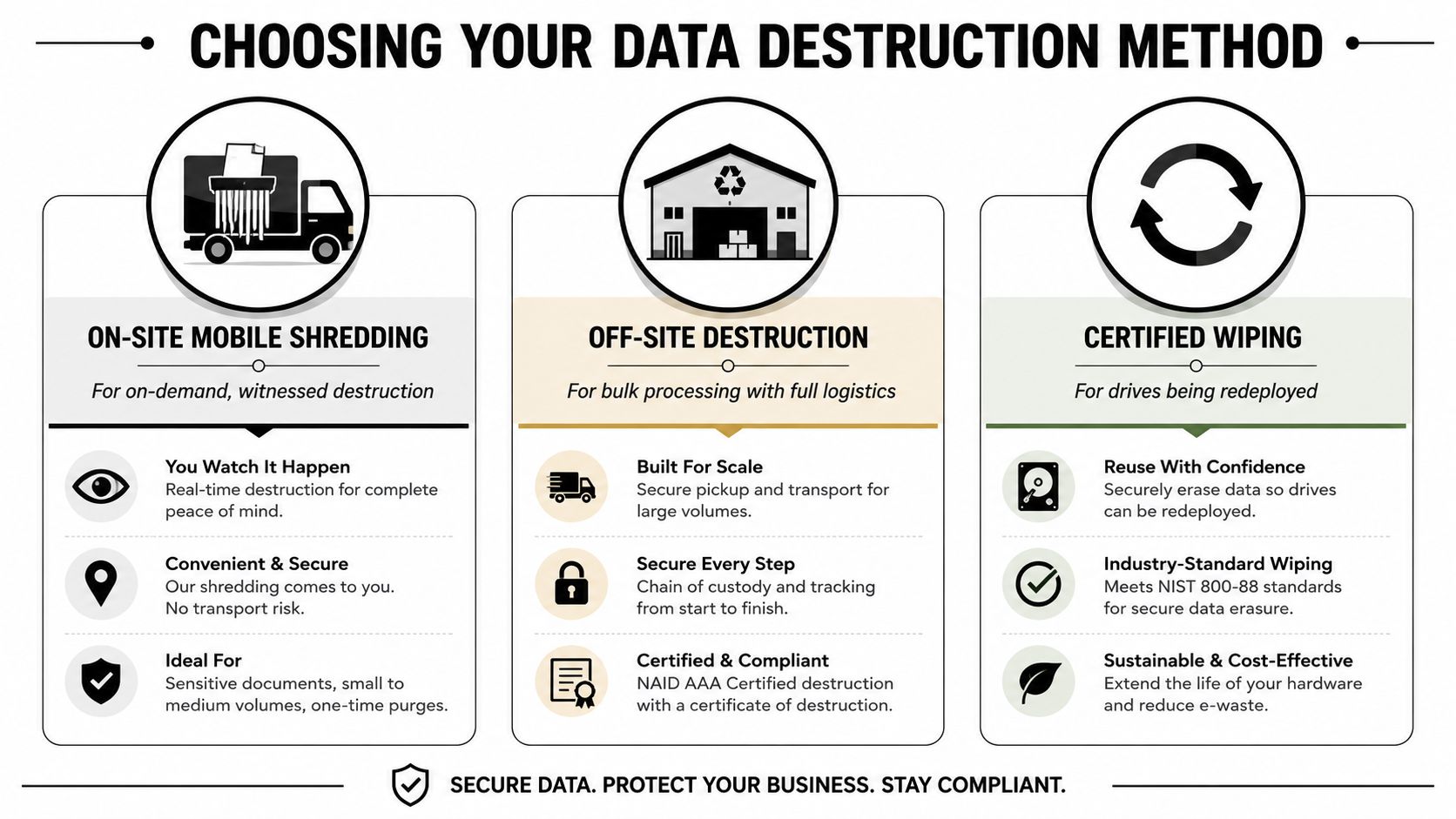
Atlanta teams should choose the method that matches the asset, the risk, and the record they need at the end. If the load includes regulated systems, witness requirements, or devices that leave the building only once they are destroyed, on-site shredding is the cleanest choice. If the priority is volume handling and the facility can manage transport and processing under a controlled chain of custody, off-site destruction makes more sense. For a practical comparison of those two paths, review this on-site vs off-site ITAD services in Georgia pros and cons.
The method should match the outcome
Certified wiping belongs in the mix whenever the asset still has resale or redeployment value and policy allows verified clearing instead of physical destruction. Beyond Surplus says every device it processes is sanitized by default with DoD 5220.22-M three-pass erasure at no charge, while serialized hard-drive shredding with a Certificate of Destruction is reserved for stricter requirements. Beyond Surplus data sanitization model
| Asset Type | Recommended Method | Best When |
|---|---|---|
| Recent laptops and reusable drives | Certified wiping | The device can be redeployed or remarketed |
| High-risk drives with strict controls | On-site shredding | Witnessed destruction is required |
| Large mixed lots headed for consolidation | Off-site destruction | Volume and logistics favor facility processing |
The wrong move is shredding everything by default. That destroys resale value the company could recover through remarketing or redeployment. It also skips the option to sanitize, document, and return some assets to the budget cycle instead of sending them straight to scrap.
If the device still has value and the policy allows clearing, do not shred it out of habit.
For Atlanta teams choosing a vendor, the ultimate test is whether the provider can support all three paths cleanly. A provider that only sells one outcome will push every asset toward that outcome. The better model is to choose by policy, device type, and recovery value, then keep the paperwork aligned with that choice.
The same discipline applies to procurement. Perth security management solutions is a useful reminder that disposal sits inside a broader risk program, not a one-off truck pickup. That mindset pushes teams to ask whether the vendor can support Clear, Purge, or Destroy, and whether the final record matches the method used.
What to Demand From an Atlanta Data Destruction Vendor
A serious vendor should show you proof, not promises. Ask for serialized certificates of destruction, not batch certificates that hide individual drives inside a generic line item. Ask for chain-of-custody logs at every transfer point, and make sure the provider can explain what happens to shredded material and where wiped assets go after processing.
Use the first call as a filter
I'd also ask the vendor to name the regulatory frameworks they align with, including HIPAA, GLBA, SOX, and NIST SP 800-88 when applicable. Beyond Surplus says its certificates record each drive's serial number, destruction method, and date, and that its methods align with those frameworks. Beyond Surplus certificate and compliance details
Common red flags are easy to spot:
- Vague certificates. If it doesn't name the serial numbers, it's weak.
- No witnessed option. That's a problem for sensitive loads.
- Loose custody records. Every transfer should be documented.
- No downstream explanation. If they won't say where the material goes, keep shopping.
For teams that want a broader procurement lens, Perth security management solutions is a useful reminder that disposal is part of a larger risk program, not a standalone truck route. That mindset helps procurement ask better questions and keeps the conversation focused on control, not convenience.
If you need a quick scorecard, judge vendors on three things: documentation quality, custody discipline, and method flexibility. Anything less leaves holes in the process.
How Georgia Law Makes Disposal Records a Compliance Asset
Georgia's breach-notification law turns disposal records into more than housekeeping. If unencrypted personal information is compromised, notification must happen without unreasonable delay and, for large breaches, within 45 days. If more than 10,000 residents are affected, consumer reporting agencies must also be notified. Georgia breach-notification requirements
Disposal can trigger the same obligations as intrusion
The law covers common identifiers such as a name combined with a Social Security number, driver's license number, or financial account data. Improper disposal can put you in the same response path as a network incident if the device held protected personal information. Atlanta healthcare, finance, education, and professional services firms cannot treat that as a minor records issue. It is a legal exposure.
The practical test is simple. If your disposal vendor is breached tomorrow, can you prove which serial numbers you sent and what happened to each one? If you cannot, your position is weak.
Atlanta teams should also understand how disposal rules fit with broader electronics handling requirements. Georgia electronics recycling and ITAD compliance rules matter because the disposal path has to support both environmental handling and defensible data handling.
An Atlanta healthcare practice I've seen handle this well kept serial-number logs and final certificates for every retired drive. When an audit question came up, the team could show exactly what left the building and when. That record did not erase the need for controls, but it made the response defensible.
Keep the records like they'll be reviewed by counsel, because one day they might be.
Disposal documentation belongs in your incident-response file. It is not paperwork for the bottom drawer. It is evidence.
Scheduling Your First Pickup and Building a Repeatable Process
Start the pickup with hard facts, not a vague cleanup request. Have your asset counts, locations, regulatory drivers, and desired outcome by asset class ready before you call the vendor. Then ask for three things on day one, a sample Certificate of Destruction, a sample chain-of-custody log, and confirmation of the default sanitization path.
Make the process inheritable
Build a one-page internal policy so the next IT hire doesn't have to invent the process under pressure. The policy should say what gets wiped, what gets shredded, what gets remarketed, and who signs off on each decision. That turns disposal into a repeatable operating routine instead of an ad-hoc scramble every time hardware is retired.
A standing vendor relationship usually produces better documentation and better value recovery than one-off cleanouts. Atlanta businesses replace hardware continuously, so the smart move is to treat destruction and wiping as part of the asset lifecycle, not as a once-a-year purge.
Beyond Surplus offers certified electronics recycling and secure IT asset disposal for business pickups, including data destruction, asset recovery, and documented chain of custody.
Contact Beyond Surplus for certified electronics recycling and secure IT asset disposal. If your Atlanta team needs a defensible process for wiping, shredding, and documenting retired devices, start with a pickup request, ask for sample certificates, and compare the workflow to your compliance requirements. Visit Beyond Surplus to schedule service and put a real sanitization process in place before the next refresh lands on your desk.


