

Say your Atlanta, Georgia, facility has forty extension cords in a storage room beside an unfiled recall notice. A few matching cords are still powering workstations, and procurement has already scheduled an electronics pickup. Adding everything to the recycling pallet might clear the room, but it won't establish that the recalled products were safely removed from circulation.
Recalled extension cord disposal services should prove an outcome, not just a collection. For business owners, IT managers, and facilities teams, the sequence is quarantine, condition assessment, manufacturer remedy, and auditable disposition. Recycling can recover the materials, but it doesn't automatically prove the product was destroyed.
Table of Contents
- Quarantine and Label Recalled Cords First
- Sorting Cords by Condition and Recall Remedy
- Choose the Right Disposal Route for Recalled Cords
- Compliance Duties and the Audit File That Proves Destruction
- Cost, Logistics and Local Service Questions for Businesses
- Schedule a Compliant Pickup and Specify the Processor
Quarantine and Label Recalled Cords First
A cord can look intact and still present a hazard. In a 1999 warning, the U.S. Consumer Product Safety Commission reported 25 recalls involving approximately 2 million extension cords, power strips, and surge protectors since 1994. Identified problems included undersized wires, loose connections, faulty components, and improper grounding.
CPSC staff later identified 29 voluntary extension-cord recalls involving approximately 3.2 million units from 1994 through August 2014, according to its extension-cord recall guidance. For a facility, the practical challenge is locating affected stock across offices, maintenance carts, and equipment rooms, then preventing it from being used or issued.
Establish physical control before arranging collection
Confirm the recall match. Compare the manufacturer, model, identifying marks, and recall identifier with the notice. A similar color or plug shape is not enough. Check satellite cabinets and other storage areas so affected units are not missed.
Disconnect safely. For an ordinary, accessible connection, unplug at the wall without touching exposed conductors or prongs. If damage, moisture, generator connections, or uncertain energization makes that unsafe, keep personnel away and have qualified staff isolate the supply. Do not pull rack or ceiling cabling under load or cut cords on-site.
Label each unit and container. Record the manufacturer, model, recall identifier, quantity, source location, and date. Label individual cords where practical. A clear container label helps preserve control if the bin changes hands.
Block reissue and repurchase. Place an inventory hold on affected stock and a purchasing hold on the recalled item. A storeroom label alone will not prevent another department from issuing a matching cord from a satellite cabinet.
Photograph ambiguous identification. When safe, capture the product label and relevant markings alongside the applicable notice. Do not energize a cord to identify it or handle exposed conductors for a clearer photograph.
Separate damaged material. After safe isolation, place cut, melted, exposed, or contaminated units in suitable nonconductive containment. Keep the condition of each batch visible in the records.
Assign a batch or asset identifier. Link the physical lot to its inventory record, photographs, and eventual disposition. Retain source-location details when several departments contribute to one shipment.
Give the hold an owner
Assign a person with authority to release items only after the return or destruction decision is approved. Keep the hold documented and the cords physically separated until that approval. A documented recalled-product quarantine process can help teams define the controls they need without treating quarantine as a disposal decision.
Beyond Surplus provides technicians to de-install equipment when necessary. Its corporate computer disposal services comply with local and federal laws governing computer disposal; recalled cords still require their own approved remedy and disposition record.
Release check: Each unit should be countable, traceable to its source, and prevented from returning to use or stock.
Sorting Cords by Condition and Recall Remedy
A sealed cord can still be subject to a recall, while a damaged one may require special handling before it can be returned or destroyed. Check the recall notice first, then assess each cord's condition. The remedy sets the authorized disposition; the condition sets the safe handling requirements.
The CPSC's cable and power-protection guidance addresses male-to-male generator cords, which can expose energized prongs and create backfeeding risks, including electrocution and fire. Short cords may also lead people to place generators near enclosed spaces, creating carbon-monoxide risk. Follow the agency's instructions to stop use, unplug without touching the live end, and dispose of affected cords.
Cord condition, hazard and required action
| Condition | Hazard Signal | Required Action |
|---|---|---|
| Intact, still in original packaging | Recall identifier matches, no visible damage | Follow the manufacturer's return or replacement remedy, or send for destruction if required |
| Intact, loose in storage | Recall matches, no visible damage | Keep quarantined and labeled until the authorized remedy is arranged |
| Exposed or cut insulation | Bare conductor or abrasion | Confirm the cord is de-energized, contain it in a nonconductive container, and use an authorized destruction route |
| Melted insulation or burn marks | Heat damage from a fault | Preserve it if needed for an incident review, then record it as damaged and arrange destruction |
| Plug bent, cracked or contaminated | Possible connection failure | Keep it out of use and follow the authorized remedy; do not return it to service |
| Attached to a generator or male-to-male plug | Backfeed and carbon-monoxide risk | Stop use. Unplug without touching the live end when safe, then follow the remedy |
| Power strip or surge protector | Includes electronic components | Separate it from cord-only material and route it for appropriate processing |
Resolve unsafe conditions before packing
Check whether a cord is plugged in, wet, visibly damaged, connected to a generator, or associated with an injury or fire. A wet or potentially energized unit is not ready for a collection container. For an active fault, smoke, or immediate danger, follow the facility's emergency response procedure instead of continuing the cleanout.
An injury or fire can also affect whether an item should be destroyed. Ask the responsible safety, legal, or insurance contact to release it before disposition, and preserve product identification without unnecessary handling.
Refund instructions and disposal instructions serve different purposes. Keep identifying information and proof of purchase when the manufacturer requires them. Only make a product unusable through a procedure authorized by the manufacturer and safe for its condition; guidance to cut a cord when a manufacturer cannot be contacted does not apply universally to damaged or energized equipment.
Beyond Surplus handles systematic disposal, resale, and recycling of retired data center assets, from server racks through structured cabling. Equipment that fails reuse standards, is unrepairable, old, obsolete, or contractually barred from remarketing is recycled and destroyed through de-manufacture and/or physical shredding. Recalled cabling removed from racks should not enter a resale stream unless an authorized remedy permits it. For a related product category, see the information on recalled lighting product disposal.
Recycling does not by itself prove destruction. Keep the cord batch tied to its recall remedy, condition assessment, and final disposition record so the audit file shows that recalled material did not re-enter commerce.
Choose the Right Disposal Route for Recalled Cords
Choose a route that resolves both the recall and your business's documentation needs. Manufacturer remedy comes first when the notice specifies return, refund, or replacement; collection convenience shouldn't erase that option.
Disposal routes for recalled extension cords
| Route | Best Fit | What It Requires | Documentation Returned |
|---|---|---|---|
| Manufacturer remedy | Cords covered by an active refund or replacement remedy | Recall identifier, model, and proof of purchase if requested | Manufacturer remedy confirmation |
| Scheduled business pickup | Multi-unit batches, pallets, or cords stored across several rooms | Business address, unit count, and labeled, segregated units | Certificate of recycling and data destruction for each load |
| Atlanta no-contact drop-off | Smaller quantities from Atlanta-area businesses | Accepted, labeled units delivered during business hours | Handoff receipt and processing documentation agreed before delivery |
| Destruction-only processing | Cords whose remedy forbids reuse or resale | Unit count and weight recorded at receipt | Certificate of destruction |
Match logistics to the actual batch
A manufacturer return can settle the recall without a separate recycling collection. Obtain the return instructions before packaging, especially if the manufacturer needs labels, photographs, or purchase documentation.
Business organizations can schedule free pickups anywhere in the contiguous United States. Priority pickup is available for one pallet of equipment, a 40-inch by 48-inch by 5-foot pile; smaller amounts can be dropped off or collected when a truck is in the area.
For smaller accepted quantities, Atlanta-area businesses can use our no-contact warehouse drop-off during business hours. After-hours drop-off isn't offered. No-contact service doesn't mean unattended dumping, so plan around posted hours and confirm acceptance before dispatching an employee.
Destruction-only processing is appropriate when the authorized endpoint excludes reuse or resale. Specify that endpoint before collection instead of expecting a generic recycling receipt to establish it afterward.
Ask three routing questions: Does the notice name a remedy? How many units are involved? Must the final record prove destruction rather than material recovery?
Those answers determine whether the project needs a manufacturer transaction, a logistics appointment, or a controlled destruction engagement.
Compliance Duties and the Audit File That Proves Destruction
Disposal depends on jurisdiction, product composition, and condition. A recalled cord isn't automatically hazardous waste, but neither should a business assume it belongs in ordinary trash or an uncontrolled scrap stream.
Cords contain copper conductors, polymer insulation, and plugs; power strips and surge protectors add components that need separate assessment. Specify controlled dismantling or shredding, removal of components requiring separate treatment, and material separation rather than allowing whole recalled products into uncontrolled landfill or export channels.
State coverage also matters. The Illinois EPA electronics-recycling guidance states that covered electronic devices must be recycled and notes that electronics can contain lead, mercury, and cadmium. That doesn't establish that every standalone cord is a covered device in Georgia; classify the actual material under the rules applicable to its location.
Prove the product cannot return to commerce
A CPSC warning about Shenzhen Lieniao male-to-male extension cords identified approximately 700 units sold on eBay between May and November 2025. Online distribution makes manufacturer follow-through an operational concern, not a reason to abandon control of recalled inventory.
Recalled products may be illegal to sell. Your audit file should therefore establish what happened to the product, not merely that someone transported its weight in mixed electronics.
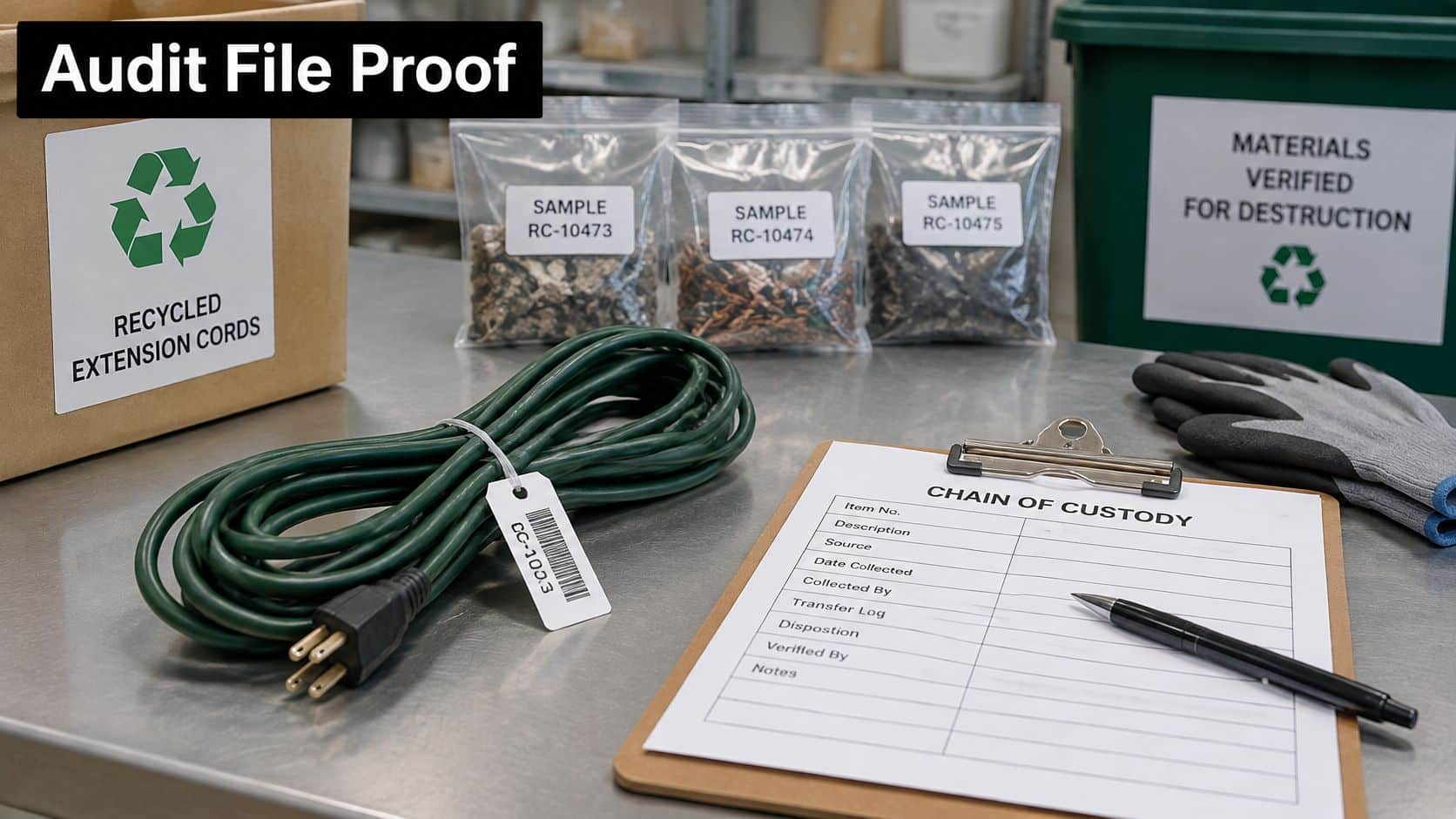
Documents for a recalled-cord audit file
| Document | What It Proves | When It Is Needed |
|---|---|---|
| Recall notice match | Units are covered by a specific recall | Before any disposition |
| Inventory count and labels | Quantity and origin of each lot | At quarantine and at receipt |
| Pickup or drop-off record | Custody moved from your site to the processor | At handoff |
| Weight and unit count at receipt | Processor received the stated load | At processor intake |
| Certificate of recycling and data destruction | Each load was processed as recorded | After processing, one per load |
| Certificate of destruction | Units were destroyed and cannot be resold | When the remedy or policy requires destruction |
| Manufacturer remedy confirmation | Refund or replacement was honored | When the remedy is used |
We provide certificates of recycling and data destruction for each picked-up load. These are contractual written guarantees of responsible disposal, but the scope still needs to identify the actual work performed.
For product-specific evidence, establish the required detail through our certificate of destruction for recalls service. Link the certificate to the recall identifier and inventory, and resolve shortages, rejected units, or separate returns before closing the file.
Keep storage media on a separate track
An ordinary extension cord doesn't store business data. Attached servers, laptops, controllers, and other IT assets may, so inventory their media separately.
NIST SP 800-88 Revision 2 distinguishes clear, purge, and destroy and ties sanitization choices to information sensitivity. Clearing or purging media doesn't establish physical destruction of a recalled cord, just as shredding a cord doesn't sanitize a server drive.
The FTC Disposal Rule guidance applies to businesses and individuals using consumer reports for business purposes and describes reasonable disposal safeguards and provider due diligence, including audits, references, certification, and security-policy evaluation. These are evaluation methods, not a requirement to apply every listed method to every cord shipment.
Free data destruction is available on qualifying enterprise pickups. Confirm its scope for the data-bearing assets rather than treating it as a substitute for product-destruction evidence.
Cost, Logistics and Local Service Questions for Businesses
What does a pickup cost?
We offer free business pickups across the contiguous United States, with scheduling based on the load and collection arrangements. Don't assume that free collection also covers every special handling task, de-installation, or recall-specific destruction requirement.
Send the unit count, estimated pallet count, access details, and any storage-media inventory for a written scope. Confirm current eligibility and charges before approving the work order, particularly where damaged products need additional assessment.
Free data destruction applies to qualifying enterprise pickups. Procurement should distinguish collection, product destruction, and information-security work rather than combining them under an undefined disposal line item.
How do Atlanta and Smyrna businesses get service?
Atlanta businesses can coordinate commercial collection or deliver accepted equipment to the warehouse during posted business hours. For Smyrna, Georgia, provide the commercial address and batch description so we can confirm the collection arrangement before you commit staff or loading space.
Use daytime drop-off arrangements for smaller quantities. Don't leave recalled equipment outside the facility when it's closed, where staff cannot receive and reconcile it.
Are small loads collected?
Pickups are scheduled for businesses at commercial addresses. Smaller loads may be collected when a truck is already in the area, so provide useful scheduling flexibility rather than assuming a dedicated collection date.
Keep the batch secured while awaiting collection. A small quantity doesn't justify leaving recalled stock in a shared returns bin.
Who handles the recall if the seller disappears?
Check the notice for a take-back or manufacturer-authorized remedy first. An overseas manufacturer or missing seller doesn't transfer your inventory-control responsibilities to the marketplace.
Where no usable return path exists, establish an accepted processor route and retain the decision record. Our certified destruction for recalled products service provides a way to define that engagement without treating the batch as unrestricted surplus.
Procurement safeguard: Approve the required outcome and documentation, not merely the removal of material from the loading dock.
Schedule a Compliant Pickup and Specify the Processor
If the recall notice names a remedy, start there. If no workable return route exists, or the remedy requires destruction, arrange a pickup with written acceptance and an explicit processing endpoint.
The useful service request is a batch specification, not a request to haul miscellaneous cables. That distinction lets facilities, procurement, IT, and the receiving processor agree on what can leave the site and what evidence must come back.
Prepare a decision-ready request
Include the information needed to assess the job without repeated clarification:
- Product identity: Recall notice, manufacturer, model, identifying photographs, and unit count.
- Load and access: Estimated pallet count, commercial address, operating hours, loading arrangements, and any de-installation needs.
- Safety exceptions: Damaged or wet units, generator connections, and material held after an incident.
- Related equipment: Computers, storage media, rack hardware, or other electronics sharing the project.
- Required evidence: The recycling, destruction, manufacturer-remedy, and data-security records your organization needs.
Customers can request recycling pickup or drop-off by phone, email, or the online form. Use our recalled-product pickup and destruction service to begin defining the commercial recall scope.
Put the processing requirements in writing
Specify recall verification, unit count and weight at receipt, and processing through a controlled downstream dismantler or shredder. Require copper and plastics recovery where appropriate, with separate handling for electronic assemblies or other screened components.
Request a final certificate for each load that identifies the material stream, destination, and agreed processing outcome. Confirm the certificate terms before the truck arrives, including how the processor will report rejected material or inventory discrepancies.
For an Atlanta electronics recycling project combined with IT equipment disposal or data center decommissioning, keep the workstreams coordinated but their acceptance criteria distinct. IT asset recovery can preserve value in cleared equipment; secure e-waste management must prevent recalled products from entering that recovery inventory.
Approve collection when the destination, handling arrangements, and evidence requirements are settled. Then assign a named employee to reconcile the returned documentation and close the recall work order.
Beyond Surplus offers commercial electronics recycling, secure IT asset disposal, and documented product destruction for businesses managing recalled equipment. Visit Beyond Surplus to request a pickup assessment, define your recalled-cord destruction requirements, and confirm the records your compliance team needs.


