

You're probably staring at two spreadsheets at once, one for housing and one for work, and trying to figure out how Atlanta fits both. That's the right instinct. Living in Atlanta in 2026 is not a casual lifestyle move, it's a decision about income, commute tolerance, and how much friction you're willing to accept every day.
Atlanta still pulls people in because it feels like a major city without coastal pricing, but the trade-offs are real. If you're relocating for a job, opening an office, or just trying to land in the right neighborhood, the smart move is to treat the city like a set of budget and logistics choices, not a brochure.
Why Atlanta in 2026 Is an Income and Lifestyle Decision
Atlanta looks accessible until you run the numbers against your actual pay, your lease, and your commute. Zillow put the typical home value at $379,509 in March 2026, with monthly rent at $1,811 and the income needed to afford that rent at $72,454 under the 30% rule. To buy the typical home with a 20% down payment, Zillow estimated a household would need $100,552 in annual income, while the typical household income in Atlanta was $97,890. That gap is the story, because it shows why Atlanta can feel affordable on paper and still force hard choices in practice. Zillow's Atlanta affordability overview
The city's appeal still comes from scale, access, and a big-job-market feel. Apartments.com reported July 2026 averages of $1,652 for a one-bedroom and $1,951 for a two-bedroom, while also saying Atlanta's cost of living is 5.8% lower than the national average and housing is 17.7% less expensive than the national average. A separate city guide places overall cost of living at about 4% below the national average. Those figures explain why Atlanta keeps winning relocations, but they don't erase the fact that your neighborhood choice changes your daily life a lot. Apartments.com's Atlanta local guide and Atlanta cost of living 2026
Practical rule: if the commute and rent both feel “fine” in month one, you probably haven't pushed hard enough on the trade-offs yet.
For professionals weighing relocation, Atlanta's growth story matters too. The city's expansion has been reinforced by transportation, population demand, and the jobs tied to it, which is why the region stays durable even when affordability tightens. If you want the broader economic backdrop, read how Atlanta's economy is driving growth across Georgia.
Choosing an Atlanta Neighborhood by Commute and Budget
Skip the “best neighborhood” fantasy. The better question is where you can live for 12 months without hating your commute, your rent, or your parking situation. Midtown, Old Fourth Ward, Buckhead, Edgewood, and Roswell each solve a different problem, and each creates a different one.
Midtown works for people who want an ITP base, a walkable feel, and a cleaner shot at rail access. Old Fourth Ward fits movers who want proximity to the BeltLine and mixed-use density, but they should expect to pay for that convenience. Buckhead gives you a more established, car-friendly option with strong access to major employers, while Edgewood tends to appeal to residents who want more urban energy without jumping fully into the highest-price submarkets. Roswell is the practical outlier for people who want more space and don't mind making driving part of the deal.
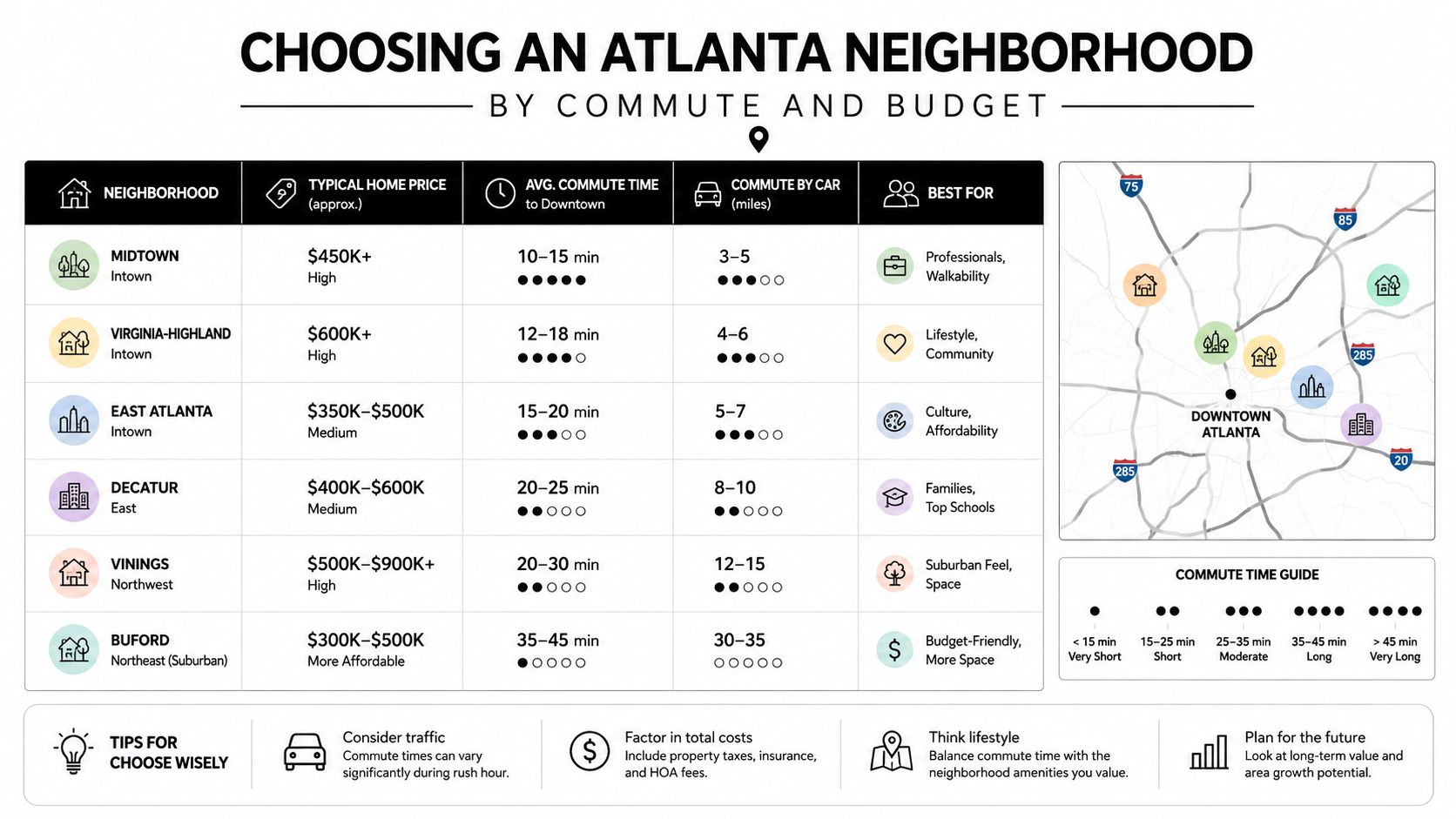
A better way to choose is to build a short list around your commute and your housing type. If you work in Midtown, on the Central Perimeter, or near the airport corridor, you should prioritize a neighborhood that keeps your drive predictable. If you're remote most of the week, you can widen the search and trade proximity for space or a calmer street grid. The mistake I see most often is someone choosing a neighborhood for restaurants, then discovering the commute is what they live with every weekday.
My rule of thumb: pick the place that still makes sense on a Tuesday in February, not the one that feels exciting on a Saturday night.
If you want a more focused comparison between two of the most common choices, Buckhead vs. Midtown, which Atlanta neighborhood is right for you is worth a look before you sign anything.
Housing and Rental Market Realities in 2026
Atlanta's housing market rewards people who move with a plan. If you arrive without one, the rent, deposit, commute, and utility stack will eat more of your budget than you expected. Zillow's Atlanta affordability overview shows how tight the numbers are, with a typical home value of $379,509, rent at $1,811, the income needed to afford that rent at $72,454, and the income needed to afford the typical home with 20% down at $100,552. Renting and buying are separate decisions because they sit on different income thresholds.
| Atlanta Housing Affordability Snapshot, March 2026 | Value |
|---|---|
| Typical home value | $379,509 |
| Monthly rent | $1,811 |
| Income needed to afford rent | $72,454 |
| Income needed to afford a typical home | $100,552 |
| Typical household income | $97,890 |
That table should make one thing clear. A household near the typical local income can still feel squeezed once parking, transportation, utilities, and school-related costs get added in. Renters need to leave room for deposits, application fees, and the fine print in the lease. If you are reviewing terms, the required Georgia lease disclosures are the first thing to check before you sign.
Supply is still tight enough to keep pressure on the better units. HBW's Atlanta new home construction update reports that metro Atlanta recorded 4,320 new residential construction permits through Q1 2026, a 13% year-to-date decline versus Q1 2025, and that apartment deliveries are projected to slow 43% year-over-year in 2026 to about 9,300 units, adding only 1.6% to inventory. The practical effect is simple, there is less slack in the market, and the nicest well-located places do not sit open for long.
If you want a broader read on where prices and rents may be headed, the Atlanta real estate market forecast for 2026 is worth a look. My advice is blunt, set your search window early, decide your max commute first, and stop waiting for a perfect place to appear on a comfortable timeline. That advice holds for relocating employees, and it holds for facility leads too, because the same habit that keeps a housing search disciplined also helps when you are choosing vendors for secure electronics recycling and ITAD compliance.
Getting Around Atlanta Without Losing Your Weekends
Atlanta transportation works best when you match the system to the neighborhood, not when you expect the whole city to behave like a transit-first market. If you live OTP, you're probably driving most days. If you live ITP, you have more realistic transit options, but only if your job location lines up with the rail network, bus routes, or a hybrid schedule.
Driving is still the default for most residents because it gives you flexibility across widely spread job centers. MARTA rail is the cleanest option for people living and working near stations, and the bus network fills gaps that rail doesn't cover. Micromobility can help with short trips and first-mile or last-mile connections, especially in denser neighborhoods, but it won't rescue a bad commute. Remote and hybrid work matter here because they can turn a borderline location into a workable one.
A simple decision frame helps:
- Live ITP, work near rail: You can reduce car dependence and keep a one-car household realistic.
- Live OTP, work across town: Expect driving to dominate your week and plan for parking, fuel, and traffic.
- Live near your employer but not near transit: A car-light setup may work, but not a car-free one.
If your household is already comparing vehicle costs, insurance, or commute-related trade-offs, Georgia DUI Schools' premium tips is a practical resource to review alongside your transportation budget.
Bottom line: the best transit plan in Atlanta is the one that makes your weekday life predictable, not the one that sounds impressive on paper.
For residents who want a walkable corridor and easier access to restaurants, errands, and exercise, the Atlanta BeltLine still shapes a lot of lifestyle decisions. Just don't confuse a pleasant weekend route with a complete commuting solution.
Jobs, Tech, and Where Atlanta's Growth Is Concentrated
Atlanta's growth still clusters where freight, offices, and high-volume operations overlap. In Q1 2026, the metro logged 7.8 million square feet of logistics net absorption, while vacancy fell to 7.6%, down 50 basis points quarter-over-quarter and below the market's 8.0% long-term average for the first time since Q3 2024. The pipeline also doubled to 15.1 million square feet, which tells you demand is still pulling supply into the market instead of waiting for it. KBC Advisors' Q1 2026 Atlanta market report
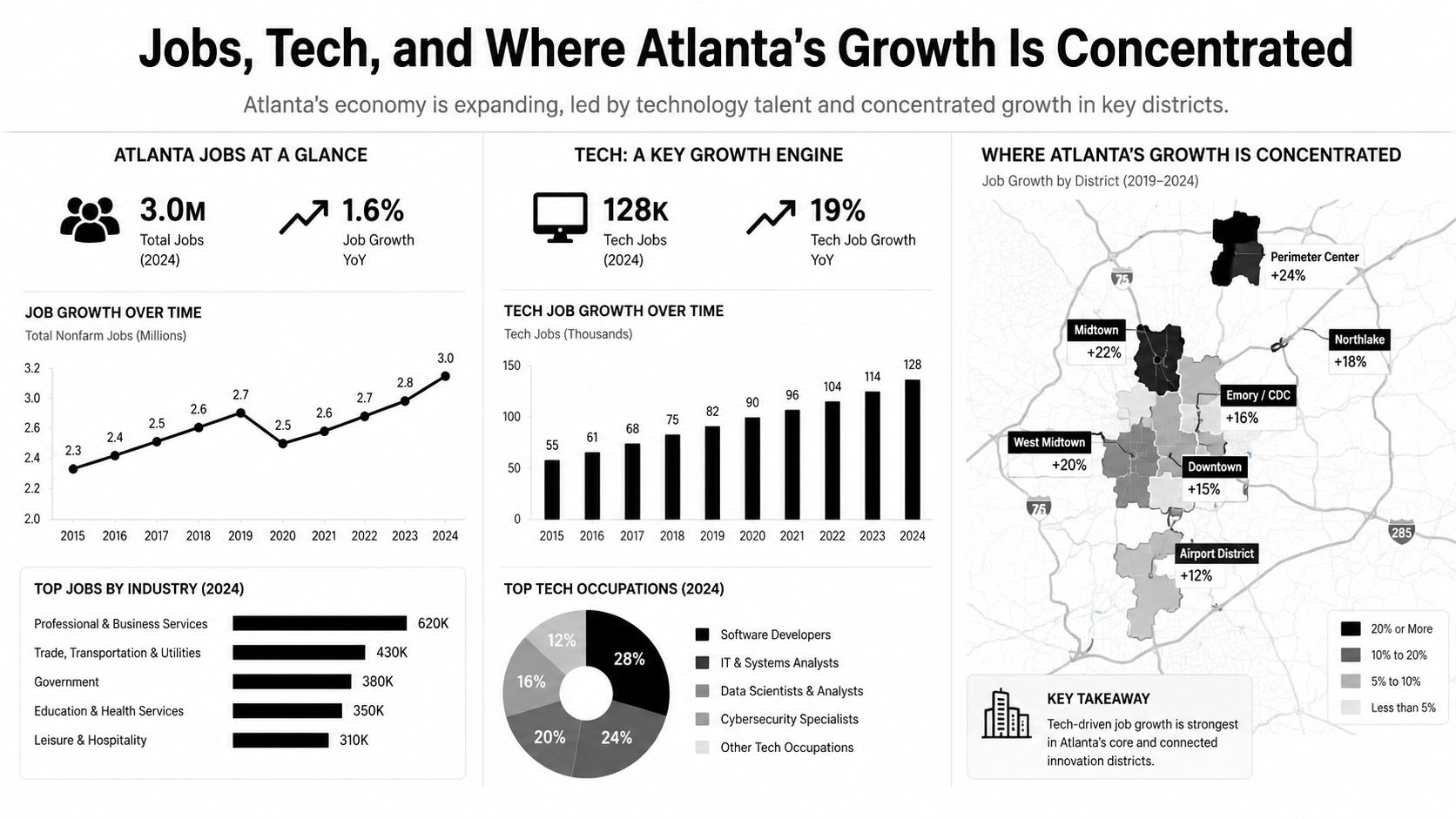
That pattern matters for relocators because the strongest employer pull still tends to sit around the airport corridor, West Midtown, and Central Perimeter. Logistics, healthcare, fintech, film and entertainment, tech, and public-sector contracting each shape different parts of the metro, but the same rule keeps showing up, people live near the places they need to reach often. If your job search is still open, focus on the corridor first and the neighborhood second.
Small-business owners should read the industrial numbers as a signal about site selection too. Tight supply and sustained throughput usually reward businesses that can move freight efficiently and get close to workforce pools. That also affects where employees want to live, because the closer you are to the employment cluster, the less your commute eats the rest of the day.
If you're choosing where to live around a specific employer, don't overcomplicate it. The right home search starts with the corridor your paycheck depends on, then moves outward until the commute and budget meet in the middle.
Schools, Healthcare, and Day-to-Day Quality of Life
The smartest Atlanta move is the one that protects household stability before problems show up. If you have kids, school zones are part of the housing decision, not something to figure out after you've already moved in. If you're relocating for work, healthcare access should be on your checklist before your first sick day, not after.
Start with the basics. Check the school assignment for the exact address, confirm how the district handles transfers, and look at the route you'd drive or walk every morning. Then pick a primary care provider and a hospital system near your likely neighborhood, because Atlanta's spread means “close enough” can still turn into a long drive when you need care quickly.
A strong move-in checklist should include:
- School zone verification: Confirm the address, not just the neighborhood name.
- Primary care setup: Book a new-patient appointment early.
- Emergency support planning: Know where shelter, crisis hotlines, legal aid, and housing support live before you need them.
- Renter stability review: Keep copies of your lease, insurance, and contact info in one place.
Atlanta Housing's Community Resource Guide is a good reminder that many residents depend on issue-specific support, not just nice neighborhoods. That's the part most lifestyle guides skip. They talk about coffee shops and trails, but they don't tell you where to turn if your housing situation gets unstable.
For households, that means neighborhood choice should be filtered through service access, not just appeal. If the area looks great but puts you far from care, school support, or practical assistance, it's a weaker choice than it first appears.
Choosing a Secure ITAD and Electronics Recycling Partner
Atlanta's business environment makes IT asset disposition a compliance issue, not a junk-removal task. If you manage laptops, servers, network gear, lab devices, or office tech, your vendor should be able to explain how it handles liability transfer, data destruction, and documentation without hand-waving. That matters under the FTC Disposal Rule, HIPAA, GLBA, and broader state and federal data-handling expectations.
The first filter is paperwork. A real ITAD partner should issue a certificate of recycling and a certificate of data destruction, maintain chain of custody, and be willing to document what left your site and what happened to it. If a vendor can't spell out those steps in writing, it's not a secure process, it's a pickup.
The second filter is service capability. You want options for on- or off-site hard drive shredding, certified data wiping, data center de-installations, product destruction, and logistics that work beyond a single metro. In Atlanta, that's especially important for companies that manage multiple offices, lab spaces, or distributed assets. How to choose an ITAD vendor in Georgia, step by step is a solid place to pressure-test your requirements before issuing an RFP.
Non-negotiable: if the vendor won't put destruction methods, custody controls, and liability transfer in writing, keep looking.
Beyond Surplus is one option for organizations that need secure electronics recycling, IT equipment disposal, and nationwide pickup coordination, including businesses that need support in the Atlanta area. The point isn't the logo, the point is whether the vendor can prove control over the asset from pickup to final disposition. That's what protects your company when auditors, customers, or regulators ask questions later.
Your 90-Day Atlanta Move-In and Onboarding Checklist
The first 30 days should be about removing friction. Set up utilities, confirm your ID and vehicle paperwork, enroll kids if needed, and lock in your transit routine before your calendar fills up. If you're furnishing a new place, North Georgia home setup tips can help you avoid the classic mistake of buying furniture before you understand the room layout.
The next 30 days should tighten your commute and service plan. Test the drive at the actual time you'll travel, not during a relaxed weekend window. Confirm your healthcare appointments, verify the neighborhood still feels right after a few weeks, and make sure you know which errands are easy and which ones are inconvenient.
In the final 30 days, bring the business side of the move into line. Review quarterly compliance needs, inventory old devices, and decide whether assets should be wiped, shredded, recovered for value, or scheduled for pickup or drop-off. If your team is winding down a site, this is also the point to line up an ITAD partner before the de-installation date sneaks up on you.
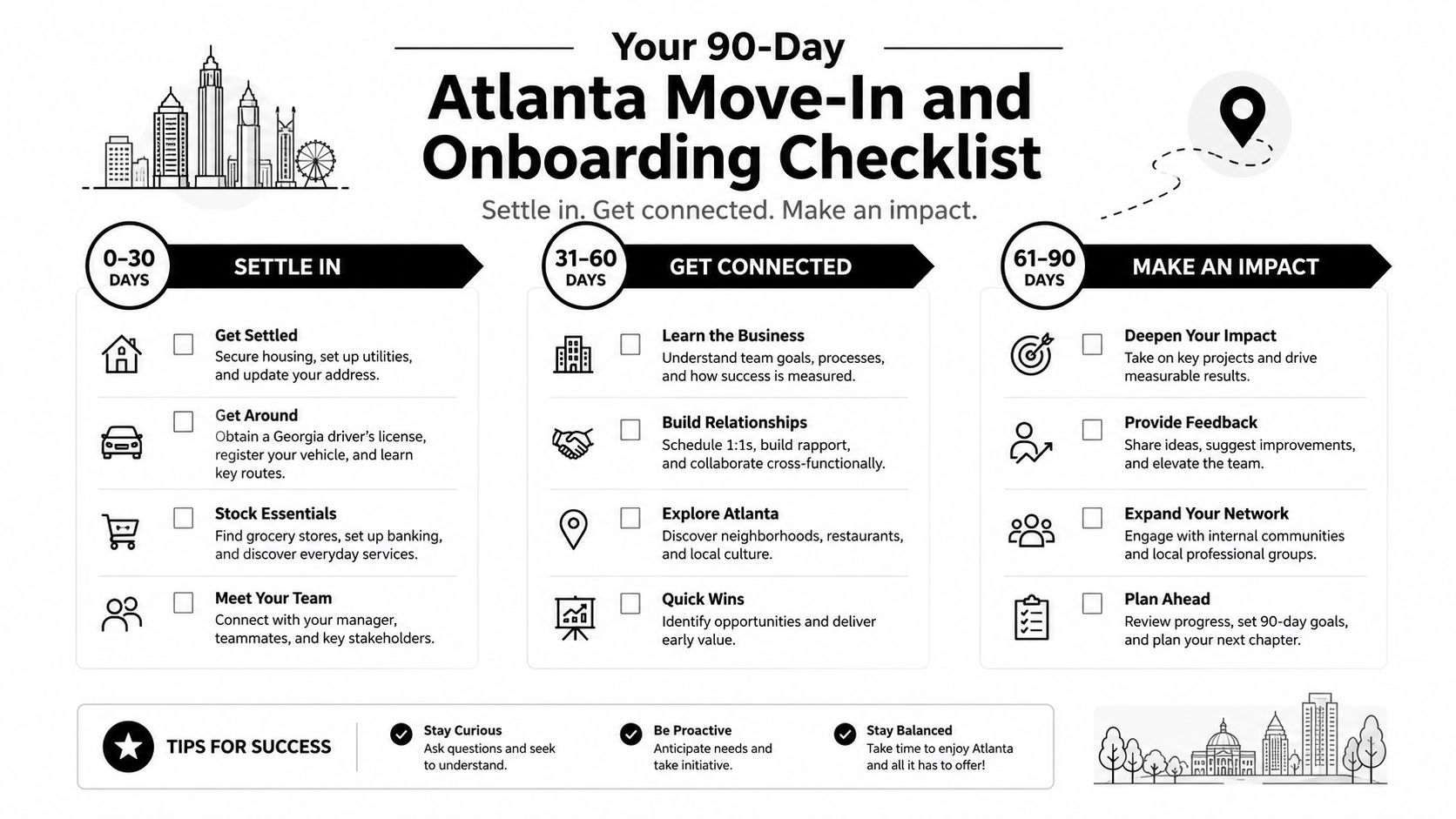
A simple 90-day sequence keeps the move from drifting:
- Days 1 to 30: utilities, IDs, school setup, transit setup.
- Days 31 to 60: commute validation, healthcare setup, neighborhood testing.
- Days 61 to 90: compliance review, asset disposition, pickup or drop-off scheduling.
If your household or business is settling in now, schedule the move with a plan, not a pile of boxes. Contact Beyond Surplus for certified electronics recycling and secure IT asset disposal, especially if you need pickup coordination, data destruction, or a clean handoff for surplus equipment.