

An Atlanta IT director is staring at a pallet of retired laptops and servers before a compliance audit. Some drives still work and could retain recovery value. Others are damaged, obsolete, or tied to sensitive records. The decision isn't hard drive shredding vs data wiping, it's whether the organization needs reuse, purge-level sanitization, or irreversible destruction.
The wrong method creates two different problems. Inadequate wiping can leave recoverable information in secondary markets, while unnecessary shredding destroys equipment that could have been reused or remarketed. The defensible choice depends on media type, device condition, data sensitivity, chain of custody, and what happens after the asset leaves your control.
Table of Contents
- Why Atlanta Businesses Choose Secure Hard Drive Disposal
- How NIST and FTC Standards Shape Secure Erasure Decisions
- Hard Drive Shredding vs Certified Data Wiping Compared
- When Device Type and Reuse Goals Change the Right Choice
- How to Verify Vendors and Certificates for Compliance
- Real Business Scenarios for Wiping vs Shredding
- How to Choose the Right Secure Disposal Method
Why Atlanta Businesses Choose Secure Hard Drive Disposal
An Atlanta enterprise refresh often begins with a practical deadline. A technology manager replaces employee laptops, a data center contractor departs, or an audit team asks for proof that retired storage media was handled correctly. The hardware may be physically stacked in a locked room, but storage alone doesn't resolve the risk. Until each drive is sanitized or destroyed and documented, the organization remains responsible for its disposition.
I've seen teams treat disposal as a shipping task and then discover that a failed wipe had no documented escalation path. I've also seen valuable, functional drives destroyed because a policy used one method for every asset. Those decisions affect security, recovery value, recycling outcomes, and the evidence available when an auditor asks who handled each serial number.
The risk extends beyond the server room
Independent reporting has summarized several studies in which used drives sold through online marketplaces or common disposal channels still contained recoverable data. One cited study found 42% of used hard drives contained recoverable information, another found about 59%, and a third found 40% of devices contained personally identifiable information, as reported in this analysis of IT disposal data breach risk. The same source set reported an average global data breach cost of $5.17 million in 2024, making undocumented disposal a financial concern as well as a technical one.
That doesn't mean every working drive must be shredded. It means the disposal method must match the risk. A certified wipe can preserve reuse value when it succeeds and is verified. Shredding is appropriate when the media is damaged, obsolete, or must never be reused.
For Atlanta organizations, secure hard drive disposal services should produce more than a verbal assurance. Require itemized records, a clear chain of custody, failure handling, and certificates that connect the chosen method to each asset.
Practical rule: If you can't prove what happened to a drive, you can't defend the disposal decision confidently.
How NIST and FTC Standards Shape Secure Erasure Decisions
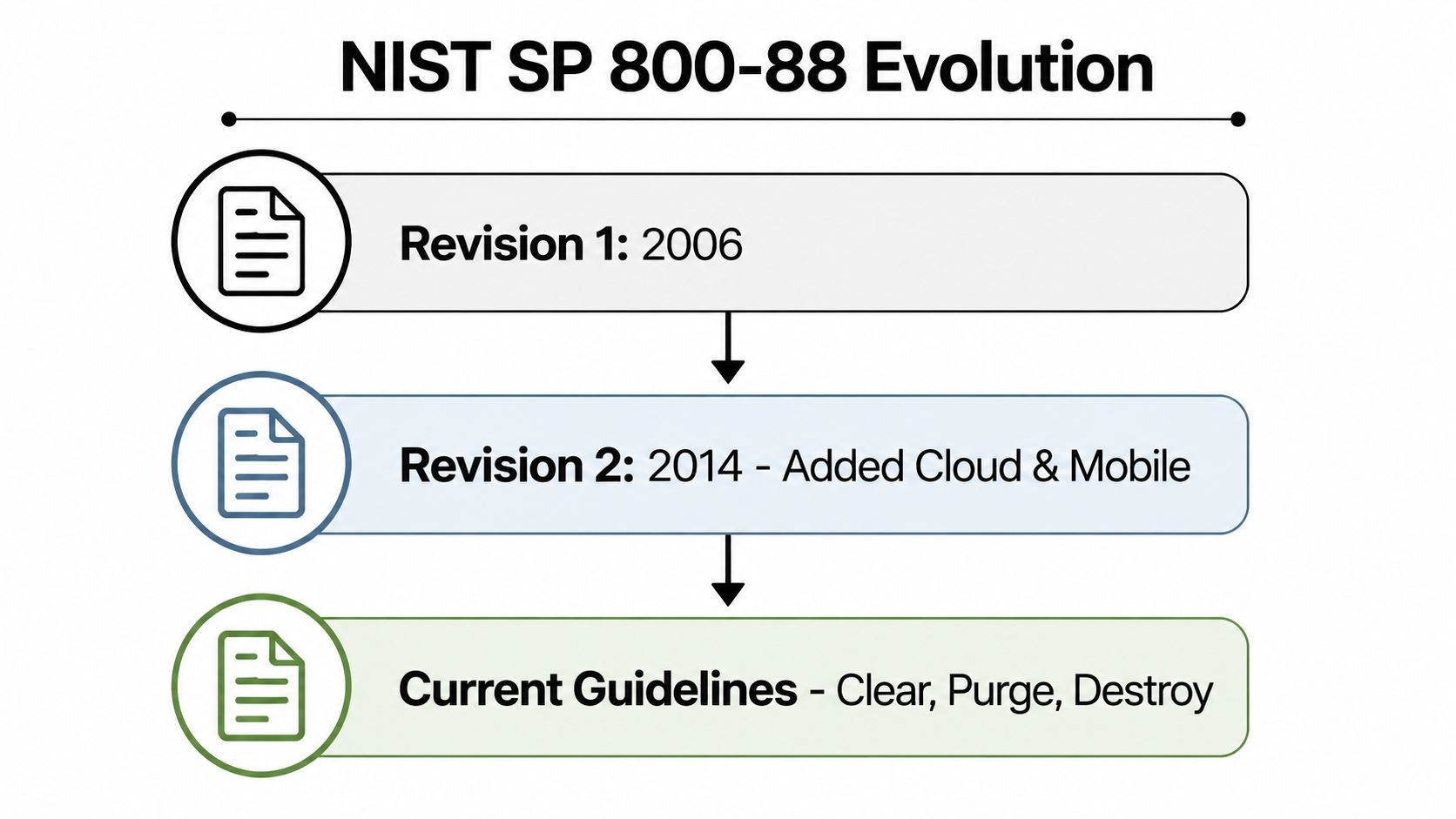
NIST's guidance provides the most useful structure for deciding between wiping and destruction. NIST first published Special Publication 800-88, Guidelines for Media Sanitization, in September 2006. It issued Revision 1 in December 2014, and Revision 1 was withdrawn and superseded by Revision 2 on September 26, 2025, according to the final NIST SP 800-88 Revision 2 publication.
The important change is conceptual. Sanitization isn't one universal procedure. The framework distinguishes among Clear, Purge, and Destroy, with the appropriate outcome determined by data sensitivity, media type, device condition, and whether the device remains under organizational control.
What the three outcomes mean
Clear removes data through techniques intended to protect against ordinary recovery methods while allowing continued use of the media. For magnetic hard drives, NIST SP 800-88 Revision 1 classifies overwriting as a Clear method and identifies a properly implemented single-pass overwrite with a fixed value, such as zeros, as sufficient for HDDs. The NIST Revision 1 publication provides the technical classification.
Purge applies stronger sanitization while preserving the device for potential reuse. Depending on the media and technology, this can involve supported secure erase or cryptographic techniques. It requires more than deleting files or performing a factory reset, because those actions don't reliably address data stored outside normal file-system access.
Destroy makes recovery infeasible using state-of-the-art laboratory techniques and leaves the media unusable for storage. NIST identifies methods such as shredding, disintegration, pulverizing, and incineration within this outcome.
The FTC Disposal Rule takes a similarly practical approach. It says reasonable measures for electronic files or media containing consumer report information can include destroying or erasing the material so it can't be read or reconstructed. The FTC guidance on disposing of consumer report information also allows businesses to use a destruction contractor when they perform due diligence and follow the rule.
NIST's current FAQ states that multi-pass overwriting is unnecessary and that a single-pass overwrite is sufficient for Clear-level sanitization of modern HDDs. It also cautions that destructive methods such as shredding or pulverizing can be ineffective for medium- and high-security categories because modern storage density changes the recovery and destruction equation. The NIST SP 800-88 Revision 2 FAQ is essential reading for teams still relying on older multi-pass assumptions.
For a business-ready explanation of the framework, review NIST 800-88 data destruction standards.
Hard Drive Shredding vs Certified Data Wiping Compared
The operational answer is straightforward. Certified wiping is usually better when the drive is healthy and reuse matters. Shredding is better when the organization needs an irreversible end state and has no reason to preserve the media. Neither method is defensible without controlled handling and verification.
| Criterion | Hard Drive Shredding | Certified Data Wiping |
|---|---|---|
| Security outcome | Physical destruction makes the media unusable and recovery infeasible when performed to the required standard | Sanitization can preserve the device when the method is supported and verified |
| Reuse | Eliminates storage reuse | Preserves potential reuse or resale value |
| Verification | Serialized destruction records and certificates document the event | Software reports, asset identifiers, exception records, and certificates document the result |
| Failure handling | Useful for drives that can't be reliably accessed or wiped | Failed, locked, damaged, or unsupported drives must be isolated for another method |
| Logistics | Requires secure transport or controlled on-site destruction and material recovery | Requires controlled processing, testing, and report retention |
| Environmental outcome | Sends the drive into material recovery rather than equipment reuse | Can support reuse before recycling when the asset remains functional |
| Best fit | Obsolete, compromised, damaged, or high-sensitivity media with no reuse requirement | Healthy supported media moving to internal reuse, resale, or another controlled disposition |
Security assurance isn't the same as operational value
A technical benchmark on overwriting found that a single raw wipe pass on a new, unused drive produced a less than 0.01% chance of recovering any data, while the estimated probability of recovering any useful data was less than 1 in 10^50, as described in this technical analysis of hard drive overwriting. That evidence supports a practical point: high-quality wiping can be extremely effective on HDDs.
The caveat is access. A wipe tool must be able to address the storage media correctly, and the provider must verify the result. A drive with bad sectors, firmware problems, encryption complications, or controller failure may not support a reliable wipe. Shredding removes that dependency, but it also removes reuse value.
Documentation changes the risk profile
A certificate should identify the processed asset, method, date, disposition, and responsible provider. Wiping records should show the software result and any exceptions. Shredding records should connect serial numbers to the destruction batch or event.
Teams comparing providers can review hard drive shredding services to understand how physical destruction fits into a broader ITAD workflow. The best method still fails as a compliance control if assets disappear between pickup, processing, and downstream recovery.
When Device Type and Reuse Goals Change the Right Choice
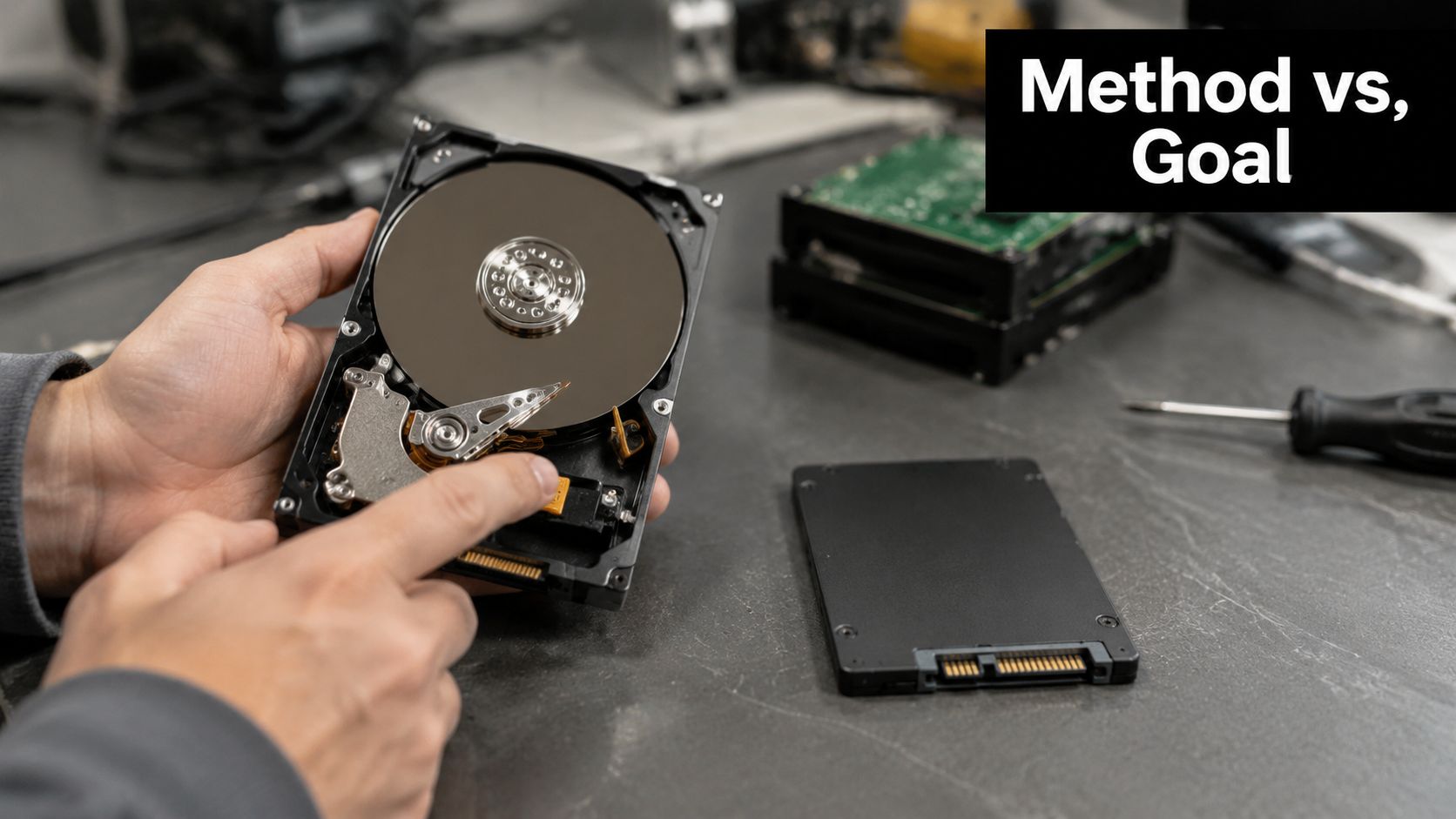
“Shredding is always safer” is a poor enterprise policy. It ignores the value of functional equipment, the differences between magnetic disks and solid-state storage, and the fact that a destruction method must match the security outcome required.
Traditional HDDs and SSDs don't store information in the same way. An overwrite that works for a magnetic drive may not address every location on flash media because SSDs use controllers, wear-leveling, and spare cells. NIST's updated guidance emphasizes choosing methods according to the media and risk, while industry commentary on the 2025 to 2026 revisions has highlighted greater attention to secure erase and cryptographic erase, alongside concerns about how increasing density and component hardness affect physical destruction.
Use a four-question inventory review
Start with media type. Separate HDDs, SSDs, removable media, and specialized storage instead of sending everything through one process.
Then assess device health. A working drive can support a controlled sanitization path. A drive that fails diagnostics, can't be accessed, or can't complete verification belongs in a destruction stream.
Next establish reuse intent. If the organization plans internal redeployment or remarketing, purge-level sanitization may preserve value. If the asset is obsolete or has no practical reuse path, destroy may be the cleaner decision.
Finally classify data sensitivity and control. The more sensitive the information and the less control the organization retains after disposition, the stronger the assurance requirement becomes.
NIST says destroy methods render recovery infeasible using state-of-the-art laboratory techniques, but it doesn't make destruction the automatic answer for every environment. Shredding can also be wasteful when a healthy device could be securely sanitized and reused. For a recovery-oriented approach to employee equipment, see returned employee laptop recovery and remarketing.
How to Verify Vendors and Certificates for Compliance
A provider's equipment doesn't prove that your process is compliant. You need evidence that the provider controlled the assets from pickup through final disposition and handled exceptions consistently.
Ask for process evidence before pickup
Request answers to these questions:
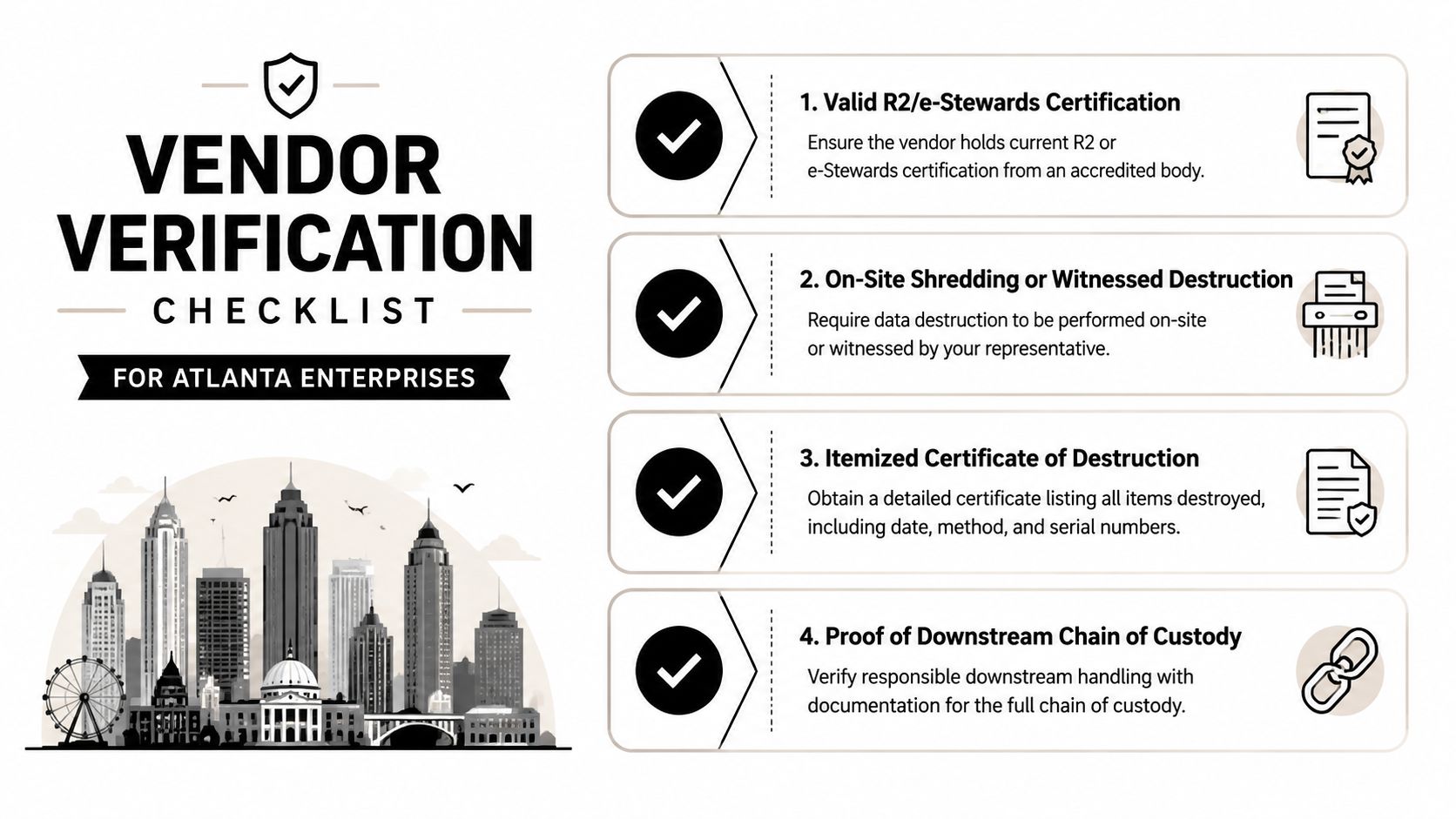
- Which media types are supported? The provider should explain how it handles HDDs, SSDs, encrypted drives, failed drives, and devices that can't complete a sanitization routine.
- How is wiping verified? Ask for the software name, outcome report, asset identifier, and failure workflow. A “wipe completed” email isn't an audit record.
- What happens when a wipe fails? The process should route the drive to an approved destruction method rather than returning it to general inventory.
- How is physical destruction documented? Look for serialized reporting, destruction dates, method details, and a certificate that matches the asset list.
- Who controls downstream processing? Chain-of-custody records should identify handoffs and final recycling or material recovery.
Treat the certificate as an audit tool
A useful certificate isn't generic. It should tie the destruction or sanitization result to identifiable assets and preserve enough detail for an auditor, security officer, or legal reviewer to understand what occurred. Match the certificate against your inventory before closing the project.
Independent certifications can strengthen vendor diligence, but they don't replace your own review. Examine insurance, incident reporting, access controls, transportation procedures, and environmental downstream practices. The Beyond Surplus data destruction certificate information illustrates the kind of documentation businesses should expect to discuss with an ITAD provider.
Audit-ready standard: Every asset needs a traceable path from your custody, through the selected sanitization method, to documented final disposition.
Real Business Scenarios for Wiping vs Shredding
A healthcare provider replacing employee workstations usually has two streams. Functional systems may be suitable for verified sanitization and controlled reuse, while failed drives or media containing especially sensitive records may require destruction. The decision should follow the organization's policy and the device's condition, not a blanket preference for one method.
A financial services firm may choose purge-level sanitization for supported equipment that remains within an approved disposition process. That preserves recovery value while meeting the required security outcome. Drives that are damaged, inaccessible, or outside the approved reuse boundary should move to destruction instead.
Situations that favor certified wiping
- Controlled technology refresh: Healthy laptops and servers can be sanitized before internal redeployment or remarketing.
- Value recovery: Equipment with meaningful residual value shouldn't be destroyed before assessing whether a supported purge method can protect the data.
- Managed reuse: Organizations that retain control of the device can document the next owner and the sanitization result.
- Standardized HDD processing: NIST's single-pass Clear guidance for modern HDDs can eliminate unnecessary multi-pass routines when the applicable policy permits it.
Situations that favor shredding
- Failed or damaged media: A drive that can't be reliably accessed can't provide a trustworthy wipe result.
- Obsolete equipment: If the storage device has no practical reuse path, physical destruction may be more efficient than testing it.
- High-consequence exposure: Some organizations need the strongest available irreversible outcome for retired media.
- Breach or chain-of-custody concerns: Physical destruction can close the recovery path when the organization can't establish confidence in prior handling.
The strongest programs sort assets before processing. They don't send every drive to a shredder, and they don't force every drive through software that can't verify the result.
How to Choose the Right Secure Disposal Method
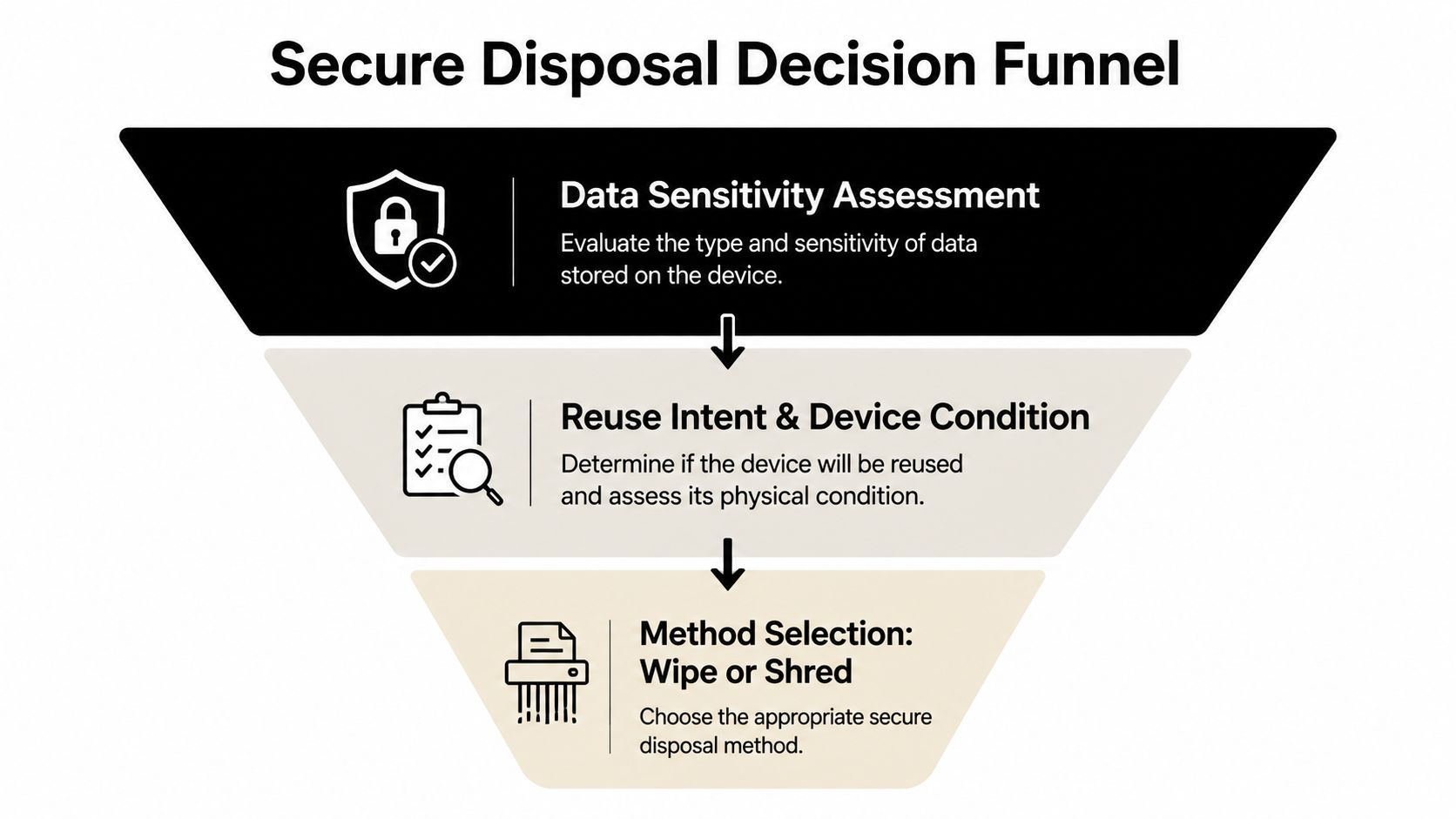
Use a decision sequence, not a slogan. The right answer to hard drive shredding vs data wiping comes from matching the required outcome to the asset's actual condition and future.
Begin with the data
Classify the information before selecting a method. Consumer report information, medical records, financial data, credentials, intellectual property, and government information may carry different internal controls and contractual obligations. Your policy should state whether Clear, Purge, or Destroy is required and who can approve exceptions.
Inspect the asset
Separate supported, healthy media from failed or questionable inventory. Identify HDDs and SSDs, record serial numbers, and flag encryption or access issues. A provider should never treat an unverified failed wipe as a successful sanitization.
Decide what happens next
If reuse is planned and the method is supported, choose certified wiping or purge-level sanitization. If the drive is damaged, obsolete, compromised, or destined for material recovery, choose shredding or another approved Destroy method. Preserve the evidence either way.
Beyond Surplus offers business ITAD services that include certified data wiping, on-site and off-site hard drive shredding, serialized reporting, equipment disposal, electronics recycling, and value recovery. The provider also handles data center de-installations and logistics coordination for commercial customers.
My recommendation: Wipe healthy supported drives when reuse has real business value. Shred drives that can't be reliably sanitized or that require irreversible destruction. Never choose either method without verification and a complete chain of custody.
Contact Beyond Surplus to plan certified data wiping or secure hard drive shredding for your business inventory. Their commercial ITAD team can coordinate pickup, documentation, electronics recycling, value recovery, and data center equipment disposition around your compliance requirements.


