

A regional bank has just completed a core-system conversion. Two hundred desktops and four servers are staged for removal, the branch managers want the equipment gone, and the IT team assumes the standard wipe process handled everything. Then a relationship-manager laptop appears on a secondary market with customer statements and remote-administration credentials still accessible. The bank now faces a regulator inquiry, customer-notification work, and a question that should have been answered before the first device left the branch: who owned the disposal decision?
This Bank Computer Disposal and Data Security Guide treats retirement as a lifecycle governance problem, not a one-time wipe. The defensible program connects asset inventory, media-specific sanitization, chain of custody, independent verification, vendor oversight, documented validation, and responsible value recovery.
Table of Contents
- The Hidden Risk in Retired Bank Hardware
- Regulatory Foundations Every Bank Program Must Meet
- Choosing the Right Data Destruction Method
- Verification and Validation That Withstand Audits
- On-Site Versus Off-Site Shredding in Practice
- Chain of Custody and Documentation Workflow
- Vendor Selection Checklist for Bank ITAD Partners
- Turning End-of-Life Hardware into Recovered Value
The Hidden Risk in Retired Bank Hardware
The laptop in that scenario doesn't need to contain an entire customer database to create serious exposure. A cached statement, an administrator credential, a browser session, or a forgotten local export can connect an abandoned device to systems and people the bank is required to protect. The risk begins before pickup, when staff move equipment into an unsecured closet or branch staging area without recording who owns it, what data it handled, or which disposition rule applies.
Residual information can remain in dormant partitions, reserved storage areas, remapped sectors, removable media, backup tapes, and system configuration records. A self-encrypting drive also needs careful treatment. Encryption doesn't eliminate the need to manage its pre-authentication state, keys, access controls, and verification evidence. A forgotten BIOS password may not be customer data, but it can complicate intake, prevent reliable sanitization, and signal that the asset wasn't processed through a controlled retirement workflow.
The branch is part of the control environment
A bank's disposal policy should assign responsibility before equipment reaches end of life. The branch manager, local IT contact, information-security team, records owner, and approved ITAD provider each need a defined handoff. Without that ownership model, staff may treat a printer, laptop, server, ATM component, or backup tape as ordinary surplus.
A practical intake control includes:
- Asset identification: Record the asset tag, serial number, device type, location, assigned owner, and media type.
- Security classification: Identify whether the equipment handled customer information, credentials, payment data, internal records, or regulated backups.
- Quarantine: Move retired hardware into a restricted staging area with access logging and dual sign-off.
- Disposition decision: Choose reuse, resale, recycling, or destruction before the asset enters transport.
- Exception handling: Escalate missing serial numbers, failed drives, locked devices, and unknown backup media rather than processing them as routine equipment.
Practical rule: If the bank can't prove where a retired device was, who handled it, and why its final method was selected, the disposal record is incomplete.
The FTC Disposal Rule became effective on June 1, 2005 and applies to entities that maintain or possess consumer information for a business purpose, including financial institutions and government agencies. It requires reasonable measures against unauthorized access during disposal, including appropriate handling of paper and electronic records. That makes end-of-life equipment a formal security control surface, not a facilities cleanup task.
Regulatory Foundations Every Bank Program Must Meet
The federal baseline is straightforward. The FTC Disposal Rule requires reasonable and appropriate measures to protect consumer information during disposal, while NIST provides the technical framework for deciding whether media should be cleared, purged, or destroyed. For financial institutions, the FTC requirement also overlaps with the Gramm-Leach-Bliley Act Safeguards Rule, which reinforces the need for documented information-security controls.
NIST defines media sanitization as a process that makes access to target data infeasible for a given level of effort. Its Special Publication 800-88 Revision 1, published in December 2014, replaced the earlier version and established a modern framework for storage-media disposal. The federal rule sets the obligation. NIST helps the bank demonstrate that its method was appropriate for the data and the intended disposition.
Translate obligations into operating controls
A bank should map each requirement to a decision, an accountable person, and an evidence package.
| Regulation | Required Disposal Control | Evidence Examiner Tests |
|---|---|---|
| FTC Disposal Rule | Reasonable measures that prevent unauthorized access or use of consumer information | Policy, asset records, vendor controls, destruction or sanitization evidence |
| GLBA Safeguards Rule | Disposal procedures aligned with the institution's information-security program | Approved standards, responsibility assignments, exception records |
| NIST SP 800-88 Rev. 1 | Media-specific selection of clear, purge, or destroy, followed by verification | Method record, tool logs, serial reconciliation, verification results |
| State privacy requirements | Apply the stricter operational requirement when the bank handles records across jurisdictions | State applicability review, retention rules, documented disposal decisions |
Massachusetts 201 CMR 17.00 and the New York SHIELD Act illustrate why a multistate bank shouldn't rely on a single generic checklist. The institution should maintain a state-law applicability matrix, then apply the stricter control where requirements overlap.
The bank should also align its workflow with applicable examination expectations and internal audit testing. A reviewer will usually ask for the record before examining the residue. That means the disposal certificate, manifest, method selection, exception history, and verification record must identify the exact asset and support the decision.
For a practical reference on the technical baseline, review FINRA-compliant IT asset disposal. The point isn't to collect certificates as paperwork. The point is to connect every certificate to a documented risk decision that an examiner can follow from intake through final disposition.
Choosing the Right Data Destruction Method
NIST's method choice should follow media type, data sensitivity, reuse intent, and verification capability. Convenience isn't a defensible selection criterion.
Clear uses logical techniques to remove data while preserving the device for reuse. It can fit a working hard disk that the bank will redeploy internally, but only when the organization can verify the complete addressable space and control the destination. A basic operating-system reset isn't equivalent to a validated sanitization process.
Purge applies stronger media-specific techniques, such as supported manufacturer commands or other methods designed to make recovery infeasible. It can support selected reuse decisions for hard drives and solid-state media, but the bank must confirm that the command addressed the device's relevant storage areas.
Cryptographic erase retires the encryption key on a self-encrypting drive. This can be an efficient reuse option when the pre-boot authentication state, key lifecycle, device health, and implementation records are controlled. If the bank can't document those conditions, cryptographic erase becomes an assumption rather than evidence.
Destroy removes reuse potential but offers a clear finality when media leaves the institution, fails sanitization, or can't be reliably verified. NIST identifies shredding, disintegration, incineration, pulverizing, and melting as physical destruction methods. Its legacy guidance specifies that shredded or disintegrated residue should be reduced to nominal edge dimensions of 5 mm and surface area of 25 mm² (NIST SP 800-88 legacy guidance).
| Method | Best Media Type | Reuse Outcome | Audit Evidence |
|---|---|---|---|
| Clear | Verified working HDDs under controlled reuse | Device remains reusable | Tool record, serial match, acceptance review |
| Purge | Supported HDD, SSD, or NVMe method | Reuse may remain possible | Command result, device details, independent verification |
| Cryptographic erase | Managed self-encrypting storage | Fast reuse when key control is proven | Key retirement record, authentication-state evidence |
| Destroy | Failed, unverified, or leaving-institution media | No reuse | Destruction record, witness, residue or process evidence |
Blanket shredding avoids some sanitization uncertainty, but it also destroys equipment that might have been safely redeployed or recovered for value. Blanket wiping creates the opposite problem, especially with SSDs and NVMe devices where wear leveling and over-provisioning can complicate logical coverage. The right answer is a documented decision per asset class, not a universal preference.
Banks reviewing broader exposure can also consult this resource on cyber liability for Georgia insurance firms. For the technical standard itself, see NIST 800-88 data destruction standards.
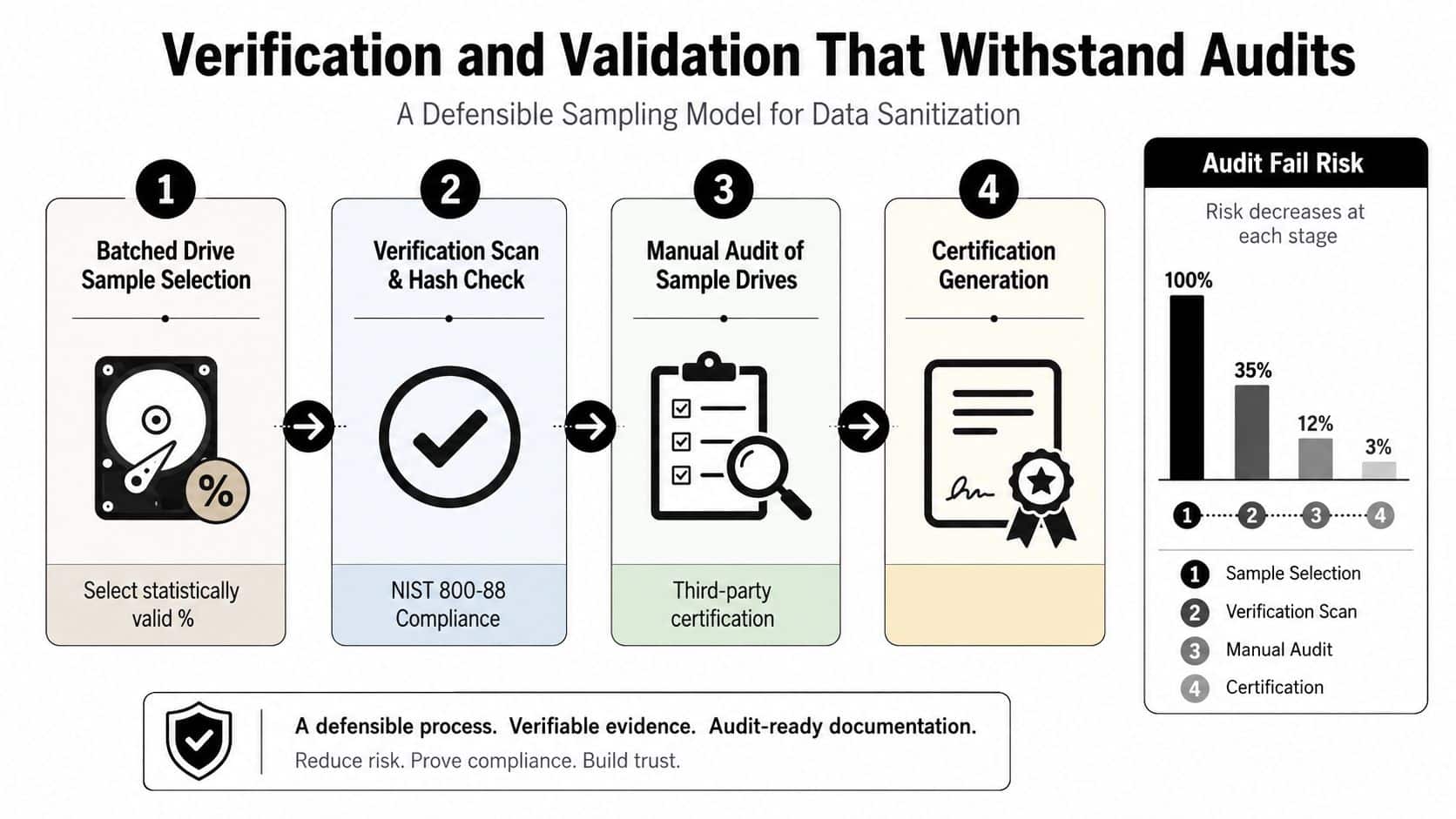
Verification and Validation That Withstand Audits
A wipe utility's success message isn't sufficient evidence. Verification asks whether the sanitization operation worked. Validation is the bank's decision to accept or reject that result from a confidentiality perspective. NIST treats both as essential, and the separation matters because a technically completed operation may still be unacceptable for the data involved.
For electronic media, NIST SP 800-88 Revision 1 recommends pseudorandom locations across the addressable space, with at least two non-overlapping samples per subsection. Each consecutive sample should cover at least 5% of its subsection, so the paired samples cover at least 10% once all subsections are tested (NIST SP 800-88 Revision 1). The guidance also calls for a secondary verification pass on a random subset using a different tool from a separate developer, with at least 20% of sanitized media selected for that additional check.
Build the evidence trail into the batch
A defensible workflow should preserve:
- Tool output: Capture the software version, method, result, timestamp, and error status.
- Serial reconciliation: Match the wipe record to the asset inventory and physical label.
- Independent review: Assign verification to personnel who weren't involved in the original sanitization action.
- Exception register: Record failed drives, inaccessible areas, mismatched serials, and reprocessing decisions.
- Validation approval: Have the data owner or security authority accept the result based on confidentiality risk.
NIST SP 800-88 Revision 2 emphasizes representative sampling when full testing isn't practical and recommends independence between the person performing sanitization and the person verifying it (NIST SP 800-88 Revision 2). A failed sample should trigger a documented root-cause review and reprocessing of the affected batch. Rerunning a utility may produce a cleaner screen, but it doesn't explain why the first control failed.
A certificate becomes meaningful only when it rests on this underlying evidence. The certificate of data destruction explained should be treated as the summary record, not the entire control.
On-Site Versus Off-Site Shredding in Practice
The on-site versus off-site decision should reflect classification, volume, transport exposure, and audit expectations. A vendor's preferred operating model shouldn't decide where sensitive bank media is destroyed.
On-site shredding keeps the drives at the bank's facility until a mobile unit renders them unrecoverable. The bank can witness the process, control the staging area, and receive destruction documentation before the equipment leaves. This is the stronger choice for ATM storage, encryption-key hosts, failed media with high sensitivity, and devices that cannot be reliably verified.
Off-site shredding can work for bulk batches when the bank has approved the transport and facility controls. The provider should use sealed containers, serialized intake records, controlled access, and a certificate that reconciles every asset. The bank should also review subcontractor use, transport insurance, and the time between pickup and destruction.
| Criteria | On-Site Shredding | Off-Site Shredding |
|---|---|---|
| Security control | Bank witnesses destruction at the source | Depends on transport and facility controls |
| Downtime per asset | May require staging around a mobile unit | Efficient for consolidated batches |
| Cost per drive | Can be higher for small or dispersed jobs | Often more efficient for bulk processing |
| Certificate quality | Issued against witnessed destruction event | Depends on serialized intake and facility records |
| Insurance coverage | Review vendor and site responsibilities | Review transport, facility, and downstream liability |
| Best fit | Sensitive, failed, or high-audit-exposure media | Approved low-classification bulk batches |
The bank should classify drives before pickup, not after a mixed load reaches the vendor. That single decision prevents sensitive media from entering a low-control stream and makes the final certificate easier to defend.
For a practical comparison of operating models, review on-site versus off-site ITAD services in Georgia. The recommendation is direct: use on-site destruction where transport risk or sensitivity dominates, and reserve off-site processing for batches whose classification and custody controls support it.
Chain of Custody and Documentation Workflow
A defensible chain of custody begins when the bank decides an asset is retired. It doesn't begin when a truck arrives. Every transfer should connect the original asset tag to the final sanitization, destruction, recycling, or resale record.
Control the movement from branch to final record
Tag and quarantine. The local owner and an independent reviewer confirm the asset tag, serial number, media type, location, and retirement status. Equipment enters a restricted staging room rather than an open facilities area.
Seal the load. Staff place devices into serialized tamper-evident bags, carts, or containers. The pickup manifest cross-references the seal number and each asset record.
Record the handoff. The vendor representative presents identification. The bank records the driver, timestamp, seal number, manifest, and Bill of Lading.
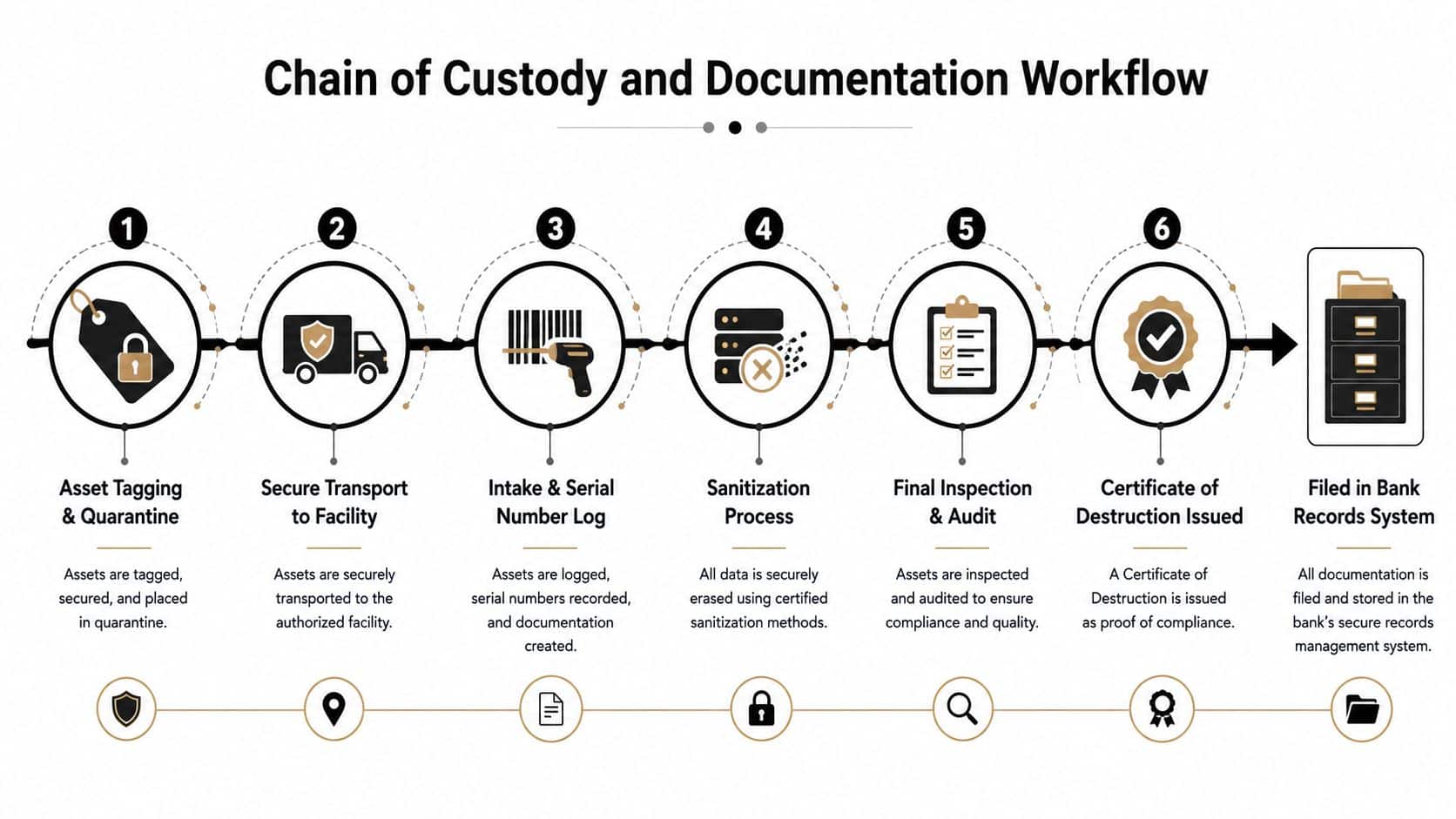
Control transport and intake. Bonded transport, sealed-container checks, and a serialized intake log establish continuity. Any broken seal or quantity discrepancy becomes an exception immediately.
Sanitize or destroy. The selected method must match the device record. Where possible, destruction occurs under controlled observation and recorded facility procedures.
Reconcile the certificate. The final record should state the asset identifiers, destruction or sanitization date, method, witness or responsible operator, and downstream destination.
File an audit packet, not a loose certificate
The bank's records system should retain the manifest, seal log, Bill of Lading, intake record, tool output, verification result, exception register, certificate, and disposal decision under the original asset tag. Retention should follow the bank's approved records schedule and any applicable legal hold.
A missing serial number is not an administrative defect. It breaks the link between the physical device and the compliance record.
The workflow also needs an escalation path for lost assets, damaged seals, failed media, unplanned subcontractors, and certificates that don't reconcile. The chain of custody for IT asset disposal should be designed as an operational control that branch staff can execute consistently, not as a form completed after the fact.
Vendor Selection Checklist for Bank ITAD Partners
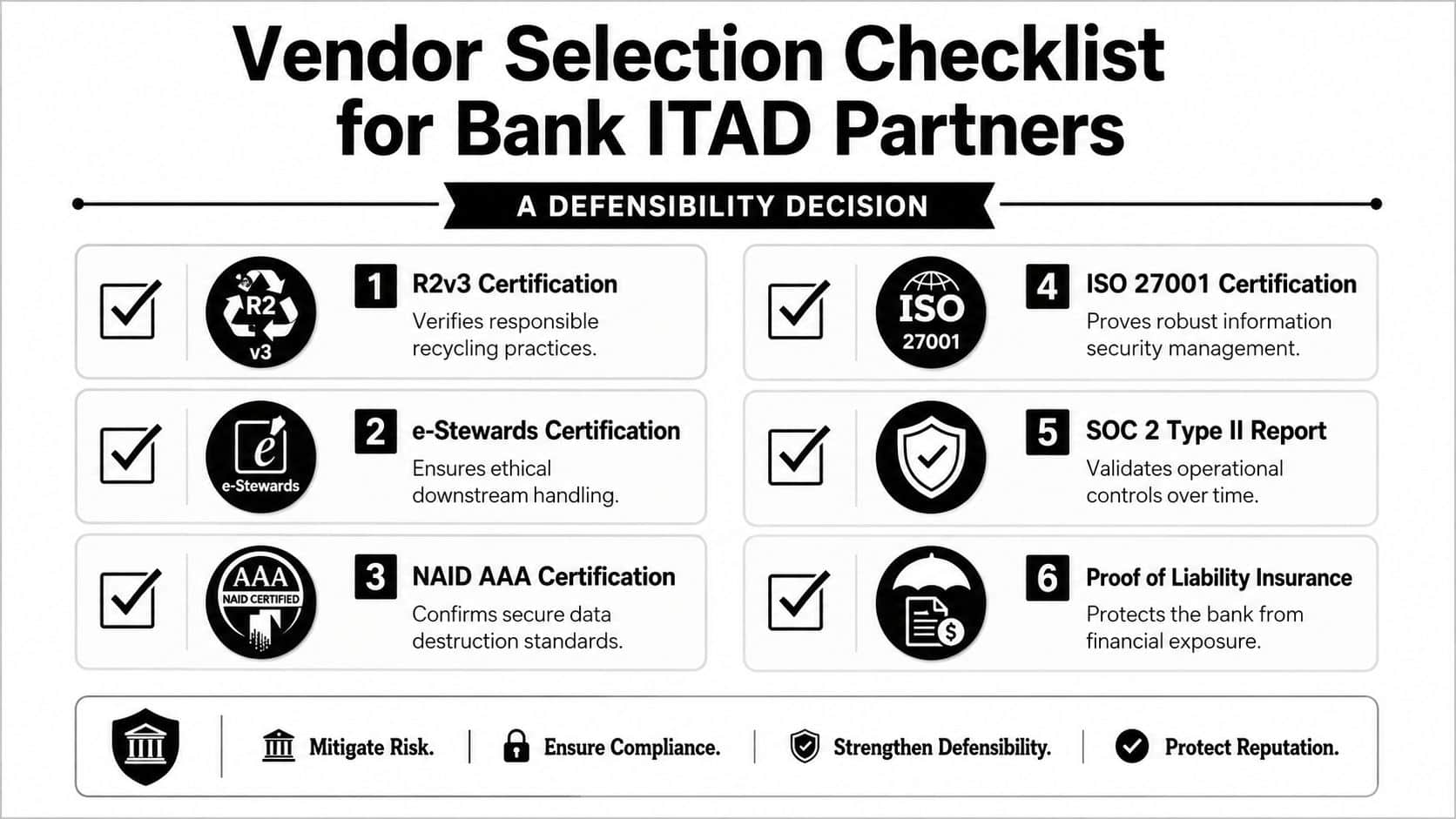
Vendor selection is a defensibility decision, not a race to the lowest quote. A provider may advertise secure recycling while offering little evidence about media sanitization, downstream handling, subcontractors, or incident response.
Require the vendor to explain what its certifications cover and what they don't prove. R2v3 addresses responsible recycling practices. e-Stewards focuses on ethical downstream handling. NAID AAA supports secure information-destruction practices. ISO 27001 indicates an information-security management framework, while SOC 2 Type II provides evidence about operational controls over a review period. None of these certificates, alone, proves that every bank drive was sanitized correctly or that every asset was reconciled.
Test the contract, not just the brochure
A bank's due-diligence file should address:
- Insurance structure: Confirm cyber, general liability, automobile, workers' compensation, and coverage for transportation and downstream events.
- Subcontractor governance: Require disclosure, approval rights, equivalent controls, and flow-down obligations.
- Audit access: Preserve rights to inspect facilities, review records, observe destruction, and request corrective action.
- Certificate samples: Test whether certificates include serial numbers, methods, dates, witnesses, and destination details.
- Incident notification: Define escalation contacts, required notice timing, investigation cooperation, and evidence preservation.
- Liability allocation: State who pays for notification, forensic work, legal response, and remediation when the vendor or subcontractor causes an incident.
- Method specificity: Require media-specific procedures for HDDs, SSDs, NVMe, encrypted storage, failed drives, and backup media.
Reject a vendor that can't describe its sanitization methodology, won't provide a relevant SOC 2 report when required by the bank's risk process, refuses reasonable audit rights, or issues certificates that identify only a shipment rather than each asset. A polished RFP response isn't a control. Evidence is.
Turning End-of-Life Hardware into Recovered Value
Value recovery belongs after security classification, not before it. A laptop may retain resale potential, while a failed storage device should move directly to destruction. A server may be reusable after a documented purge, but a drive containing sensitive information shouldn't enter a remarketing stream merely because it has market value.
| Asset Class | Resale Potential | Recommended Method | Disposition Path |
|---|---|---|---|
| Business laptops | Often suitable for controlled reuse when functional | Clear, purge, or cryptographic erase based on media and policy | Internal redeployment, approved resale, or parts recovery |
| Desktop computers | May support reuse or component recovery | Verified sanitization for retained systems | Redeploy, resell, or recycle |
| Servers | Depends on configuration, age, and storage condition | Purge or destroy storage according to risk | Reuse, controlled resale, or material recovery |
| HDDs | Reuse may be possible when health and verification are strong | Clear or purge for approved reuse, destroy when unverified | Redeployment, resale, or destruction |
| SSDs and NVMe | Reuse requires media-specific assurance | Purge or cryptographic erase when documented, otherwise destroy | Controlled reuse or destruction |
| Failed or locked media | Little defensible reuse value | Physical destruction | Certified destruction and downstream recycling |
The bank should maintain a disposition matrix that assigns each asset class a default method, an exception owner, and an evidence requirement. That matrix should distinguish redeployment, resale, parts harvesting, recycling, and destruction. It should also identify when a device's residual value doesn't justify the verification burden or residual-recovery risk.
This approach protects finances as well as confidentiality. It prevents the bank from destroying valuable working equipment without review, but it also prevents remarketing pressure from weakening the primary control. The opening scenario would have ended differently if the laptop had been tagged, quarantined, sanitized through a media-appropriate process, independently verified, and released only after validation.
The next practical step is an asset-population review. Map laptops, desktops, servers, storage devices, backup media, branch equipment, and data-center hardware, then assign each class a method before the next refresh cycle begins.
Beyond Surplus provides business IT asset disposition, secure data wiping, on-site and off-site hard-drive shredding, chain-of-custody tracking, and certificates of data destruction and recycling. Visit Beyond Surplus to plan a bank computer disposal program that connects media-specific controls with audit-ready documentation and responsible value recovery.


