

Your Atlanta office refresh is complete, but the retired laptops, servers, storage devices, and loose drives are still sitting in a locked room. Facilities wants the space cleared, IT needs proof that sensitive data is gone, and procurement wants to know whether any equipment still has resale value. Treating that inventory as a junk-removal task creates avoidable security, compliance, and environmental risk.
IT asset disposition in Atlanta gives businesses a controlled process for inventory, data sanitization, reuse, recycling, destruction, and reporting. This guide explains how to choose the right path for each asset, what an audit-ready chain of custody should contain, and how commercial organizations can manage Atlanta electronics recycling, laptop disposal, data center decommissioning, and related services.
Table of Contents
- Why Atlanta Businesses Need Secure IT Asset Disposition Now
- What IT Asset Disposition Means for Your Business
- Secure Data Destruction Methods That Protect Your Data
- Value Recovery Recycling and Responsible Disposition Options
- Chain of Custody Documentation and Logistics in Atlanta
- Business Benefits Compliance and ROI of Professional ITAD
- How to Choose an ITAD Vendor and Get Started With Beyond Surplus
Why Atlanta Businesses Need Secure IT Asset Disposition Now
An Atlanta company completes a technology refresh across its offices. Employees return laptops, an infrastructure team removes servers from a data center, and a facilities manager discovers boxes of drives from an earlier relocation. The equipment may be obsolete, but the information on it may still include employee records, customer data, credentials, financial material, or proprietary files.
The first mistake is treating every device the same. A functioning business laptop may be suitable for certified wiping and remarketing. A damaged SSD may require physical destruction. A server may need de-installation, serialized inventory, secure transport, and downstream processing. A basic pickup that offers no item-level evidence can't answer the questions an auditor, insurer, or legal team may ask later.
Atlanta organizations also need to consider the environmental side of disposal. The Global E-waste Monitor 2024, published by the ITU and partners, reports that the world generated a record 62 billion kg of e-waste in 2022, or 7.8 kg per person. Only 22.3% was formally collected and recycled in an environmentally sound way, while generation had risen 82% since 2010. The report projects 82 million tonnes by 2030, making documented IT asset disposition increasingly important for organizations retiring electronics.
The business problem behind a full equipment room
Secure ITAD helps commercial and enterprise teams manage several risks at once:
- Data exposure: Retired storage media can remain readable unless a suitable sanitization method is completed and verified.
- Compliance gaps: A general recycling receipt doesn't establish which device was processed, how it was handled, or when destruction occurred.
- Operational delays: Unplanned removal leaves IT, security, and facilities staff coordinating packing, loading, transport, and records.
- Lost recovery value: Recyclable equipment may still qualify for reuse or remarketing if the business evaluates it before destruction.
- Environmental liability: Responsible downstream processing needs more evidence than a claim that equipment was “recycled.”
A useful local overview is IT asset disposition trends in Atlanta, but the operating principle applies beyond Georgia. Organizations with offices across the contiguous United States need one process that works in Atlanta and at remote sites.
What IT Asset Disposition Means for Your Business
IT asset disposition is the managed end-of-life process for business technology. It starts before a truck arrives and ends only when each asset has a documented outcome. That outcome might be internal reuse, certified wiping followed by resale, materials recycling, or physical destruction.
Think of ITAD as a triage line rather than a dumpster. First, the team identifies what arrived. Next, it separates data-bearing devices from items such as keyboards, cables, monitors, and other peripherals. Then it applies a risk-based decision to each category, preserving value where practical and destroying media when the sensitivity or condition requires it.
The core stages of a defensible ITAD workflow
- Inventory and identification: Capture asset tags, serial numbers, device types, and condition before removal. This creates the starting record for later reconciliation.
- Data classification: Determine whether a laptop, server, drive, tape, or other media contains information requiring sanitization. The control should reflect confidentiality requirements.
- Disposition decision: Choose reuse, remarketing, recycling, or destruction. A mixed enterprise fleet shouldn't receive blanket treatment because it arrived in one shipment.
- Processing and downstream control: Sanitize or destroy data-bearing media, then route equipment and materials through responsible processing channels.
- Reporting: Provide certificates and item-level records that connect pickup, handling, processing, and final disposition.
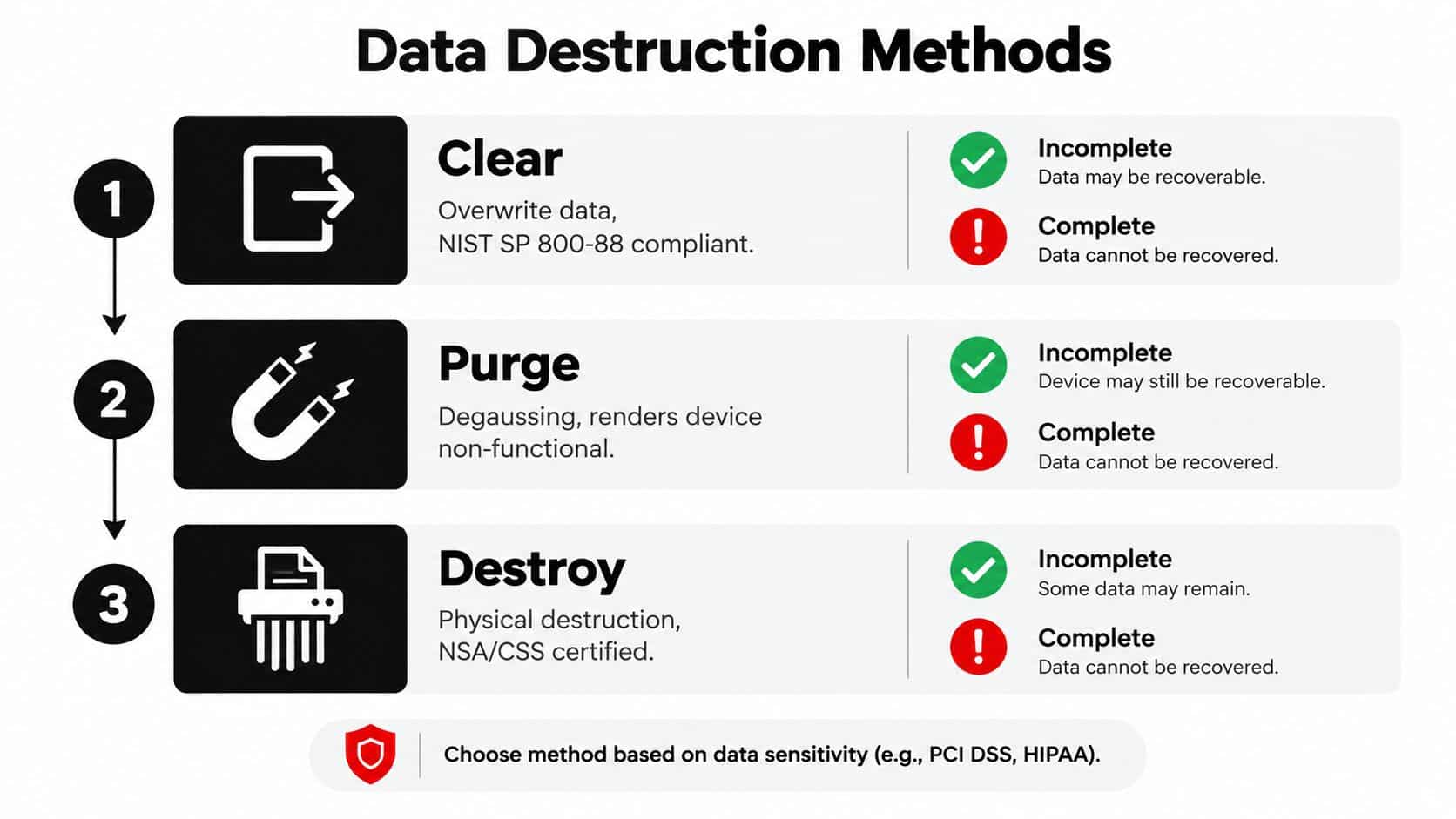
NIST SP 800-88 Rev. 2 says media sanitization should make access to target data infeasible for a given level of effort. It frames sanitization as a formal program, with controls selected according to the sensitivity of the information. The standard identifies Clear, Purge, and Destroy as core actions, which makes data destruction a defined process rather than a generic disposal step.
ITAD applies to more than office computers. Commercial programs may include laptop disposal, server recycling, storage-device destruction, data center decommissioning, medical equipment disposal, laboratory equipment disposal, product destruction, and electronic waste pickup. Residential drop-off and household recycling are separate use cases. This article focuses on business and enterprise requirements, where documentation and custody matter as much as physical removal.
Practical rule: If your team can't identify what left the building and what happened afterward, the process is disposal, not audit-ready ITAD.
Secure Data Destruction Methods That Protect Your Data
The right sanitization method depends on two questions: How sensitive is the information, and does the hardware need to remain usable? NIST SP 800-88 Rev. 2 connects the decision to confidentiality requirements and the level of assurance the organization needs.
Clear for appropriate reuse
Clear applies a logical process intended to remove user-addressable data while preserving the device for continued use when the media and circumstances support that outcome. A certified wiping program should record the device identity, method, result, and any exception. That record matters because “the drive was wiped” doesn't establish which drive was wiped or whether the process completed successfully.
A business may choose certified data wiping for laptops, desktops, or enterprise equipment that passes testing and can be remarketed. Reuse can recover value and avoid unnecessary destruction, but only when the data risk and technical condition make that choice defensible.
Purge when stronger assurance is needed
Purge uses a method intended to make data recovery infeasible while potentially preserving the media, depending on the technology and process. The control must match the device. Magnetic hard drives, SSDs, removable media, and embedded storage don't all respond to the same technique.
That is why a vendor should identify the media type before promising a result. A generic “wipe all devices” statement leaves too much unanswered. Review NIST SP 800-88 guidance for ITAD alongside your internal data classification policy and required assurance level.
Destroy for irreversible disposition
Destroy physically renders the media unusable. Professional shredding is appropriate when the organization requires the strongest practical assurance, when a drive is damaged or unsuitable for reuse, or when policy requires destruction rather than resale. On-site shredding can let authorized staff witness processing at the Atlanta facility, while off-site destruction can work when locked containers, controlled transport, and complete custody records are in place.
The FTC Disposal Rule requires reasonable and appropriate measures to prevent unauthorized access to consumer-report information. It specifically recognizes destroying or erasing electronic files and media so the information can't be read or reconstructed. It also permits due diligence when a business hires a destruction contractor.
Match the control to the risk
- Reuse planned: Use certified wiping when the device can be sanitized and retained safely.
- Higher assurance required: Select a purge method appropriate for the media and confidentiality level.
- No reuse or extreme sensitivity: Use physical destruction, with serial-level documentation.
- Regulated information: Confirm vendor qualifications, procedures, custody controls, and destruction evidence before pickup.
Value Recovery Recycling and Responsible Disposition Options
Destruction isn't automatically the most responsible outcome. A mixed enterprise fleet contains assets with different conditions, data profiles, and remaining value. Risk-based triage separates those variables before the processing decision is made.
A newer laptop may support certified wiping and resale. A failed drive may go directly to destruction. A rack, cable bundle, or non-data-bearing peripheral may follow a materials-recycling route. Data center de-installation adds another layer because teams must coordinate removal, labeling, power-down procedures, equipment handling, and floor clearance.
Three practical disposition paths
Sanitized reuse and remarketing preserve functional equipment. This path can support IT buyback, internal redeployment, or resale after the vendor verifies the device and completes the required data process. It works best when the organization receives transparent grading, inventory, and financial reporting.
Materials recycling fits end-of-life equipment that has no reasonable reuse path. Responsible recycling should include controlled downstream processing and documentation, not a truck ride to an unknown destination.
Physical destruction fits high-risk media, failed storage devices, and products that must never re-enter a market. Product destruction may also apply to prototypes, recalled items, branded materials, or equipment that requires documented elimination rather than resale.
Choosing the right disposition path for each asset
| Asset Scenario | Recommended Action | Value and Risk Outcome |
|---|---|---|
| Functional business laptops with ordinary corporate data | Certified wipe, testing, and remarketing | Retains possible recovery value while addressing data risk |
| Failed SSDs or hard drives | Physical destruction and materials recycling | Removes recovery risk and routes material to responsible processing |
| Decommissioned servers and networking equipment | Inventory, sanitize media, then reuse, resell, or recycle by condition | Separates valuable hardware from high-risk storage |
| Keyboards, cables, and non-data peripherals | Electronics recycling | Avoids applying media-destruction controls where they aren't needed |
| Prototypes, recalled products, or sensitive branded equipment | Documented product destruction | Prevents unauthorized reuse or distribution |
Recovering value from used business IT assets requires more than asking whether equipment turns on. The vendor should explain testing, data handling, grading, resale channels, revenue reporting, and the treatment of unsold assets. That transparency lets procurement compare recovery value against the cost and risk of processing.
Chain of Custody Documentation and Logistics in Atlanta
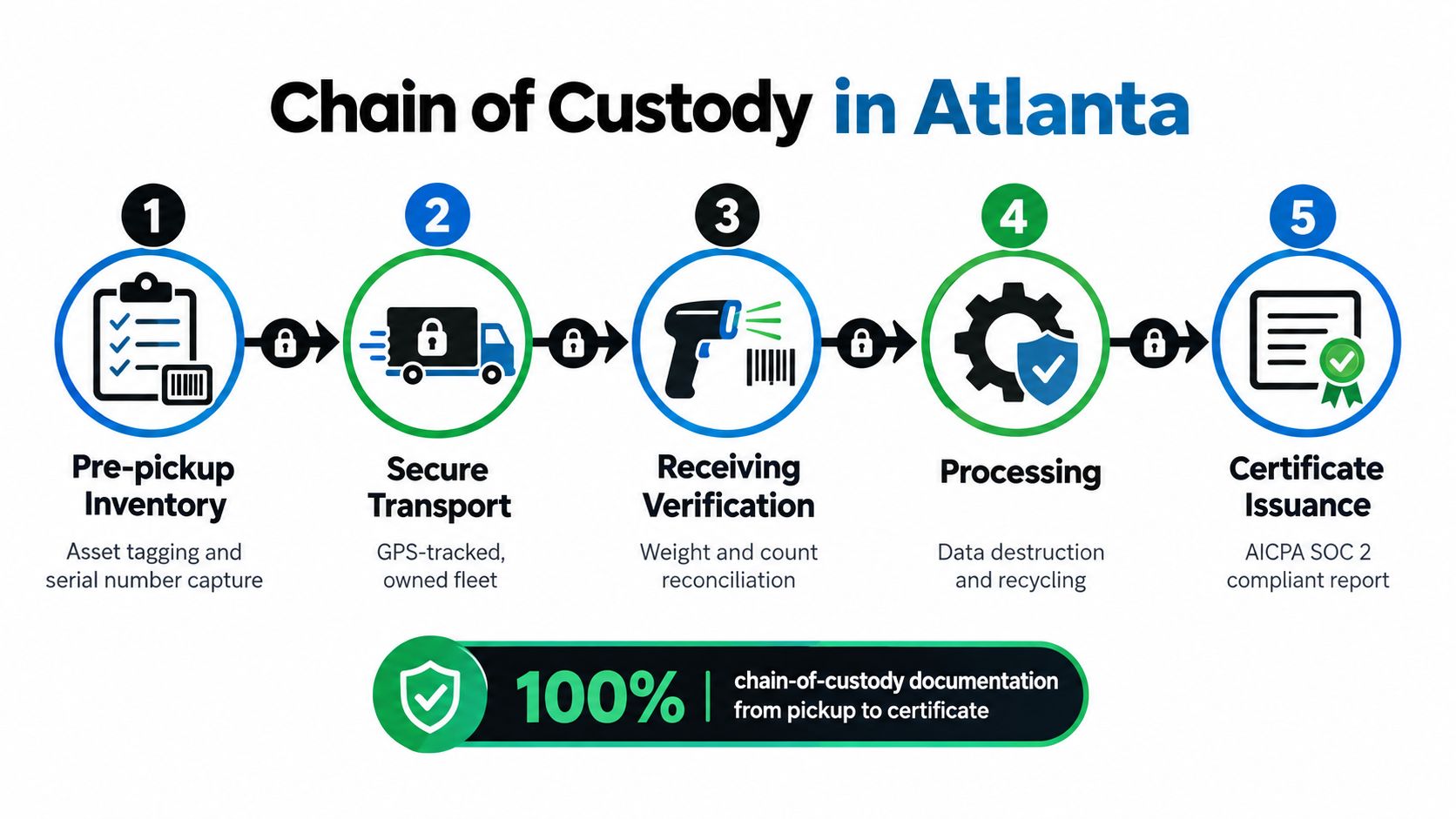
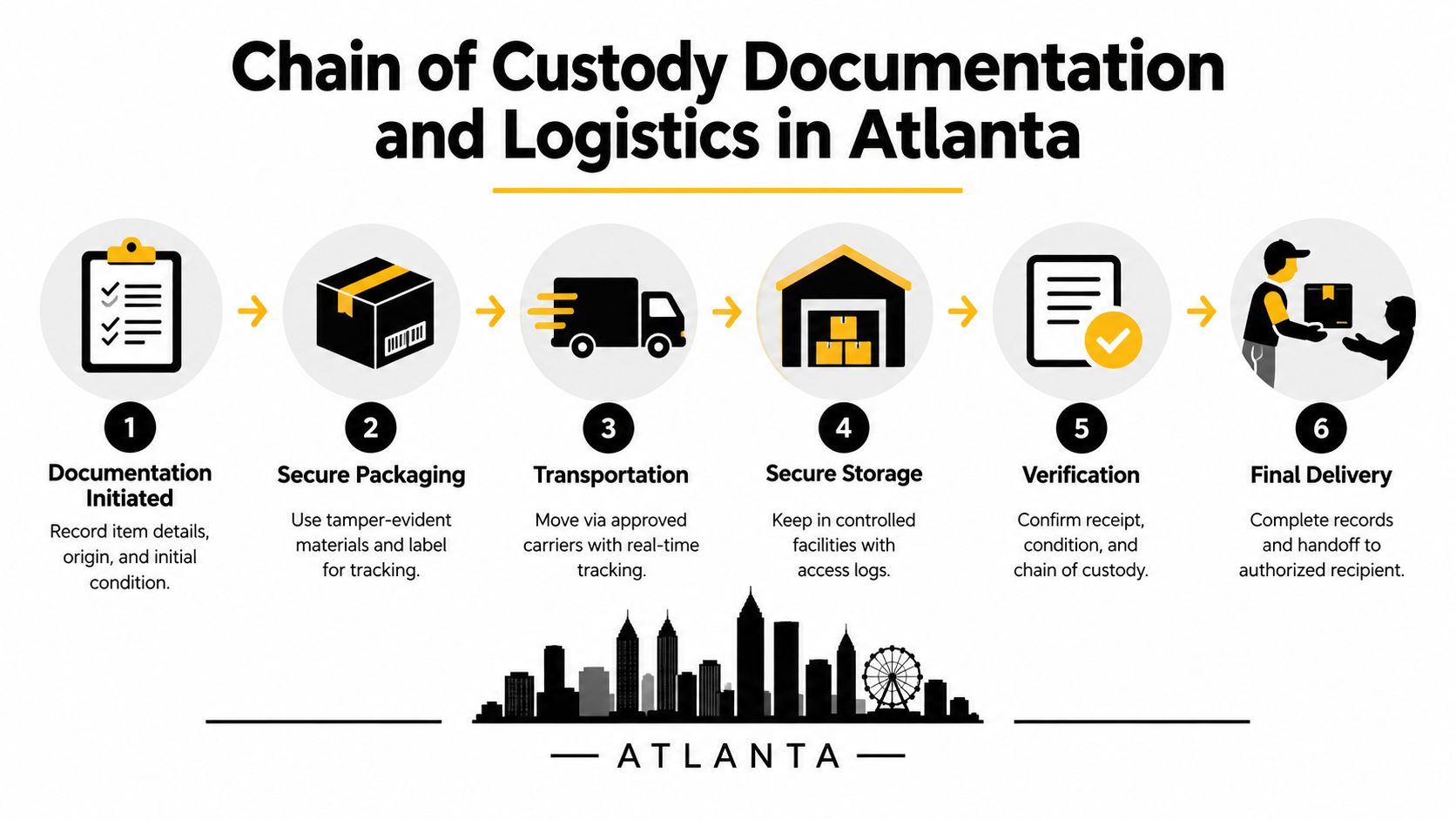
A certificate issued at the end of a project is useful, but it isn't the entire chain of custody. Auditors and legal teams need to understand how the asset moved from your site to final processing. A defensible record begins with the inventory and continues through transport, receiving, reconciliation, sanitization, destruction, recycling, and reporting.
What the operational trail should show
Before pickup, the provider should capture serial numbers or asset identifiers and confirm the scope of work. During loading, staff should reconcile the inventory against what leaves the site. Locked containers, controlled vehicles, trained personnel, and documented handoffs reduce uncertainty during transport.
At the receiving location, the provider should verify counts and identify discrepancies. Processing records should distinguish a wiped laptop from a shredded drive and a recycled peripheral. The final report should connect those outcomes to the original inventory rather than provide only a broad statement that an event occurred.
Audit question: What exact documentation will you receive, and can it support your obligations across HIPAA, PCI DSS, GLBA, SOX, and NIST expectations?
Atlanta service and multi-site coordination
For Atlanta-area businesses, scheduling often involves more than a pickup window. The provider may need to coordinate with building management, security desks, loading docks, data center operators, and facilities teams. A Smyrna processing facility can support local workflows, while nationwide pickup across the contiguous United States helps organizations apply the same disposition policy at offices and sites outside Georgia.
Ask for two separate outputs when the project includes both equipment and media:
- Certificate of recycling: Identifies the responsible processing outcome for equipment and materials.
- Certificate of data destruction: Documents the sanitization or destruction of specified storage media.
- Serialized asset report: Connects identifiers to condition, processing route, and final status.
- Custody records: Show pickup, transport, receiving, processing, and handoff details.
Chain-of-custody documentation for ITAD should be specific enough for someone who wasn't present at pickup to reconstruct the event. That level of evidence supports audit defense and helps demonstrate due diligence under the FTC Disposal Rule.
Business Benefits Compliance and ROI of Professional ITAD
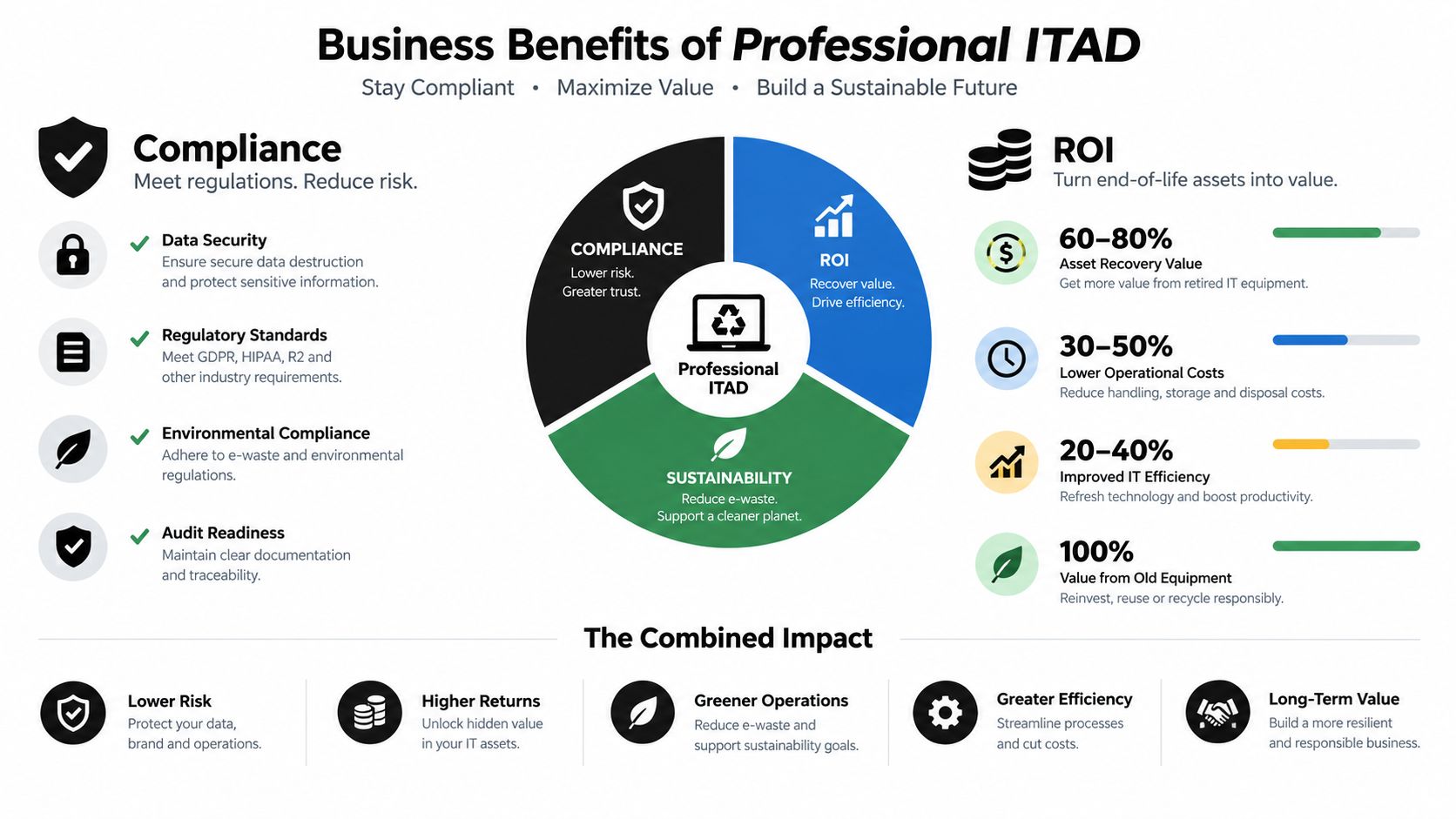
Professional ITAD connects four business outcomes: security, compliance, sustainability, and financial recovery. The work begins with risk-based triage. A device containing sensitive data may need verified wiping or destruction, while a tested laptop may support reuse and value recovery. The provider then records why that route was selected.
Security and compliance
A documented sanitization program reduces uncertainty around retired data-bearing devices. For organizations handling consumer-report information, the FTC Disposal Rule recognizes destruction or erasure that prevents information from being read or reconstructed. Written procedures, vendor due diligence, custody records, and certificates help show that the organization took reasonable steps.
Healthcare providers, financial institutions, schools, manufacturers, government agencies, and enterprise IT teams may follow different internal controls. Their shared need is traceability. A serialized record can show which asset was received, which treatment it received, and what result was recorded. That evidence is more useful in an audit than a generic recycling receipt.
Sustainability with financial discipline
The same Global E-waste Monitor findings cited earlier show recoverable materials going unaccounted for. That connects environmental responsibility to financial control. A business can compare the processing cost, resale proceeds, and material recovery associated with each asset group, rather than treating every retired device as disposal expense.
Operational efficiency and recovery
A managed program gives IT and facilities one workflow for packing, removal, transport, processing, and reporting. It also reduces internal handling of heavy servers, racks, laboratory equipment, and medical technology.
For procurement, buyback and remarketing records make the recovery decision easier to review. A report can show the asset identifier, condition, selected route, recovery amount where applicable, and processing cost. That comparison helps teams decide whether wiping for a legitimate second use makes sense or whether destruction is the safer choice.
The result is a clearer decision system: destroy what must be destroyed, recycle what has reached end of life, and recover value from equipment with a legitimate second use.
How to Choose an ITAD Vendor and Get Started With Beyond Surplus
Choose an ITAD vendor by reviewing the process, not just the pickup promise. A credible provider should answer these questions clearly:
- Documentation: Will reports identify assets by serial number, disposition route, and processing result?
- Data controls: Can the provider offer certified wiping, purge methods, on-site shredding, and off-site destruction?
- Custody: Who handles the assets during loading, transport, receiving, and downstream processing?
- Recovery: How does the provider test, grade, remarket, and report value from usable equipment?
- Environmental processing: Which downstream partners handle recycled materials, and what evidence is supplied?
- Coverage: Can the workflow support Atlanta sites, data center de-installations, and business pickups across the contiguous United States?
- Scope: Can one project include laptops, servers, storage media, medical equipment, laboratory equipment, and product destruction where required?
Read how to choose an ITAD vendor in Georgia before requesting proposals. Ask each vendor to map your asset categories to Clear, Purge, Destroy, reuse, remarketing, or recycling, and request sample documentation before the project begins.
Beyond Surplus provides commercial IT asset disposition, secure data destruction, electronics recycling, IT equipment disposal, product destruction, data center de-installation, value recovery, and logistics coordination from its Atlanta-area operation. Its business services include on-site and off-site destruction options, certified data wiping, certificates of recycling and data destruction, and nationwide pickup for organizations.
Contact Beyond Surplus to plan secure IT asset disposition for your Atlanta business, from serialized inventory and data sanitization to responsible recycling and destruction. Share your equipment types, site locations, and documentation requirements so the team can build a controlled disposition plan for your next refresh, relocation, or decommissioning project.


