
A data center refresh rarely ends when the replacement servers are installed. The old racks still contain storage media, serialized equipment, regulated information, and recoverable value. The same applies to a corporate laptop rollout, a hospital technology upgrade, or a laboratory cleanout. IT asset disposition services turn that retirement phase into a controlled business process, combining secure logistics, data sanitization, reuse, value recovery, and responsible electronics recycling.
For procurement and IT operations teams, the right question isn't just where retired equipment will go. It's which disposition path fits each asset, how every handoff will be documented, and whether the final outcome protects the organization while preserving resale or redeployment potential.
Table of Contents
- The Hidden Risks of Hardware Retirement
- Core Processes of Enterprise ITAD
- Navigating Compliance and Data Security Standards
- Maximizing Value Recovery Through Remarketing
- Vendor Evaluation Checklist for IT Directors
- Beyond Surplus Capabilities for Enterprise Clients
- Building a Sustainable IT Lifecycle Strategy
The Hidden Risks of Hardware Retirement
A data center cutover can look successful while retired equipment becomes the least controlled part of the project. Servers may wait in a staging area, laptops may pile up in locked rooms, and drives may enter mixed shipments before anyone verifies the data they hold.
That blind spot creates distinct exposures. Equipment can disappear in transit, be accessed before sanitization, lose its processing record, or enter a recycling stream that cannot support the organization's requirements. Deleting an operating system is not a reliable data-control method. The security risks of improper computer disposal include information remaining recoverable on storage media.
Operational reality: Retirement needs the same governance as deployment. If control ends at the loading dock, the organization loses visibility while the asset's security, compliance, and resale risks remain.
The financial risk is easy to miss. A rushed bulk shipment can send reusable laptops, servers, or components into a lower-value route before condition, configuration, and market demand are assessed. That decision may also weaken the evidence procurement needs to reconcile equipment and confirm the intended outcome.
Environmental responsibility is part of the control framework, not a separate communications exercise. The Global E-waste Monitor 2024 reported 62 billion kilograms of e-waste in 2022, with only 22.3% documented as formally collected and recycled in an environmentally sound manner. Reuse, refurbishment, and certified recycling therefore protect both material value and disposal accountability.
Core Processes of Enterprise ITAD
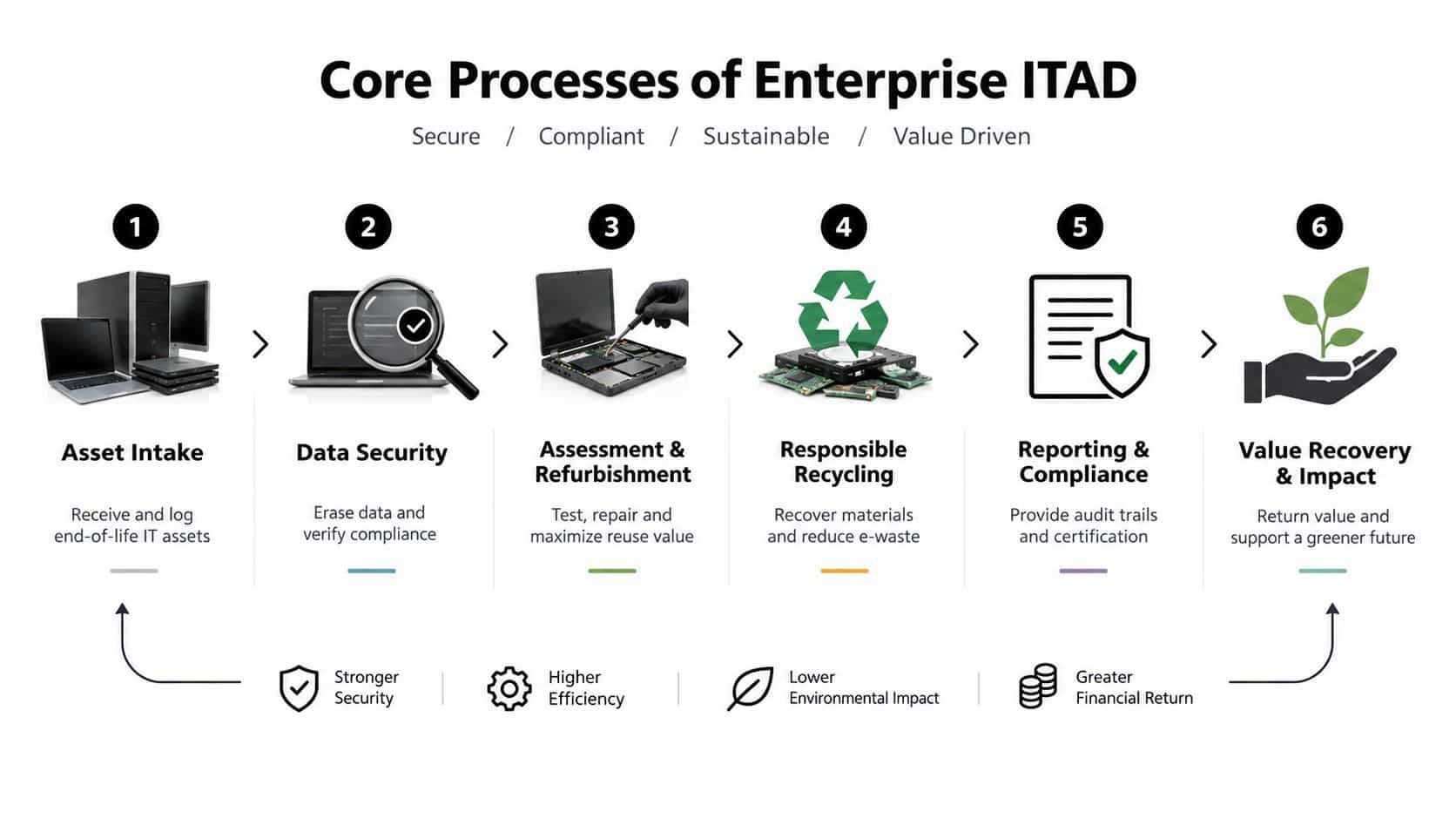
A reliable ITAD program follows a controlled sequence. The exact route varies by asset, but the process should remain visible from pickup through final disposition.
Start with scope and serialized inventory
Before the truck arrives, define the buildings, rooms, equipment categories, access requirements, and expected disposition paths. A serialized inventory should capture manufacturer, model, serial number, asset tag, storage media, condition, and ownership details where available.
That inventory does two jobs. It gives the provider a processing plan, and it gives procurement a baseline for reconciling what left the site against what was ultimately destroyed, resold, reused, or recycled.
Control the physical handoff
Secure pickup begins at the loading dock. Staff should verify the collection team, record the transfer, use appropriate containers, and keep high-risk media separated from ordinary equipment. Transportation controls should preserve the documented path rather than relying on an informal promise that everything will arrive safely.
A complete chain-of-custody process records each handoff, including the asset or controlled lot, responsible party, movement details, and receiving location. If the record stops at pickup, the organization still has an evidence gap.
Sanitize media before choosing the downstream route
Data destruction isn't one universal action. The provider should identify the media type and data sensitivity, then select wiping, purging, or physical destruction according to the required assurance. A device intended for reuse may need a verifiable software process, while failed media or highly sensitive storage may require a stronger route.
After sanitization, the provider evaluates the equipment. Functional systems may enter refurbishment or IT buyback channels. Usable components can be harvested. Non-viable electronics should move through certified e-waste recycling, with downstream records that connect the materials to the original project.
Close the project with evidence
The final package should reconcile the serialized inventory with certificates of data destruction, certificates of recycling, resale or value-recovery records, and exception notes. Procurement teams should be able to answer what happened to each tracked asset without reconstructing the project from emails and spreadsheets.
Navigating Compliance and Data Security Standards
Commercial ITAD turns legal and technical requirements into controlled handling decisions. FTC business guidance requires covered organizations to dispose of consumer report information so it cannot be read or reconstructed. The FTC also recommends software-based wiping for old computers and portable storage devices when reuse is not the objective.
The rule became effective on June 1, 2005, and it still applies to organizations retiring laptops, desktops, servers, and storage media containing sensitive information. Secure disposal belongs in the control environment for personal and consumer report information, not as an informal step after recycling.
Why ordinary deletion fails
Deleting a file, emptying a recycle bin, or running a standard operating-system format can remove visible references while leaving underlying data recoverable. The FTC's guide for protecting personal information explains this distinction and describes wiping as overwriting the entire drive.
The sanitization method must match the media and its next use. The provider should confirm whether a drive is healthy enough for software sanitization, whether the media supports the selected technique, and whether the result was verified. Paper records and mixed destruction streams may require shredding, burning, or pulverizing to prevent reconstruction.
Apply NIST methods to the actual risk
NIST SP 800-88 defines three operational categories. For a practitioner summary, see the NIST SP 800-88 guidelines.
- Clear: Apply logical sanitization when residual risk is acceptable and the media remains suitable for its intended use.
- Purge: Use a stronger process when logical removal does not provide sufficient assurance, while preserving reuse where technically appropriate.
- Destroy: Physically render the media unusable when confidentiality requirements, media condition, or organizational policy demand it.
The choice should reflect data sensitivity, media type, and downstream intent. Wiping and shredding serve different purposes. A procurement specification that says only “data destroyed” leaves execution open to inconsistent interpretation.
Certificates should identify each device by serial number or controlled lot, state the method, identify the technician or facility, include the date, and reference the applicable standard. Those fields connect the disposition decision to audit-ready evidence and make the custody record defensible.
Maximizing Value Recovery Through Remarketing
A retired laptop may still support another employee, while a server may retain resale value after a secure reset. Treating both as waste can destroy financial value and create demand for replacement equipment. The better decision is to preserve reuse potential while keeping data security and custody evidence intact.

Use a disposition decision, not a blanket rule
Assess each asset by function, age, physical condition, configuration, market demand, data risk, and transport economics. That assessment should direct the device to one of four routes:
- Redeploy internally when it meets a business requirement and can be sanitized and reconfigured.
- Remarket or resell when demand exists and testing supports a defensible resale value.
- Harvest components when the complete unit has limited commercial value but usable parts remain.
- Recycle or destroy when damage, obsolescence, contamination, or security requirements rule out reuse.
A device that powers on is not automatically ready for resale. Conversely, leaving its original department does not make destruction the right answer. The decision should connect technical condition, data classification, and expected recovery value.
Industry coverage has described a preference for reuse over recycling because refurbished devices can perform comparably to new equipment in typical work settings. Separate market coverage identifies remarketing as a fast-growing service type. Those trends support reuse, but they do not replace device-level testing or documented custody.
Measure value against risk
Procurement should require transparent grading, testing criteria, market-pricing logic, revenue reconciliation, and exception handling. The enterprise IT asset recovery process should also explain what happens when equipment fails inspection, cannot be identified, or has a lower value than expected. A buyback offer has limited value if the provider cannot show how the amount was calculated and reconcile the final disposition.
The market context is substantial. One estimate placed the global ITAD market at USD 25.31 billion in 2024, projecting USD 54.54 billion by 2030 at a 14.0% CAGR from 2025 to 2030, according to Grand View Research's ITAD market analysis. This market projection does not guarantee equivalent returns for an individual asset portfolio. Recovery depends on condition, demand, testing quality, transport cost, and the provider's downstream controls.
Decision rule: Preserve reuse potential until testing and data classification show that destruction or recycling is the better route.
Vendor Evaluation Checklist for IT Directors
A vendor can sound compliant and still provide weak evidence. During an RFP, ask to see the workflow, sample reports, escalation process, downstream controls, and exception handling before awarding the project.
Evaluate the evidence, not the slogan
The most useful questions are operational. Who accepts the equipment? How are serial numbers captured? Which media receive software sanitization, and which are destroyed? How does the provider reconcile missing, damaged, or unidentifiable assets? Where do recovered materials go after the first processing facility?
Use the following matrix to keep evaluation consistent across vendors:
| Evaluation Criteria | Enterprise Requirement | Red Flag Indicator |
|---|---|---|
| Chain of custody | Serialized tracking from pickup through final disposition, with documented transfers | Provider offers only a pickup receipt |
| Data sanitization | Method selected by media type and data sensitivity, with standard referenced | One method claimed for every device |
| Certificates | Device-level or controlled-lot records showing method, date, facility, and responsible party | Generic certificate without asset identifiers |
| Transportation | Controlled collection, documented handoffs, and defined receiving location | Unclear subcontractor or informal transport process |
| Downstream processing | Named controls for resale, recycling, destruction, and further vendors | Provider cannot explain downstream routing |
| Value recovery | Testing, grading, pricing basis, and reconciliation of proceeds | “Market value” without supporting criteria |
| Cross-border handling | Documented export and consent controls where transboundary movement applies | Vendor treats international shipment as ordinary freight |
Test the downstream chain
The Basel Convention e-waste amendments took effect on January 1, 2025, requiring prior informed consent for transboundary movement of hazardous and non-hazardous e-waste. The business guidance on e-waste laws explains why downstream movement now requires closer attention from organizations managing data center hardware and large electronics streams.
Ask whether the provider exports equipment or materials, which party obtains required consent, and how the shipment is documented. A domestic pickup doesn't guarantee a domestic final outcome.
For a structured review, use this vendor due diligence checklist alongside your information-security, legal, facilities, and procurement stakeholders. The strongest partner is the one whose records remain coherent when an auditor asks for one specific serial number and its complete disposition history.
Beyond Surplus Capabilities for Enterprise Clients
Enterprise projects need more than a place to drop equipment. They need coordinated removal, secure data handling, asset reporting, and defined outcomes for mixed equipment streams. Beyond Surplus operates from the Atlanta area, supports commercial pickups nationwide, and provides services including data center de-installations, IT equipment disposal, medical equipment disposal, product destruction, electronics recycling, data wiping, and hard-drive shredding.

Match the service to the project
A corporate laptop refresh may require serialized collection, certified wiping, and remarketing. A data center decommissioning project may add rack removal, equipment staging, storage-media segregation, and coordinated transportation. Healthcare and laboratory environments can introduce specialized equipment, access procedures, and additional documentation requirements.
The provider's own fleet and transportation partners can support planned logistics, while transparent chain-of-custody records connect the pickup to final processing. Certificates of recycling and data destruction give the client evidence for internal controls and support liability transfer where the service agreement defines it.
Generic e-waste hauling often focuses on removing volume. Enterprise ITAD focuses on what each asset is, who handled it, how its data was treated, and what happened afterward. That difference matters when the project contains servers, laptops, medical devices, laboratory equipment, or products requiring controlled destruction.
For procurement teams, the useful test is whether the provider can support both ordinary equipment disposal and complex programs without forcing every item into one processing route. A practical engagement should define scope, access, inventory expectations, security controls, certificates, value recovery, downstream routing, and exceptions before the first pickup.
Building a Sustainable IT Lifecycle Strategy
A sustainable IT lifecycle strategy starts at acquisition, not at the loading dock. Procurement should capture ownership, serial numbers, warranty status, and retirement requirements in the purchasing record. During use, IT can maintain data-classification tags and condition history, giving the refresh team evidence for reuse, resale, parts recovery, or recycling.
Before funding a refresh, add ITAD terms to the RFP. Require serialized inventory at collection, approved handling locations, documented handoffs, disposition routes matched to data risk, and certificate service-level requirements. Make exceptions explicit, including missing assets, damaged media, leased equipment, and items that cannot be remarketed.
The operating review should connect three measures: recovery value, audit evidence, and environmental outcome. A low-cost vendor that cannot reconcile serials or document downstream processing can create more exposure than savings. A higher-return route is useful only when custody records and data treatment remain verifiable.
Set these requirements across procurement, security, facilities, finance, and sustainability reporting. This turns retirement into a controlled lifecycle decision rather than an end-of-life cleanup.
Contact Beyond Surplus for commercial electronics recycling, secure IT asset disposition, certified data destruction, data center de-installation, and value recovery support. Visit Beyond Surplus to arrange a secure pickup or discuss the disposition plan for your next enterprise technology refresh.


