
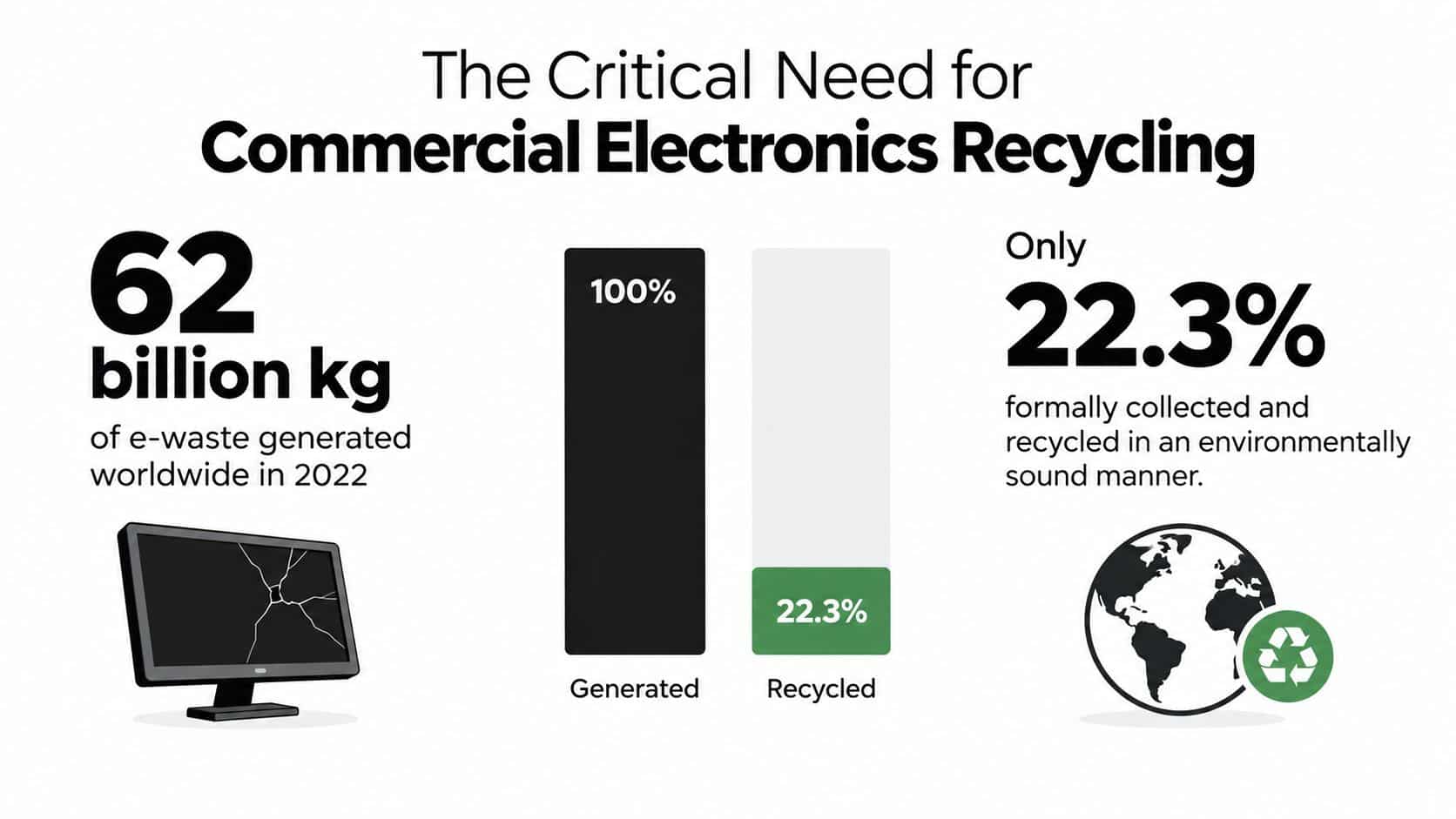
In 2022, only 22.3% of the world's 62 billion kilograms of e-waste was formally collected and recycled. Certified commercial electronics recycling gives businesses a controlled way to protect data, manage compliance exposure, recover usable value, and keep retired equipment out of informal disposal streams.
For an enterprise, the question isn't where old computers go. It's whether every device is inventoried, transported securely, sanitized or destroyed appropriately, processed through accountable downstream channels, and supported by documentation that stands up to procurement, security, and environmental review.
Table of Contents
- The Critical Need for Commercial Electronics Recycling
- Understanding the Commercial Electronics Recycling Process
- Service Models and Logistics for Enterprise Disposal
- Compliance, Certification, and Data Security Standards
- Workflows for Different Industry Types
- Vendor Selection and RFP Essentials
- Maximizing Value and Ensuring Secure Disposal
The Critical Need for Commercial Electronics Recycling
The global gap is too large for businesses to treat electronics disposal as an occasional facilities task. The Global E-waste Monitor 2024 records 62 billion kilograms of e-waste generated in 2022, compared with 34 billion kilograms in 2010. Formal recycling grew from 8 billion kilograms to 13.8 billion kilograms over the same period, but that increase didn't keep pace with the expansion of the electronics market and shorter replacement cycles.
For business buyers, this is an operational risk as much as an environmental concern. Retired laptops, servers, storage arrays, monitors, printers, medical devices, laboratory equipment, and networking hardware can contain recoverable materials, data-bearing media, batteries, and components requiring controlled handling. A dumpster pickup doesn't provide the same accountability as a documented IT asset disposition program.
Formal recycling in 2022 avoided extraction of 900 million tonnes of primary ore and prevented 93 million tonnes of CO2-equivalent emissions, according to data summarized by Human-I-T's overview of recycling, donation, and resale. Those outcomes depend on equipment reaching appropriate recovery channels rather than being abandoned, exported without sufficient controls, or mixed with general waste.
Recycling is part of risk management
A commercial program should connect four decisions:
- Data disposition: Determine whether storage media requires verified wiping or physical destruction.
- Asset recovery: Identify equipment that can be reused, resold, or harvested for parts.
- Material processing: Separate electronics, batteries, displays, and specialty equipment for appropriate downstream handling.
- Evidence: Retain pickup records, chain-of-custody information, certificates, and final disposition reports.
Businesses that manage these decisions together get more than a waste receipt. They create a repeatable process for office refreshes, data center closures, mergers, lease returns, and product destruction projects. The commercial recycling and carbon reduction guidance provides useful context for connecting material recovery with broader sustainability planning.
Understanding the Commercial Electronics Recycling Process
A reliable workflow starts before the truck arrives. IT, facilities, security, and procurement teams should agree on what is being retired, which equipment contains data, what may retain resale value, and what documentation the organization needs.
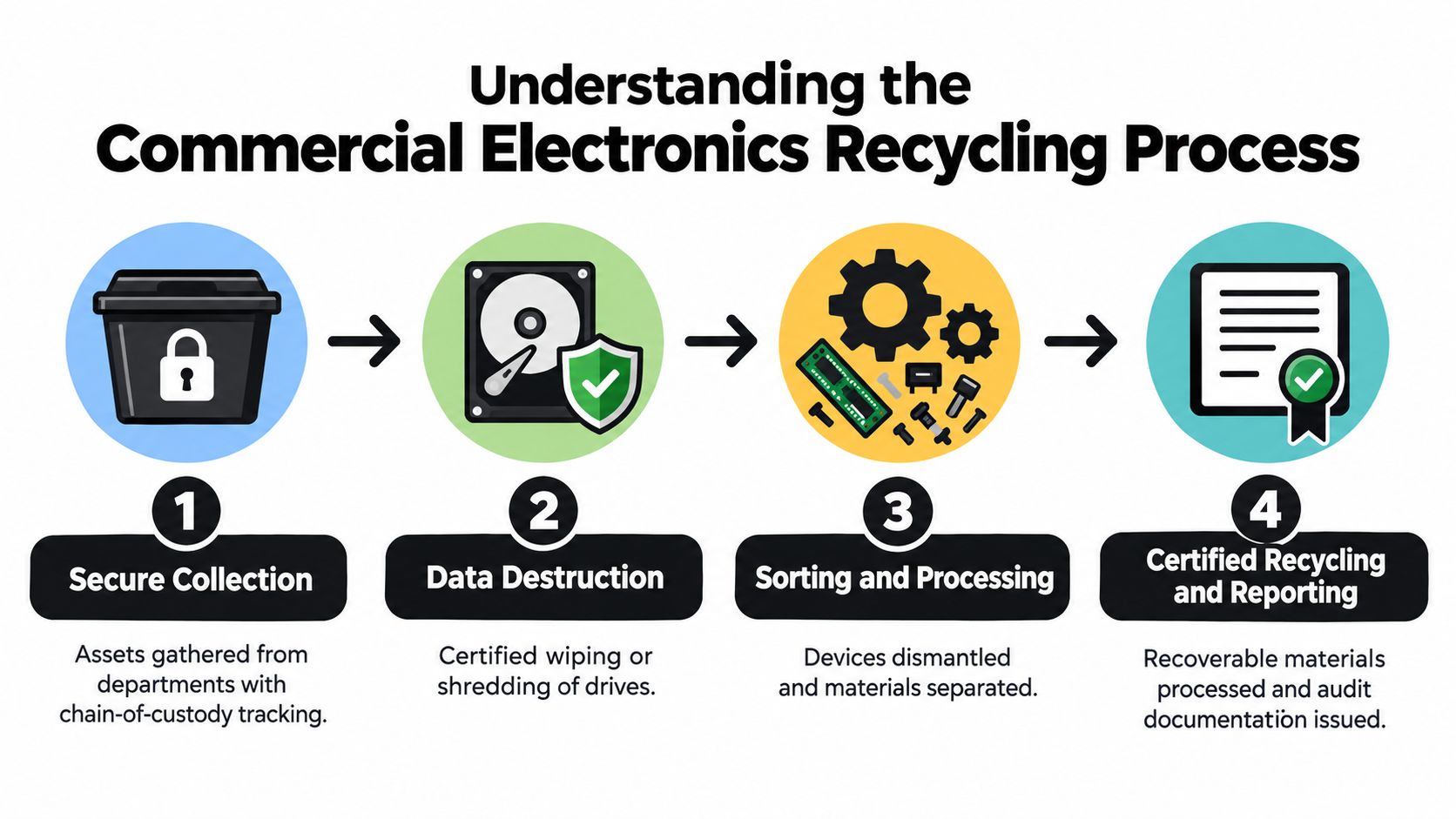
1. Collection and inventory
Start with an inventory that matches the project risk. A mixed office cleanout may need category counts, while a server retirement may require serial numbers, asset tags, drive identifiers, and rack locations. Keep laptops, desktops, servers, drives, mobile devices, displays, batteries, printers, and loose accessories reasonably separated.
Use a controlled staging area with restricted access. Seal containers where appropriate, label them by site or department, and document the handoff to the carrier or recycling provider. If multiple facilities are involved, assign an internal owner who can reconcile equipment leaving each location.
2. Transport and chain of custody
Transport is part of data security. Ask who collects the equipment, how loads are secured, where assets are taken, and whether the provider uses approved downstream processors. High-value IT hardware should not sit unattended in an open loading area or move through an undocumented series of third parties.
The documentation should identify the pickup date, originating location, material categories, responsible parties, and any exceptions. Businesses arranging recurring commercial electronics pickup should establish the records once and apply them consistently to every collection.
3. Data destruction and processing
Data-bearing equipment needs a separate disposition decision. Verified wiping can support reuse when a device is functional and the organization permits that method. Physical destruction is more appropriate for failed media, equipment that can't be accessed reliably, or assets subject to stricter internal controls.
After sanitization or destruction, processors sort equipment for reuse, parts recovery, dismantling, and material recycling. Don't accept a broad sustainability statement as proof of performance. Ask what happens to mixed streams, batteries, non-reusable parts, and material sent to downstream facilities. Teams responsible for facilities programs may also benefit from this practical resource on managing vendor waste contracts, particularly when several waste vendors share responsibility across a portfolio.
4. Reporting and final disposition
The final file should connect the original asset or controlled lot to its outcome. Depending on the project, that may include certificates of data destruction, certificates of recycling, resale or recovery reports, and an exception log.
A certificate matters most when it reflects a traceable process. It shouldn't be the only question asked. Procurement teams should also evaluate downstream accountability, recovery performance, and whether the vendor can explain what happens to material that isn't reused.
Service Models and Logistics for Enterprise Disposal
No single service model fits every retirement project. A data center shutdown, a distributed laptop refresh, and a small laboratory cleanout have different access, security, labor, and transportation requirements.
On-site destruction
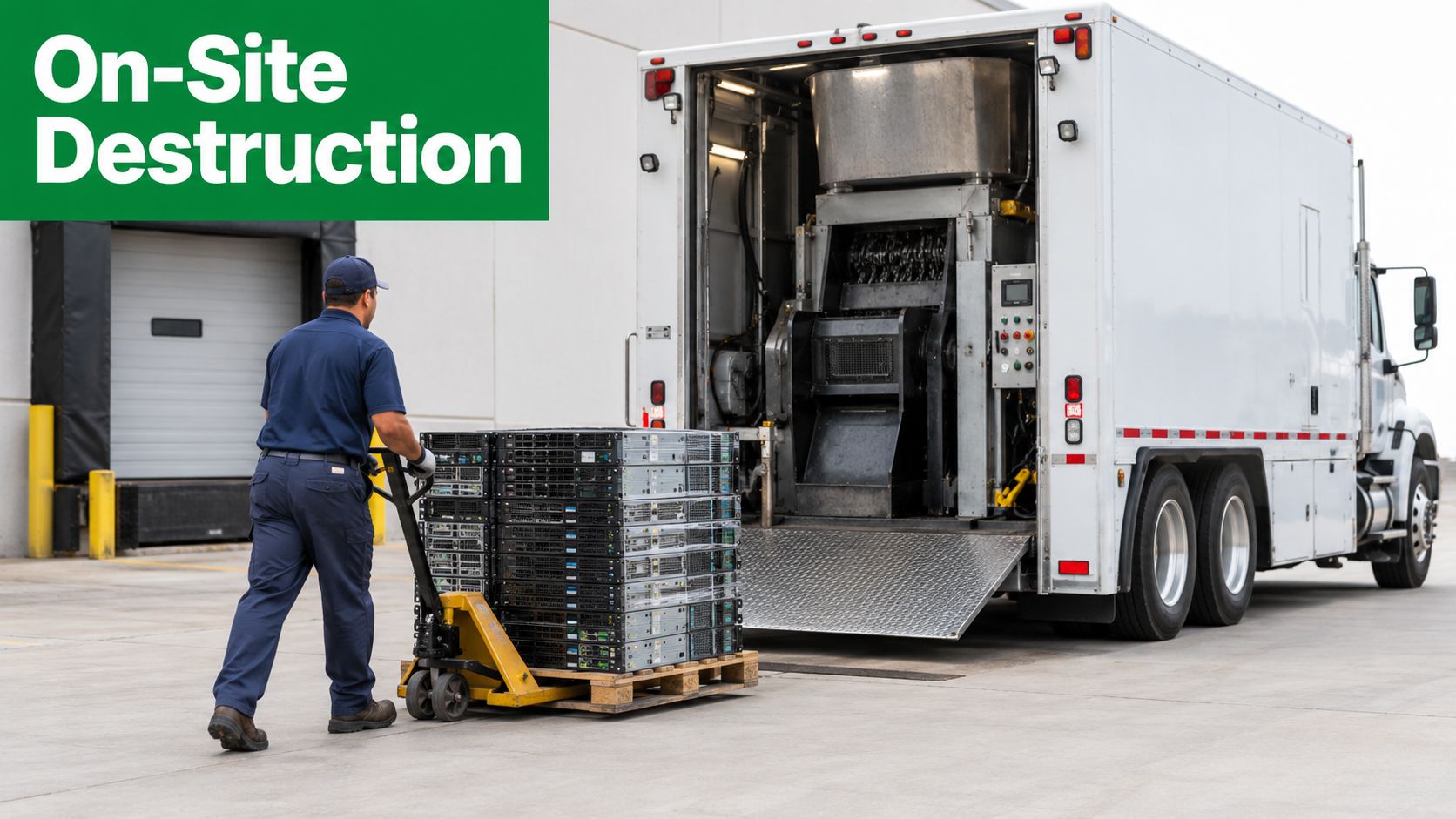
On-site shredding brings destruction equipment to the facility. It works well when the organization wants staff to witness the process, when storage media is highly sensitive, or when removing drives before destruction would disrupt the decommissioning schedule.
The trade-off is logistical. The site needs suitable access, staging space, safety controls, and enough material to justify mobilization. On-site destruction also doesn't eliminate the need for inventory or recycling. Shredded material still needs documented downstream processing.
Off-site processing
Off-site service moves equipment to a secure processing facility, where trained staff can wipe, shred, test, dismantle, and sort assets using established workflows. This option often suits larger mixed loads and projects where the client doesn't have space for industrial equipment.
The buyer should verify how custody is maintained between pickup and processing. Ask whether drives are destroyed on arrival, whether reusable equipment is isolated, and how the facility records exceptions. The business electronics pickup service guide can help teams assess the practical requirements before scheduling.
Scheduled pickup, mail-in, or drop-off
Scheduled commercial pickup is usually the most efficient choice for pallets, racks, office fleets, and multi-site projects. It allows the provider to plan labor, loading equipment, vehicle capacity, and any special handling.
Mail-in or drop-off can work for small, well-defined quantities, but the organization still needs secure packaging, asset records, and a clear data-destruction plan. These channels are less suitable for servers, heavy medical equipment, large printers, or a distributed enterprise refresh.
Practical rule: Choose the service model based on data sensitivity, volume, access conditions, and reporting needs, not simply the advertised pickup price.
Compliance, Certification, and Data Security Standards
Commercial disposal has two connected control objectives: protect information and manage materials responsibly. A vendor that addresses only one creates an incomplete solution.
The FTC Disposal Rule guidance for business technology disposal states that businesses using consumer reports for a business purpose must take reasonable measures so consumer information can't be read or reconstructed after disposal. The rule became effective on June 1, 2005. For electronics programs, that principle supports documented sanitization or destruction rather than ordinary disposal.
Build a defensible data file
A practical record should connect each device, serial number, or controlled lot to:
- Disposition method: Record whether the media was wiped, shredded, or handled through another approved method.
- Responsible party: Identify the facility or technician responsible for the work.
- Timing: Retain the relevant pickup, processing, and destruction dates.
- Outcome: Document whether the asset was reused, resold, dismantled, or recycled.
- Chain of custody: Keep transfer records and certificates with the project file.
The method should match the media. Hard disk drives and solid-state drives don't always respond to the same process, particularly when a device is damaged or cannot be powered on. Organizations should define acceptable methods before the equipment leaves their control. Their internal security policy may require more than a basic reset.
Use certification as a procurement control
The EPA identifies R2 and e-Stewards as the two accredited electronics recycling certification standards in the United States. It recommends certified electronics recyclers because independent third parties audit them against specific standards for safe electronics management.
Certification isn't a substitute for due diligence, but it gives procurement teams a meaningful baseline. Ask for current certification details, scope, processing locations, downstream controls, and documentation samples. A vendor should be able to explain how certification connects to the actual equipment in your project.
For teams formalizing wiping requirements, the NIST SP 800-88 resource can help frame discussions about media sanitization. The strongest program links security requirements, environmental controls, vendor certification, and evidence retention in one workflow.
Workflows for Different Industry Types
The same pickup process won't work equally well for a cloud infrastructure team, a hospital, a school district, or a manufacturer. The equipment may overlap, but the risks, approval paths, and timing constraints differ.
Data centers and cloud infrastructure
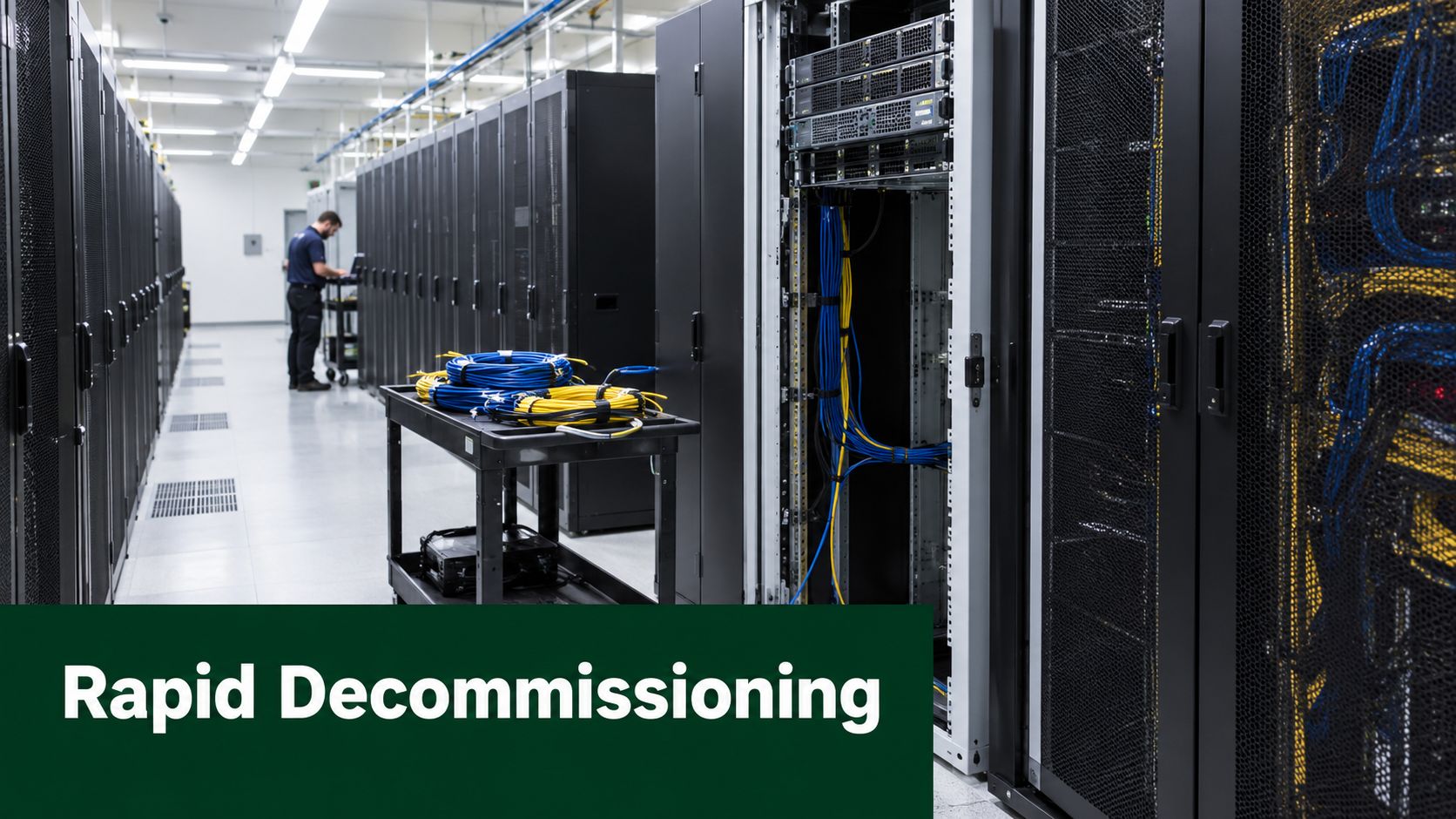
A data center decommissioning project should begin with a rack-level plan. Identify servers, storage arrays, network devices, rails, power distribution equipment, and drives before disconnecting anything. Record the relationship between each asset and its location so the team can reconcile what was removed.
The critical decision is whether media will be wiped in place, removed for physical destruction, or transported intact to a secure facility. A staged shutdown, controlled loading path, and signed handoff reduce confusion when hundreds of components move through the same project.
Healthcare and medical equipment
Healthcare organizations need a device-by-device review because medical equipment may combine electronics, storage, batteries, displays, and patient-related information. That includes diagnostic systems, workstations, printers, mobile carts, and network-connected devices.
The disposition plan should identify who approves data handling, which equipment can be reused, and what documentation the organization requires. Medical equipment disposal may also involve manufacturer requirements, service contracts, specialized components, or restrictions on moving certain devices. Keep those decisions in the project file rather than leaving them to a pickup crew.
Schools, universities, and laboratories
Educational institutions often manage equipment across classrooms, libraries, labs, offices, and research facilities. A central inventory and scheduled collection cycle can prevent devices from being abandoned in separate buildings.
Laboratory equipment needs an additional screening step. Separate electronics from chemicals, unknown liquids, biological materials, and other streams that require different handling. Computers and instruments with storage media should follow the approved data workflow, while reusable equipment can be evaluated before material recovery.
Manufacturers and product owners
Manufacturers may need product destruction for defective units, obsolete inventory, prototypes, returns, or recalled products. The requirement isn't only to recycle the material. It may also involve confirming that branded products, components, labels, or confidential designs cannot re-enter the market.
Use controlled lots, photographs where appropriate, destruction instructions, and a final report that records the outcome. Product destruction should be treated as a secure logistics project, not an ordinary scrap pickup.
Vendor Selection and RFP Essentials
A strong RFP makes vendor comparison possible. It should describe the equipment categories, locations, approximate volume, access conditions, data requirements, desired value recovery, and documentation standards. Avoid asking only for a price per pickup. That approach hides the operational differences between a broker, a hauler, a recycler, and a full ITAD provider.
Specify the service requirements
Include questions that force precise answers:
- Certification: Which locations hold R2 or e-Stewards certification, and what activities does the certification cover?
- Data handling: Does the provider offer verified wiping, physical shredding, or both? How does it handle failed drives and solid-state media?
- Chain of custody: What records are created at pickup, transport, intake, destruction, and final disposition?
- Downstream control: Which processors receive non-reusable material, and how does the vendor evaluate them?
- Value recovery: How are reusable laptops, servers, network equipment, and mobile devices tested, graded, and priced?
- Exceptions: What happens to batteries, medical equipment, laboratory equipment, printers, and oversized assets?
- Reporting: Can the provider issue serialized certificates, recycling documentation, recovery reports, and exception records?
For public-sector procurement, a government RFP database can help teams monitor relevant opportunities and compare how agencies describe disposal, security, and recycling requirements.
Test the evidence before award
Request sample certificates, a sample chain-of-custody record, downstream policy documents, insurance information, and current certification evidence. Ask the vendor to walk through one asset from pickup to final disposition. If the answer skips intake controls or becomes vague around overseas processing, ask follow-up questions.
The vendor due diligence checklist can help procurement, security, and facilities teams standardize this review. The provider should also disclose what it can't accept, which services incur additional charges, and how it handles equipment that arrives in a different condition than described.
Maximizing Value and Ensuring Secure Disposal
Commercial electronics recycling works best when it treats every asset according to its condition and risk. A functional laptop may be suitable for reuse after verified sanitization. A failed server drive may require physical destruction. A damaged monitor, battery, or obsolete cable may have no practical resale path but still needs responsible material processing.
That separation protects value without weakening security. It also gives finance, IT, facilities, and sustainability teams a shared record of what happened. The useful questions aren't only “How much did we receive?” or “Was the equipment recycled?” They're “Was the data handled as required, was the asset evaluated fairly, and can we prove the final outcome?”
Ask vendors to report recovery performance across the whole stream, including material that cannot be reused. A certificate is useful, but it should sit alongside chain-of-custody records, processing details, and documented exceptions. That combination supports audit readiness and helps teams identify where future projects can improve.
A proactive program also reduces emergency work. Schedule disposition around refreshes, office moves, data center closures, lease returns, and product changes. Separate data-bearing assets early, protect batteries and specialty equipment, and choose a provider capable of coordinating pickup, destruction, recovery, and recycling under one documented plan.
Use Beyond Surplus for commercial electronics recycling, secure data wiping or hard drive shredding, IT equipment disposal, product destruction, and data center decommissioning support. Request a project assessment with your equipment categories, locations, security requirements, and documentation needs so your organization can retire technology with controlled logistics and accountable final disposition.


