An Atlanta agency retires a batch of laptops, servers, and multifunction printers. The IT team deletes files, loads the equipment for pickup, and files a basic recycling receipt. Months later, an auditor asks a simple question: which assets were sanitized, by what method, who handled them, and where did the materials go? If the answer is incomplete, the agency has a governance problem, not just a paperwork problem.
Government electronics recycling in Atlanta must connect data destruction, chain of custody, and environmental accountability in one controlled process. Secure IT asset disposal isn't complete when a truck leaves the loading dock, and a certificate alone doesn't prove that every required control worked.
Table of Contents
- Why Secure ITAD Matters for Atlanta Government Agencies
- Steps for Compliant Electronics Recycling and IT Asset Disposal
- Understanding NIST 800-88 Media Sanitization Standards
- On-Site Versus Off-Site Data Destruction Options
- How to Select a Certified Electronics Recycling Vendor
- Integrating Value Recovery with Compliance and Sustainability
Why Secure ITAD Matters for Atlanta Government Agencies
A public agency can retire equipment responsibly and still fail an audit if it can't reconstruct what happened to the data-bearing assets. The FTC Disposal Rule became effective on June 1, 2005, under the Fair and Accurate Credit Transactions Act of 2003. It applies to large and small organizations that use consumer reports or information derived from them, including government agencies and service providers. The rule requires reasonable measures to prevent unauthorized access or use, including destroying or erasing electronic files and media so information can't be read or reconstructed. The FTC's disposal guidance also treats the sale, donation, transfer, or abandonment of equipment containing consumer information as disposal.
That scope matters in Atlanta. Retired laptops may contain personnel or applicant information. Servers can hold tax, student, public-record, or law-enforcement data. Printers and multifunction devices may retain documents on internal storage. Normal deletion doesn't establish that the information became inaccessible.
The audit record matters as much as the physical outcome
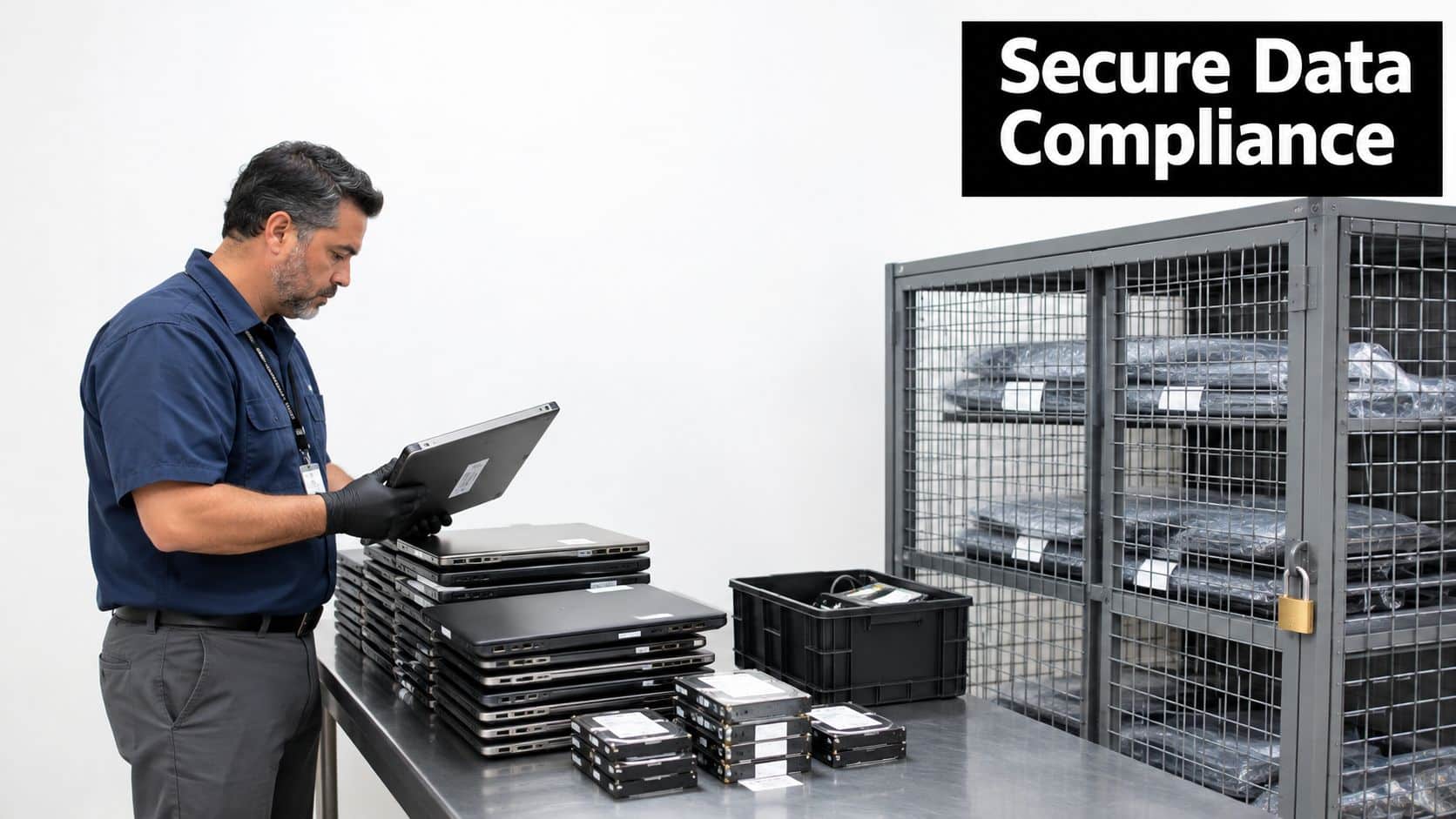
A defensible ITAD file should identify the asset, media type, sanitization or destruction method, authorization, verification result, exceptions, custody transfers, and final disposition. A certificate of destruction is useful evidence, but it isn't the entire control record. Procurement language, processor work instructions, destruction reports, and downstream documentation must tell the same story.
The environmental side belongs in that story. An agency shouldn't prove that a drive was destroyed while ignoring where the remaining equipment, batteries, mercury-containing components, and recovered materials went. Teams managing complex facilities may also find practical value in reliability consulting for Southeast plants when coordinating equipment retirement with broader operational risk controls.
Practical rule: Treat every retired device as both a potential data container and a regulated material stream until documented assessment proves otherwise.
Atlanta agencies should select a secure electronics recycling partner as a governance decision. The right provider supports confidentiality, accountable logistics, documented destruction, responsible recycling, and evidence an auditor can independently review.
Steps for Compliant Electronics Recycling and IT Asset Disposal
A compliant workflow starts before equipment leaves the agency. Government buyers should require a process that preserves identity and accountability from intake through final disposition.
Build the record before moving the equipment
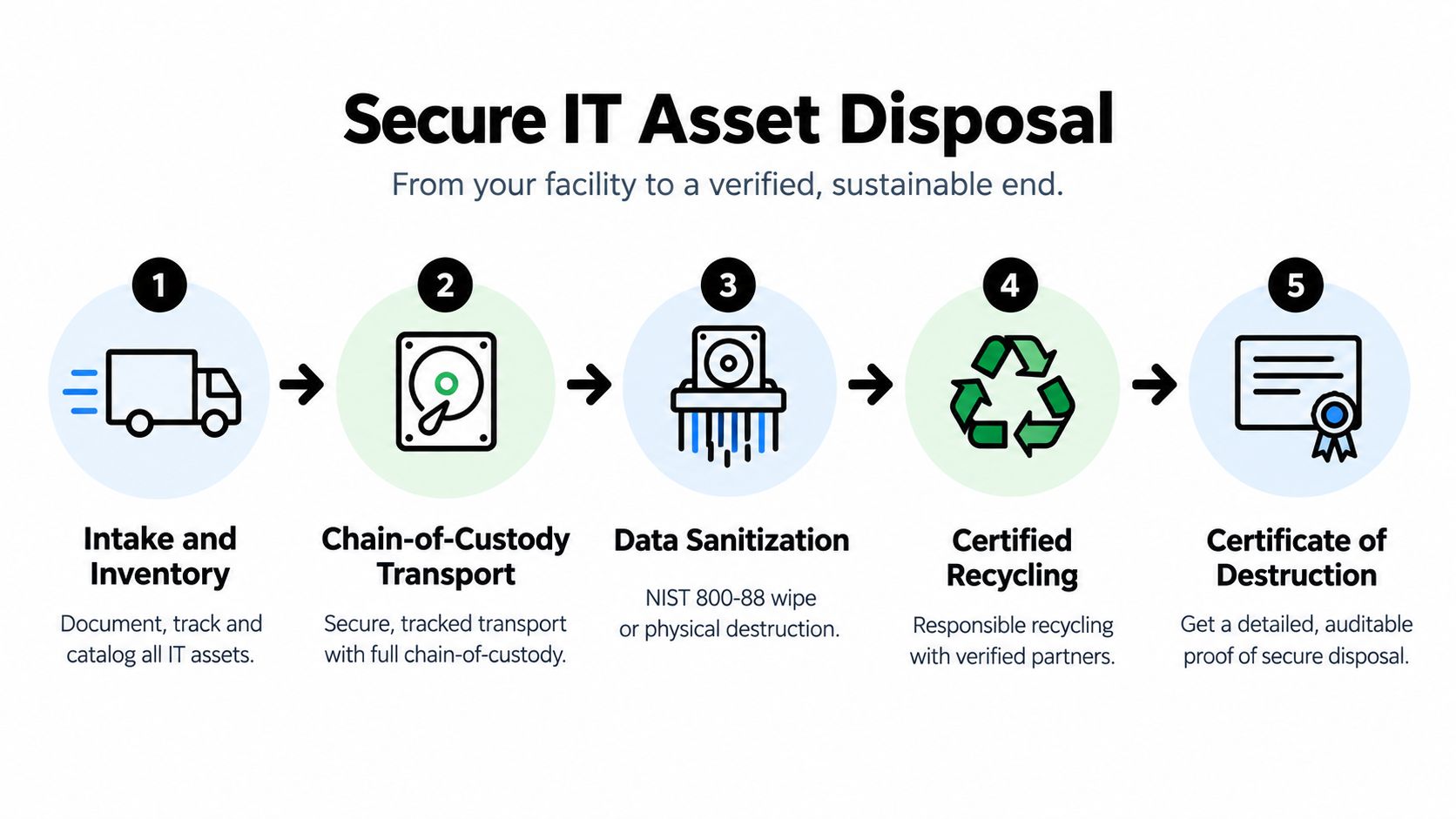
Inventory and classify. Record asset identifiers, serial numbers, equipment type, storage media, condition, location, owner, and data sensitivity. Separate hard disk drives, solid-state drives, removable media, failed devices, encrypted equipment, servers, medical technology, and data-center hardware. A failed drive still requires a deliberate disposition decision.
Approve the method. Match Clear, Purge, or Destroy to the media, sensitivity, failure condition, and reuse objective. Don't allow a processor to apply one wiping method to every device without documenting why it is appropriate.
Control transport. Use scheduled pickup, sealed loads where appropriate, authorized personnel, timestamped handoffs, and a custody log. The record should show who accepted the assets, when they changed hands, and where they went. For Atlanta electronics recycling services, transportation controls are part of the security process, not a separate logistics detail.
Verify the work, then document final disposition
Sanitize or destroy under controlled procedures. Request work instructions that identify the approved technique, equipment, operator controls, and exception handling. If a device can't be sanitized reliably, physical destruction may be the appropriate outcome.
Reconcile and report. Require method verification, validation results, destruction reports, certificates, material disposition records, and a reconciliation between the original inventory and final output. A certificate should identify what was processed and how, not merely state that a service occurred.
Agencies can use Beyond Surplus electronics recycling pickup services as one possible logistics reference when evaluating pickup, transportation, and reporting requirements. The procurement team should still verify the provider's current procedures, subcontractors, downstream facilities, and contract language.
The critical question isn't whether a vendor issues a certificate. It's whether the complete file demonstrates that the agency authorized the method, maintained custody, verified the result, and connected secure destruction to responsible recycling.
Understanding NIST 800-88 Media Sanitization Standards
NIST Special Publication 800-88 provides the framework government agencies use to choose and document media sanitization. The original publication was finalized on September 1, 2006, and Revision 1 was published on December 17, 2014. NIST finalized Revision 2 on September 26, 2025, replacing Revision 1 and placing greater emphasis on enterprise-wide sanitization programs, confidentiality governance, validation, vendor trust, and risk-based decisions. NIST's Revision 2 publication is the current reference point for policy and contract updates.
The framework retains three primary methods.
Clear, Purge, and Destroy serve different outcomes
- Clear uses logical techniques, such as standard read and write commands or factory-reset functions, to address user-accessible storage locations. It protects against simple, non-invasive recovery, but agencies shouldn't assume it meets every risk profile.
- Purge uses physical or logical techniques intended to make recovery infeasible with state-of-the-art laboratory methods while potentially preserving the device for reuse. The selected technique must account for the media type and implementation controls.
- Destroy makes recovery infeasible and leaves the media unusable for storage. Physical approaches recognized by NIST include disintegration, incineration, pulverizing, shredding, and melting. NIST's media-sanitization guidance explains the distinction.
Deleting files or reformatting a drive isn't automatically sanitization. For an agency that requires Purge or Destroy, those actions may leave an unacceptable recovery path. Solid-state drives, failed media, removable storage, and encrypted devices also need method-specific decisions.
Revision 2 changes the procurement conversation
Revision 2 moves the focus away from buying a tool and toward operating a controlled program. Agencies should define policy, identify responsible owners, approve methods, validate outcomes, manage exceptions, and assess vendor implementation. Cryptographic erase receives expanded treatment, including key sanitization and zeroization, but its suitability depends on the device, encryption architecture, key management, and evidence available.
Use NIST 800-88 data destruction standards explained as a practical orientation, then update agency policies and contracts against the current NIST publication. A processor that still cites only withdrawn Revision 1 should explain its transition plan, revised work instructions, certificate fields, and validation records.
On-Site Versus Off-Site Data Destruction Options
On-site destruction gives an agency direct visibility. A mobile unit can destroy selected hard drives or solid-state media at the facility, allowing authorized staff to witness the event and reducing the time sensitive assets remain in transit. This option fits high-sensitivity devices, urgent projects, or sites with strict custody requirements.
Off-site destruction moves equipment to a controlled processing facility. It can support larger mixed-equipment projects, centralized processing, reuse evaluation, and material recovery. The trade-off is straightforward: transportation introduces another custody stage, so the agency must demand documented handoffs and facility-level reporting.
Choose based on risk, condition, and objective
| Criteria | On-Site Destruction | Off-Site Destruction |
|---|---|---|
| Data sensitivity | Strong fit for media requiring witnessed physical destruction | Appropriate when transport controls and facility security meet the risk requirement |
| Equipment volume | Practical for selected high-risk media | Efficient for consolidated equipment streams and larger inventories |
| Reuse objective | Physical destruction eliminates storage reuse for the destroyed media | Enables assessment for sanitization, reuse, resale, or recycling before final disposition |
| Logistics | Limits transport exposure but requires site access and scheduling | Requires verified custody, secure transport, and receiving controls |
| Audit evidence | Supports witnessed destruction records and immediate confirmation | Supports facility reports, method validation, downstream records, and certificates |
| Media condition | Useful for failed or unsanitizable drives | Useful when centralized equipment and specialized processing are required |
Physical shredding reduces data-recovery risk but also eliminates reuse value for the destroyed media. That decision should be deliberate, not automatic. Agencies should assess sensitivity, media technology, failure condition, operational constraints, and whether redeployment or value recovery is an approved objective.
The on-site versus off-site ITAD services comparison can help procurement teams frame the decision. The contract should specify the chosen pathway, custody controls, verification requirements, destruction evidence, and environmental disposition records.
How to Select a Certified Electronics Recycling Vendor
Vendor qualification must go beyond accepting obsolete equipment and printing a certificate. Ask for the documents that prove how the processor manages both information risk and material risk.
A national audit reported that only 51.6% of 31 EPA RCRA-registered electronics recyclers reviewed across 18 states had clean Significant Non-Compliance status in EPA ECHO records, according to the reported audit findings. This result doesn't establish the performance of Atlanta-area processors. It does establish why registration alone isn't enough.

Require evidence for downstream control
A serious procurement review should request:
- Regulatory records: Applicable permits, recent regulatory-status checks, and the identities of downstream facilities.
- Material accountability: Disposition records showing what happened to equipment, components, batteries, mercury-containing equipment, and damaged lithium-ion batteries.
- Data controls: Sanitization procedures, method-selection logic, validation practices, exception handling, and destruction-equipment controls.
- Custody evidence: Timestamped pickup records, receiving logs, transfer records, inventory reconciliation, and authorized personnel information.
- Contract alignment: Work instructions, certificates, destruction reports, and procurement language updated for NIST Revision 2 where applicable.
- Export oversight: Controls that address downstream movement, export restrictions, and the agency's approval requirements.
A certificate should identify the assets, method, date, facility, and responsible party. It shouldn't replace the supporting record. The agency must be able to show why the method was selected and verify that the physical and environmental outcomes match the contract.
Use this step-by-step guide to choosing an ITAD vendor in Georgia to structure an initial review. Then require references, sample reports, subcontractor disclosures, and an explanation of how the vendor handles exceptions. A provider that can't explain failed drives, mismatched serial numbers, or damaged batteries before award will create avoidable risk after award.
Integrating Value Recovery with Compliance and Sustainability
Secure ITAD shouldn't force an agency to choose between control and recovery. The stronger approach separates assets by condition, data risk, and material pathway, then documents every decision. Reusable laptops and networking equipment may follow a validated sanitization and resale route. Failed storage media may require destruction. Servers from a data-center decommissioning project may need staged removal, inventory reconciliation, component recovery, and controlled recycling.
That structure protects value without treating resale as the default. Physical destruction is appropriate when the risk assessment requires it, but destroying every device can discard useful equipment and increase processing demands. Conversely, sending equipment into a resale stream without validated sanitization transfers unacceptable risk to the agency and its downstream parties.
Use one disposition plan for three obligations
A practical government disposition plan should connect:
- Confidentiality. Identify data-bearing media, assign the approved NIST method, validate the outcome, and retain evidence.
- Operational control. Coordinate shutdowns, de-installations, pickups, transport, custody transfers, and exception approvals without losing asset identity.
- Environmental accountability. Verify permits, downstream facilities, material destinations, battery handling, mercury controls, and export requirements.
This combined approach improves procurement clarity. The statement of work should require an asset-level inventory, approved method fields, custody timestamps, verification results, exceptions, certificates, and final material disposition. It should also state whether the agency permits resale, component harvesting, refurbishment, or only destruction for defined asset classes.
Beyond Surplus is one Atlanta-based option for organizations evaluating these requirements. Its services include secure data wiping, on-site and off-site hard-drive shredding, electronics recycling, IT equipment disposal, product destruction, data-center de-installations, logistics coordination, certificates of recycling and data destruction, and IT asset recovery. For agencies considering recovery pathways, IT asset recovery in Atlanta provides a relevant service reference.
Make the final report audit-ready
The final package should allow an auditor, records officer, inspector general, or procurement reviewer to trace the project without relying on verbal explanations. Include the original inventory, approved disposition decisions, transport records, receiving confirmation, sanitization or destruction evidence, exception approvals, certificates, downstream documentation, and reconciliation.
For Atlanta agencies, local pickup can simplify facility coordination, while nationwide transportation may support distributed departments or multi-site programs. The service geography matters less than consistent controls. Every location should use the same asset fields, custody expectations, method logic, and reporting standards.
Sustainability also requires more than a recycling logo. Ask where materials went, which downstream processors handled them, how batteries and hazardous components were managed, and whether the processor can produce records supporting those answers. Environmental responsibility becomes credible when the agency can independently review the path from collection to final disposition.
The best secure electronics recycling program is therefore not a one-time truck service. It's a repeatable lifecycle control that protects information, preserves eligible recovery value, supports responsible material processing, and leaves an evidence trail strong enough for scrutiny.
Beyond Surplus provides Atlanta-area and nationwide business ITAD support, including secure data destruction, electronics recycling, asset recovery, data-center de-installation, logistics, and certification packages. Visit Beyond Surplus to discuss an audit-ready disposal plan for government equipment and retired technology.