A recalled laptop, power bank, or medical device isn't ordinary e-waste waiting for a routine pickup. It's a fire-control and custody problem first, and a recycling problem second. That order matters because a damaged or defective lithium-ion cell can fail in a cage, on a dock, or inside a truck long before a recycler recovers any material.
For facility and IT managers, recalled battery device disposal services should therefore start with triage, segregation, and records. If your team can't show what condition each unit arrived in, how it was packed, who carried it, and where it ended up, you don't have a defensible program. You have a pile of hazardous inventory and a hope that nothing gets hot.
Table of Contents
- Sort Recalled Devices by Condition at Intake
- Contain Swollen, Hot or Smoking Batteries on Site
- Choose the Right Disposal Route
- Segregate, Package and Ship Recalled Batteries
- Vendor Documentation and Chain of Custody
- Certify Data Destruction Separately from Battery Custody
- Schedule a Compliant Pickup for Recalled Inventory
Sort Recalled Devices by Condition at Intake
Condition decides routing. That's the rule your intake team should apply before any recalled device moves, gets stacked, or joins a general electronics load.
The scale makes casual handling hard to justify. CPSC recall data shows battery actions covering thousands of devices in a single year, and sometimes well into the millions. A provider that can handle ten laptops may not be ready for a multi-site recall involving thousands of units.
The CPSC battery standards page identifies overheating, fire, electrical shock, thermal burns, electrolyte exposure, and ejected internal components among the potential hazards associated with batteries and chargers. Those hazards don't switch off when a device reaches your loading dock. Storage, charging, transport, and processing can all trigger a failure.
The Triage Table Your Team Should Post at Intake
| Condition | Visible signs | Routing decision | Packaging starting point |
|---|---|---|---|
| Intact recalled device | Undamaged casing, no swelling, recall notice matches the model | Segregated recall stream | Isolate terminals, bag individually, keep labels legible |
| Loose recalled battery | Battery removed from device, terminals exposed | Recall stream with hazmat packaging | One battery per nonmetallic inner package |
| Swollen or bulging | Casing expanded, warped or cracked | Quarantine and escalate to specialist | Specialist review before any packing |
| Hot, leaking or smoking | Heat, electrolyte odor, vapor or hissing | Emergency response, do not move | Hazmat specialist and fire services |
| Crushed or punctured | Dented, pierced or deformed casing | Quarantine and escalate to specialist | Specialist packaging with protected terminals |
Read the rows as decisions, not descriptions. An intact recalled device still leaves the normal IT asset disposition stream, but it can move under controlled recall handling. A loose recalled battery needs terminal protection immediately, because exposed contacts can short against metal, tools, or another battery.
A swollen or crushed unit doesn't get faster handling to clear the dock. It gets quarantine and specialist review, which means a marked-off holding area and a phone call, not a packing station. A hot, leaking, or smoking unit is an emergency, and nobody should be touching it.
A recall notice confirms status. It doesn't reduce the hazard of a damaged cell.
Staff can check recall status against the CPSC recalls portal, the source federal transport guidance directs shippers to consult when determining whether a battery has been recalled. Record manufacturer, model, serial number, and recall identifier for every unit at intake, whether it arrives at a front desk, warehouse, school, hospital, or data center.
Don't let one site tape and bag units while another throws them into a gaylord with keyboards and cables. The table only works if every location applies it the same way, every time.
Contain Swollen, Hot or Smoking Batteries on Site
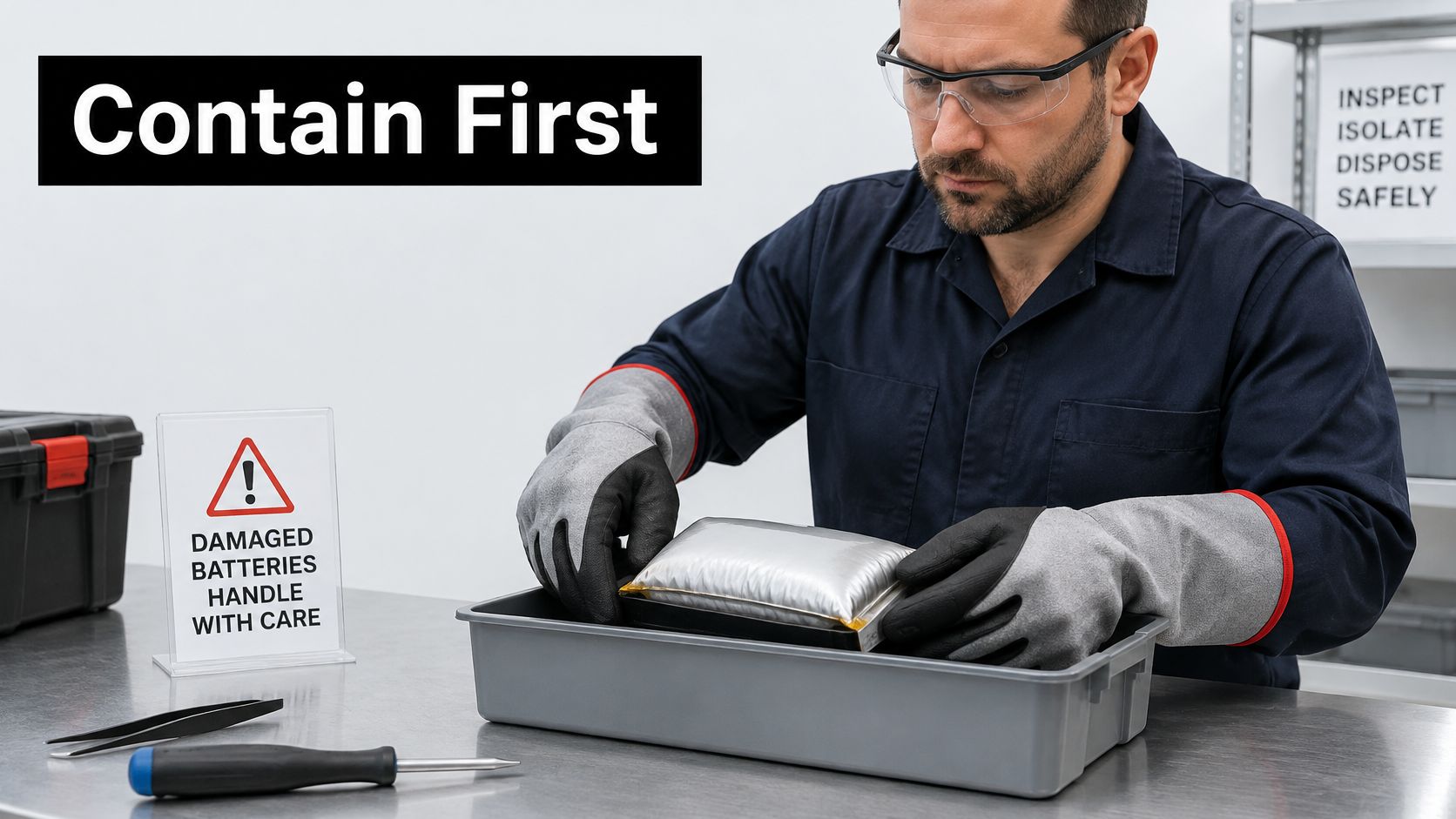
Contain first. Dispose later.
When a unit is swollen, hot, leaking, smoking, or hissing, OSHA's lithium-ion battery safety guidance says a damaged battery or device should be removed from service immediately, isolated from flammable materials, and placed in a fire-resistant container such as a metal drum with sand or another extinguishing agent. OSHA also recommends disposal at designated recycling facilities, not municipal trash or recycling bins, and keeping lithium-ion batteries from being mixed with alkaline, lead-acid, and other battery types.
Run the Response in This Order
- Keep people back: Clear the immediate area and stop anyone from picking up the device to inspect it more closely.
- Don't stack or move a hot unit: Pressure and movement can worsen internal damage.
- Photograph from a safe distance: The photo supports the intake record without putting hands on the casing.
- Call fire services for active smoke or fire: Don't wait to see whether it settles down.
- Escalate uncertain conditions: Contact the manufacturer or a hazardous-materials specialist when your team can't classify the unit confidently.
The common mistake is putting a smoking device in a trash can, dock bin, or cardboard box until the next scheduled collection. That turns a single failing cell into a container fire surrounded by fuel. Cardboard, foam inserts, packing paper, and mixed electronics make the outcome worse.
Put lithium-related incident procedures in your emergency action plan before you need them. Train dock staff, IT technicians, facilities personnel, and anyone accepting returns using manufacturer instructions and relevant NFPA guidance. A plan that lives only with EHS won't help the night-shift employee who finds a hot tablet in a return cage.
Stage the containment drum away from flammables in a ventilated, monitored area until pickup. Label it, restrict access, and tell the pickup provider exactly what's inside before the truck arrives. Surprises at the dock door are how a contained incident becomes a refused shipment, or worse, an improperly loaded one.
Choose the Right Disposal Route
Start with a blunt question: who will accept the whole device? Not who recycles batteries in general. Not who gave you the lowest electronics recycling quote last year.
CPSC recall notices, including the CPSC Belkin power bank and wireless charging stand recall, repeatedly direct people away from trash, curbside recycling, and standard retail battery-collection boxes, and toward calling a municipal household hazardous-waste center first because acceptance of recalled lithium-ion devices isn't guaranteed. Businesses face the same acceptance problem at larger scale, with more paperwork at stake.
| Route | Whole device accepted | Paperwork | Best fit |
|---|---|---|---|
| Municipal household hazardous-waste center | Call first, acceptance not guaranteed | Intake receipt, no enterprise certificate | Individual items and small volumes |
| Manufacturer take-back program | Depends on the recall notice | Return authorization and refund record | Units covered by a return or refund offer |
| Certified ITAD pickup | Yes, scheduled pickup | Certificates of recycling or destruction and chain-of-custody records | Multi-site and enterprise batches |
| Hazardous-waste transporter | Yes, with a permitted destination facility | Transport documents and destination facility record | Large or damaged volumes under full hazardous-waste rules |
Two gaps catch organizations out. First, a refund offer doesn't make a recalled product routine. The manufacturer may solve the commercial claim while your site still holds a fire-risk shipment. Second, a facility may accept a loose battery and refuse the laptop, scanner, power tool, or medical device that contains it.
For business volumes, I'd favor a scheduled ITAD route when you need serial-level records across sites. Review the scope of lithium battery recycling services against your inventory before you commit, especially where devices also need data destruction or product destruction.
Before requesting a quote, confirm three things in writing. Ask whether the route accepts whole devices and loose batteries, who supplies and applies the packaging, and whether pickup requires an appointment or advance approval. If a vendor can't answer those questions clearly, don't hand over recalled inventory and hope the details sort themselves out in transit.
Segregate, Package and Ship Recalled Batteries
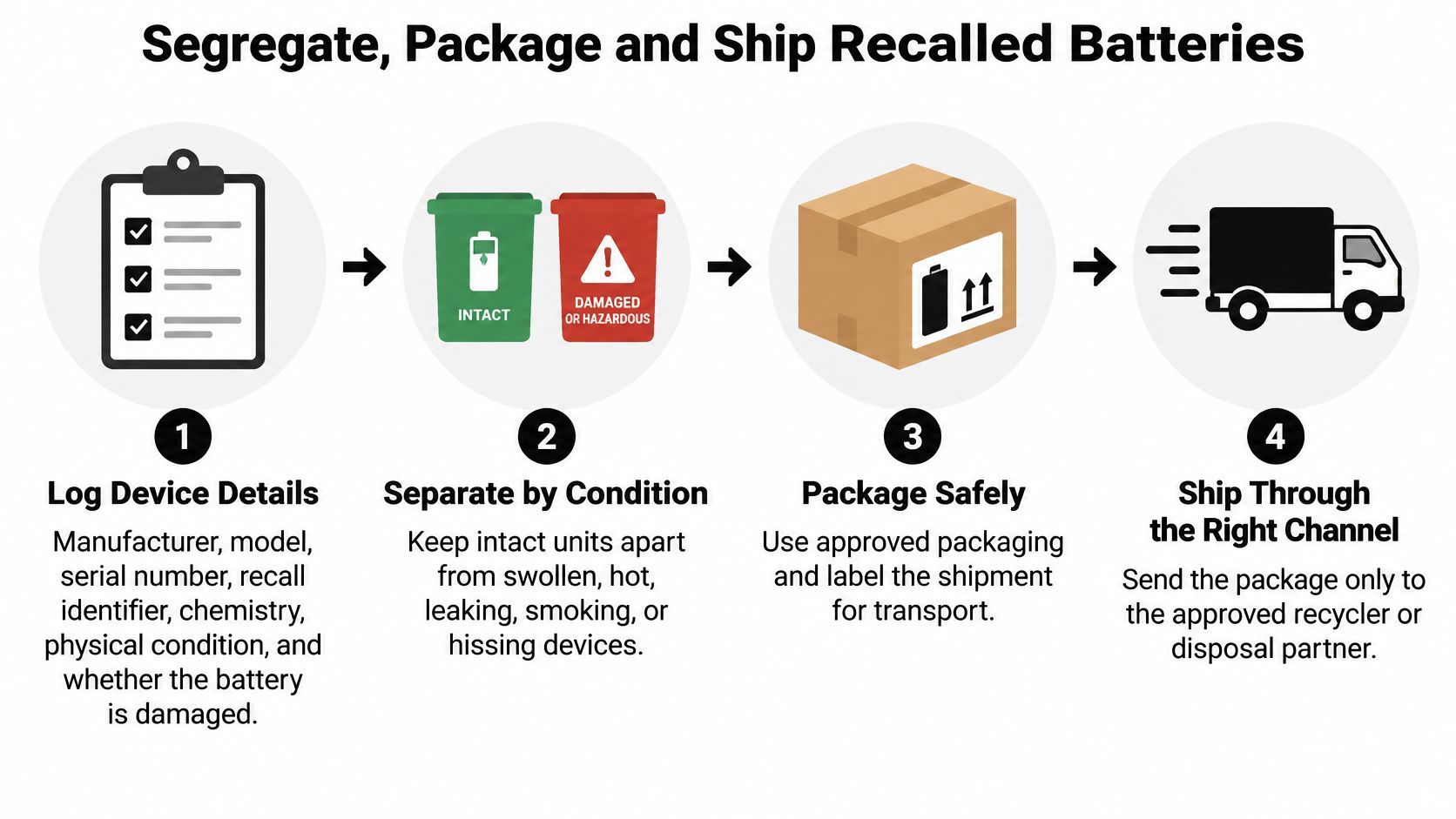
Most expensive mistakes happen at step one. Teams pack carefully, then discover nobody logged which serial numbers were in the shipment. Once units are consolidated, you can't rebuild recall traceability from a pallet photo.
Follow the sequence in the EPA lithium-ion battery recycling frequently asked questions, which support intake segregation, hazard screening, individual terminal protection, and one battery per nonmetallic inner package for damaged, defective, or recalled units. EPA also documented more than 240 lithium-ion-battery fires at 64 facilities from 2013 through 2020, which explains why ordinary electronics-processing controls aren't enough.
The Seven-Step Packaging Sequence
- Log the unit: Record manufacturer, model, serial number, recall identifier, chemistry, physical condition, and whether the battery is installed or loose.
- Keep it out of ordinary streams: Don't route recalled devices into e-waste, municipal recycling, or trash, where material-recovery equipment can crush cells and start fires.
- Protect intact units: Isolate terminals with nonmetallic tape or bag each battery individually, keeping labels legible for later reconciliation.
- Pack DDR units individually: Place one battery in a nonmetallic inner package that fully encloses it, surrounded by noncombustible, electrically nonconductive, absorbent cushioning.
- Use the rated outer package: Place each inner package in a specification outer package meeting Packing Group I performance requirements, with one inner package per outer package.
- Mark the package: Identify the battery type and its damaged, defective, or recalled status. Your team should understand universal waste labels and how they differ from transport marking.
- Hand off the record with the freight: Attach the intake log and condition photos so the receiving team can verify what it accepted.
Transport follows the same logic. The PHMSA lithium battery recycling safety advisory classifies these units as damaged, defective, or recalled (DDR) batteries, states they may be transported only by highway, rail, or vessel, and prohibits commercial aircraft transport. Shippers must evaluate fire hazards and protect terminals whether they're shipping one battery, a palletized load, or a battery-powered device.
| Requirement | Rule | Scope |
|---|---|---|
| Transport mode | Highway, rail or vessel permitted when hazardous-material requirements are met | Every shipment of recalled or damaged batteries |
| Commercial air | Prohibited | All recalled and damaged lithium batteries |
| Inner package | One battery in a nonmetallic package that fully encloses it | Each damaged, defective or recalled battery |
| Cushioning | Noncombustible, electrically nonconductive and absorbent | Around each inner package |
| Outer package | Specification package meeting Packing Group I performance | Every consolidated shipment |
| Units per package | One battery per inner package and one inner package per outer package | All recalled battery shipments |
| Terminal protection | Terminals protected against short circuits before shipping | Loose and installed batteries alike |
Never let ordinary and recalled batteries share packaging to fill a truck. Consolidation saves a little freight and destroys the control you built at intake. If a carrier, warehouse, or recycler asks you to treat DDR units like normal laptop batteries, stop the shipment and reclassify it.
Vendor Documentation and Chain of Custody
The record is the deliverable. Material recovery happens downstream, but your audit exposure starts the moment a recalled device leaves a site without a traceable handoff.
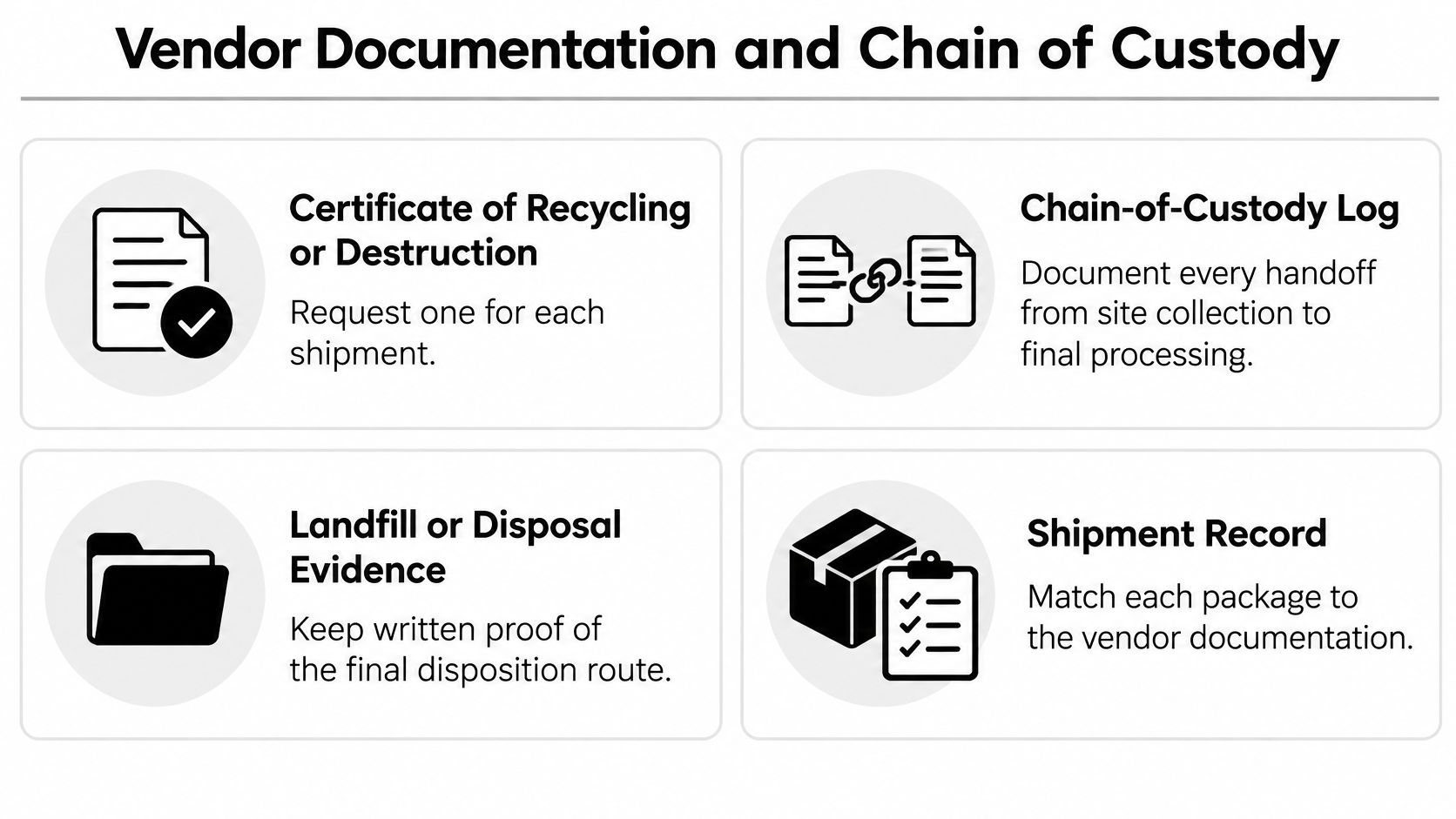
Ask every provider for the same document set before pickup, not after the invoice arrives. A useful reference point is the scope of a certificate of destruction for recalls, compared against the records below.
| Record | Purpose | Regulatory link |
|---|---|---|
| Certificate of recycling or destruction | Proof of final disposition per shipment | Permitted destination requirement |
| Chain-of-custody log | Traces each handoff from collection to processing | Recall traceability |
| Serial-number reconciliation | Ties each unit to its recall identifier | CPSC recall determination |
| Carrier authorization and transport documents | Shows lawful movement of recalled shipments | PHMSA transport rules |
| Arrival inspection report | Records condition on receipt | Intake hazard screening |
| Final treatment record | Names the permitted destination facility | 40 CFR Part 273 |
Each record answers a different audit question. The certificate proves disposition, but it doesn't prove which truck carried the units. The chain-of-custody log traces handoffs, but it's weak if serial numbers were never reconciled. The arrival inspection report matters when a unit left your site intact and arrived crushed, or when a quarantined device was mixed into a routine load.
Audit standard: Every serial number should connect to a recall notice, packaging decision, carrier record, arrival inspection, final treatment route, and certificate.
The regulatory layer needs equal clarity. The EPA lithium-ion battery recycling guidance explains that businesses may consider federal universal-waste regulations in 40 CFR Part 273, that universal-waste shipment doesn't require a hazardous-waste manifest, and that waste must still go to a permitted hazardous-waste disposal facility or recycler. EPA further reports most discarded lithium-ion batteries are likely hazardous waste and many would likely carry ignitable D001 and reactive D003 waste codes.
Ask each vendor which regime it applies and why. "We recycle it" isn't an answer.
Close every vendor review with three questions. Who classified each battery? Where does the complete record sit? How do serial numbers tie back to the recall notice? If the provider answers with a sample certificate but can't show the custody chain behind it, you're buying paperwork, not control.
Certify Data Destruction Separately from Battery Custody
A recalled tablet creates two liabilities at once. The battery can ignite in transit or in storage, and the embedded storage can hold customer records, employee data, network credentials, or regulated files. One certificate should not try to cover both risks.
Treat the battery as the urgent physical hazard and the data as the slower-moving liability that still needs its own proof. Keep battery custody and data destruction as separate records with separate certificates. The battery log proves condition, packaging, transport, and final treatment. The data record should identify each device or media batch, list serial numbers, and state whether storage was wiped, shredded, or otherwise physically destroyed.
Review how a certificate of data destruction is structured before you approve a pickup. Then compare it with your battery documentation and look for serial numbers that appear in one record but not the other.
Keep the Two Chains Separate
- Inventory storage at intake: List drives, embedded flash, and removable media separately from battery condition. A device under quarantine for a swollen battery still carries data that needs its own disposition record.
- Confirm the method before pickup: Agree on certified wiping or physical destruction while the devices are still under your control. Once a unit leaves on a hazmat load, your options narrow fast.
- Receive both certificates: Match the data destruction certificate against the battery recycling or destruction certificate for the same shipment.
- Reconcile every serial number: Investigate gaps before closing the recall file, not during an audit months later.
Confirm the legal basis with counsel. Federal rules require reasonable disposal measures for consumer report information, and that duty covers a defined subset of records rather than every device your organization retires. Don't stretch it into a blanket claim, and don't ignore it where it clearly applies.
Hospitals, banks, schools, and government agencies may carry additional contractual or sector duties. Your provider should map those duties to a specific destruction method and certificate format.
Separate logs prevent a subtle failure. A complete battery chain can make a shipment look closed even when three laptops never received data certificates. Reconcile both chains independently, then close the file once.
Schedule a Compliant Pickup for Recalled Inventory
Schedule pickup after triage is complete and the route is chosen. Booking a truck first pressures your team to pack whatever it finds, including units nobody has classified.
Send the provider one intake package. It should include site addresses and a named contact, unit counts by condition from the triage table, manufacturer and model, serial numbers and recall identifiers, and photos of swollen or damaged units. State whether each battery is installed or loose, identify any embedded storage, and give a preferred pickup window for each location.
That package lets the provider quote the full job. Without condition counts, you're asking for a price on unknown hazmat packaging, unknown carrier requirements, and unknown labor at the dock. The low quote usually survives by assuming every unit is intact.
What to Require in the Written Quote
- Packaging responsibility: Name who supplies inner packages, cushioning, outer packages, labels, and containment drums.
- Carrier and mode: Identify who moves the load and confirm highway, rail, or vessel routing where required.
- Quarantine handling: Schedule quarantined units first and keep them out of routine electronics loads.
- Returned records: List the certificates, custody logs, arrival reports, and final treatment records you'll receive.
- Multi-site coordination: For distributed inventory, review multi-location recall collection services and confirm how each site's serial numbers roll into one recall file.
Beyond Surplus, based in Atlanta with a Smyrna facility, schedules business pickups across the contiguous United States using its own fleet and transportation partners, and handles recalled electronics within its IT asset disposition services. Treat that as one route to evaluate against manufacturer take-back, hazardous-waste transport, and your existing ITAD provider using the same documentation standard.
Don't let a site add unlisted devices at the dock because the truck is already there. Additions need intake photos, serial numbers, condition screening, and packaging approval. A driver shouldn't have to decide whether a bulging power bank can ride with decommissioned desktops.
Contact Beyond Surplus for certified electronics recycling and secure IT asset disposal. Send your site list, condition counts, serial numbers, and recall identifiers so the pickup, packaging, transport, data destruction, and certificates are planned as one controlled shipment instead of improvised at loading time.
Beyond Surplus provides recalled battery device disposal services for businesses that need segregated pickup, compliant transport coordination, secure data destruction, and auditable certificates across one site or many. Share your recalled inventory list and condition counts, then visit Beyond Surplus to schedule a compliant business pickup.