

You've pulled a pallet of recalled space heaters from the sales floor, returns staff have added two cartons of recalled power banks, and facilities wants the cage cleared before the next delivery. Booking one general e-waste pickup feels efficient, but it's exactly how a recalled lithium battery ends up in a mixed load and a manager ends up with a receipt that proves nothing.
Recalled home product disposal services work when you route each product by hazard and by the remedy in its recall notice, then keep records that reconcile every unit. This guide is for retailers, property managers, facility teams, and offices handling recalled inventory, returns, or removals at commercial volume.
Table of Contents
- Match Each Recalled Product to a Disposal Route
- Who Controls the Disposal Decision in Your Organization
- Batteries and Hazardous Items Need Their Own Route
- How to Quarantine Recalled Stock Step by Step
- What Your Records Must Prove About Final Disposition
- How to Choose a Certified Disposal Partner
- Book the Pickup and Keep the Proof
Match Each Recalled Product to a Disposal Route
A recalled power bank, a leaking cleaning product, and an appliance containing refrigerant cannot share one disposal route. Start with the recall remedy, then match each item to its hazard and the rules for your organization's disposal stream.
| Product group | Main hazard | Disposal route | Check before pickup |
|---|---|---|---|
| Lithium-ion battery devices (power banks, e-bike packs, battery tools) | Fire risk from damaged or defective cells | Follow the recall instructions and use a facility or battery channel that accepts recalled lithium-ion batteries. Keep them out of ordinary trash and curbside recycling. | Written confirmation that the facility accepts recalled lithium-ion batteries |
| Children's products with lead or over federal limits | Lead content | Follow the recall remedy first. For non-household generators, assess whether the discarded products qualify as hazardous waste. | Waste determination signed by a named responsible person |
| Appliances with refrigerant or oil | Refrigerant release and oil leaks | Follow the manufacturer's remedy. If disposal is required, use an appliance recycler that recovers refrigerant. | Refrigerant recovery documentation for each unit |
| Electronics with displays, batteries or circuit boards | Lead in displays, battery hazards, and data on storage media | Use an electronics recycler that documents recycling and any required data destruction. | Certificate for the load that states the data destruction method |
| Chemical or cleaning products | Flammable, corrosive or toxic contents | Use a licensed hazardous-waste transporter and permitted facility. Keep products out of drains and storm sewers. | Waste profile and manifest completed before transport |
| Products whose recall notice requires destruction | Product-specific hazard; the notice sets the endpoint | Arrange destruction according to the notice's written instructions. | Certificate of destruction naming the units and date |
The decision order that prevents most mistakes
Read the recall notice first. It determines whether the product should be returned, repaired, replaced, refunded, or destroyed. Then identify the hazard from the product label, battery type, and notice language. Choose a disposal route that meets both the remedy and the hazard requirements.
A manufacturer remedy may preserve a refund, replacement, or credit. Keep affected units in quarantine while the remedy is unresolved, and obtain written confirmation of what may leave the site before releasing them to disposal.
Practical rule: When an item fits two rows, use the stricter route. A laptop belongs in electronics recycling, but a swollen battery needs a battery-safe route first.
For appliances, confirm who is responsible for refrigerant recovery and what documentation will show it was completed before arranging recalled appliance disposal services. A weight ticket alone does not show that refrigerant was recovered from each unit.
For future purchases made for resale, tenant use, or staff deployment, registering products for safety updates can help keep model and contact details together for a recall. Registration does not determine the disposal route; the recall remedy and the product's hazard do.
Sort recalled inventory by these rows. Mark any item that fits more than one category, record the stricter route on its quarantine label, and require the responsible decision maker to approve any change to that route.
Who Controls the Disposal Decision in Your Organization
The rules change when the product sits in a business, not a home. Who generated the waste controls which disposal duties apply, so a consumer instruction on a recall poster isn't a compliance plan for your loading dock.
The U.S. Environmental Protection Agency household hazardous waste guidance says consumers should first follow the manufacturer's or recall notice's recommended remedy, which commonly involves returning the product. It also explains that household sources generally fall under the federal household hazardous-waste exemption for recalled children's products containing lead or exceeding federal limits, while retailers, businesses, institutions, and other non-household generators must determine whether discarded products qualify as hazardous waste and comply with applicable storage, treatment, transportation, and disposal rules.
That split is where businesses get caught. A store manager reads that a household may use ordinary trash in certain circumstances and applies it to 300 returned units. The store isn't a household. It needs its own determination.
| Generator | Regulatory position | Ordinary trash allowed | Required action |
|---|---|---|---|
| Retailer | Must determine whether discarded products are hazardous waste | No, unless a written determination and local rules allow it | Document the determination and use a licensed hauler |
| Business or institution | Non-household generator with storage, transport and disposal duties | No for any stream classed as hazardous | Keep manifests, use licensed transporters and retain records |
| Recycler or contractor | Must hold the permits for the materials it handles | No | Provide a certificate for each load and maintain chain of custody |
Assign the determination to one name
State and local governments can impose requirements on top of federal rules, so checking only federal guidance leaves a gap. Your environmental lead, compliance manager, or operations director should check both levels for each stream, especially chemicals, batteries, and lead-containing products.
Ordinary trash and curbside recycling aren't options for a business stream until a written determination supports them. That document should name the product, recall notice, hazard considered, conclusion, date, and the person who decided. Without it, a driver, janitor, or returns clerk is effectively making a hazardous waste decision with no record.
Don't pour hazardous products into drains, place them in storm sewers, or mix them with other chemicals to make a container look full. Those shortcuts turn a manageable recall into a cleanup and reporting problem, and they can contaminate an otherwise acceptable load.
Name one person who signs the waste determination for each recall before any unit leaves the building. Put that name on the quarantine log, the pickup request, and the final file. If that person is unavailable, name a backup in writing. Recalls stall when everyone can move product but nobody can authorize the route.
Batteries and Hazardous Items Need Their Own Route
Recycling isn't always the safe choice. For some recalled products, recycling can be unsafe or unauthorized unless the manufacturer, regulator, or receiving facility has approved that route. That's especially true for recalled lithium-ion batteries, which must not enter household trash, curbside recycling, or ordinary battery drop boxes because of fire risk.
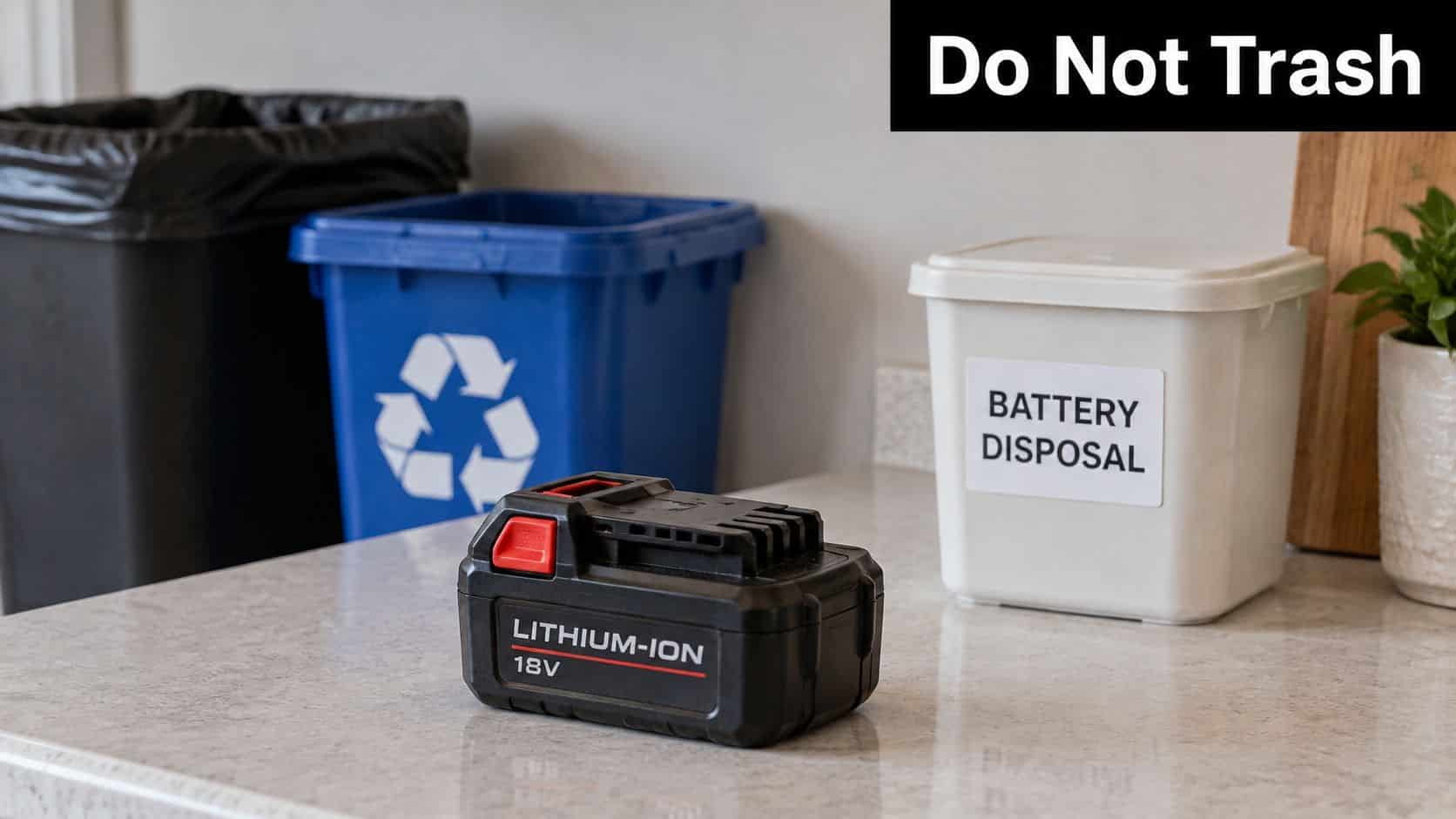
The Consumer Product Safety Commission recalls guidance directs consumers to contact their municipal household hazardous-waste facility in advance and verify that it accepts recalled or defective lithium-ion batteries, and to seek alternative municipal guidance if it does not. Businesses should apply the same acceptance discipline through a municipal program that accepts their material or a licensed provider, since a household site isn't automatically available for a commercial load.
Confirm acceptance before you pack anything
Use this sequence for every hazardous line:
- Contact the facility or provider in advance. Give the exact brand, model, battery condition, and quantity.
- Confirm acceptance for recalled or defective batteries. A general yes for lithium batteries isn't enough.
- Get packaging and transport instructions in writing. Ask what container, terminal protection, labeling, and vehicle limits apply.
- Seek another approved route if acceptance is refused. Don't re-label the load as general electronics to get it accepted.
Temporary storage matters while you're waiting. Keep damaged, swollen, hot, or leaking units isolated in their own container, away from combustible materials, in a cool and ventilated area. Don't stack loose packs in a gaylord, charge a suspect battery to test it, or open a device housing to remove an embedded cell unless trained personnel have an authorized procedure.
Build the before pickup checklist
For each hazardous line, record brand, model, serial number, recall notice, battery condition, quantity, and destination requirements. Add a photo of the label and visible damage when you can take it safely. That checklist lets a provider price and accept the actual load, rather than discovering excluded batteries at your dock.
Where electronics can't be reused or remarketed, we recycle and completely destroy equipment by de-manufacture and/or physical shredding, with product destruction supported by documented chain of custody and sustainable material recovery. For battery-bearing loads, discuss the scope through our lithium battery recycling service using the checklist, not a vague description like mixed electronics.
Complete the checklist for every hazardous line before calling any provider. If you can't state the battery condition and destination requirement, you're not ready to book transport.
How to Quarantine Recalled Stock Step by Step
A recall hold can fail before the truck arrives: one mixed pallet or an unmarked carton can put affected stock back into saleable inventory. Keep the physical hold, the inventory record, and the handling instructions aligned.
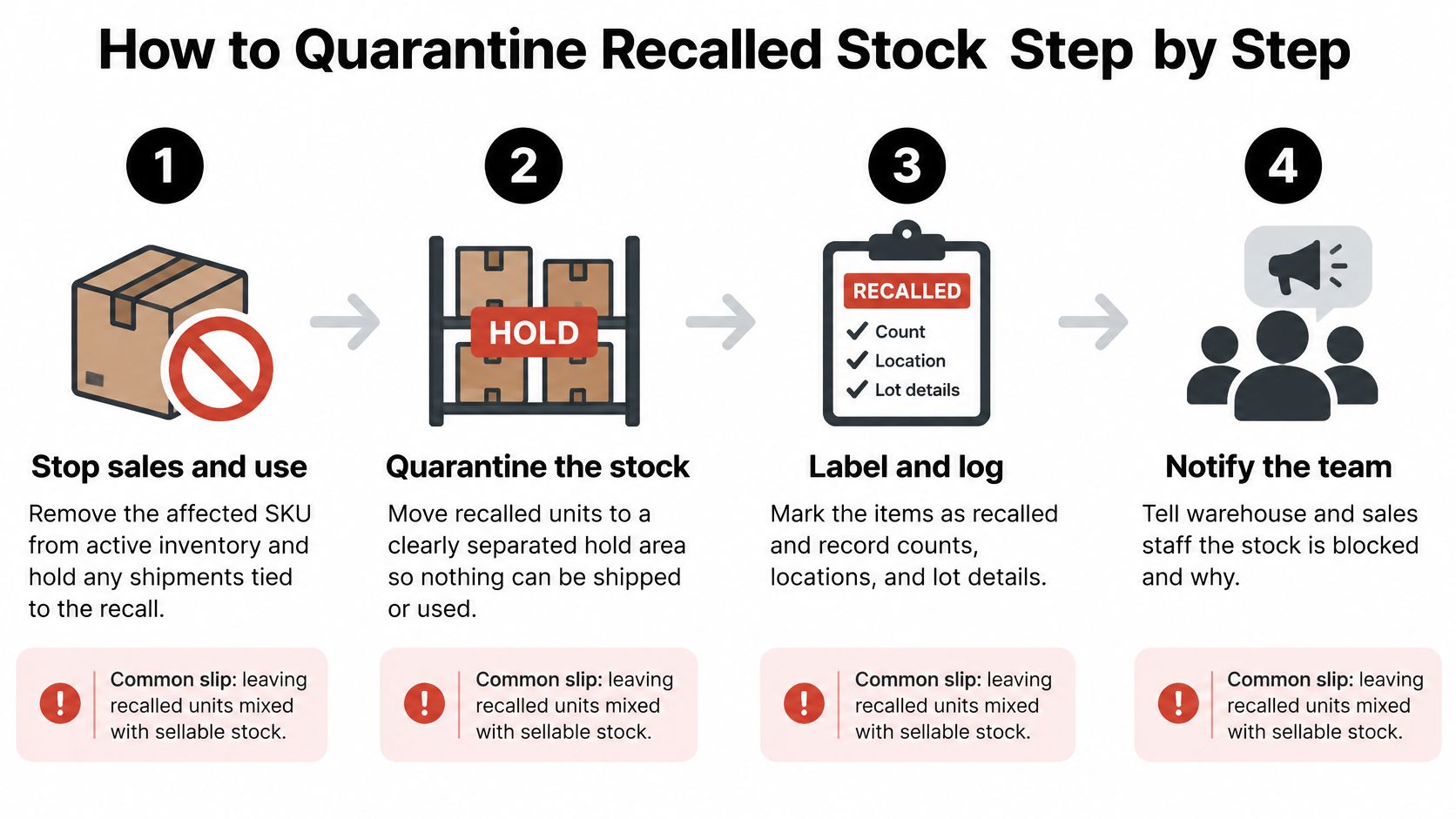
The CPSC Recall Handbook recommends written instructions for third-party destruction that identify the material, prohibit commingling, require clear package marking, and request a certificate of destruction. Set up the hold so each instruction can be followed and checked.
Six steps before the first truck
- Stop sales and use. Remove the affected SKU from active inventory, block it in the point-of-sale or asset system, and stop outbound shipments. Check online listings and transfer orders as well as shelf stock.
- Record identifiers. Capture manufacturer, model, serial or lot number, recall notice number, quantity, and current location for each unit. Verify carton contents where returns may have mixed models.
- Segregate physically. Move recalled units to a marked hold area, apart from saleable, salvage, donation, and routine recycling stock. Restrict access so staff cannot pull from the pallet by mistake.
- Label every carton and pallet. Mark the recall ID and clear instructions: do not sell, salvage, or recycle without authorization. Barcode or QR codes can support scanning, but the label should also carry readable instructions. BEDHEAD's guide to mattress labeling discusses barcode and QR code formats.
- Confirm the remedy. Check whether the recall notice calls for return, repair, refund, replacement, or destruction. Get destruction instructions in writing; a verbal summary does not establish the required remedy.
- Prepare provider instructions. Identify the material being shipped, prohibit commingling, specify package markings, and state what completion record is required.
If your organization needs help managing the hold and handoff, scope recalled product quarantine services against these steps and the product's required remedy.
A label that slips beneath shrink wrap can leave a pallet unidentified. Mark the carton itself as well as the wrap.
Before pickup, have someone other than the person who compiled the log compare it with the physical count. Resolve discrepancies while the stock is still on site by checking returns cages, repair benches, and transfer staging. Once the load leaves, unclear counts make it harder to establish where units went.
What Your Records Must Prove About Final Disposition
A receipt proves a truck came. It doesn't prove every recalled unit was destroyed, returned, recycled, or otherwise remedied through the route its notice required.
Scale makes informal proof weak. The CPSC fiscal year 2024 annual report says the agency negotiated and implemented 333 voluntary recalls during fiscal year 2024, covering approximately 41 million consumer-product units. At that volume, a manager's memory and a single disposal invoice won't answer a regulator, insurer, retailer, or manufacturer asking where specific units went.
| Record field | What to capture | Why it matters |
|---|---|---|
| Manufacturer and model | Exact brand, model and product name from the label | Ties each unit to the correct recall notice |
| Serial or lot number | Serial numbers for individual units, lot codes for batches | Prevents counting errors and mixed lots |
| Recall notice and remedy | Notice number, date and required remedy | Shows the disposal was the remedy the notice required |
| Unit reconciliation | Quarantined, shipped, destroyed, returned and remedied counts | Confirms every unit is accounted for against the original inventory |
| Date, method and location | Pickup date, destruction or recycling method, facility address | Establishes when and how each unit left your control |
| Responsible party | Name and title of the staff member and the provider contact | Identifies who certified each step |
| Certificate of destruction or recycling | Signed certificate for each load naming the units | Serves as the provider's written evidence of final disposition |
Where records usually fail
Watch for four failure modes. Undocumented handoffs break the chain between warehouse, carrier, and processor. Mixed loads make it impossible to show recalled units weren't diverted to salvage. Incomplete unit counts hide missing product until the final certificate arrives short. Receipt-only files treat pickup as proof of destruction.
Reconciliation is the control that catches all four. Units quarantined should equal units transported, destroyed, returned, repaired, replaced, refunded, or otherwise remedied, measured against the original inventory. Explain every difference in writing, including units rejected at pickup, units held for manufacturer inspection, and units found after the first shipment.
For electronics that carry data, name the sanitization or destruction method in the record and keep verification separate from a general recycling statement. A certificate that only says electronics recycled doesn't tell your IT or compliance lead what happened to drives inside those products.
We provide a certificate of recycling and data destruction for each load of equipment picked up, which are contractual written guarantees that equipment will be disposed of responsibly. Check any certificate of destruction for recalls against your record fields before accepting it. Reconcile the final log against the original inventory before closing the file, and retain the signed certification with date, method, location, and responsible party for the period your compliance program requires.
How to Choose a Certified Disposal Partner
Build the shortlist around the streams you send. A provider that's strong for office laptops may have no authority for chemical products, no acceptance for recalled batteries, and no witnessed destruction process for branded goods.
Start with licences and permits for every material class, including transporter authority for hazardous streams. Ask which facility receives each stream, because a broker's office address isn't the processing location. If a subcontractor handles destruction, require the subcontractor's name, permits, and certificate format before the first load.
Next, request independent audits and recognised certifications for recycling and data destruction. Verify that certificates are current and cover the site doing your work. Check references from businesses with similar recall volumes and ask those references one specific question: did final certificates reconcile to the units shipped without chasing corrections?
| Criterion | What to request | Red flag |
|---|---|---|
| Licences and permits | Current permits for each material class and transporter authority for hazardous streams | Permits that do not cover a stream you send |
| Audits and certifications | Independent audit reports and recognised data-destruction certifications | Certifications that cannot be verified or have expired |
| References | Two or more clients with similar recall volumes | No references from comparable businesses |
| Destruction standards | Written standards for destruction and recycling methods | Methods described only as proprietary |
| Load certificates | A sample certificate naming units, date, method and location | Certificates issued per batch instead of per load |
| Liability terms | Written allocation of liability after the load leaves your site | Liability capped at a fixed amount with no explanation |
Test the paperwork before the product moves
Request a sample certificate from each finalist and score it against your required fields: manufacturer, model, serial or lot, recall notice, quantity, date, method, location, and responsible party. Reject samples that report only weight. Weight is useful for billing, but recalled product control is unit based.
Confirm written destruction standards, how rejected material is handled, and whether the provider will stop work if an unlisted battery or chemical appears in a load. A provider that promises to take everything without an exception procedure is asking your staff to trust dockside improvisation.
Our corporate computer disposal services are compliant with local and federal laws governing the disposal of computers, certificates of recycling and data destruction are available for each load of equipment picked up, and every load receives certified data destruction, zero-landfill recycling, and documented proof of disposal. Use a structured vendor due diligence checklist so procurement, operations, IT, and compliance score the same evidence, and put liability allocation in writing for the moment the load leaves your control.
Book the Pickup and Keep the Proof
Book the pickup only after the route, acceptance, and count are settled. Speed helps, but a fast truck for the wrong destination creates a second project.
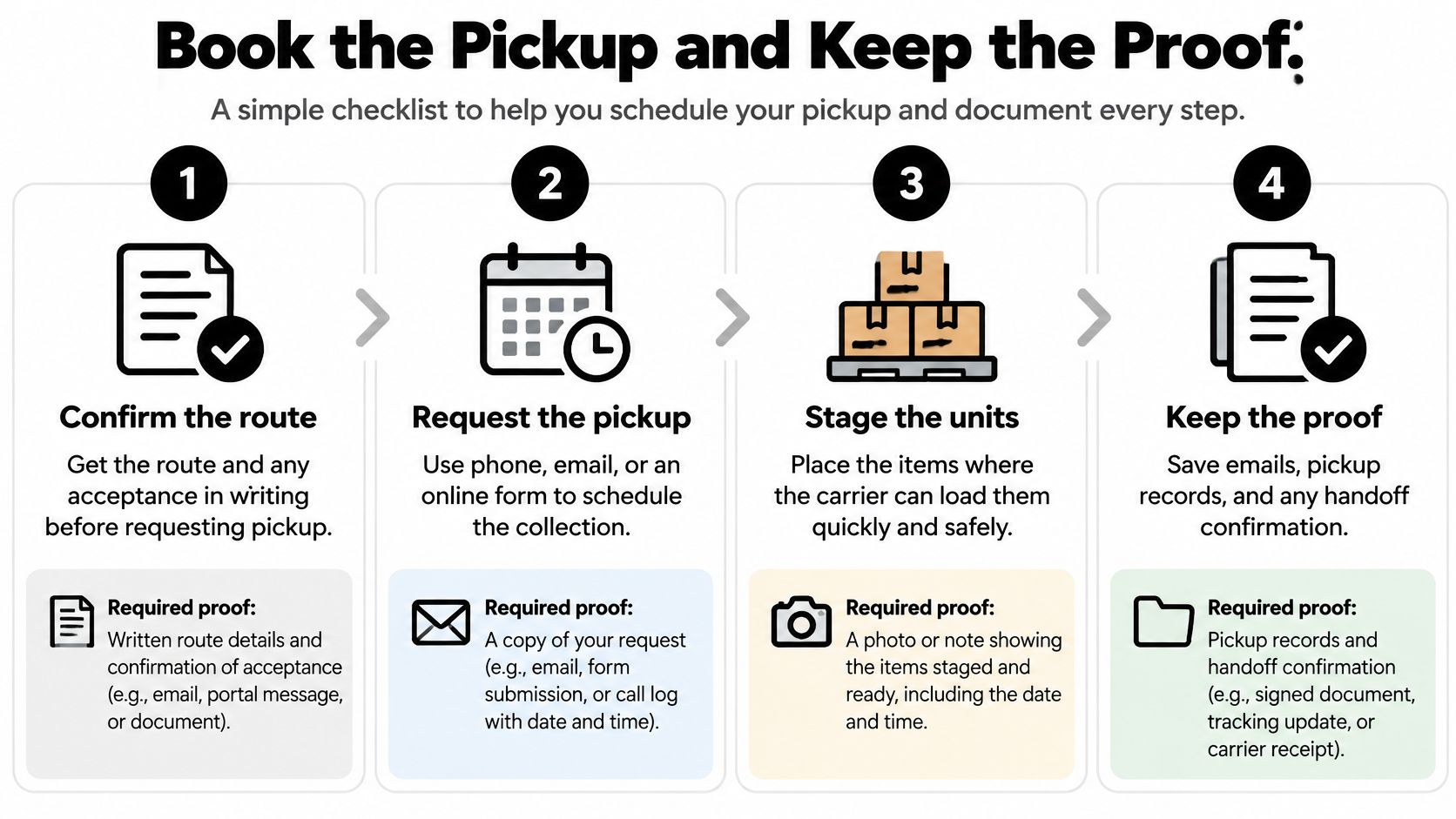
Handoff in order
- Confirm the route in writing. Attach acceptance, packaging instructions, and the recall remedy to the pickup request.
- Request the pickup. Customers can request a recycling pickup or drop-off by phone, by email, or by filling out the online form. Businesses can get priority pickup by recycling 1 pallet of equipment (a 40″x48″x5′ pile); smaller amounts can be dropped off or picked up when the truck is in the area.
- Stage by product group. Put one routing category on each pallet, keep labels facing out, and separate damaged batteries from stable electronics so the crew doesn't have to sort hazards at the dock.
- Name the signer. Confirm who signs the bill of lading and who can authorize exceptions. For business pickups, our team handles palletizing, loading, and delivery to the recycling facility, and arrives prepared to manage full removal from any location type.
- Verify counts at handoff. Compare each pallet against the quarantine log before loading. Note shortages, damage, rejected units, and substitutions on the paperwork while both parties are present.
- File the final proof. Put the certificate of destruction or recycling with the notice, determination, log, manifest, bill of lading, and reconciliation. Don't close the recall file on a pickup confirmation alone.
Closing check: If the final certificate names fewer units than the bill of lading, keep the file open and get the difference explained in writing.
Contact Beyond Surplus for certified electronics recycling and secure IT asset disposal when your recalled products include electronics, battery devices, data-bearing equipment, or branded goods that need documented product destruction. Send the recall notice, quantities, model list, battery condition, and your required certificate fields with the first request, so the quote covers the actual route.
Beyond Surplus provides certified electronics recycling, secure IT asset disposal, and documented product destruction for businesses that need recalled products removed without losing control of chain of custody. Send your recall notice, unit counts, and hazard details, and we'll help you stage the load, coordinate pickup, and keep the certificates that prove final disposition. Visit Beyond Surplus to request a pickup and discuss the right disposal route for your recalled inventory.


