

Old servers, laptops, and hard drives piling up in your California office are more than just clutter—they are a significant liability. For businesses operating in the Golden State, professional California hard drive shredding is a critical component of IT asset disposal, ensuring sensitive corporate and client data is permanently destroyed. This is the final, non-negotiable step in the IT equipment lifecycle, safeguarding your company against data breaches and regulatory penalties.
Why Hard Drive Shredding Is a Business Imperative In California
In a state governed by the stringent California Consumer Privacy Act (CCPA), your responsibility to protect data extends well beyond a device's operational life. Simply wiping or degaussing a hard drive can leave your enterprise dangerously exposed to sophisticated data recovery methods.
Deleting a file is like removing a chapter title from a book's table of contents; the data remains on the disk for anyone with the right tools to find. Physical hard drive shredding, in contrast, is the equivalent of feeding the entire book into an industrial shredder. The process pulverizes the drive platters into small, unrecoverable fragments of metal and plastic, making data recovery impossible. This is your most effective defense against data breaches, steep regulatory fines, and brand damage.
The Inadequacy of Software-Based Solutions
While software wiping and degaussing (using powerful magnets to erase data on traditional hard disk drives) are common terms, they have significant vulnerabilities, particularly with modern IT equipment.
- Solid-State Drives (SSDs): Degaussing is completely ineffective on SSDs, as they do not use magnetic storage.
- Failed Drives: Wiping software cannot run on a non-functional or damaged hard drive, leaving the data intact and vulnerable.
- Human Error: The effectiveness of software wiping depends on flawless execution. A single procedural error or incomplete wipe can leave recoverable data fragments accessible.
- Lack of Physical Proof: Software generates a digital log, but shredding provides a container of destroyed hardware. This physical evidence is indisputable.
Physical destruction is the gold standard for data sanitization because it eliminates all doubt. It provides an absolute, auditable end to the data lifecycle, which is essential for demonstrating compliance with regulations like the CCPA and HIPAA.
This comparison highlights why physical shredding offers unmatched security for corporate data.
Comparing Data Destruction Methods
| Method | Security Level | Verification | Best For |
|---|---|---|---|
| Software Wiping | Moderate to High | Digital logs and reports | Functional drives being repurposed internally |
| Degaussing | High (for HDDs only) | Visual indicator or field verification tools | Magnetic media (HDDs, tapes) that are not SSDs |
| Shredding | Absolute | Certificate of Destruction, visual proof | All drive types (HDDs, SSDs), damaged drives, end-of-life assets |
For businesses in California, where data security stakes are exceptionally high, physical shredding provides the definitive protection that other methods cannot guarantee.
A Growing Market Driven by Compliance
The demand for certified data destruction is a rapidly growing global trend, directly fueled by stringent data privacy legislation. The hard drive shredding market is expanding as businesses recognize that physical destruction is the only foolproof method for sanitizing end-of-life IT assets. Understanding the crucial reasons you need data destruction services today is the first step toward building a robust data security protocol.
This market surge is a direct response to the immense financial and reputational risks of a data breach. The global hard drive shredding services market is projected to reach USD 631.8 million by 2025, driven by laws like the CCPA. For enterprises in healthcare, finance, and legal sectors, the cost of a data breach from improperly retired hardware makes professional shredding an essential investment.
Navigating California's Strict Data Privacy And Environmental Laws
Operating a business in California requires navigating a complex regulatory framework governing both data privacy and environmental protection. These laws carry significant penalties for non-compliance, making professional California hard drive shredding services indispensable for risk management.
The cornerstone of this legislation is the California Consumer Privacy Act (CCPA), further strengthened by the California Privacy Rights Act (CPRA). These laws impose a legal duty on businesses to protect consumer data from collection through to its final destruction.
A single compliance failure can be financially devastating. The CCPA allows for fines of up to $7,500 per intentional violation. Considering the thousands or millions of customer records stored on legacy servers and corporate laptops, the potential liability is substantial, making certified hard drive shredding a fundamental business practice.
The CCPA and The Burden Of Proof
Under CCPA, your business must be able to prove it took definitive steps to destroy sensitive information. A software wipe log can be challenged during an audit or data breach investigation, but a Certificate of Destruction from a certified shredding partner provides solid, auditable proof. This document demonstrates due diligence and formally transfers the liability for proper disposal to your vendor.
The CCPA framework treats data as a liability until it is verifiably destroyed. Physical shredding provides the definitive, non-reversible endpoint that satisfies regulators and protects your organization from claims of negligence.
This documented, physical destruction is your strongest defense, closing the loop on data stewardship and ensuring you meet your legal obligations without ambiguity.
The Intersection of Data Security and Environmental Law
California's regulatory demands extend to environmental stewardship. The state enforces some of the nation's strictest laws regarding electronic waste (e-waste). Disposing of IT equipment in landfills is illegal and environmentally irresponsible.
This dual requirement means California businesses must both secure the data on retired assets and ensure the devices are disposed of in an eco-friendly manner. A certified IT Asset Disposition (ITAD) partner provides a unified solution for both challenges.
California’s waste statistics underscore this urgency. In 2024, the state's waste management systems handled 77.2 million tons of materials. A concerning 58%, or 44.7 million tons, was sent to landfills, with only 42% being recycled. These figures highlight the critical need for responsible e-waste management.
A certified vendor specializing in California hard drive shredding not only destroys data but also ensures the resulting electronic scrap is responsibly recycled in accordance with state law. The shredded aluminum, steel, and other materials are recovered and reintroduced into the manufacturing supply chain, supporting a zero-landfill policy. Partnering with the right ITAD expert allows you to meet your obligations under CCPA and HIPAA while complying with California’s environmental mandates. Explore comprehensive solutions for California electronics recycling that address these critical areas.
Choosing Between On-Site And Off-Site Shredding Services
When planning the destruction of retired hard drives, California businesses must choose between on-site and off-site shredding services. This decision should be based on your company's specific security requirements, budget, operational needs, and the volume of assets being processed.
On-site shredding, also known as mobile shredding, brings the destruction process directly to your facility. A specialized truck equipped with an industrial-grade shredder arrives at your location to destroy your hard drives while you watch.
Off-site shredding, or plant-based shredding, involves the secure collection of your IT assets by a GPS-tracked vehicle. The devices are then transported to a dedicated, secure facility for destruction. Both methods are highly secure and compliant, but they cater to different operational priorities.
The Case For On-Site Mobile Shredding
For organizations with strict compliance mandates that require visual confirmation of destruction, on-site shredding is the preferred solution. It offers the highest level of transparency and is ideal for businesses in heavily regulated sectors such as healthcare, finance, and government.
The primary benefit is immediate, undeniable proof of data destruction. Your staff can witness every hard drive being fed into the shredder and reduced to fragments. This direct oversight eliminates any chain-of-custody concerns from the moment the drives are decommissioned.
Key advantages include:
- Maximum Transparency: Direct observation provides unmatched peace of mind and simplifies internal or external audits.
- Instant Verification: A Certificate of Destruction is often issued on-site immediately following the service.
- Zero Chain-of-Custody Gaps: The drives are destroyed before leaving your premises, eliminating transportation risks.
This method is ideal for smaller batches of highly sensitive assets or for companies whose risk management policies require direct supervision of data destruction.
The Power Of Off-Site Plant-Based Shredding
While on-site shredding offers transparency, off-site services provide superior efficiency, scalability, and cost-effectiveness for large-volume projects. This makes it the optimal choice for data center decommissioning, enterprise-wide technology refreshes, or any project involving hundreds or thousands of drives.
With off-site shredding, a certified vendor utilizes locked, sealed containers and secure, GPS-monitored transport. Destruction occurs in a highly controlled facility with 24/7 surveillance, using shredders that are more powerful than mobile units. The process is engineered for high volume without compromising security.
Off-site shredding is built for efficiency at scale. It allows for the processing of thousands of drives in a controlled, monitored environment, making it the most practical and economical solution for large-scale enterprise ITAD projects.
This service is ideal for businesses needing to manage large-scale disposals without operational disruption. The stringent security protocols at a certified plant ensure data is protected throughout the entire process, delivering the same compliant outcome as on-site shredding.
On-Site Vs Off-Site Shredding A Head-To-Head Comparison
This table outlines the key differences to help California businesses select the service that best aligns with their security, budget, and operational requirements.
| Feature | On-Site Shredding | Off-Site Shredding |
|---|---|---|
| Security & Oversight | Maximum. Witness destruction firsthand. | High. Secure transport & 24/7 facility surveillance. |
| Best For | Small to medium batches, highly sensitive data. | Large volumes, data center decommissioning, IT asset refresh. |
| Chain of Custody | Zero gaps. Drives are destroyed on your property. | Secure & documented. GPS tracking & locked containers. |
| Cost-Effectiveness | Higher cost per unit due to dedicated truck and staff. | More economical for large volumes due to plant efficiency. |
| Logistics | Requires scheduling and space for the mobile truck. | Simple pickup process; the vendor handles all transport. |
| Verification | Instant. Certificate of Destruction issued on the spot. | Prompt. Certificate issued after batch processing is complete. |
Ultimately, both services are secure and effective. The choice depends on whether your organization prioritizes the absolute transparency of on-site observation or the scalable efficiency of off-site processing.
Beyond Surplus offers both on-site and off-site California hard drive shredding services, ensuring a secure and compliant process. Explore our full range of secure California e-waste services that align with your security and sustainability goals.
The Importance Of Chain Of Custody And Official Certification
If a data breach were traced back to one of your retired hard drives, could you prove you followed proper disposal protocols? A clear and unbroken chain of custody is the backbone of any defensible California hard drive shredding strategy. It provides the documented, verifiable proof that you took every necessary step to protect sensitive information.
This documented trail follows your IT assets from the moment they leave your control to their final destruction. A professional shredding partner manages this process meticulously, using serialized asset lists, secure transport logs, and signed transfer receipts. The process culminates in the issuance of a Certificate of Data Destruction. This legally defensible document officially transfers liability from your company to the vendor and serves as your proof of compliance.
Why Industry Certifications Are Non-Negotiable
How do you verify a vendor's chain of custody is secure? Third-party certifications are the answer. An uncertified vendor can make promises, but a certified one provides independently verified proof of their security standards.
The leading certification in the data destruction industry is NAID AAA Certification. This is not a purchased credential; it is earned through rigorous, unannounced audits of a vendor’s entire operation.
NAID AAA certified vendors must adhere to strict standards, including:
- Employee Screening: All personnel with access to sensitive materials undergo extensive background checks.
- Facility Security: The processing plant must be equipped with monitored alarms, 24/7 video surveillance, and strict access controls.
- Operational Procedures: The entire process, from asset collection to final shredding, is audited to ensure there are no security vulnerabilities.
Choosing a NAID AAA certified partner for your California hard drive shredding ensures their process can withstand any legal or regulatory scrutiny.
This flowchart illustrates the secure shredding options.
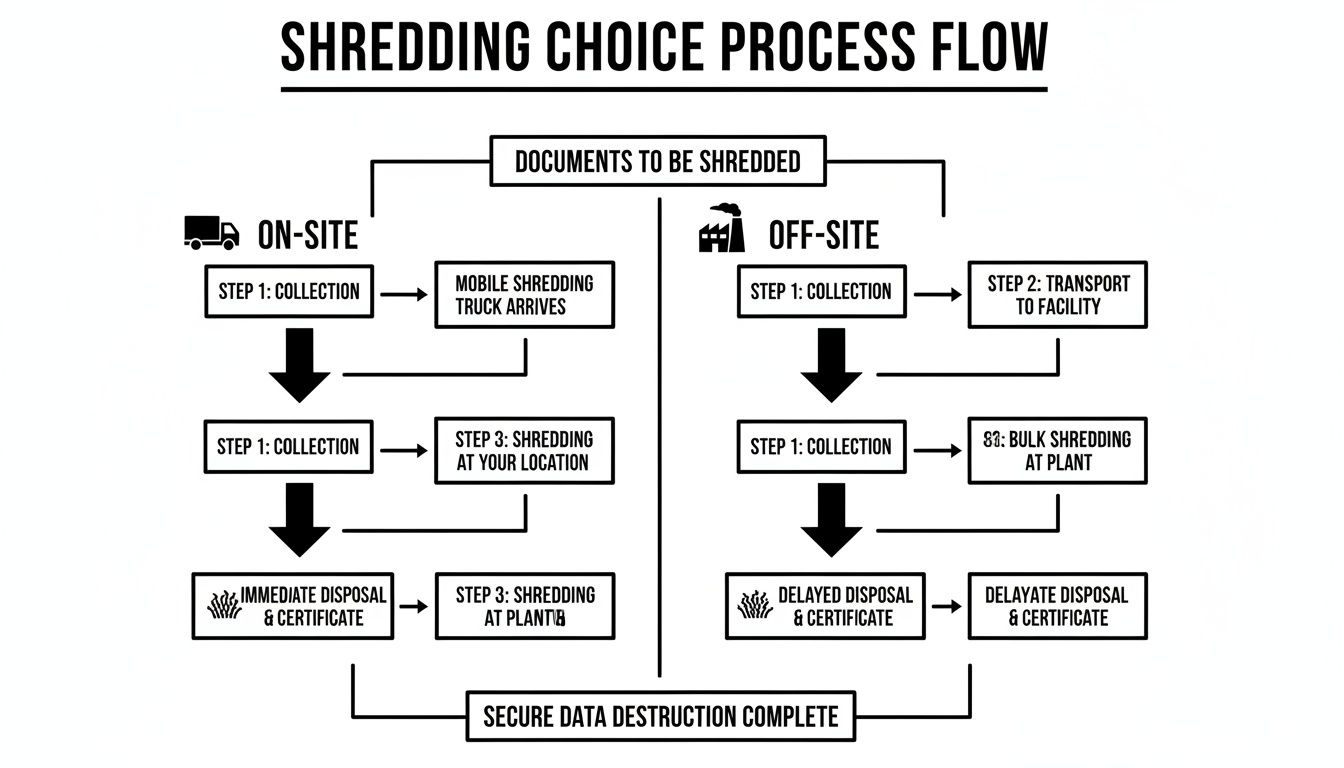
Whether you choose on-site or off-site services from a certified provider, the end result is the same: secure, documented destruction. The primary difference is the location of the shredding process.
Market Trends Reflecting Business Needs
The growing enterprise focus on certified, high-volume destruction is reflected in market data. The hard disk destruction equipment market is dominated by commercial use at $450 million, far surpassing industrial and personal use segments.
This market is expanding at a 5.2% CAGR, driven by the need for efficient, automated shredders capable of processing large quantities of end-of-life media. This demand for secure, certified disposal is a critical component of responsible IT asset management in a state as regulatorily conscious as California. By insisting on a documented chain of custody and working only with certified vendors, you can transform hard drive shredding into a defensible and compliant business process. For a deeper look at the methods involved, review our overview of security and data destruction services.
How To Select The Right Hard Drive Shredding Partner In California
Selecting a vendor for hard drive shredding in California is a critical decision that impacts your company's security and compliance posture. The right partner acts as an extension of your security team, while the wrong one can expose your business to significant risk.
It is essential to evaluate providers beyond their marketing materials to understand their operational integrity. The goal is to find a partner who not only destroys your data securely but also aligns with your company's broader compliance, security, and sustainability objectives.
Core Certifications To Look For
The most critical step is to verify a vendor's certifications. These third-party validations are non-negotiable, confirming adherence to the industry's highest standards for security and environmental responsibility.
Key certifications include:
- NAID AAA Certification: The gold standard for data destruction, ensuring the highest level of security through rigorous, unannounced audits of hiring practices, operational security, and destruction processes.
- R2 (Responsible Recycling) or e-Stewards: These certifications focus on environmental compliance. They guarantee that the vendor processes e-waste responsibly, prevents the illegal export of hazardous materials, and protects worker health and safety.
A vendor holding both data security and environmental certifications has demonstrated a commitment to meeting California's dual compliance requirements.
Evaluating Security Protocols And Logistics
Beyond certifications, scrutinize the vendor's specific security and logistical capabilities. These details reveal how they protect your assets throughout the disposition process.
Ask potential partners direct questions:
- Chain of Custody: How are assets tracked? Request samples of their serialized tracking reports and the final Certificate of Data Destruction.
- Transportation Security: Are vehicles GPS-tracked? Are assets transported in locked, secure containers?
- Facility Security: What access control measures are in place? Is there 24/7 monitored surveillance?
- Employee Screening: What are the requirements for employee background checks?
A reputable and transparent vendor will provide detailed answers and documentation for each of these points.
Assessing Service Scope and Geographic Reach
Your company's operational footprint in California is a key consideration. A business with a single office has different logistical needs than an enterprise with locations from San Francisco to San Diego. The ideal vendor should provide consistent service across all your sites.
A partner with statewide or national capabilities can streamline vendor management, ensure uniform compliance documentation, and offer more competitive pricing for high-volume needs. A professional online presence, as seen in effective local SEO strategies for contractors, often indicates a well-established and reliable service provider.
Choosing a vendor isn't just about finding a shredder. It's about selecting a strategic partner who can manage the entire lifecycle of your retired IT assets, from secure logistics to certified destruction and responsible recycling.
Finally, look for a vendor offering comprehensive IT Asset Disposition (ITAD) services. A true ITAD partner can provide value-added services like IT asset value recovery, reselling functional equipment to offset disposal costs. This holistic approach, detailed in our California ITAD services, can transform a cost center into a value stream, creating a more sustainable and economical disposal program.
Got Questions About Hard Drive Shredding in California? We’ve Got Answers.
Navigating the details of hard drive destruction in California can raise many questions regarding compliance, cost, and logistics. This section provides clear, practical answers to the most common inquiries from businesses.
Is Software-Based Wiping Good Enough For CCPA?
While software wiping is a useful step for devices being reused internally, it is not a foolproof solution for end-of-life assets under the strict standards of CCPA or CPRA. Software can fail, processes can be executed incorrectly, and modern Solid-State Drives (SSDs) are notoriously difficult to wipe completely due to wear-leveling technology, often leaving residual data behind.
When it comes to a CCPA audit or a data breach investigation, a Certificate of Destruction from a certified shredding partner is your ironclad proof. It shows you took irreversible action, leaving absolutely no room for doubt about whether the data is gone for good.
Physical California hard drive shredding is the only method that guarantees data is 100% unrecoverable, providing the definitive finality that regulators require.
What’s The Typical Cost For Shredding Business Hard Drives In California?
The cost of professional hard drive shredding in California is based on several project-specific factors.
The final price is influenced by:
- Quantity of drives: Pricing is typically calculated per drive or per pound, with volume discounts available for larger quantities.
- Service type (On-site vs. Off-site): On-site mobile shredding generally has a higher per-unit cost due to the dedicated vehicle and personnel. Off-site shredding is more economical, especially for large volumes.
- Logistical requirements: The location of your facilities and any additional services, such as de-installation of drives from servers, can affect the cost.
Consider this service an investment in risk mitigation. A single data breach costs a U.S. company an average of $4.45 million in fines, legal fees, and reputational damage. This figure far exceeds the cost of certified shredding. Furthermore, a qualified ITAD partner can often recover value from your other retired IT assets, which can help offset or even cover the cost of data destruction.
Can We Use One Vendor For All Our Offices Across California?
Yes. Partnering with an established IT Asset Disposition (ITAD) provider is the most efficient way to manage services for multiple locations. Leading vendors are equipped to manage secure, consistent service plans for companies with offices throughout the state.
A provider with a statewide footprint can coordinate logistics for your teams in the Bay Area, Los Angeles, San Diego, and Sacramento. This centralized approach offers significant benefits:
- Single point of contact: Streamline communication and invoicing with one partner.
- Consistent compliance: Ensure uniform certified service and documentation across all locations, simplifying company-wide audits.
- Optimized pricing: Bundle services to unlock volume discounts and more efficient logistics.
This approach ensures every office adheres to the same high standard for data security and environmental responsibility.
What Happens To The Shredded Hard Drive Pieces?
The process does not end with destruction. A certified, environmentally responsible vendor ensures that no shredded material ends up in a California landfill, a key requirement of R2 and e-Stewards certifications.
After destruction, the shredded material is securely transported to a certified recycling facility. There, a sophisticated process separates and recovers the raw commodities, including:
- Aluminum from drive casings
- Steel from internal components
- Precious metals from circuit boards
These recovered materials are then reintroduced into the global manufacturing supply chain for use in new products. This supports a zero-landfill policy for your retired IT assets, conserves natural resources, and aligns your IT program with California's strong commitment to sustainability.
For California businesses seeking a reliable partner for secure and compliant IT asset disposition, Beyond Surplus offers certified solutions tailored to your needs. We provide both on-site and off-site hard drive shredding, comprehensive e-waste recycling, and detailed chain-of-custody documentation to ensure your data is protected and your compliance obligations are met.
Contact Beyond Surplus today for certified electronics recycling and secure IT asset disposal. Schedule a consultation or pickup at https://www.beyondsurplus.com.


