

Atlanta's data-center inventory reached 1,279.4 megawatts in the first quarter of 2025, more than triple its capacity from a year earlier, so operators should manage ITAD as a certified, serial-level, audit-ready workflow that protects data and recovers asset value. The practical model connects secure de-installation, NIST-aligned sanitization, documented custody, reuse decisions, and responsible recycling before equipment leaves the facility.
A migration window rarely ends when the last workload moves. Drives remain in chassis, RAID members sit in staging areas, switches await buyer inspection, and facility teams must coordinate loading activity around live rows, security procedures, utilities, and tight schedules. Atlanta operators facing that reality need more than a truck and a generic recycling certificate.
Table of Contents
- Why Atlanta Data-Center Growth Changes ITAD Planning
- Building an Auditable Data Sanitization Workflow
- Choosing Between Reuse, Purging, and Destruction
- Planning Secure De-Installation and Chain of Custody
- Aligning Decommissioning with Operational and Community Constraints
- How to Choose a Certified Local ITAD Partner
- Next Steps for Secure Asset Recovery in Atlanta
Why Atlanta Data-Center Growth Changes ITAD Planning
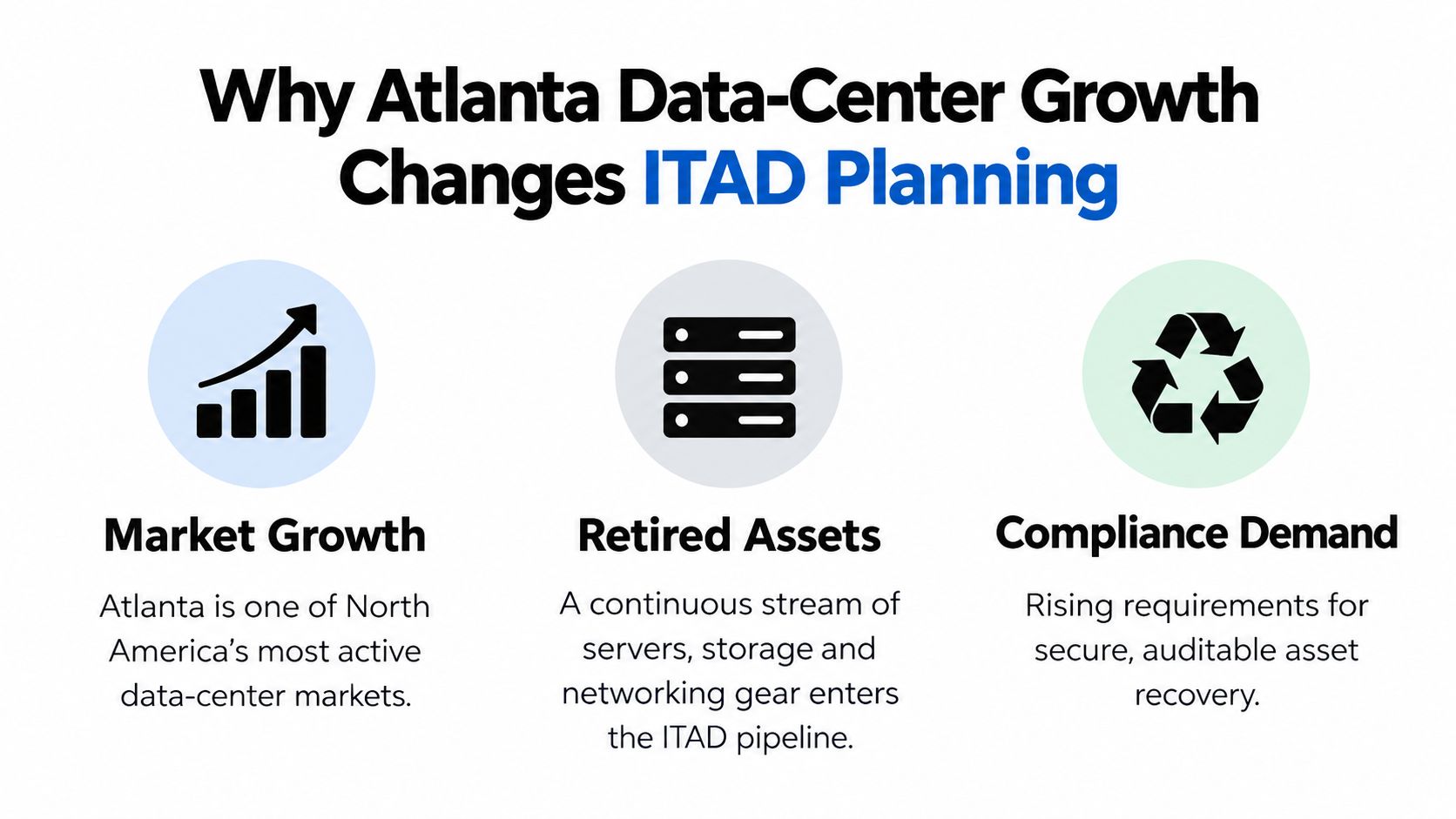
Atlanta's infrastructure expansion creates a recurring disposition pipeline. Servers, storage arrays, networking equipment, racks, batteries, and other electronics leave service whenever a facility expands, migrates workloads, replaces hardware, or changes tenants. If ITAD planning starts after the teardown, the most important decisions have already been made under pressure.
In the first quarter of 2025, Atlanta's data-center inventory reached 1,279.4 megawatts, more than triple its capacity from a year earlier. The market recorded 951.0 megawatts of net absorption, the largest increase among North American markets tracked in the cited report, while vacancy fell from 8.8% to 3.6%, according to CBRE's 2025 global data-center trends report. Average rental rates also rose 13.0% year over year, reflecting demand from hyperscale cloud providers, artificial-intelligence companies, and enterprise users.
Refresh volume becomes a control problem
Another market summary reported approximately 2,160 megawatts of data-center capacity under construction across metro Atlanta in 2024, more than twice the region's existing operational space, as described in Atlanta data-center market analysis. That buildout points to repeated cycles of deployment, migration, expansion, and replacement.
For an IT director, the implication is straightforward. A disposition program must scale with the infrastructure program. It should connect serialized inventory to pickup, transport, processing, sanitization, resale, recycling, and final reporting. Otherwise, the organization can lose recoverable value while creating gaps in audit evidence.
Practical rule: Treat ITAD as a workstream in the data-center lifecycle plan, not as cleanup assigned after the migration is complete.
The operational controls matter because a server chassis isn't the same thing as the data-bearing media inside it. A refresh plan that tracks only chassis serials can miss removable drives, cache modules, backup tapes, and failed disks. Atlanta organizations can use this overview of the data-center boom and its ITAD implications to connect market growth with practical recovery planning.
Building an Auditable Data Sanitization Workflow
A secure wipe isn't a certificate by itself. The defensible unit is the individual drive or storage device, supported by evidence showing what happened, who performed it, how the result was checked, and where the media went afterward.
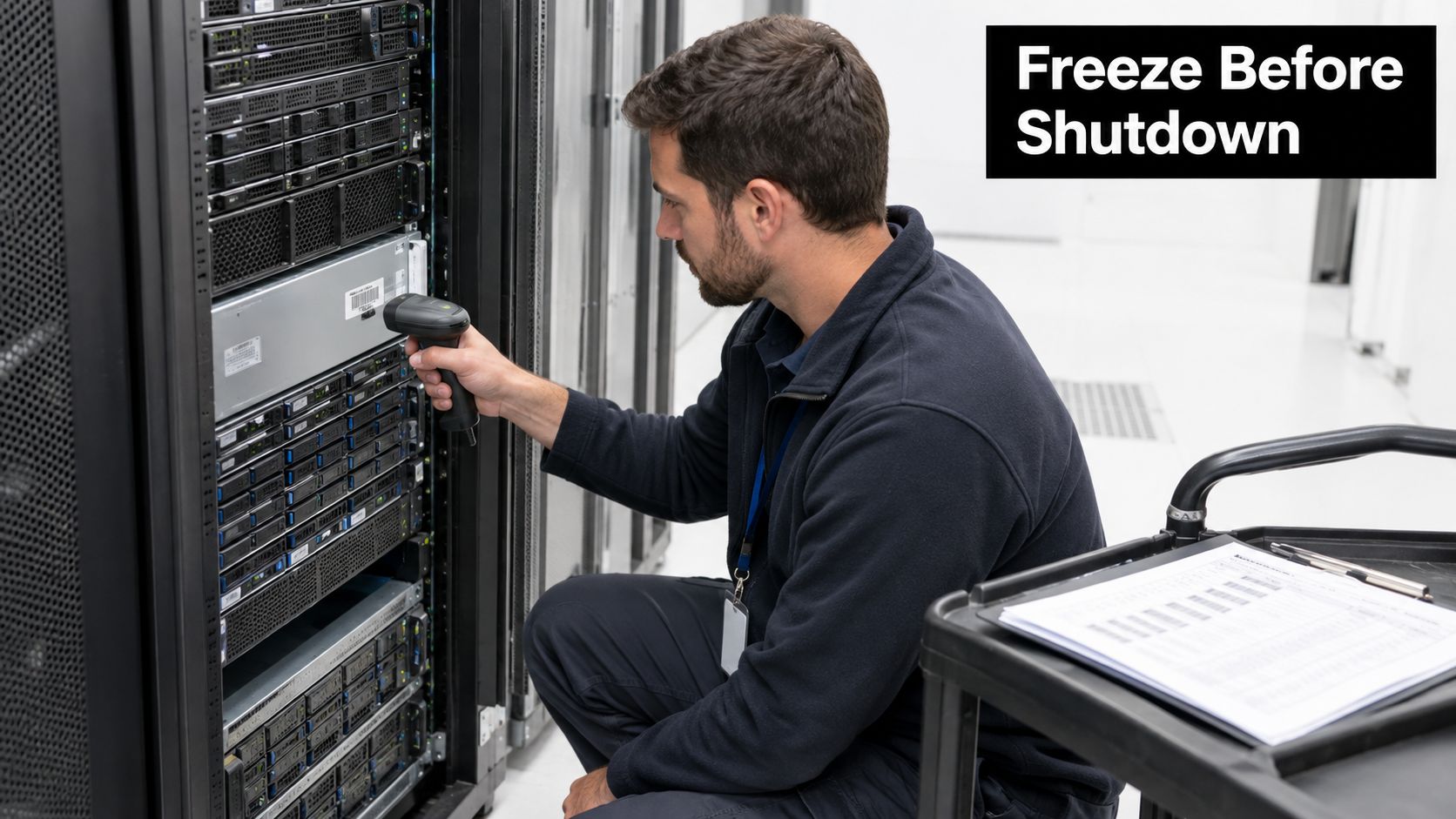
Start by freezing the inventory before shutdown. Record every HDD, SSD, NVMe device, tape, and embedded storage component with a unique identifier. Then classify the data and choose the appropriate NIST SP 800-88 method, Clear, Purge, or Destroy, based on media type, sensitivity, intended reuse, and organizational control.
Record the operation, not just the outcome
A useful workflow captures:
- Asset identity: Match the device serial number or other unique identifier to the manifest.
- Sanitization decision: Document why the selected media method fits the device and data classification.
- Execution details: Record the technique, tool and version, operator, timestamp, and verification method.
- Immediate verification: Check whether the operation completed without errors.
- Independent validation: Review a randomized sample to determine whether the evidence supports acceptance of residual confidentiality risk.
- Final reconciliation: Issue a media-disposition record tying each device to reuse, resale, destruction, or recycling.
NIST recommends full verification whenever feasible. When sampling is necessary, its guidance says samples should cover user-addressable and reserved areas, use pseudorandom locations, and be checked with a separate tool from a different developer, as set out in NIST SP 800-88 Rev. 1.
Verification and validation aren't interchangeable
Verification asks whether the sanitization operation completed without errors. Validation is the management decision that the available evidence supports accepting the remaining confidentiality risk. Confusing those two steps leaves a program dependent on a software completion screen.
Common failure points include skipped reserved areas, serial numbers mixed during pallet movement, and wiping failed media that can't reliably complete the process. Encrypted drives may require a cryptographic-erase evaluation, while highly sensitive or damaged media may need physical destruction.
This NIST-focused explanation of media sanitization provides useful context for aligning the written procedure with the evidence an auditor will expect.
Choosing Between Reuse, Purging, and Destruction
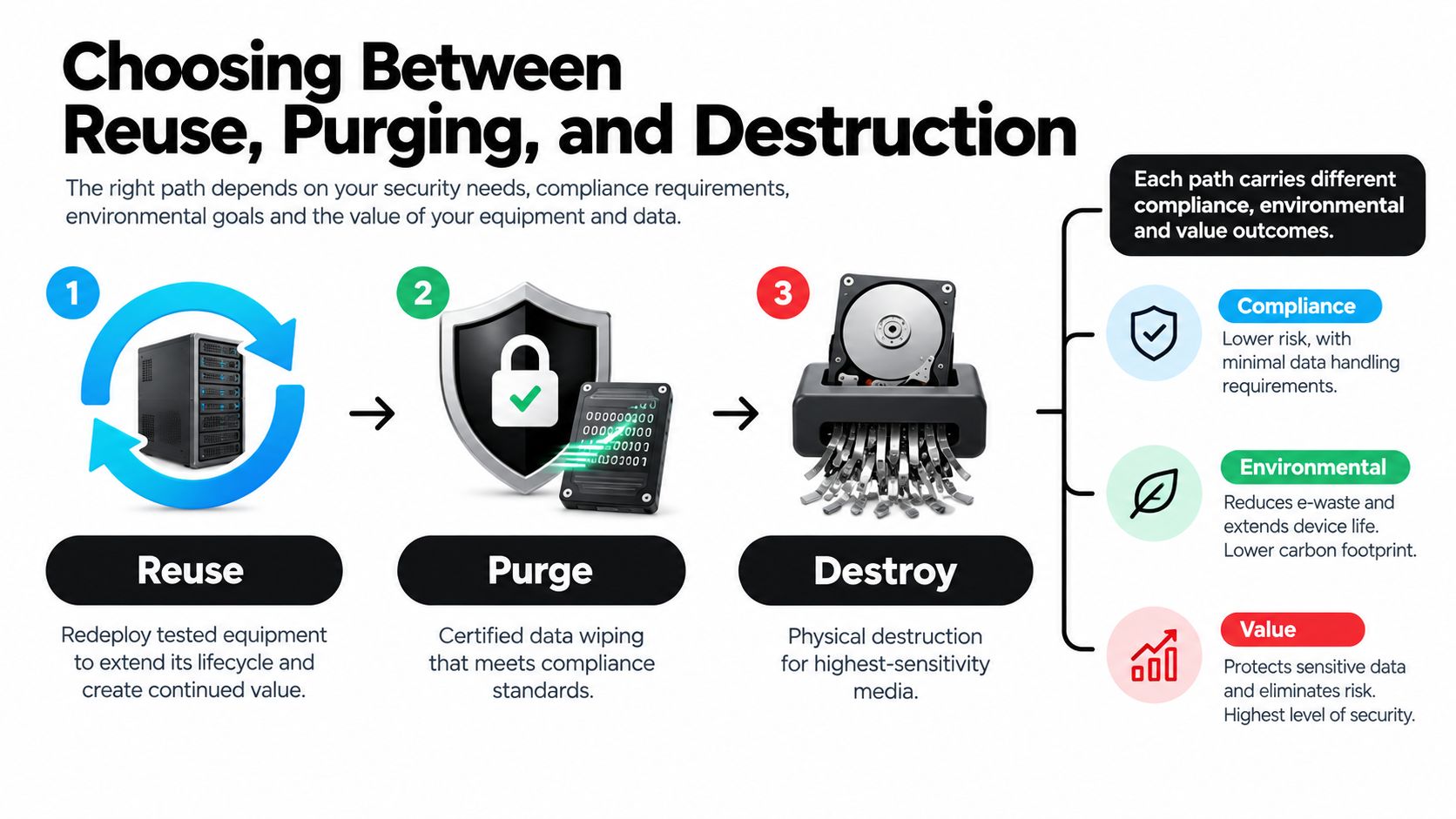
The right disposition path depends on data risk, media condition, intended outcome, and recoverable value. A blanket destruction policy may feel safer, but it can eliminate equipment value and embedded manufacturing impacts when verified reuse is appropriate. A blanket wiping policy creates a different problem if a drive is failed, encrypted, obsolete, or too sensitive to release.
NIST distinguishes sanitization from ordinary file deletion. Secure erase commands and degaussing are examples of purging, while disintegration, incineration, pulverizing, shredding, and melting are examples of destruction, as summarized in NIST media sanitization guidance.
Use a decision tree instead of a default route
Reuse fits tested equipment that can be securely sanitized and still has a credible operational or resale market. Purge fits media where an approved method can remove the data while preserving the device. Destroy fits failed, restricted, obsolete, or highly sensitive media where reuse would create unacceptable residual risk.
The environmental case for examining reuse is concrete. Google reported that it harvested approximately 8.8 million components from decommissioned data-center hardware in 2024, including more than 3 million hard drives that were securely wiped and reused or resold, according to its data-center circularity report.
| Route | Appropriate when | Required evidence |
|---|---|---|
| Reuse | Equipment passes testing and sanitization | Asset identity, test results, sanitization record, disposition |
| Purge | The media supports a verified sanitization method | Method, tool, operator, verification, validation |
| Destroy | Media is failed, restricted, or too risky to release | Custody records, destruction record, exception controls |
Reverse logistics often includes returns, inspection, routing, and recovery decisions, so teams managing managing product returns can offer useful process context. For Atlanta data-center assets, the same discipline should distinguish data destruction from material recycling. This comparison of refurbishing and recycling can help teams make that decision before equipment is moved.
Planning Secure De-Installation and Chain of Custody
The safest teardown starts before the first rack is powered down. Freeze the asset list, define the shutdown sequence, and assign responsibility for every handoff. A field crew should know which rows are live, which devices contain media, where assets will be staged, and how the manifest will be reconciled at the receiving point.
Control the physical movement
Tag chassis, drives, tapes, RAID members, cache modules, and embedded flash separately. Photograph or scan each handoff. Move media in sealed, access-controlled containers, then reconcile received quantities against the manifest before processing begins.
A practical sequence looks like this:
- Pre-shutdown review: Confirm the approved asset list, data classifications, rack locations, and exceptions.
- Rack-level capture: Scan each item as technicians remove it, rather than relying on a later bulk count.
- Secure staging: Separate resale-eligible equipment from media awaiting sanitization or destruction.
- Transport control: Record container seals, custody signatures, vehicle or carrier details, and receiving confirmation.
- Processing reconciliation: Match every received identifier to a final outcome and investigate every discrepancy.
Don't let the chassis hide the risk
The most consequential miss is treating the server as one asset. A chassis can leave the facility while removable drives, failed disks, backup tapes, or RAID members remain in a cabinet or staging area. Destruction also generally doesn't support practical per-item verification, which makes custody records, controlled containers, exception logs, and representative post-process checks especially important.
The FTC Disposal Rule requires practices reasonably designed to prevent unauthorized access to consumer-report information. Its due-diligence guidance includes reviewing an ITAD provider's independent audit, references, recognized certification, and information-security procedures, as explained by the FTC Disposal Rule guidance.
Physical access deserves the same attention as processing records. For facilities with multiple contractors or restricted loading areas, information about commercial gate access control can help inform site-level entry and handoff procedures. A documented chain of custody for IT asset disposal should then connect that physical control to the final certificate.
Aligning Decommissioning with Operational and Community Constraints
Atlanta decommissioning projects operate inside a larger utility and community environment. A facility may be expanding, mothballed, relocated, or partially decommissioned while adjacent operations continue. The ITAD plan must therefore account for loading access, rack-by-rack shutdowns, battery handling, refrigerants, staging space, and contingency capacity.
Water use is one reason a teardown can't be planned as a simple removal exercise. A 2026 North Georgia Water planning document says evaporative-cooled facilities can use as much as 9 million gallons of water per day, while closed-loop systems typically use about 5,000 to 50,000 gallons per day, according to the North Georgia Water planning document.
Build the field plan around the facility
A workable plan should include:
- Phased inventories: Release assets in controlled groups instead of creating an unmanageable mixed pile.
- Rack coordination: Align de-racking with the facility's shutdown authority and live-row restrictions.
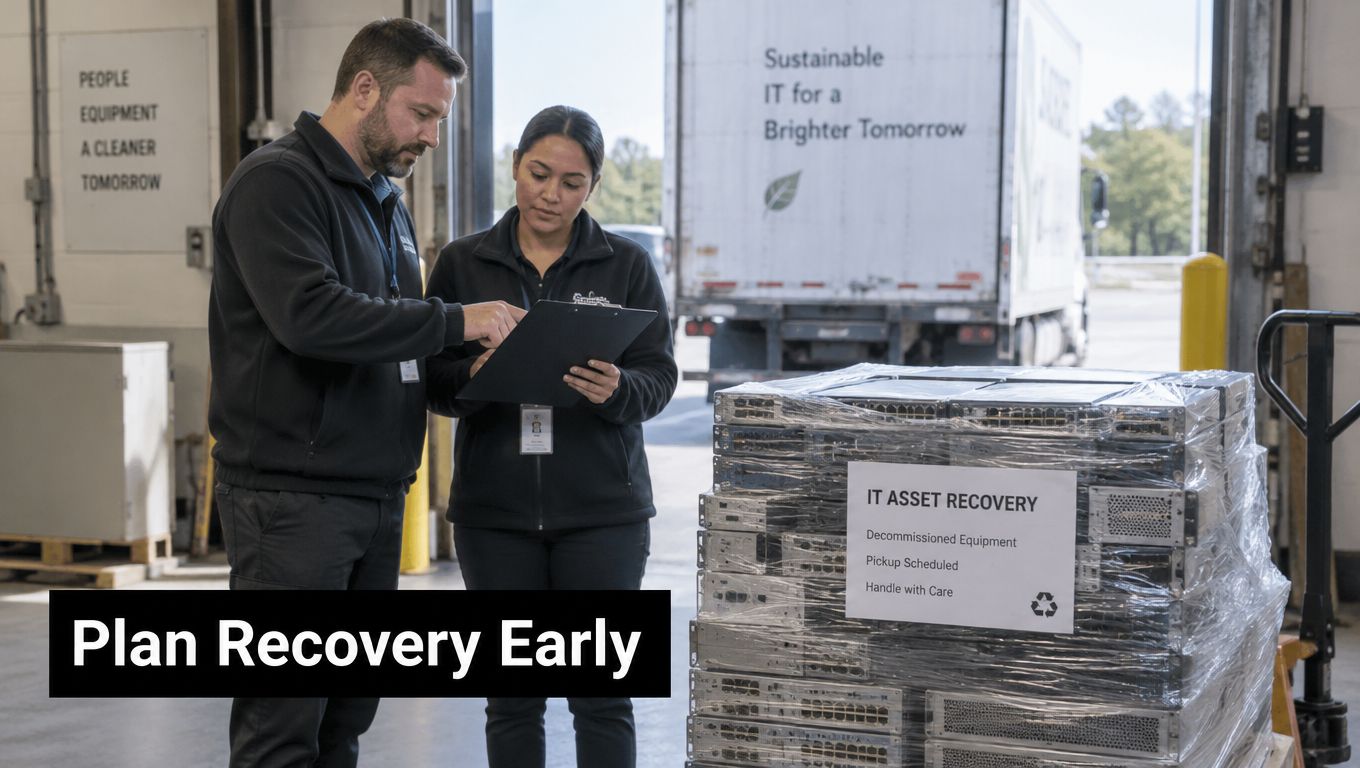
- Loading design: Confirm dock schedules, lift-gate needs, container dimensions, and secure vehicle access.
- Hazard handling: Identify batteries, refrigerants, and other components requiring specialized routing.
- Contingency capacity: Maintain an alternate staging or transport plan if the primary route becomes unavailable.
- Outcome reporting: Separate reused, resold, destroyed, and recycled equipment in the final report.
This approach also changes how sustainability is measured. Recycling is only one outcome. Reusing a suitable server or component can preserve value and avoid unnecessary material recovery, while destruction remains appropriate for media that can't be safely released.
The responsible question isn't “Can this equipment be recycled?” It's “What is the safest, highest-value, and most defensible route for each serialized asset?”
Cloud, colocation, healthcare, finance, and government operators often manage several sites with different access rules and risk profiles. Their ITAD schedule should fit the operating plan, not force the facility team to improvise around a disposal vendor's arrival window.
How to Choose a Certified Local ITAD Partner
Partner selection should begin with evidence, not a service label. Ask how the provider tracks serial numbers, where sanitization occurs, how exceptions are escalated, when custody changes, and whether the final report reconciles every asset in the original manifest.
The FTC's due-diligence checkpoints provide a useful starting point. Review independent audits, recognized certifications, references, and information-security procedures. Then test whether those credentials translate into the specific controls your Atlanta facility needs.
ITAD Partner Due-Diligence Checklist
| Checkpoint | What to Verify |
|---|---|
| Data sanitization | NIST-aligned methods, tool records, verification, and validation procedures |
| Asset tracking | Serial-level scans from pickup through final disposition |
| Physical security | Sealed containers, restricted staging, controlled transport, and documented handoffs |
| Certificates | Separate records for data destruction, recycling, resale, and exceptions |
| Value recovery | Clear testing, grading, resale, and credit methodology |
| Environmental routing | Responsible downstream processing and documented recycling outcomes |
| Project logistics | De-racking, loading, scheduling, and contingency capacity for the site |
Atlanta-based Beyond Surplus provides business ITAD and electronics recycling services that include secure data destruction, certified data wiping, hard-drive shredding, equipment disposal, IT buyback, product destruction, data-center de-installation, and logistics coordination. Its service model also includes certificates of recycling and data destruction. Organizations comparing providers can use this Georgia ITAD vendor selection guide before scheduling a project.
Don't accept a certificate that only states a pallet was processed. Require an asset-level report, a clear exception list, custody evidence, and a final outcome for every device. A partner that can't explain those records may still remove equipment, but it hasn't demonstrated an audit-ready disposition process.
Next Steps for Secure Asset Recovery in Atlanta
Secure asset recovery works when the operator makes disposition decisions before the equipment enters the logistics stream. Freeze the inventory before shutdown, map every custody handoff, separate media from chassis, and decide which assets are candidates for reuse, purging, destruction, resale, or recycling.
The certificate package should reflect those distinctions. A data-destruction certificate shouldn't be presented as a recycling certificate, and a recycling report shouldn't imply that every embedded drive was sanitized. Exception records should identify verification failures, missing identifiers, damaged media, and any device that required escalation.
Turn the plan into a repeatable operating control
For recurring refreshes, standardize the following:
- Inventory baseline: Establish the approved manifest before technicians begin work.
- De-installation method: Define rack sequencing, staging, loading, and site-access procedures.
- Sanitization matrix: Match media type and data sensitivity to Clear, Purge, or Destroy decisions.
- Recovery review: Test equipment for redeployment or resale before sending it to material recovery.
- Evidence package: Reconcile serials, custody signatures, verification records, certificates, and exceptions.
- Management review: Confirm that final outcomes support security, environmental, contractual, and regulatory obligations.
Atlanta's data-center expansion makes this repeatability more important. New deployments create future retirement streams, and utility or access constraints can narrow the time available for de-installation. A mature ITAD program gives facility, security, procurement, and finance teams a shared record of what left the site and what value or risk remained.
The strongest Atlanta Data Center ITAD programs don't treat recycling as the end of the story. They preserve reusable equipment where the risk is controlled, destroy media when the risk requires it, and produce records that let an auditor trace every asset from rack to final outcome.
Contact Beyond Surplus for certified electronics recycling, secure data destruction, equipment buyback, and data-center de-installation support. Visit Beyond Surplus to discuss a serial-level asset recovery plan for your Atlanta facility, including custody documentation, reuse decisions, and final recycling or destruction records.


