
The most popular advice about corporate electronics recycling in Atlanta is also the least complete: schedule a pickup, remove the equipment, and ask for a recycling receipt. That approach may work for low-risk material, but it doesn't give an IT manager defensible control over data, custody, downstream processing, or regulatory exposure. Corporate Electronics Recycling Atlanta: A Guide for IT Managers starts from a more practical premise. Retired servers, laptops, networking equipment, medical devices, and laboratory hardware should be managed as controlled business assets until the organization can reconcile their final disposition.
The environmental stakes are substantial. The world generated 62 million tonnes of e-waste in 2022, equal to 7.8 kg per person, but only 22.3% was documented as formally collected and recycled in an environmentally sound manner, according to the Global E-waste Monitor data summarized by the European Commission. For Atlanta organizations, however, environmental responsibility is only one part of the decision. The operational priority is to transfer liability through documented sanitization, serialized custody records, and verified final processing.
Table of Contents
- Navigating Compliance and Liability Transfer
- Building a Serialized Chain of Custody
- Evaluating Secure Data Destruction Methods
- Selecting a Certified ITAD Partner
- Coordinating Logistics and Value Recovery
- Executing the Final Audit and Internal Policy
Navigating Compliance and Liability Transfer
A local drop-off option isn't automatically an enterprise recycling program. Ordinary business equipment may move through a convenient channel without giving the organization a complete record of who handled each asset, whether storage media was sanitized correctly, or where components were processed. For an IT director, that gap can matter long after a truck leaves the loading dock.
Georgia doesn't have a statewide electronics take-back mandate for ordinary businesses. That doesn't mean Atlanta companies operate without obligations. The relevant legal drivers commonly include federal data-disposal requirements, sector-specific controls, contractual duties, and rules for hazardous components where they apply. Guidance on business computer disposal and the FTC Disposal Rule explains that organizations must use reasonable and appropriate safeguards, including destroying or erasing electronic files and media so they can't be read or reconstructed when equipment is sold, donated, transferred, or discarded.
Practical rule: Treat every retired device as an information-bearing asset until a documented process proves otherwise.
The FTC framework is only one layer. Healthcare organizations may need to align disposition procedures with HIPAA safeguards, financial institutions may face GLBA-related expectations, and government contractors may work under FISMA or contract-specific controls. The exact obligation depends on the organization, the data, the contract, and the equipment involved. What doesn't change is the need to demonstrate that the company used a reasonable process and can produce evidence afterward.
Why liability transfer requires evidence
A certificate with a total weight or a general statement that equipment was recycled may not identify which device was destroyed, wiped, resold, or sent to material recovery. It also may not show the handoffs between collection, transport, processing, and final disposition. That is why an enterprise program should reconcile asset records to certificates rather than file a single receipt and close the ticket.
A defensible program normally documents:
- Asset identity: Serial number, internal asset ID, device type, and relevant location.
- Data status: Media type, data sensitivity, sanitization method, and completion status.
- Custody evidence: Transfer time, handler identity, vehicle or shipment reference, and receiving confirmation.
- Final outcome: Resale, reuse, parts recovery, recycling, or physical destruction.
- Supporting documents: Certificates of data destruction, recycling records, and downstream processing evidence.
A structured certificate of data destruction should support that chain, not substitute for it. The certificate is useful because it records a completed control. It becomes much stronger when the organization can connect it to the original serialized inventory and show exactly which media it covers.
The business case follows from risk, not green branding. Formal recycling in 2022 avoided extraction of 900 million tonnes of primary ore and prevented 93 million tonnes of CO2-equivalent emissions, according to the electronic waste recycling overview. Those benefits matter, but an Atlanta IT manager still needs to budget for secure handling because an environmentally responsible outcome without data evidence leaves a significant control weakness.
Building a Serialized Chain of Custody
The chain of custody starts before the recycler arrives. If the internal inventory is incomplete, the organization can't reliably prove what it released, what it received back as a certificate, or what remains unaccounted for. A pallet count is a logistics measure, not an asset-control record.
Create the intake record first
Begin with a complete export from the configuration management database, asset management platform, purchasing records, or data center inventory. Reconcile that list against the equipment physically staged for retirement. Don't assume the serial number in a procurement file matches the label on the chassis. Servers may have multiple identifiers, laptops may have replaced asset tags, and networking equipment may be grouped under a rack or project record.
For each device, capture:
- Manufacturer, model, and serial number. Record the identifier that the processing partner will use on its certificate.
- Internal asset ID. Preserve the organization's own accounting or configuration reference.
- Media details. Note whether the unit contains a hard disk drive, solid-state drive, removable media, or embedded storage.
- Physical condition. Separate working equipment, damaged devices, stripped units, and equipment with missing components.
- Data classification. Mark the device according to the sensitivity of the information it may contain, not its resale value.
- Disposition path. Assign a preliminary route such as reuse, resale, wiping, shredding, parts recovery, or material recycling.
A tracking platform can help when teams are coordinating large inventories across facilities. For organizations reviewing options, the Enasys asset tracking system provides useful context on how serialized material handling records can support movement and status control. The tool matters less than the discipline behind it. A spreadsheet can be adequate for a small, stable project, while a distributed data center decommissioning program usually needs controlled permissions, scan events, and an exportable audit history.
Match custody records to every handoff
At the loading dock, scan or verify each asset before it enters a container, cage, vehicle, or shipment. Log the transfer timestamp and the identity of the person releasing the equipment. The receiving party should confirm the same identifiers at intake, then record any discrepancy before processing begins.
The minimum custody record should include:
- Who released the asset
- Who accepted it
- When the handoff occurred
- Where the handoff occurred
- Which assets changed hands
- What condition or count was observed
- What exception was created if records didn't match
A single end-of-life receipt proves that something arrived. It doesn't prove that every serialized device in your retirement population was handled correctly.
That distinction becomes important when one shipment contains laptops, switches, servers, printers, and medical or laboratory equipment. Different asset classes may require different processing routes. A recycling certificate for a pallet of mixed electronics shouldn't be treated as proof that a specific server's storage media was sanitized.
The chain of custody for IT asset disposal should remain continuous from collection through final processing. Reconcile the receiving report to the release inventory, investigate missing serials immediately, and require the processor to identify exceptions in writing. This approach eliminates the black hole between “picked up” and “disposed of,” which is where undocumented substitutions, lost devices, and certificate mismatches tend to surface.
Evaluating Secure Data Destruction Methods
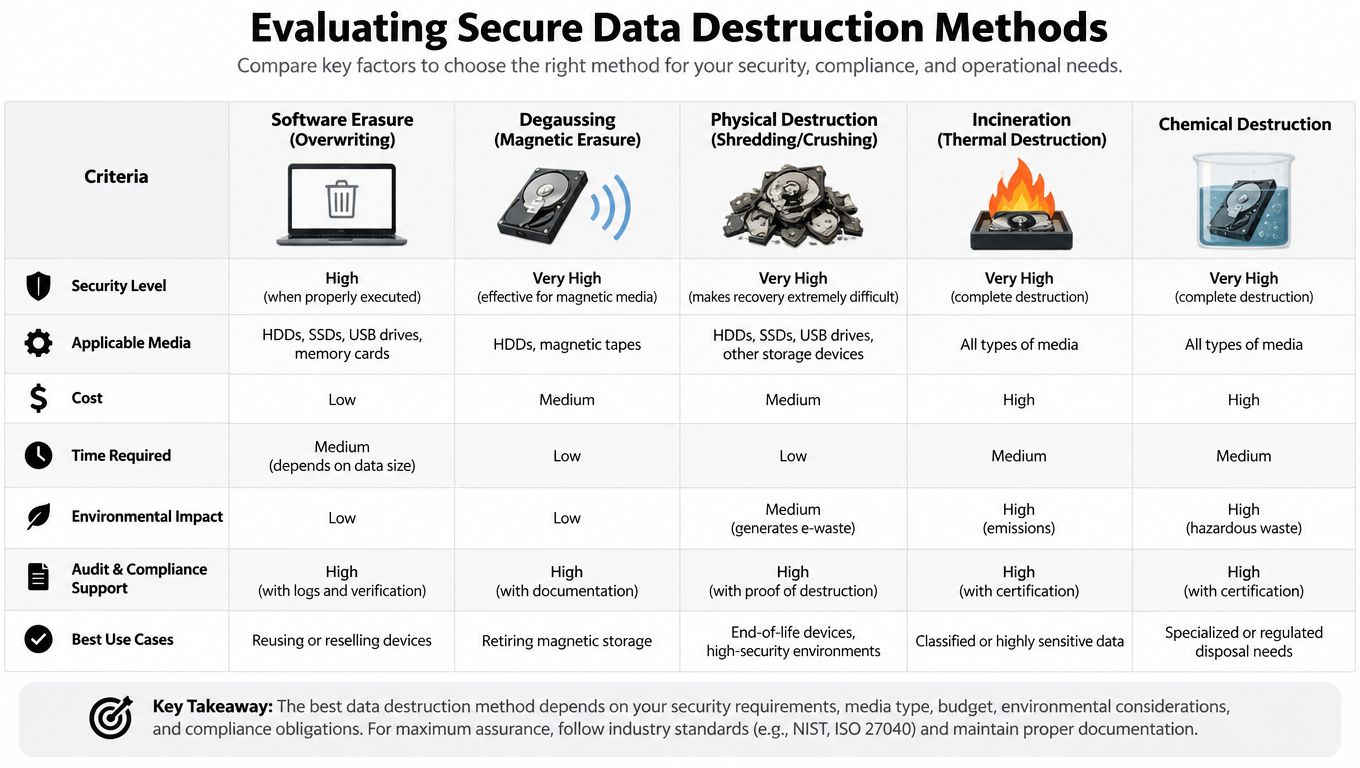
Data destruction isn't a single service. The correct method depends on the media, the device condition, the sensitivity of the information, and whether the organization needs to preserve residual value. A functioning enterprise laptop may justify certified wiping and resale. A failed solid-state drive from a sensitive server may require physical destruction because the device can't be reliably accessed or verified.
Certified wiping for recoverable equipment
Software-based sanitization can be the right choice for standard employee laptops, desktops, and servers that are operational and suitable for reuse. The processor should identify the media, apply a documented sanitization procedure, record the result, and produce a device-level certificate. A basic operating-system reset or quick format isn't a defensible sanitization method because it may leave recoverable data behind.
A good decision framework asks:
- Can the device boot and communicate with the sanitization tool?
- Does the process address the entire storage device?
- Does the tool generate a result tied to the device serial number?
- Can the organization retain the method, status, and completion record?
- Is the remaining device suitable for resale or internal reuse?
The NIST SP 800-88 data sanitization resource provides a useful reference point for selecting and documenting media sanitization procedures. It helps teams distinguish a controlled process from the informal practice of deleting files and assuming the risk has disappeared. A separate complete HDD wiping guide can help technical staff understand why a conventional deletion or format doesn't equal verified erasure.
Physical destruction and degaussing
On-site shredding offers direct visual assurance. A mobile shredder can destroy hard drives at an Atlanta facility while an authorized employee observes the process, which reduces the time media spends in transit before destruction. The trade-off is that on-site equipment may require staging space, access coordination, and a process capable of handling the organization's specific media types.
Off-site shredding can be more efficient for mixed loads or large projects. It places transportation and facility controls into the risk calculation, so tracked movement, secure packaging, receiving scans, and documented processing become essential. A vendor that says “we shred everything” without identifying the custody controls between pickup and destruction isn't providing enough detail.
Degaussing can disrupt data on magnetic media, but it isn't a universal answer for modern electronics. It doesn't address solid-state storage in the same way because SSDs store information in flash memory rather than magnetic patterns. Mobile devices may also contain embedded storage that requires device-specific sanitization or physical destruction. For failed, encrypted, highly sensitive, or nonfunctional media, shredding may offer the most straightforward finality.
The practical choice often looks like this:
| Asset condition | Sensible starting point | Main control |
|---|---|---|
| Working laptop with reusable value | Certified software wiping | Device-level result tied to serial number |
| Functional server prepared for resale | Controlled wiping and inspection | Sanitization record plus disposition record |
| Failed HDD or SSD | Physical destruction | Serialized destruction certificate |
| Mixed mobile devices | Device-specific sanitization or destruction | Media identification and exception tracking |
| High-sensitivity media | Destruction selected by risk owner | Witness, custody, and final evidence |
Don't select a method because it sounds familiar. Select it because the method matches the media and produces evidence that an auditor can reconcile to the asset record.
Selecting a Certified ITAD Partner
A scrap hauler and an ITAD provider solve different problems. The hauler may remove material efficiently. An enterprise ITAD partner must also protect data, preserve serialized records, manage downstream processors, document final outcomes, and support value recovery without weakening the control environment.
Compare certifications with actual controls
Certifications are useful screening tools, but they shouldn't end the evaluation. e-Stewards and R2 address responsible electronics recycling practices and downstream management. SOC 2 focuses on controls relevant to service organizations and can provide additional insight into security and operational processes. Each credential has a different scope, so ask what facilities, services, and processes the certification covers.
A vendor review should request:
- Current certification scope: Confirm the legal entity, facility, and service covered.
- Data destruction process: Ask how wiping and shredding results are generated and reconciled.
- Downstream disclosure: Identify where commodities, parts, and non-reusable equipment go.
- Transportation controls: Review packaging, vehicle tracking, handoff records, and exception handling.
- Audit support: Confirm how quickly the vendor can produce inventory and certificate evidence.
- Environmental processing: Verify that hazardous or regulated components follow the appropriate route.
The global formal recycling gap shows why downstream diligence matters. In 2022, only 22.3% of worldwide e-waste was formally collected and recycled in an environmentally sound manner, while Europe documented 42.8% and Africa remained below 1%, according to the Global E-waste Monitor 2024. Those figures aren't an Atlanta vendor scorecard, but they show why an organization shouldn't assume that a collected device automatically reaches a controlled recycling stream.
Audit the answer behind the certificate
Ask whether the provider can show a sample certificate with serial numbers, destruction status, dates, and processing details. Ask how the provider handles a missing serial, a device that fails wiping, or equipment that arrives with a different count from the release inventory. The quality of those answers tells you more than a sustainability paragraph on a website.
A written contract should define custody, data responsibility, downstream disclosure, reporting, insurance, exceptions, and retention. The step-by-step guide to choosing an ITAD vendor in Georgia can serve as a practical checklist for procurement and security reviewers.
Don't award the work solely on pickup price. A low-cost removal that produces weak records can shift hidden work back to your IT, legal, security, and compliance teams.
Coordinating Logistics and Value Recovery
Secure disposal fails in practice when the logistics plan is vague. A data center decommissioning, office refresh, hospital technology replacement, or laboratory equipment removal needs a controlled schedule, a prepared staging area, and clear authority over what can leave the building.

Start with the site constraints. Confirm dock access, loading hours, elevator capacity, security requirements, parking restrictions, badge procedures, and whether the facility can accommodate pallets, rolling cages, or serialized scanning. Coordinate with facilities, physical security, network operations, procurement, and the business owner before the pickup date. A truck arriving before the equipment is disconnected creates delay. A truck arriving after the dock closes creates a custody and scheduling problem.
Protect equipment during movement
Servers and networking hardware should be separated from loose peripherals and packed to prevent impact damage. Laptops and mobile devices should remain grouped by inventory record. Remove batteries, accessories, and removable media only when the process calls for it, and document exceptions rather than relying on memory.
The shipment record should identify:
- Release location and authorized contact
- Asset count and serialized inventory
- Container or pallet identifiers
- Pickup time and receiving destination
- Transport reference and custody handoffs
- Exceptions, damage, or count discrepancies
Dedicated fleets and tracked transportation partners can reduce uncertainty, but the contract should still state who carries responsibility during each leg. “In transit” shouldn't become an undocumented status that lasts until a final invoice arrives.
Separate recovery value from recycling value
Not every retired asset belongs in a shredder. Recent-model enterprise laptops, working servers, memory, processors, and networking equipment may have residual market value. Older or damaged equipment may have little resale value but still require secure destruction and responsible material processing.
The commercial objective is to route each asset according to its condition and risk:
- Reuse: Keep suitable equipment in service when policy and security allow.
- Resale: Wipe, grade, and document equipment before transfer.
- Parts recovery: Separate components that retain practical value.
- Material recycling: Process non-reusable equipment through approved channels.
- Product destruction: Destroy branded, defective, recalled, or contract-restricted goods.
An ITAD contract can apply recovered value against service costs, but the valuation method must be transparent. Require a device-level or category-level accounting record, define who owns the proceeds, and establish how disputed grades are resolved. The secure asset recovery service for enterprise IT describes the type of combined recovery and disposition model procurement teams should evaluate.
Value recovery isn't a reason to delay sanitization. Data controls come first, and the commercial route follows the approved disposition status.
Executing the Final Audit and Internal Policy
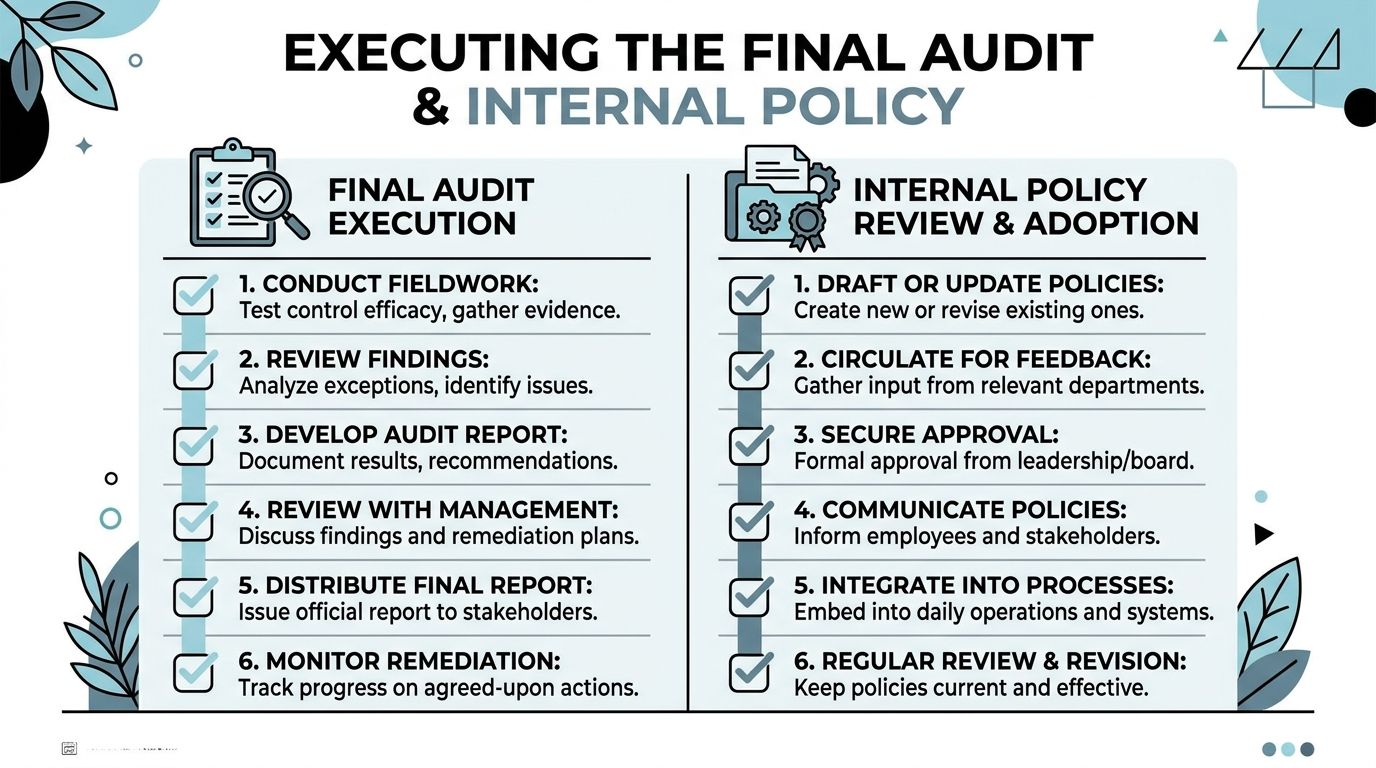
The pickup is the midpoint, not the conclusion. Closeout begins when the processor returns the receiving report and continues until every released asset has a documented status. The final audit should identify what was wiped, what was destroyed, what was resold, what was recycled, and what remains under investigation.
Reconcile before you archive
Use the original release inventory as the control document. Match every serial number to the receiving record, then match each storage-bearing device to a data destruction result. Match non-storage equipment to the appropriate recycling, resale, parts, or product-destruction record.
A practical closeout checklist includes:
- Compare counts and serials. Investigate missing, duplicate, or unexpected identifiers.
- Review sanitization results. Confirm the method and outcome for each storage device.
- Check certificates. Ensure destruction and recycling records cover the actual released assets.
- Resolve exceptions. Document damage, failed wiping, unprocessed devices, and corrective action.
- Record financial outcomes. Reconcile buyback credits, resale proceeds, service charges, and disputed valuations.
- Approve closure. Obtain signoff from the asset owner, security or privacy representative, and relevant facilities or procurement contact.
Record retention should follow the organization's industry, contracts, and internal policy. Recent enterprise ITAD guidance notes that retention commonly spans three to seven years, depending on the industry, as described in this enterprise electronics recycling and ITAD guidance. Store certificates, inventories, transport records, exception reports, and approvals in a controlled repository with access restrictions and a reliable retrieval process.
Make the policy usable inside the business
A policy that only the ITAD manager understands will fail at the first office move or emergency replacement. Give facilities teams a clear staging procedure, tell employees where to take retired laptops, require service desk staff to preserve asset identity, and prohibit informal disposal through general waste channels. Procurement should include data destruction, downstream processing, insurance, and evidence requirements in vendor terms before equipment is purchased or retired.
The C-suite needs a concise risk explanation. Security teams need the sanitization and custody controls. Facilities teams need loading and access instructions. Finance needs the asset valuation and credit process. Each group should know who can authorize release and who investigates an exception.
Atlanta businesses shouldn't wait for a breach, audit request, or disputed certificate to discover that their disposal process is informal. A controlled program makes the final record as reliable as the initial inventory, supports responsible electronics recycling, and gives decision-makers evidence that the organization managed its retired technology deliberately.
Beyond Surplus provides Atlanta-area businesses with secure electronics recycling, IT equipment disposal, certified data wiping, on-site or off-site hard drive shredding, asset recovery, and chain-of-custody documentation. For data center decommissioning, laptop disposal, product destruction, or enterprise e-waste pickup, visit Beyond Surplus to discuss a documented disposition program for your organization.